 @Techmeme@techhub.social
2026-07-19 03:40:52
Alibaba open-sources its chip software, following similar plays from Huawei and Moore Threads, as Chinese GPU makers try to break the dominance of Nvidia's CUDA (Ann Cao/South China Morning Post)
https://www.scmp.com/tech/tech-war/article

 @cdarwin@c.im
2026-07-18 01:21:56
The Newsom administration is suing five more California cities
— Calexico, Costa Mesa, Half Moon Bay, Ridgecrest and Turlock — for failing to complete state-mandated housing plans, known as the “housing element.”
Huntington Beach was the first city to face such a legal action, and it recently finalized its housing element plans following a court-order and massive fines.
The law, which has been in place since 1969, requires cities and counties every eight years to d…

 @burger_jaap@mastodon.social
2026-08-18 13:24:44
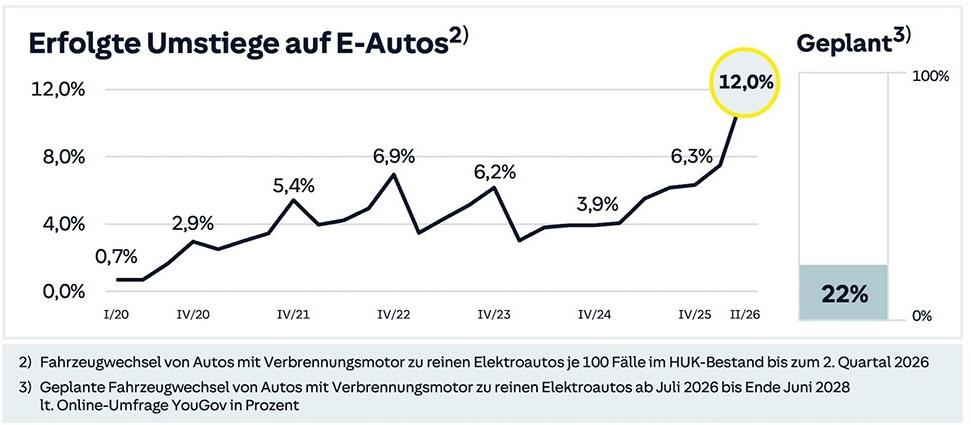
Data from German vehicle insurer HUK-COBURG (which holds a quarter of the market) shows that Germans have been choosing EVs almost twice as often since the latest oil price crisis in March: 12 per cent of car insurance policy switches in Q2 2026 were to an EV
Second-hand EVs are also becoming increasingly popular amongst frequent drivers, for whom the cost savings are even greater. Volkswagen EVs are popular as second-hand cars, whilst new German EVs are less so.
 @Mediagazer@mstdn.social
2026-08-18 12:01:04
Discord suspends livestreams in Brazil, after the country's data protection authority ordered it last week, saying Discord failed to protect children and teens (Associated Press)
https://apnews.com/article/brazil-discord-children-social-me…

 @doktrock@toad.social
2026-09-18 01:07:01
Faulty AI use: Tennessee woman who was wrongly accused by #Fargo investigators and held in jail for months based on faulty artificial intelligence facial recognition evidence, has filed a $10 million civil rights lawsuit against the Fargo Police and the detective. #NorthDakota

 @simon_brooke@mastodon.scot
2026-08-17 12:11:12
My mental health is falling apart again. This is both really annoying and very boring. I am unlikely to be as active on social media for a while, and, in particular, I won't be responding to private messages from people I don't know.
If I can't keep myself reasonably sane I can't help anyone.
I need to concentrate on regaining my balance and putting in place the things I need for my personal wellbeing.
 @jonippolito@digipres.club
2026-08-15 18:23:16
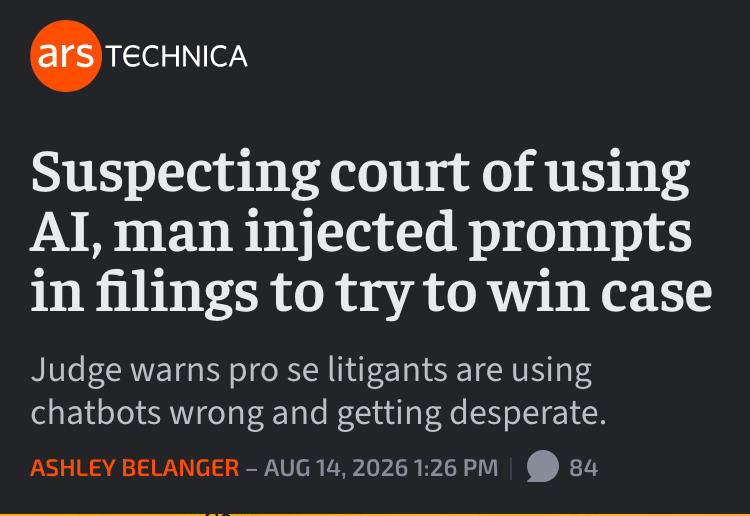
How many cases of prompt injection in legal cases are we unaware of because they succeeded?
https://arstechnica.com/tech-policy/2026/08/suspecting-court-of-using-ai-man-injected-prompts-in-filings-to-try-to-win-case…
 @cdarwin@c.im
2026-09-15 14:45:42
A police department in Texas that arrested a local resident for complaining on social media about their city’s contaminated water supply
💥 has been ordered closed after failing to prove it provided any benefit to the community.
State officials stepped in to investigate after Jennifer Combs spent a night in jail in May
after a post appeared on her Facebook page suggesting people were hospitalized by bacteria in the water pipes of Trinidad,
a municipality in Henderson co…
 @Techmeme@techhub.social
2026-08-18 03:20:46
Discord suspends livestreams in Brazil, after the country's data protection authority ordered it last week, saying Discord failed to protect children and teens (Associated Press)
https://apnews.com/article/brazil-discord-children-social-me…
 @cdarwin@c.im
2026-08-18 03:40:27
A White House post targeted Kristen Holmes, a senior White House correspondent for CNN,
after she asked Donald Trump to respond to a widely shared comment by Democratic senator Jon Ossoff in a speech on Sunday.
The Georgia senator told a crowd that Trump “doesn’t want to do the job”
and instead “wants to build his ballroom and travel with Natalie on their apparently defenseless flying palace gifted by the emir of Qatar”.
The comment was an apparent reference to Natali…
