 @cdarwin@c.im
2026-08-18 03:40:27
A White House post targeted Kristen Holmes, a senior White House correspondent for CNN,
after she asked Donald Trump to respond to a widely shared comment by Democratic senator Jon Ossoff in a speech on Sunday.
The Georgia senator told a crowd that Trump “doesn’t want to do the job”
and instead “wants to build his ballroom and travel with Natalie on their apparently defenseless flying palace gifted by the emir of Qatar”.
The comment was an apparent reference to Natali…

 @Techmeme@techhub.social
2026-08-18 18:10:51
OpenAI says it has made several changes to its safety practices following the Hugging Face breach and has paused two weeks of deployment-focused RL training (Ina Fried/Axios)
https://www.axios.com/2026/08/18/openai-pause-astra-preparedness-framework

 @almad@fosstodon.org
2026-07-17 07:12:45
You can really feel the warmth of the north american neighborhood
"Sovereignty comes with responsibility, and the responsibility to prevent a foreseeable disaster from crossing into another country's airspace has not been met"
Reacting to a social media post about the air quality in Cleveland, Moreno wrote: "I’ll be introducing a bill next week to sanction Canada and the responsible Canadian government officials for this atrocity."

 @Sustainable2050@mastodon.energy
2026-07-17 05:37:03
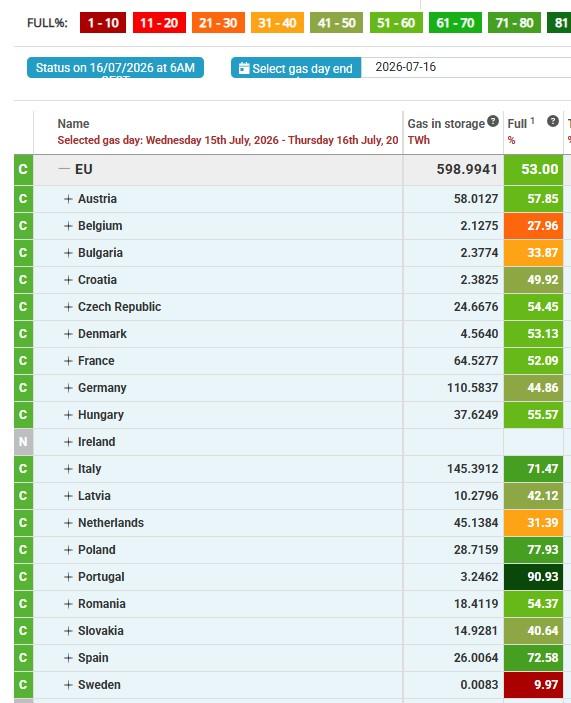
Halfway the EU gas storage filling season, the Netherlands is lagging. Our storages are only at 31% now, way behind the EU average of 53%, and other major storage countries like France (52%), Germany (45%) and Italy (71%).
Based on security of supply advice by Gasunie, Dutch government had set a target of 80% by 1 November 2026. Our EU obligation is 74%. Both would practically seem out of reach by now, which is unfortunate in view of our dependence on LNG imports in an unstable world.
 @cdarwin@c.im
2026-09-17 19:50:30
Former Department of Government Efficiency, (or DOGE), employees are working on an artificial intelligence takeover of federal government services for the Trump administration.
The Washington Sun reports that the staffers are setting up an AI-driven website,
America.gov,
to help Americans with everything from obtaining and renewing passports to potentially preparing and filing taxes for free.
(The latter is still under discussion and would be a reversal from the Whit…
 @Techmeme@techhub.social
2026-07-19 03:40:52
Alibaba open-sources its chip software, following similar plays from Huawei and Moore Threads, as Chinese GPU makers try to break the dominance of Nvidia's CUDA (Ann Cao/South China Morning Post)
https://www.scmp.com/tech/tech-war/article
 @cdarwin@c.im
2026-06-19 00:08:55
The Trump administration has decided to start phasing out HIV funding for South Africa following the country’s
“failure to make demonstrable progress on policy requests by the administration,”
a State Department official told POLITICO on Thursday.
The official, who agreed to discuss the decision only if POLITICO did not use their name,
said the decision to “initiate a phased drawdown of PEPFAR programming in South Africa”
is in line with Donald Trump’s February …
 @hippyjo@c.im
2026-09-18 20:32:28
Truth delivered in a style appropriate for the mental age of the idiots and assholes who voted for Trump.
Lots and lots of FUCK bombs. So NSFW, or turn your volume down...
One more time, with feeling!
https://www.reddit.com/r/antitrump/s/p2CKDmGJXQ
 @hikingdude@mastodon.social
2026-07-14 19:37:02
Just another place we visited in the Fränkische Schweiz. We just walked along a little stream and suddenly passed through this rock-gate with all the lush green on either side.
Just beautiful.
https://www.franzgraf.de/blog/2026/caves-and-meadows-d…
 @cdarwin@c.im
2026-09-15 14:45:42
A police department in Texas that arrested a local resident for complaining on social media about their city’s contaminated water supply
💥 has been ordered closed after failing to prove it provided any benefit to the community.
State officials stepped in to investigate after Jennifer Combs spent a night in jail in May
after a post appeared on her Facebook page suggesting people were hospitalized by bacteria in the water pipes of Trinidad,
a municipality in Henderson co…
