 @cdarwin@c.im
2026-08-19 21:15:01
Since China offered a truce in the trade war last October following its threat to deprive the United States of rare-earth magnets,
the Trump administration has been happy to stop escalating.
After all, imports from China have been falling, down by 40% in the year to June, compared with the same period in 2024.
Best to declare victory and call it a day.
But the US hasn’t won this battle
– and there’s strong evidence to show it’s afraid to really try.
Last …

 @bourgwick@heads.social
2026-07-11 18:27:24
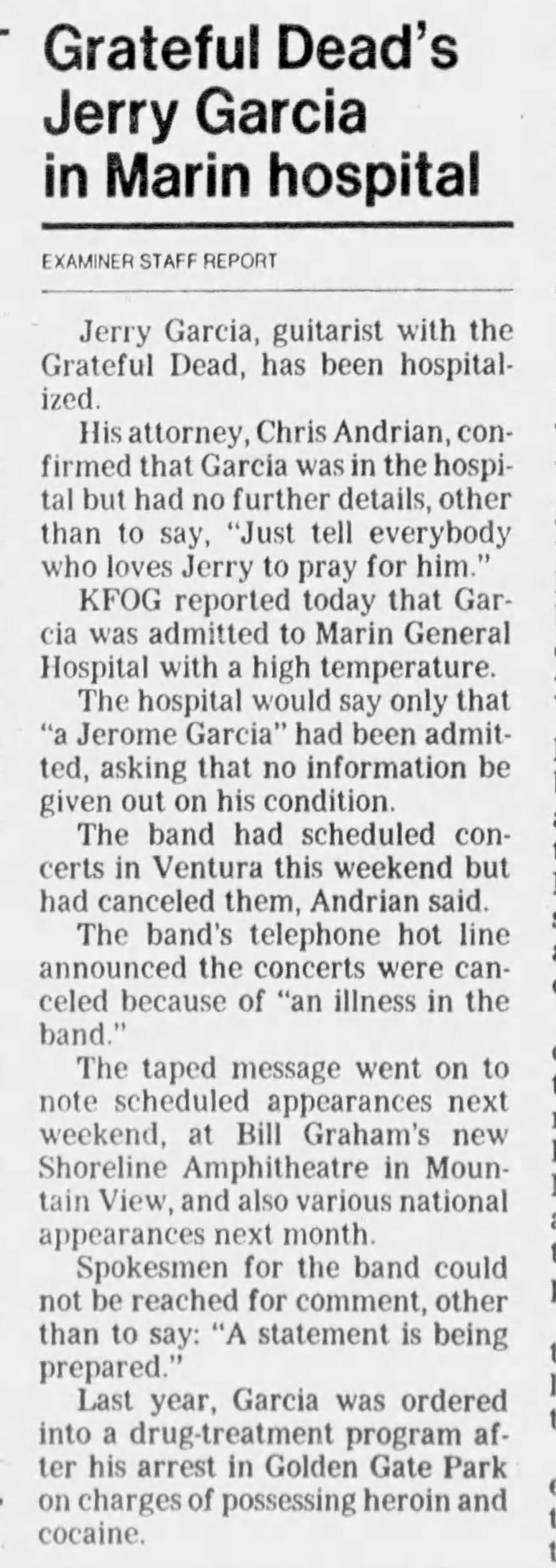
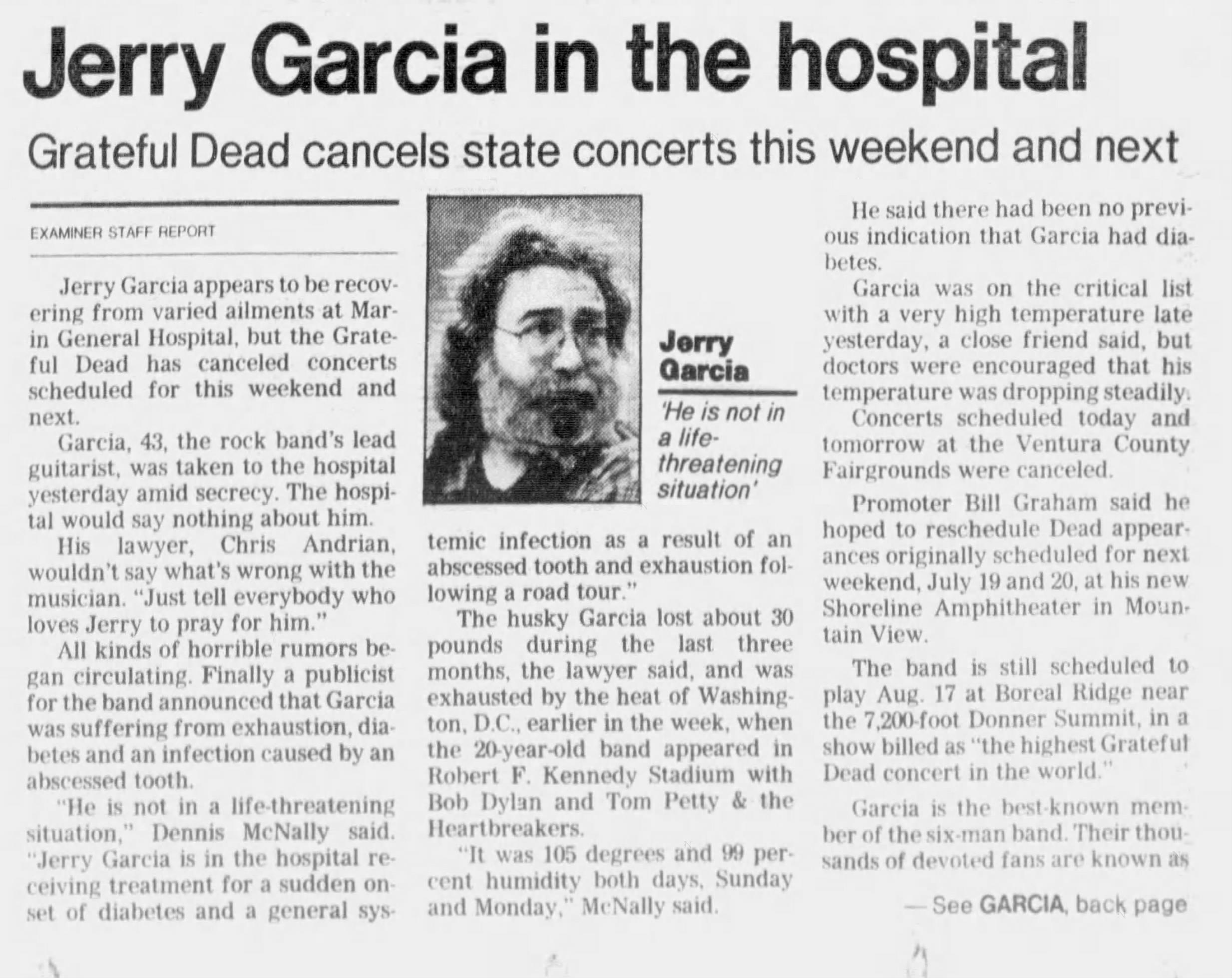
40 years ago this weekend, jerry garcia falls into a diabetic coma & nearly dies. in the hospital, his heart stops following an allergic reaction when doctors give him valium. the dead will cancel 30 dates through fall. he relearns to play guitar & is performing again by october.


 @inthehands@hachyderm.io
2026-08-20 21:30:44
I’ve been thinking a lot about the gulf between people who think LLMs can cut 90% of the cost of software development or whatever and people who think that’s a pile of catastrophes balanced on top of a nonsense wish.
I think a lot of that chasm boils down to the fact that software is already •terrible•, and people have very different feelings about that. I don't just mean “Liquid Glass is ugly” terrible; I mean “it’s broken and insecure and unreliable and just doesn't flipping WORK” terrible, like Arbiter Sports.
We are right now in a war between people who think software should treat humans humanely and people who are perfectly willing to offload their development costs onto captive users in the form of wasted time, anger, anxiety, and other forms of personal harm even more severe than those. That war was raging well before LLMs entered the picture, but LLMs drove it to fever pitch. I’m extremely skeptical of the idea that LLMs make any significant positive contribution to the long-term speed or cost of writing •good• software, but they clearly have the potential to lower the floor for •bad• software to unheard-of levels at unheard-of speeds. How you feel about that fact probably predicts a lot about how you feel about the “LLMs can 10x software dev!” hype.
3/3
 @arXiv_hepth_bot@mastoxiv.page
2026-08-14 08:17:50
Lee-Yang paradigm of phase transition in eigenstate thermalized systems
Yongjiang Xu, Weixin Sun, Chushun Tian, Huajia Wang
https://arxiv.org/abs/2608.13174 https://arxiv.org/pdf/2608.13174 https://arxiv.org/html/2608.13174
arXiv:2608.13174v1 Announce Type: new
Abstract: As phase transitions in isolated quantum systems remain elusive, here we show how a thermodynamic-like phase transition, falling into the Lee-Yang paradigm, can arise in systems displaying eigenstate thermalization. Specifically, we show that in holographic conformal field theories, the eigenstate expectation of the auto-correlation function can be mapped to the partition function ${\cal Z}_{{gauge}}(z)$ of a virtual interacting instanton gas, with the conformal mapping of the imaginary time: $z=1-e^{-\tau}$ and the central charge $c$ mimicking the instanton fugacity and volume, respectively. We find that akin to the Lee-Yang paradigm, for $c\to\infty$ a pair of complex conjugate zeros of ${\cal Z}_{{gauge}}(z)$ move to the real axis located at the famous forbidden singularity. Passing through the singularity the system transits from the low- to high-fugacity phase, accompanied by dramatic changes in scaling behaviors of the free energy and dominant microscopic configurations. Our findings indicate that physics of phase transitions from eigenstate thermalization is very rich.
toXiv_bot_toot