 @raiders@darktundra.xyz
2026-01-24 00:02:24
Raiders' Tom Brady Makes His Feelings Clear on Fernando Mendoza https://www.si.com/nfl/raiders/onsi/las-vegas-tom-brady-makes-his-feelings-clear-fernando-mendoza
 @salrandolph@zirk.us
2026-04-23 13:28:33
We’ve been living through an extravagant “Let them eat cake” time, a gilded age of tech robber barons who are swinging to precarious heights. At the same time, I’m feeling (are you feeling it?) invisible revolutions forming in hearts everywhere. Nothing has changed, but everything is changing.
https://salrandolph.substack.…

 @macandi@social.heise.de
2026-04-23 07:03:00
Tipp: iTunes-Extras auf dem Smart-TV ansehen
Beim Filmekauf kommen manchmal Zusatzmaterialien mit, die man auf Apple-TV-Geräten leicht anzeigen kann. Geht das auch auf Smart-TVs?
https://www.he…
 @memeorandum@universeodon.com
2026-02-23 01:35:38
Kash Patel Faces Backlash For Flying To Winter Olympics, Partying It Up With Team USA (Ben Blanchet/HuffPost)
https://www.huffpost.com/entry/kash-patel-fbi-jet-team-usa-hockey-winter-olympics-2026_n_699b6be7e4b0f41da8d1f357
http://www.memeorandum.com/260222/p49#a260222p49
 @Sustainable2050@mastodon.energy
2026-03-23 20:02:54
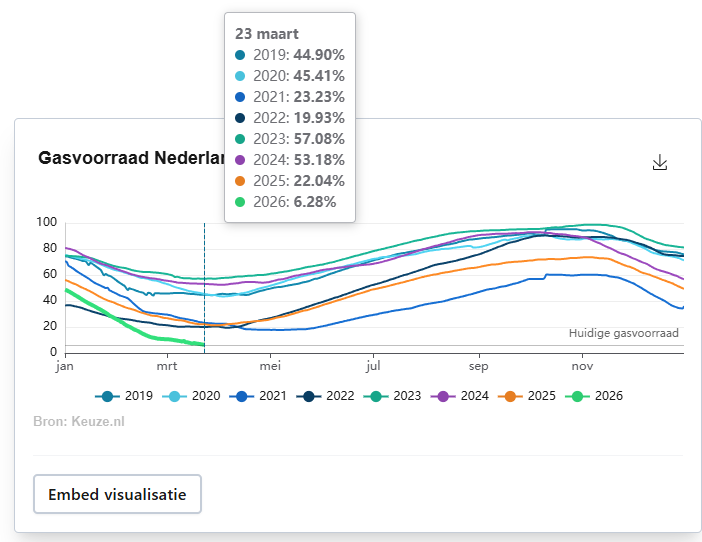
Q: How does the filling level of Dutch gas storages compare to that of previous years?
A: Not good.
 @karlauerbach@sfba.social
2026-03-23 00:06:00
This article is interesting about thoughts of using flying networks to support military operations.
It is a complex system - and my sense is that they will screw it up with application specific protocols and APIs that evolve and change over time as as military events (the kind that go boom or are intentional forms of in-band attacks - think everything from hyper-phishing to spoofing to zero-day attacks).
But even if it were put together with the precision of a Swiss watch, my old…
 @mikeymikey@hachyderm.io
2026-03-21 18:09:10
I know that following a hashtag is part of the Mastodon protocol itself, but since I'm in @… the majority of the time - it feels like it would be cool to:
- Offer a "follow for a week" / month option
- "We'll ask you when time's up"
mechanism (maybe the ask part is configurable? maybe the client could also just handle it when next it runs?)
I hit this time and time again for moment in time events where during the thick of it, I'm invested and interested - conferences, world news, etc - but after which there's no more signal in the hashtag and it's just detritus putting load on a server somewhere.
Ideally this is something that should be in the protocol itself, but it feels like similar to quote replies that @… could bring a better user experience in advance of adoption of something like that
 @andres4ny@social.ridetrans.it
2026-02-22 03:19:50
I don't understand figure skating.
Like, I don't understand how it's physically possible. You're on an extremely slippery surface that you can't even stand on, but you're standing on thin steel blades. And then you're moving _backwards_. And then you're *jumping* and *spinning* without getting dizzy and falling over. And then you're landing without snapping your ankles and still moving.
Most other sports have nothing on that.
 @inthehands@hachyderm.io
2026-02-21 19:55:38
There’s definitely a hopeful feeling in having room to worry about Space Camp fundraising right now, instead of, say, ICE staging at the local Target parking lot yet again (with Target’s tacit blessing, damn them). It’s been quiet in the city these last few days. Fingers crossed.
Hopeful, but also melancholy: even if ICE does in fact draw down to pre-Dec levels, our “after” is not really going to come for a long time — and when it does, it will feel more like a scar than a sunrise.
/end
 @ruth_mottram@fediscience.org
2026-04-23 20:49:44
RE: https://fediscience.org/@Ruth_Mottram/116455909974691993
And now on to the next paper*:
the deadline for which is Tuesday...
🤦♀️
*Revisions following review this time only, thankfully.