 @veit@mastodon.social
2026-03-16 09:36:03
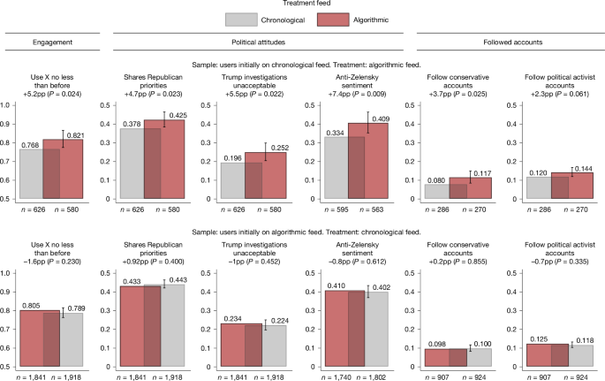
Social media algorithms prioritize right-wing content and influence the political views and behavior of real users. This is the finding of the recent study “The political effects of X’s feed algorithm”: https://www.nature.com/articles/s41586-026-10098-2

 @tomkalei@machteburch.social
2026-03-15 14:50:10
Toxic feed algorithms that serve Meta or X are bad, but that does not mean that we can't do something better ourselves here.
For many years I have been using a fork of mastodon_digest that scores posts by engagement and emails me a daily summary. It's open source and helps me to discover what has been going on in my timeline without following it all the time.
If you see me fav-ing your posts like 18h after the post. That's probably why!
 @profcarroll@federate.social
2026-02-18 19:41:25
New Study: Evidence shows how X’s algorithmic feed is radicalizing its users toward the Right. https://www.nature.com/articles/s41586-026-10098-2
 @ErikJonker@mastodon.social
2026-02-18 18:25:08
The political effects of X’s feed algorithm
https://www.nature.com/articles/s41586-026-10098-2

 @kubikpixel@chaos.social
2026-01-23 15:05:14
Fediverse Punk Month — We can grow something better!
We invest too much of our culture in centralized, for-profit, corporate social media platforms. These platforms enrich billionaires, expand surveillance, and fund the cult of capitalist war, all while trapping us with addictive algorithms that feed us mindless content. […]
— by @…<…

 @arXiv_csDS_bot@mastoxiv.page
2026-02-03 07:35:01
End Cover for Initial Value Problem: Complete Validated Algorithms with Complexity Analysis
Bingwei Zhang, Chee Yap
https://arxiv.org/abs/2602.00162 https://arxiv.org/pdf/2602.00162 https://arxiv.org/html/2602.00162
arXiv:2602.00162v1 Announce Type: new
Abstract: We consider the first-order autonomous ordinary differential equation \[ \mathbf{x}' = \mathbf{f}(\mathbf{x}), \] where $\mathbf{f} : \mathbb{R}^n \to \mathbb{R}^n$ is locally Lipschitz. For a box $B_0 \subseteq \mathbb{R}^n$ and $h > 0$, we denote by $\mathrm{IVP}_{\mathbf{f}}(B_0,h)$ the set of solutions $\mathbf{x} : [0,h] \to \mathbb{R}^n$ satisfying \[ \mathbf{x}'(t) = \mathbf{f}(\mathbf{x}(t)), \qquad \mathbf{x}(0) \in B_0 . \]
We present a complete validated algorithm for the following \emph{End Cover Problem}: given $(\mathbf{f}, B_0, \varepsilon, h)$, compute a finite set $\mathcal{C}$ of boxes such that \[ \mathrm{End}_{\mathbf{f}}(B_0,h) \;\subseteq\; \bigcup_{B \in \mathcal{C}} B \;\subseteq\; \mathrm{End}_{\mathbf{f}}(B_0,h) \oplus [-\varepsilon,\varepsilon]^n , \] where \[ \mathrm{End}_{\mathbf{f}}(B_0,h) = \left\{ \mathbf{x}(h) : \mathbf{x} \in \mathrm{IVP}_{\mathbf{f}}(B_0,h) \right\}. \]
Moreover, we provide a complexity analysis of our algorithm and introduce a novel technique for computing the end cover $\mathcal{C}$ based on covering the boundary of $\mathrm{End}_{\mathbf{f}}(B_0,h)$. Finally, we present experimental results demonstrating the practicality of our approach.
toXiv_bot_toot
 @thomasfuchs@hachyderm.io
2026-01-26 16:44:33
Not linking to it, but why do news outlets keep amplifying “AI” propaganda from companies making chatbots without at the very least some basic vetting?
(No, statistical algorithms on calculators don’t have feelings. Never have, never will.)