 @AimeeMaroux@mastodon.social
2026-04-23 17:46:46
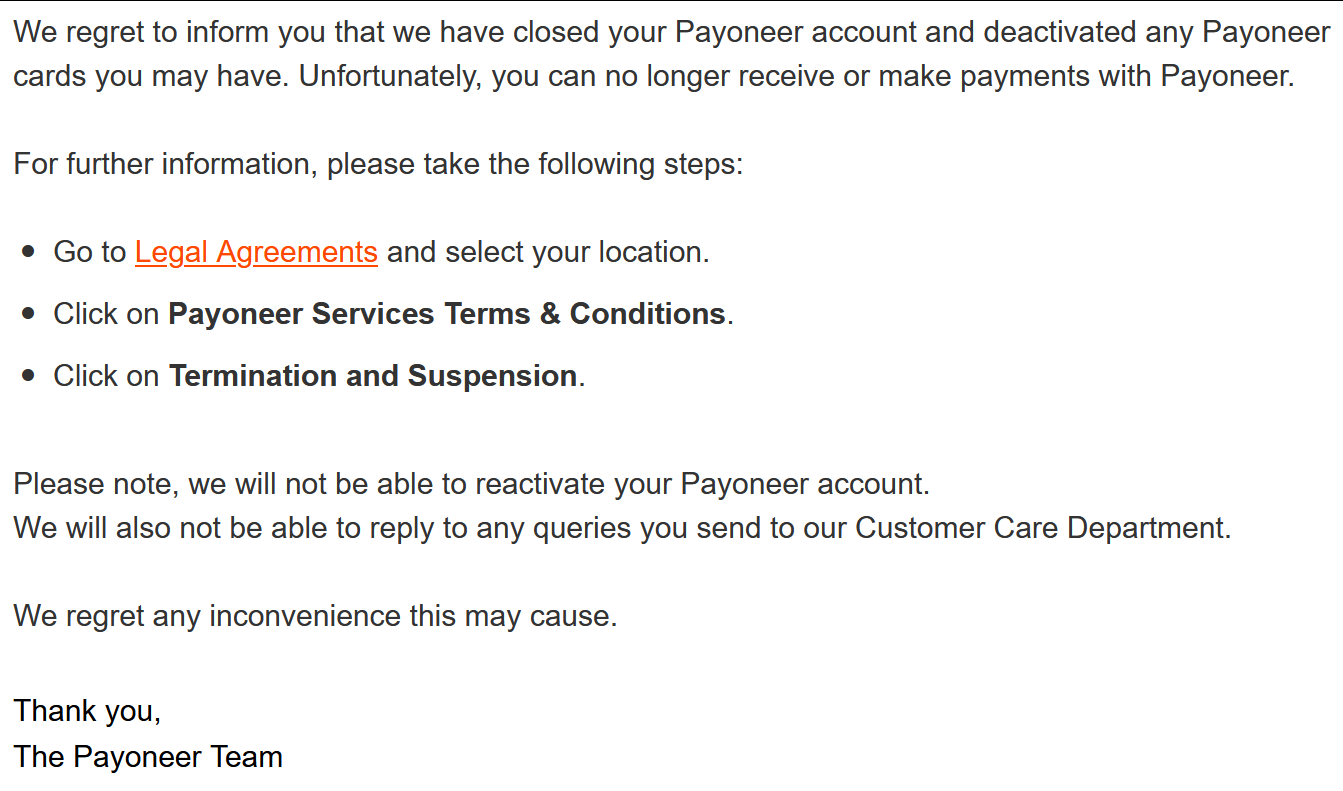
Wow. #Payoneer emailed me to say they closed my account without providing any information as to why in a manner that I first thought was spam.
"Please note, we will not be able to reactivate your Payoneer account.
We will also not be able to reply to any queries you send to our Customer Care Department."
I don't log in often so I'm not sure if there's any …
 @bourgwick@heads.social
2026-03-15 00:58:18
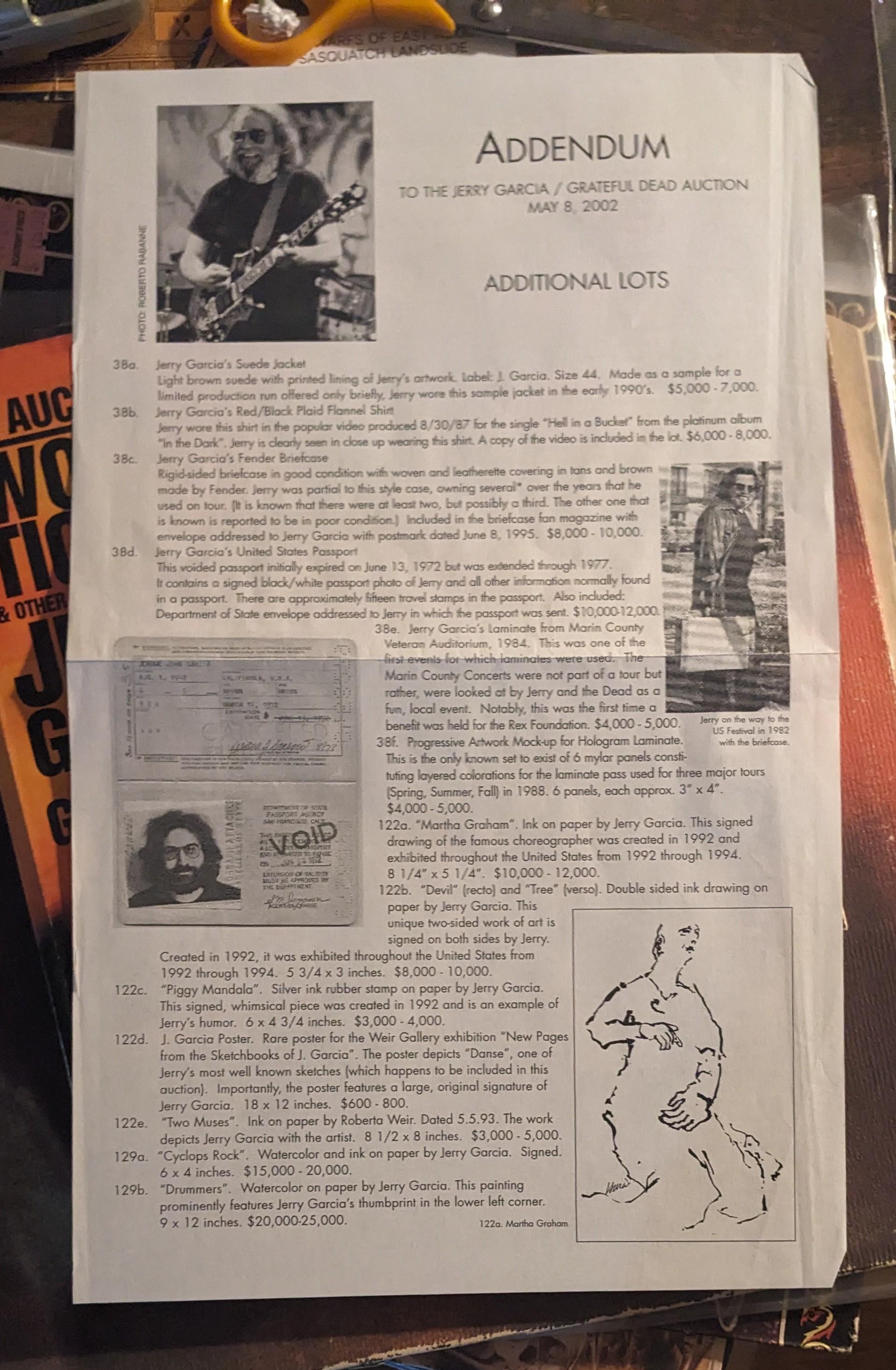
just dislodged a memory of attending the original 2002 auction of jerry garcia's guitars, at studio 54 for some reason, & guitar maker doug irwin (who garcia willed them to) literally cackling/laughing from the back of the room when tiger went for almost a million.

 @tiotasram@kolektiva.social
2026-04-02 09:21:35
Imagine:
You are these parent of an adorable 4-year-old kid. They have made a toy airplane out of spare cardboard. Sadly, during play the wing has fallen off. You, a wise parent, produce a piece of duct tape and tape it back on. Your kid asks: "but what if the tape breaks, or the other wing falls off?" Dutifully, and with a completely serious manner, you duct tape the other wing, and then with a sharpie you write "Please DO NOT fall off!" on each wing. "There," you say, now the wings will not fall off. "
Your child happily returns to their play.
Imagine:
You are boarding a Boeing airplane for an intercontinental flight. Just the other day you were reading news about the emergency exit door falling off a Boeing airplane during flight. Thankfully nobody was injured in that incident, but a passenger could have been sucked out the gap and killed. As you walk down the aisle towards your seat at the back, you notice that around the emergency exit door of this plane, there are some scratch marks. It looks like it might not be 100% seated in place. You see several rolls worth of duct tape slapped onto the gaps between the door and the frame. In sharpie, someone has written "Please DO NOT fall off!" on the duct tape.
This is a post about #Agentic #AI.
To clarify: there are a host of reasons why using Claude Code is unethical in the first place, besides the fact that its a danger to its users. These make it unethical to use it even for a child's-toy-like application. But the source code we've just witnessed in the recent leak is *exactly* this level of "engineering." If you see an app that claims to be "programmed with AI" and it has any possibility of failing in a way that could harm you (for example, if it connects to the internet, meaning that poor programming could allow hackers to take over the device you run it on), my advice is: "Do not use it and warn your friends and family."
P.S. yes, this advice does apply to Microsoft Widows at this point, although that can be a tougher bullet to bite.
 @Techmeme@techhub.social
2026-02-16 12:25:38
Sources: Sony is considering pushing back the debut of its next PlayStation console to 2028 or even 2029, as the AI boom fuels huge memory chip demand (Bloomberg)
https://www.bloomberg.com/news/articles/2026-02-15/rampant-ai-de…
 @Sustainable2050@mastodon.energy
2026-03-07 08:55:45
Dutch farmland has a major water quality problem, in part due to the overload of manure ending up in ditches. Turns out that farmers have found a workaround: in just 7 years, they made 30,000 ditches disappear by filling them up, 1/3 of those illegally.
Bad for biodiversity and water management.
https:…

 @gwire@mastodon.social
2026-04-17 07:29:18
> Moving to a version of IOS XE that doesn’t write the log file is the obvious fix, but Cisco warns it’s not that simple because if your Wi-Fi box has filled its flash with junk, it may not have enough internal storage space to hold the updated OS.
https://www.theregister.com/2026/04/17/cis

 @arXiv_csOS_bot@mastoxiv.page
2026-02-10 09:40:07
Equilibria: Fair Multi-Tenant CXL Memory Tiering At Scale
Kaiyang Zhao, Neha Gholkar, Hasan Maruf, Abhishek Dhanotia, Johannes Weiner, Gregory Price, Ning Sun, Bhavya Dwivedi, Stuart Clark, Dimitrios Skarlatos
https://arxiv.org/abs/2602.08800 https://arxiv.org/pdf/2602.08800 https://arxiv.org/html/2602.08800
arXiv:2602.08800v1 Announce Type: new
Abstract: Memory dominates datacenter system cost and power. Memory expansion via Compute Express Link (CXL) is an effective way to provide additional memory at lower cost and power, but its effective use requires software-level tiering for hyperscaler workloads. Existing tiering solutions, including current Linux support, face fundamental limitations in production deployments. First, they lack multi-tenancy support, failing to handle stacked homogeneous or heterogeneous workloads. Second, limited control-plane flexibility leads to fairness violations and performance variability. Finally, insufficient observability prevents operators from diagnosing performance pathologies at scale.
We present Equilibria, an OS framework enabling fair, multi-tenant CXL tiering at datacenter scale. Equilibria provides per-container controls for memory fair-share allocation and fine-grained observability of tiered-memory usage and operations. It further enforces flexible, user-specified fairness policies through regulated promotion and demotion, and mitigates noisy-neighbor interference by suppressing thrashing.
Evaluated in a large hyperscaler fleet using production workloads and benchmarks, Equilibria helps workloads meet service level objectives (SLOs) while avoiding performance interference. It improves performance over the state-of-the-art Linux solution, TPP, by up to 52% for production workloads and 1.7x for benchmarks. All Equilibria patches have been released to the Linux community.
toXiv_bot_toot
 @BBC6MusicBot@mastodonapp.uk
2026-04-17 16:55:54
🇺🇦 #NowPlaying on #BBC6Music's #HuwStephens
Catherine Anne Davies & Bernard Butler:
🎵 In Memory Of My Feelings
#CatherineAnneDavies #BernardButler
https://open.spotify.com/track/4u2X4GaUB68lwh9NYgEwVe
 @paulbusch@mstdn.ca
2026-03-17 12:12:54
Good Morning #Canada
On this day in 1955, the passion of French Canadian #Hockey fans spilled over into the streets outside of the Montreal Forum. The Richard Riot was named after the Canadiens star player Maurice (Rocket) Richard. Following a violent altercation on March 13th, in which Richard hit a linesman, #NHL president Clarence Campbell suspended him for the remainder of the 1954–55 NHL season (3 games) and the entire playoffs. Montreal fans protested that the suspension was too severe and the Francophone fan base claimed the length of the suspension was motivated by Richard's French Canadian ethnicity. On March 17th the Canadiens played Boston, with the Rocket watching from the players bench in street clothes. The Forum was surrounded by chanting fans and when Clarence Campbell took his usual seat at the Forum the anger ignited. The resulting riot damaged neighbourhood stores and buildings, and led to dozens of arrests.
#CanadaIsAwesome #CrazyCanucks
https://www.nhl.com/news/richard-riot-still-chilling-memory-in-montreal-70-years-later