 @yaxu@post.lurk.org
2026-03-29 10:42:35
What's a nice way of writing "Thank you for choosing algorithms" in French, German and Flemish?
Feel free to also provide translations into other languages
(I have アルゴリズムを選んでくれてありがとう。for Japanese)
 @qurlyjoe@mstdn.social
2026-01-27 18:49:25
View public domain films for free. No ads, no login, no algorithms, just movies. Maintained by wikimedia folks.
https://boingboing.net/2026/01/27/wikiflix-is-like-netflix-for-public-domain-films-with-no-ads-n…
 @profcarroll@federate.social
2026-02-18 19:41:25
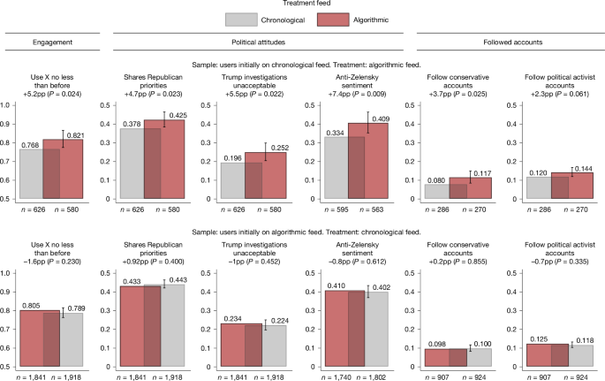
New Study: Evidence shows how X’s algorithmic feed is radicalizing its users toward the Right. https://www.nature.com/articles/s41586-026-10098-2
 @ErikJonker@mastodon.social
2026-02-18 18:25:08
The political effects of X’s feed algorithm
https://www.nature.com/articles/s41586-026-10098-2

 @veit@mastodon.social
2026-03-16 09:36:03
Social media algorithms prioritize right-wing content and influence the political views and behavior of real users. This is the finding of the recent study “The political effects of X’s feed algorithm”: https://www.nature.com/articles/s41586-026-10098-2

 @arXiv_nlinAO_bot@mastoxiv.page
2026-03-26 08:17:02
Hidden Higher-Order Vulnerabilities in Simplicial Complexes Revealed by Branch-Consistent Functional Robustness
Kaiming Luo
https://arxiv.org/abs/2603.24286 https://arxiv.org/pdf/2603.24286 https://arxiv.org/html/2603.24286
arXiv:2603.24286v1 Announce Type: new
Abstract: Robustness of higher-order networks is often quantified by the instantaneous smallest positive eigenvalue of the Hodge $1$-Laplacian under simplex deletion. We show that this observable is generically ill-defined: along a deletion trajectory, eigenvalue branches can switch, so the quantity being monitored may correspond to different nonharmonic modes at different steps. The primary issue is therefore definitional rather than algorithmic. We resolve it by fixing the first nonharmonic branch of the intact complex and following that same branch throughout the damage process, which defines a branch-consistent functional robustness. Triangle sensitivities then follow directly from first-order perturbation theory, making the resulting mode-sensitive deletion protocol a consequence of the observable itself rather than an independent heuristic. Across synthetic and empirical clique complexes, removing only a small fraction of triangles is sufficient to drive the tracked mode to collapse, while graph-level observables remain unchanged because the $1$-skeleton is exactly preserved. The same framework also reveals bridge-like localization of functionally critical simplices and provides a compact predictor of dynamical timescales.
toXiv_bot_toot
 @arXiv_csDS_bot@mastoxiv.page
2026-02-03 07:35:01
End Cover for Initial Value Problem: Complete Validated Algorithms with Complexity Analysis
Bingwei Zhang, Chee Yap
https://arxiv.org/abs/2602.00162 https://arxiv.org/pdf/2602.00162 https://arxiv.org/html/2602.00162
arXiv:2602.00162v1 Announce Type: new
Abstract: We consider the first-order autonomous ordinary differential equation \[ \mathbf{x}' = \mathbf{f}(\mathbf{x}), \] where $\mathbf{f} : \mathbb{R}^n \to \mathbb{R}^n$ is locally Lipschitz. For a box $B_0 \subseteq \mathbb{R}^n$ and $h > 0$, we denote by $\mathrm{IVP}_{\mathbf{f}}(B_0,h)$ the set of solutions $\mathbf{x} : [0,h] \to \mathbb{R}^n$ satisfying \[ \mathbf{x}'(t) = \mathbf{f}(\mathbf{x}(t)), \qquad \mathbf{x}(0) \in B_0 . \]
We present a complete validated algorithm for the following \emph{End Cover Problem}: given $(\mathbf{f}, B_0, \varepsilon, h)$, compute a finite set $\mathcal{C}$ of boxes such that \[ \mathrm{End}_{\mathbf{f}}(B_0,h) \;\subseteq\; \bigcup_{B \in \mathcal{C}} B \;\subseteq\; \mathrm{End}_{\mathbf{f}}(B_0,h) \oplus [-\varepsilon,\varepsilon]^n , \] where \[ \mathrm{End}_{\mathbf{f}}(B_0,h) = \left\{ \mathbf{x}(h) : \mathbf{x} \in \mathrm{IVP}_{\mathbf{f}}(B_0,h) \right\}. \]
Moreover, we provide a complexity analysis of our algorithm and introduce a novel technique for computing the end cover $\mathcal{C}$ based on covering the boundary of $\mathrm{End}_{\mathbf{f}}(B_0,h)$. Finally, we present experimental results demonstrating the practicality of our approach.
toXiv_bot_toot