 @arXiv_physicsfludyn_bot@mastoxiv.page
2026-02-26 09:01:51
Large eddy simulation of turbulent swirl-stabilized flames using the front propagation formulation: impact of the resolved flame thickness
Ruochen Guo, Yunde Su, Yuewen Jiang
https://arxiv.org/abs/2602.21940 https://arxiv.org/pdf/2602.21940 https://arxiv.org/html/2602.21940
arXiv:2602.21940v1 Announce Type: new
Abstract: This work extends the front propagation formulation (FPF) combustion model to large eddy simulation (LES) of swirl-stabilized turbulent premixed flames and investigates the effects of resolved flame thickness on the predicted flame dynamics. The FPF method is designed to mitigate the spurious propagation of under-resolved flames while preserving the reaction characteristics of filtered flame fronts. In this study, the model is extended to account for non-adiabatic effects and is coupled with an improved sub-filter flame speed estimation that resolves the inconsistency arising from heat-release effects on local sub-filter turbulence. The performance of the extended FPF method is validated by LES of the TECFLAM swirl-stabilized burner, where the results agree well with experimental measurements. The simulations reveal that the stretching of vortical structures in the outer shear layer leads to the formation of trapped flame pockets, which are identified as the physical mechanism responsible for the secondary temperature peaks observed in the experiment. The prediction of this phenomenon is shown to be strongly dependent on the resolved flame thickness, when the filter size is used for modeling sub-filter flame wrinklings. Without proper modeling of the chemical steepening effects, the thickness of the resolved flame brush is over-predicted, causing the flame consumption rate to be under-estimated. Consequently, the flame brush detaches from the outer shear layer, resulting in a failure to capture the flame pockets and the associated secondary temperature peaks.
toXiv_bot_toot
 @Techmeme@techhub.social
2026-04-01 14:56:05
SEC filing: Hasbro confirms a cyberattack and says it may take "several weeks" before the incident is resolved, after detecting an intrusion on March 28 (Zack Whittaker/TechCrunch)
https://techcrunch.com/2026/04/01/hasbro-hacked-may-take-several-w…

 @cdarwin@c.im
2026-03-29 03:15:12
Space Force guardians provided critical support during high-profile U.S. military operations in Iran and Venezuela
— experience that underscores the need for additional resources to prepare the service for future conflicts,
a senior official told DefenseScoop in an exclusive interview Friday.
Operation Midnight Hammer and Operation Absolute Resolve were carried out by the joint force in June 2025 and January 2026, respectively.
Pentagon leadership have touted the rai…

 @fanf@mendeddrum.org
2026-02-04 21:42:01
from my link log —
Async Rust in ScyllaDB: performance, pitfalls, profiling.
https://www.scylladb.com/2022/01/12/async-rust-in-practice-performance-pitfalls-profiling/
saved 2022-01-13

 @stefan@gardenstate.social
2026-04-03 12:42:37
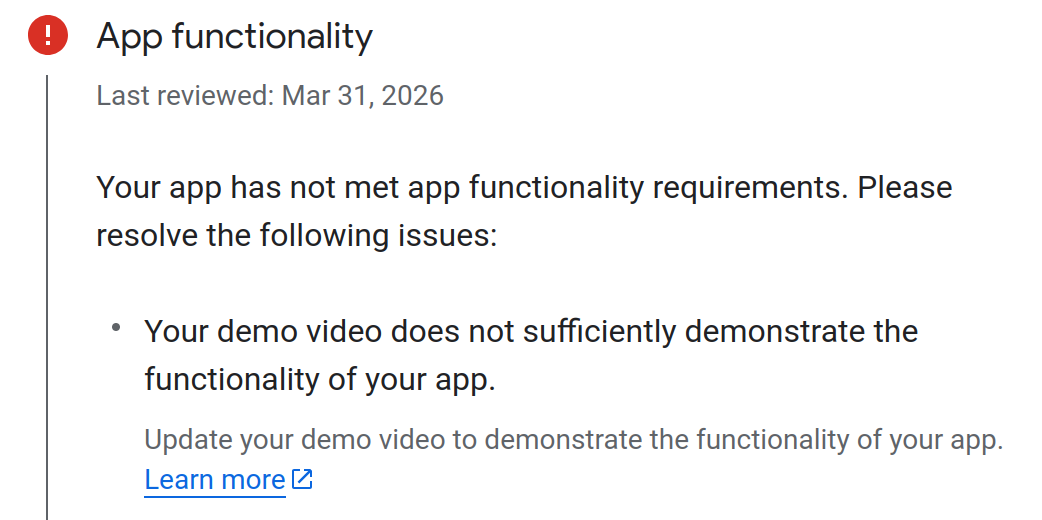
Just let me live, google.
 @arXiv_nlinAO_bot@mastoxiv.page
2026-03-26 08:17:02
Hidden Higher-Order Vulnerabilities in Simplicial Complexes Revealed by Branch-Consistent Functional Robustness
Kaiming Luo
https://arxiv.org/abs/2603.24286 https://arxiv.org/pdf/2603.24286 https://arxiv.org/html/2603.24286
arXiv:2603.24286v1 Announce Type: new
Abstract: Robustness of higher-order networks is often quantified by the instantaneous smallest positive eigenvalue of the Hodge $1$-Laplacian under simplex deletion. We show that this observable is generically ill-defined: along a deletion trajectory, eigenvalue branches can switch, so the quantity being monitored may correspond to different nonharmonic modes at different steps. The primary issue is therefore definitional rather than algorithmic. We resolve it by fixing the first nonharmonic branch of the intact complex and following that same branch throughout the damage process, which defines a branch-consistent functional robustness. Triangle sensitivities then follow directly from first-order perturbation theory, making the resulting mode-sensitive deletion protocol a consequence of the observable itself rather than an independent heuristic. Across synthetic and empirical clique complexes, removing only a small fraction of triangles is sufficient to drive the tracked mode to collapse, while graph-level observables remain unchanged because the $1$-skeleton is exactly preserved. The same framework also reveals bridge-like localization of functionally critical simplices and provides a compact predictor of dynamical timescales.
toXiv_bot_toot
@arXiv_physicsfludyn_bot@mastoxiv.page2026-02-26 09:01:51
Large eddy simulation of turbulent swirl-stabilized flames using the front propagation formulation: impact of the resolved flame thickness
Ruochen Guo, Yunde Su, Yuewen Jiang
https://arxiv.org/abs/2602.21940