I've mentioned it before, and I'm sure I will again, but, as much as there's a reason why I reject Christianity, there were also a lot of good things. Churches have governing bodies (with varying degrees of democratic representation) that guide the ministry (preaching and actions) as well as managing logistics (building maintenance, accounting, etc). This provides opportunities for self-governed collective action.
Quakers are the most radical in terms of this, and are basically anarchists. Quaker circles often meet at people's houses and can be as small as 3 people. There is often no leadership. A Quaker service could easily just be everyone sitting in a circle and someone talking at one point.
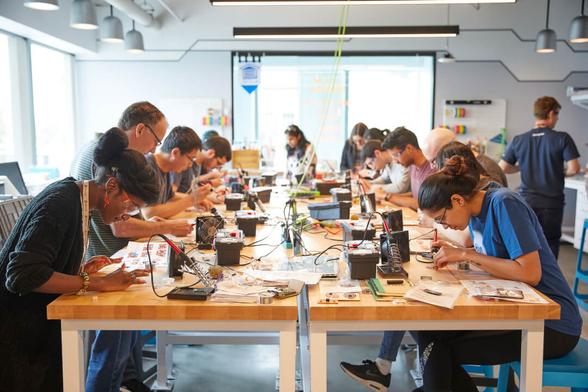
I grew up in a Presbyterian church, and one of my first jobs (at 11 or 12) was landscaping there. Within the church there were a lot of different trades, which meant that you could volunteer time and learn basically any kind of maintenance. Basically everything that needed to be done was done in-house. This also meant that if you needed a plumber, an electrician, etc, that you could pick one from within the church.
I remember painting the church, learning how to paint, with a bunch of other members of the congregation at a work party. I also remember being volunteered for child care during choir. There were a few rooms around that were used for different things, such as music practice. But these rooms could be made available for any type of community activity. This can actually include community organizing. In fact, Seattle GDC was offered an occasional space for organizing in a church (we didn't take it, but appreciated the offer), and that same church hosted a lot of other community events. I actually went to a queer relationships skills class once hosted in a church, which was great.
What I'm saying is that churches often act as a kind of parallel society up-to-and-including acting as dual power structures....
This summer is shaping up to be an expensive and uncertain time to fly, especially if you’re planning a European vacation.
Volatile fuel prices because of the war in Iran are straining airlines around the globe,
but perhaps nowhere as much as in Europe,
where jet fuel supplies could run low by mid-May.
European airlines like Lufthansa and KLM have announced they are cutting flights,
and others could follow.
Carriers everywhere are increasingly passing cost…
I feel like I am missing my SLA to turn around portraits so it is a guilty pleasure to share a #sliceoflife of which I will say two things: (1) I told the clerk at the 7-11 that "I didn't know she was still around" and (2) the photo is above the dignity of the object because I took it with a huge lens
"Report: Poland as a target of Russian hybrid attacks."
#Russia
Just finished "A Psalm for the Wild-Built" by Becky Chambers. Overall it's good but I also have some Thoughts.
First, it was very pleasant to finally read some non-trite utopian solarpunk after having read stuff like Octavia Butler recently. Both hope and despair can be poisonous on their own IMO, so getting some balance in is nice. It's definitely a very valuable thing to be able to lay out an actually desirable and in many ways imaginable future given our grim present. Chambers is no LeGuin though. I'll probably be reading more of her work and maybe she fleshes out these ideas elsewhere, but at least in this book there is no focus on either how the transition to a better society could happen nor on how the better society holds up in the face of adverse events and inclinations. Compare LeGuin's "The Dispossessed" or N. K. Jemisin's short story "The Ones Who Stay and Fight" and it feels like there's something important missing from Chambers' portrait of a future society. Of course, maybe the point is to make a cozy book, in which case fine, there's certainly a place for such things, and I can look for deeper inspiration elsewhere.
The second big thought I had was that Chambers' worldview seems not well-informed by certain indigenous perspectives, and this creates some contradictions. For example, (minor spoilers) when Dex enters the wilderness there's a whole bit about understanding humankind's place in nature and how human settlements are what we're used to but they're only a brief interruption of the vast untouched wilderness. Along the same lines, much of the world is intentionally left untouched by humans as a way to keep it pristine and natural. Later however, a character makes the point that humans *are* animals. The indigenous perspective that I appreciate would agree with that, and would further question the value in distinguishing between human influence on ecosystems and influences that others have. More sharply, one might observe that there's a bigger difference between how different kinds of humans relate to and influence their environments than between how less-disruptive humans and various animals do the same: the strip-mine-operator vs. migrant tribesperson impact difference is probably much greater than the migrant tribesperson vs. beaver gap, for example. Rather than talking about limiting human disruption, then, as if all human-environment interactions are disruptive and must be minimized, we could/should be talking about how to create human societies that have beneficial relationships with their environments and acknowledging that we actually have many positive examples of that, both historical and contemporary. Chambers' utopia is a "humans dominate nature but restrain themselves so that their disruptions are minimal and thus nature can thrive" vision, but what I'd even more like to see would be a "humans study old ways and make new ones so that they can interact positively with ecosystems again" vision, including some of "here are the places that sometimes breaks down but also the patterns and institutions that ensure repair of those breakdowns and thus long-term sustainability."
Final big thought: Chambers' utopia is too homogenous for my tastes. Of course it's hard enough and valuable work dreaming up and sharing any utopia and Chambers' transcends triteness in a number of ways, so this criticism is a bit rude. But the single shared religion, lack of mention of conflicts around shared decisions, especially historical society-defining ones, and nagging questions like "what about the people indigenous to the now-uninhabited lands?" and "what about the indigenous peoples who weren't part of the factory-building societies?" leave me wishing for more nuance in this direction.
All in all: a good book, and I'm criticizing out of a place of appreciation, not scorn. I've got there sequel out from the library as well and will probably detour to a few other books but get to it pretty soon.
Sadly I don't remember who, but I got this one because of a recommendation on here, so thanks if you're someone who recommended it!
#AmReading #ReadingNow #Bookstodon
The discussion around "age verification" in systemd/XDG has been largely focused against the California law. But honestly, there's a much deeper problem there.
Firstly, the data collected. The question initially asked is "are you at least 18 years old?" However, that's not the data collected. In fact, the data collected is not even the age — it's the full birth date. It's a perfect example of collecting more data than you need, and a sensitive information too, and sharing it with any application that asks.
Secondly, the extended goal of "parental controls" used as a justification to collect more data. When you think about it, you realize how bad this is: it isn't the case of asking the user about their birth date (with the assumption that a kid will enter a fake date to workaround the limitations). It is effectively a tool for *parents* to impose restrictions on their children, which means that they are more likely to enter the real date to ensure that these restrictions work. And given how popular sharenting is today, do you really think they'd come up with a fake birth date that happens to roughly match their child's age?
This is simply irresponsible.
https://github.com/flatpak/xdg-desktop-portal/pull/1922
Good journalistic review of the disconnect between LGBTQIA laws on paper and actual discrimination in Nepal. What it misses, and what is key here, is that heterosexual gender inequality - laws around inheritance and citizenship, for example - are horrible there. Any substantive reform of the law around gender will have to cover all of this. At present, there is partial legal recognition of third gender identity, but citizenship only follows men - so the children of a Nepalese woman married…
The .sln format has been around forever and it shows. SLNX brings a clean, XML-based solution file that’s readable, diffable, and open. https://www.poppastring.com/blog/a-simpler-solution-file-format
This is actually not too far off from a pamphlet I wrote at my community college as an experiment in "turning assignments into creative writing." I was taking a religion class, so I decided to create one. I was working in a group and by the end we had developed 3 sects of the religion and we each talked about our sect and how it related and differed from the original text.
I also handed out pamphlets at a mall, half as part of a psychology class (because why not find a way to reuse my material) and part as an experiment to see how long it would take to get kicked out of said mall. (The answer was bout 15 minutes, if I remember correctly.)
Somewhere between there and here, the books "The Evolution of God" and "Non-Zero" came out (written, interestingly but probably unrelated, by someone who lived in the town with that mall where I handed out those flyers). These books both have heavily overlapping ideas with the original pamphlet (lost, which may not be the worst thing since it was full of spelling and grammar errors).
But both of those books had a decidedly theistic flavor, though, I think, they were more generally liberal. The whole #CultPunk thing feels like a missing piece to something that's been bouncing around in my head for... uh... some years. But not so much at the front of my mind.
It was actually in the hospital, on pain killers and ketamine, that this all came rushing back. Perhaps that's the right state of mind for such things.