 @hynek@mastodon.social
2026-08-16 07:46:41
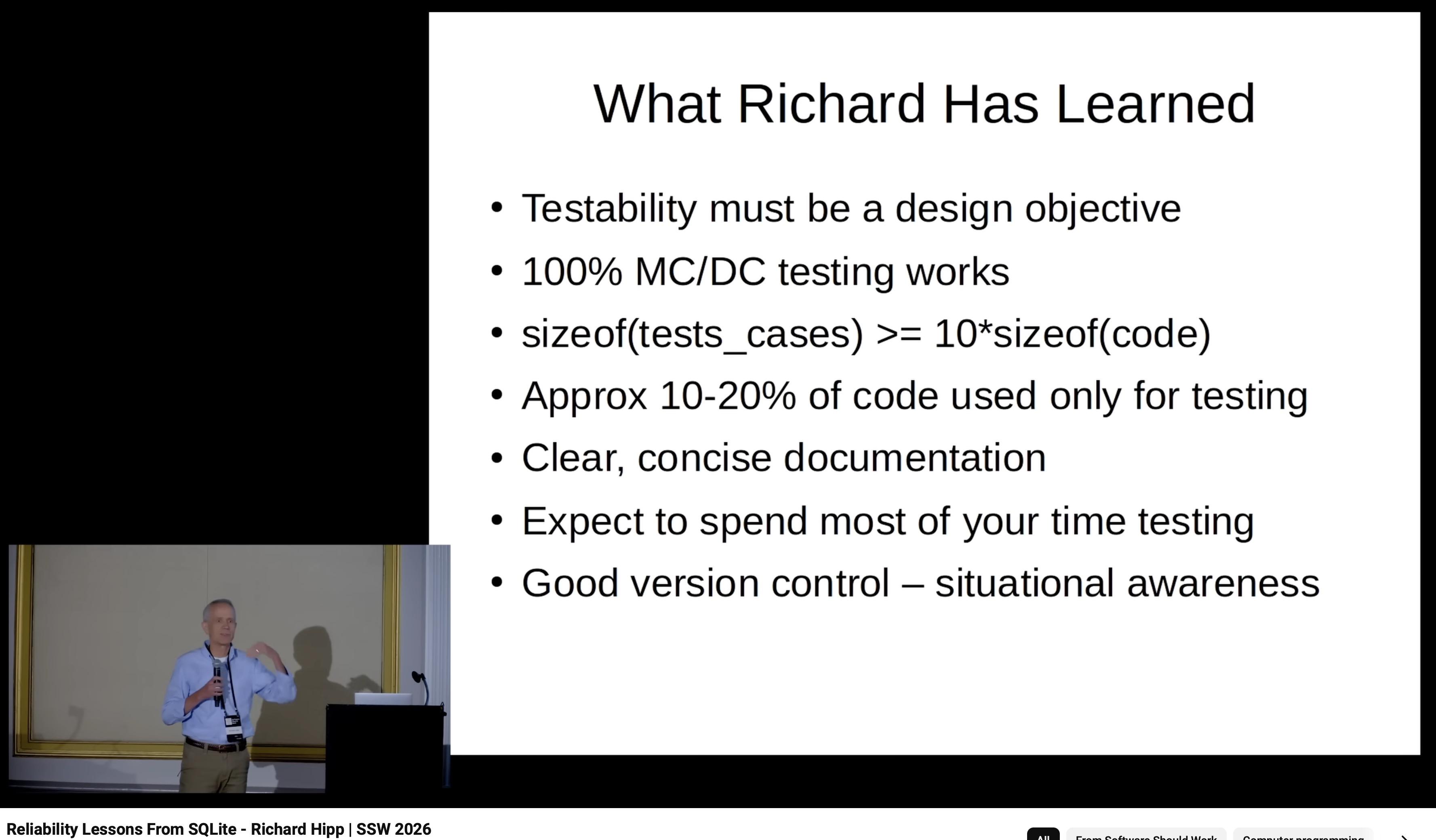
between weird LinkedIn influencers urging to delete tests that never failed and Richard’s learnings I know on what team I want to be and whose software I want to use
https://www.youtube.com/watch?v=V_qzqY1bb7I
 @mszll@datasci.social
2026-09-14 12:57:09

 @arXiv_mathST_bot@mastoxiv.page
2026-08-14 08:12:26
On the Structural Limits of Machine Learning Decision Systems: An Information-Theoretic, Interaction-Based, and Stochastic-Dynamical Perspective
Nestor R. Barraza, Gabriel Pena
https://arxiv.org/abs/2608.13510 https://arxiv.org/pdf/2608.13510 https://arxiv.org/html/2608.13510
arXiv:2608.13510v1 Announce Type: new
Abstract: Machine learning procedures are commonly evaluated in terms of predictive accuracy and computational efficiency. However, their achievable performance is fundamentally constrained by structural properties of the underlying data-generating process, which are formalized in terms of informational bounds. In this work we examine intrinsic limits of data-driven decision systems from an information-theoretic and interaction-based perspective. We analyze minimal achievable error in classification through Fano-type bounds and precision limits in parametric estimation via the Cram\'er-Rao inequality, emphasizing that such limits depend on the underlying model rather than on algorithmic sophistication alone. We further discuss how implicit assumptions, such as independence, ergodicity, and distributional stability, affect the validity of inferential procedures. Building on interaction-based modeling principles, we review typical frameworks such as Markov Random Fields and potential based representations for encoding dependence mechanisms. We also describe decision systems, including LLM-integrated agent architectures, as feedback-driven stochastic processes where state-dependent dynamics may induce emergent macroscopic behavior. This perspective highlights the importance of having adequate models for the data as a prerequi- site for expanding predictive capability, and situates algorithmic learning within the informational limits imposed by the models.
toXiv_bot_toot
 @arXiv_astrophCO_bot@mastoxiv.page
2026-08-06 08:41:46
Crosslisted article(s) found for astro-ph.CO. https://arxiv.org/list/astro-ph.CO/new
[1/1]:
- Consistent Thermal Resummation and Phase Transitions with 2PI Methods
Amitayus Banik, Kimmo Kainulainen
https://arxiv.org/abs/2608.04102 https://mastoxiv.page/@arXiv_hepph_bot/117047502693663591
- Amnesia in the Axion Misalignment Landscape
Kierthika Chathirathas, Cem Er\"oncel, Mathieu Kaltschmidt, Javier Redondo, Kenichi Saikawa
https://arxiv.org/abs/2608.04139 https://mastoxiv.page/@arXiv_hepph_bot/117047523928429238
- Corrections to Hawking radiation from asteroid-mass primordial black holes: analytic and numerica...
Gabriel Vasquez, Bowen Chen, Cara Nel, Emily Koivu, Makana Silva, Christopher M. Hirata
https://arxiv.org/abs/2608.04346 https://mastoxiv.page/@arXiv_grqc_bot/117047445284689579
- Relativistic Signatures of Dark Matter Equations of State in Static Spherically Symmetric Spacetimes
Akash Yadav, Sudhava Yadav, K. K. Venkataratnam
https://arxiv.org/abs/2608.04470 https://mastoxiv.page/@arXiv_grqc_bot/117047473794282581
- Inflow-driven galaxy evolution - I. Revealing the physics of the fundamental metallicity relation
Kai Wang, et al.
https://arxiv.org/abs/2608.04784 https://mastoxiv.page/@arXiv_astrophGA_bot/117047534350606403
- Evolution of matter perturbations in the context of cosmic slowing down
D. Koh Cuende, G. Panotopoulos
https://arxiv.org/abs/2608.04922 https://mastoxiv.page/@arXiv_grqc_bot/117047514099918452
- Post-Inflationary Constraints on Nonminimally Coupled Quintessential Inflation
Min Gi Park, Seong Chan Park, Tomo Takahashi, Jos\'e Jaime Terente D\'iaz
https://arxiv.org/abs/2608.05079 https://mastoxiv.page/@arXiv_grqc_bot/117047542803232910
- CCAT: Design and Characterization of the 350 GHz Instrument Module
Ben Keller, et al.
https://arxiv.org/abs/2608.05121 https://mastoxiv.page/@arXiv_astrophIM_bot/117047574262723419
toXiv_bot_toot
 @mgorny@social.treehouse.systems
2026-07-08 19:41:52
Back when I was diagnosed with #diabetes, I've found two apps to help me. Both were proprietary.
The first one came from the glucometer's manufacturer, and it featured the ability to copy its readings over Bluetooth. It also had a pretty useful bolus calculator. However, it was also annoying in a number of ways: it required an account with all the implied data sharing, was premiumware (though using their glucometer implied a free "pro" version), was quite childish in design, didn't respect disabled animations or dark theme.
The second one was an independent Polish app to compute carbs from meals. It wasn't perfect, but it had a rich database of products and quite a few convenient features (like copying meals or calculating carbs based on recipes). Unfortunately, the authors went full way into AI hype, and while I didn't use any of the "AI" features (they were premiumware anyway), the app itself was becoming increasingly crappy.
Eventually, this motivated me to look for a new app. I've settled for #Diaguard. It's just got the basics: meal composition and computing carbs, plus letting me log blood sugar and insulin doses manually. It used to have a bolus calculator before I used it, but it was removed over legal concerns. Still, it's open source, it's nice, it's got no crap and it respects the dark theme. And honestly, given that I've already reached the point of overriding bolus calculator, I've figured out it's enough for me.
In fact, it's so "enough" that I'm not even using it regularly. I mean, if my blood sugar is predictable and my meals are predictable, there's no reason to waste time logging them. The app is there to assist me when I need it, not force me to use it.
I still keep the two other apps installed. The first one in case I had doubts over insulin doses and wanted to use the bolus calculator. The second one over my database of meals; though I had already exported it, so I just need to figure out if the export is complete enough.
#Android
 @arXiv_csHC_bot@mastoxiv.page
2026-08-12 08:25:59
When the Interviewer Is a Bot: Behavior, Breakdowns, and Trust in MLLM-Led Interviews
He Zhang, Kambinachi Chukwuma, ChanMin Kim, John M. Carroll
https://arxiv.org/abs/2608.10412 https://arxiv.org/pdf/2608.10412 https://arxiv.org/html/2608.10412
arXiv:2608.10412v1 Announce Type: new
Abstract: Semi-structured interviews are a cornerstone of qualitative research but remain labor-intensive. We report an empirical study of what actually happens when the interviewer is an off-the-shelf real-time multimodal LLM (MLLM). We built InterviewBot, a voice-based interviewing system that wraps a real-time MLLM with a researcher-authored outline, and deployed it not as a novel architecture but as a research instrument for observing default MLLM interviewing behavior. In a practice study (N=15), participants completed a bot-led semi-structured interview and then a human-led reflection session about that experience. We contribute (i) a turn-level behavioral analysis of an MLLM interviewer (N_turns=428) showing that it is acknowledgment-heavy but probe-light (deepening probes account for 4.9% of all turns), and that 28.7% of question-bearing turns pack multiple questions into one turn despite an explicit one-question-at-a-time instruction; (ii) an inductive catalogue of four data-collection breakdowns (information loss, premature termination, latency, and interruption) observed in a deployed rather than simulated system; and (iii) three social dynamics from participants' reflections: disclosure calibration, where reduced social pressure coincided with shallower elaboration; institutional legitimacy, where trust tracked perceived stakes and what delegation to AI signaled about the organizer rather than conversational competence; and conversational grounding, where content-grounded paraphrase, not generic social filler, was what participants read as listening. We conclude with design implications for depth control, transparent handoffs, and non-templated listening mechanisms in human-centered interview automation.
toXiv_bot_toot
 @arXiv_csAR_bot@mastoxiv.page
2026-08-14 07:30:59
Spec-Driven Hardware Evolution via Executable Contract Refinement and Proof-Guided RTL Update
Shibo Zhao, Yang Zhang, Mengxia Tao, Baoqi Zhang, Kezhi Li, Qiang Xu, Binwu Zhu, Hao Yan, Min Li
https://arxiv.org/abs/2608.12684 https://arxiv.org/pdf/2608.12684 https://arxiv.org/html/2608.12684
arXiv:2608.12684v1 Announce Type: new
Abstract: Hardware development is inherently evolutionary: major revisions typically begin by changing intended behavior and then updating a previously validated implementation, rather than regenerating RTL from scratch. Yet most recent LLM-based hardware research still frames the task primarily as prompt-to-RTL generation, offering limited support for semantic version evolution of trusted legacy designs. We present spec-driven hardware evolution, a contract-centered formulation for RTL version iteration. Instead of treating a new feature request as a direct prompt for RTL generation, we refine it into a reviewed executable contract for the next version. This contract specifies what must hold at the externally visible transactional level through a behavior-level reference together with explicit observation and checking semantics, while leaving how the change is realized in RTL to the evolution process. Based on this formulation, we organize hardware evolution into four stages: Specify, Plan, Implement, and Validate. After contract approval, the remaining stages proceed automatically: Plan derives cross-version semantic deltas and localizes affected RTL regions, aided by mutation-based semantic probing; Implement and Validate then perform legacy-aware RTL update under proof-guided checking and iterative repair. We evaluate the framework on a controlled version-evolution case study of a representative TPU datapath block under data-format changes. The results support the feasibility of contract-driven hardware evolution and demonstrate that the proposed backend workflow can effectively drive validated legacy RTL toward next-version functional convergence under a reviewed executable contract. An anonymous artifact for reproducibility is available at https://anonymous.4open.science/r/SDHE-3A6C.
toXiv_bot_toot
 @Mediagazer@mstdn.social
2026-08-26 16:50:45
Q&A with Karen Attiah about getting fired from WaPo over her social media posts after Charlie Kirk's killing, her willingness to go back to WaPo, and more (Riddhi Setty/Columbia Journalism Review)
https://www.
 @arXiv_csHC_bot@mastoxiv.page
2026-08-12 08:29:20
AI-Generated Interactive Fiction for Educational Use: A Pilot Study of Perceived Comprehensibility, Coherence, and Engagement
Finn Rogosch, Andreas Schrader
https://arxiv.org/abs/2608.10818 https://arxiv.org/pdf/2608.10818 https://arxiv.org/html/2608.10818
arXiv:2608.10818v1 Announce Type: new
Abstract: Generative artificial intelligence (AI) can produce educational content at scale, including interactive and narrative learning experiences, but technical generation alone is not sufficient: scenarios that are confusing, narratively inconsistent, or unengaging are unlikely to be useful in practice. This paper presents a pilot user-centred evaluation of AI-generated interactive fiction (IF) for educational use in higher education. Using a previously described domain-agnostic pipeline and a shared STEM content base, we generated a controlled pool of scenarios and asked participants (N = 22, STEM higher-education) to play one generated episode and rate it on narrative clarity, story-content coherence, engagement, and length acceptance. A free-text prompt captured open feedback. Narrative clarity and length acceptance were rated positively, engagement sat near the neutral mid-point of the scale, and story-content coherence was the weakest dimension by a clear margin. Qualitative feedback points to quiz integration as the bottleneck. Artificial in-fiction motivation for quiz prompts and abrupt setting changes were reported. Feedback also pointed to missing story-level consequences for wrong answers. From these observations, we derive concrete design implications that can inform larger follow-up studies, including later work on learning effectiveness.
toXiv_bot_toot
@arXiv_csAR_bot@mastoxiv.page2026-08-14 07:35:14
ROLoad-PMP: Securing Sensitive Operations for Kernels and Bare-Metal Firmware
Wende Tan, Chenyang Li, Yangyu Chen, Yuan Li, Chao Zhang, Jianping Wu
https://arxiv.org/abs/2608.13287 https://arxiv.org/pdf/2608.13287 https://arxiv.org/html/2608.13287
arXiv:2608.13287v1 Announce Type: new
Abstract: A common way for attackers to compromise victim systems is hijacking sensitive operations (e.g., control-flow transfers) with attacker-controlled inputs. Existing solutions in general only protect parts of these targets and have high performance overheads, which are impractical and hard to deploy on systems with limited resources (e.g., IoT devices) or for low-level software like kernels and bare-metal firmware. In this paper, we present a lightweight hardware-software co-design solution ROLoad-PMP to protect sensitive operations from being hijacked for low-level software. First, we propose new instructions, which only load data from read-only memory regions with specific keys, to guarantee the integrity of pointees pointed by (potentially corrupted) data pointers. Then, we provide a program hardening mechanism to protect sensitive operations, by classifying and placing their operands into read-only memory with different keys at compile-time and loading them with ROLoad-PMP-family instructions at runtime. We have implemented an FPGA-based prototype of ROLoad-PMP based on RISC-V, and demonstrated an important defense application, i.e., forward-edge control-flow integrity. Results showed that ROLoad-PMP only costs few extra hardware resources (< 1.40%). Moreover, it enables many lightweight (e.g., with negligible overheads < 0.853%) defenses, and provides broader and stronger security guarantees than existing hardware solutions, e.g., ARM BTI and Intel CET.
toXiv_bot_toot