 @hynek@mastodon.social
2026-06-18 13:58:42
httpx2 has proper API docs and intersphinx 🥲
now they just need to start using it themselves in their narrative docs 😅
https://github.com/hynek/stamina/commit/63663956d99aea06b8350293c0a7b12353793d12
 @cdarwin@c.im
2026-07-17 19:57:38
The declassified documents Trump just released to “prove” the 2020 election was “rigged”
actually show that Russia tried to interfere to hurt Biden and help Trump.
https://x.com/tvietor08/status/2077943979656851489?s=12&t=JIzXmAfBKPksn8uWZp4aaA

 @aral@mastodon.ar.al
2026-07-16 08:12:29
‘Last year, the online magazine 972 revealed the existence of a specialised military intelligence unit known as the “legitimisation cell”. Its mandate is narrative management. “Whenever criticism of Israel in the media intensified on a particular issue,” the report said, the cell combed through intercepted calls and fragments of intelligence from Gaza to identify material that could be deployed to defend Israel on the international stage.
“If the global media is talking about Israel ki…

 @arXiv_csHC_bot@mastoxiv.page
2026-08-12 08:20:44
Narrative Keyframing for Generative Creative Writing
Chao Zhang, Abe Davis
https://arxiv.org/abs/2608.10337 https://arxiv.org/pdf/2608.10337 https://arxiv.org/html/2608.10337
arXiv:2608.10337v1 Announce Type: new
Abstract: We introduce narrative keyframing, an interaction technique for AI-assisted creative writing that lets writers specify different types of narrative constraints at selected moments in a story, then use AI to generate intervening prose. Inspired by the use of keyframing in animation, narrative keyframing offers a flexible way to connect story planning with adaptive control over generated text. We explore three types of keyframes: plot keyframes define significant events in a story, character keyframes represent how individual characters change over the narrative, and perspective keyframes capture how individual characters experience different events through first-person narratives. Plot and character keyframes offer a flexible way to adapt the type of high-level conditioning explored in previous AI writing tools to more customizable, iterative, and fine-scale control, while perspective keyframes add a new way to control characterization and focalization by using first-person narratives as an intermediary. Through a user study, we show that narrative keyframing supports a more controllable, transparent, and engaging way to use generative AI in creative writing.
toXiv_bot_toot
 @toxi@mastodon.thi.ng
2026-07-06 11:58:38
Just noticed the (Computing Within) LIMITS 2026 workshop papers are on arXiv already. A selection:
Narratives That Limit the Possible: Interrupting Narrative Closure in Computing Practice
https://arxiv.org/abs/2606.17360
Modest, artistic, and radical solutions to the environmental impact of ima…

 @tiotasram@kolektiva.social
2026-08-16 23:32:08
Just finished reading "The Beast Player" by Nahoko Uehashi. I had already watched the anime, but it had been so king I didn't remember all the details. While the anime was great, the book is even better, and it's going to be high on my list of things to recommend to my children when they're old enough to read for fun.
The neurodivergent representation is cool, as is the deep central question of interspecies bonds and the political possibilities and dangers they entail. Uehashi handles the exploration of that question well in my judgment, including appropriate ambiguity without muddying moral clarity. Elin is a truly fantastic protagonist, not without flaws but nevertheless a excellent role model and a very sympathetic figure without being pitiful.
One thing I really love about Uehashi's writing is that she's not shy about using interior narration to tell the reader directly what a variety of characters are feeling, but when she does this she focuses on human contradictions, quirks, and weaknesses that make those characters feel much richer, and that remind the reader of all the ways our weird and sometimes contradictory or inexplicable quirks guide our actions just as much as both logical thought and predictable/expected feelings. None of the characters is an unerring source of wisdom, with every grand principle presented shown to have its weaknesses and biases, and even the wisest characters making mistakes and learning from them.
Overall, a wonderful book, and having also seen the "Seirei no Moribito" anime but not read the books, I'm excited to dig into more of Uehashi's extensive catalog.
#AmReading #ReadingNow #Bookstodon
 @newsie@darktundra.xyz
2026-08-03 17:21:17
‘Own the Narrative’: Leaked Flock Guide Shows How It Teaches Cops to Promote Its Tech https://www.404media.co/own-the-narrative-leaked-flock-guide-shows-how-it-teaches-cops-to-promote-its-tech/
@arXiv_csHC_bot@mastoxiv.page2026-08-12 08:29:20
AI-Generated Interactive Fiction for Educational Use: A Pilot Study of Perceived Comprehensibility, Coherence, and Engagement
Finn Rogosch, Andreas Schrader
https://arxiv.org/abs/2608.10818 https://arxiv.org/pdf/2608.10818 https://arxiv.org/html/2608.10818
arXiv:2608.10818v1 Announce Type: new
Abstract: Generative artificial intelligence (AI) can produce educational content at scale, including interactive and narrative learning experiences, but technical generation alone is not sufficient: scenarios that are confusing, narratively inconsistent, or unengaging are unlikely to be useful in practice. This paper presents a pilot user-centred evaluation of AI-generated interactive fiction (IF) for educational use in higher education. Using a previously described domain-agnostic pipeline and a shared STEM content base, we generated a controlled pool of scenarios and asked participants (N = 22, STEM higher-education) to play one generated episode and rate it on narrative clarity, story-content coherence, engagement, and length acceptance. A free-text prompt captured open feedback. Narrative clarity and length acceptance were rated positively, engagement sat near the neutral mid-point of the scale, and story-content coherence was the weakest dimension by a clear margin. Qualitative feedback points to quiz integration as the bottleneck. Artificial in-fiction motivation for quiz prompts and abrupt setting changes were reported. Feedback also pointed to missing story-level consequences for wrong answers. From these observations, we derive concrete design implications that can inform larger follow-up studies, including later work on learning effectiveness.
toXiv_bot_toot
 @olav@bonn.social
2026-07-09 17:14:26
#LIMITS2026 Die Papers der Workshops zu https://computingwithinlimits.org/2026/ sind veröffentlicht. An dem Titel bin ich hängen geblieben: "Narratives That Limit the Possible: Interrupting Narrative C…
 @coreyjrowe@detmi.social
2026-09-05 13:53:53
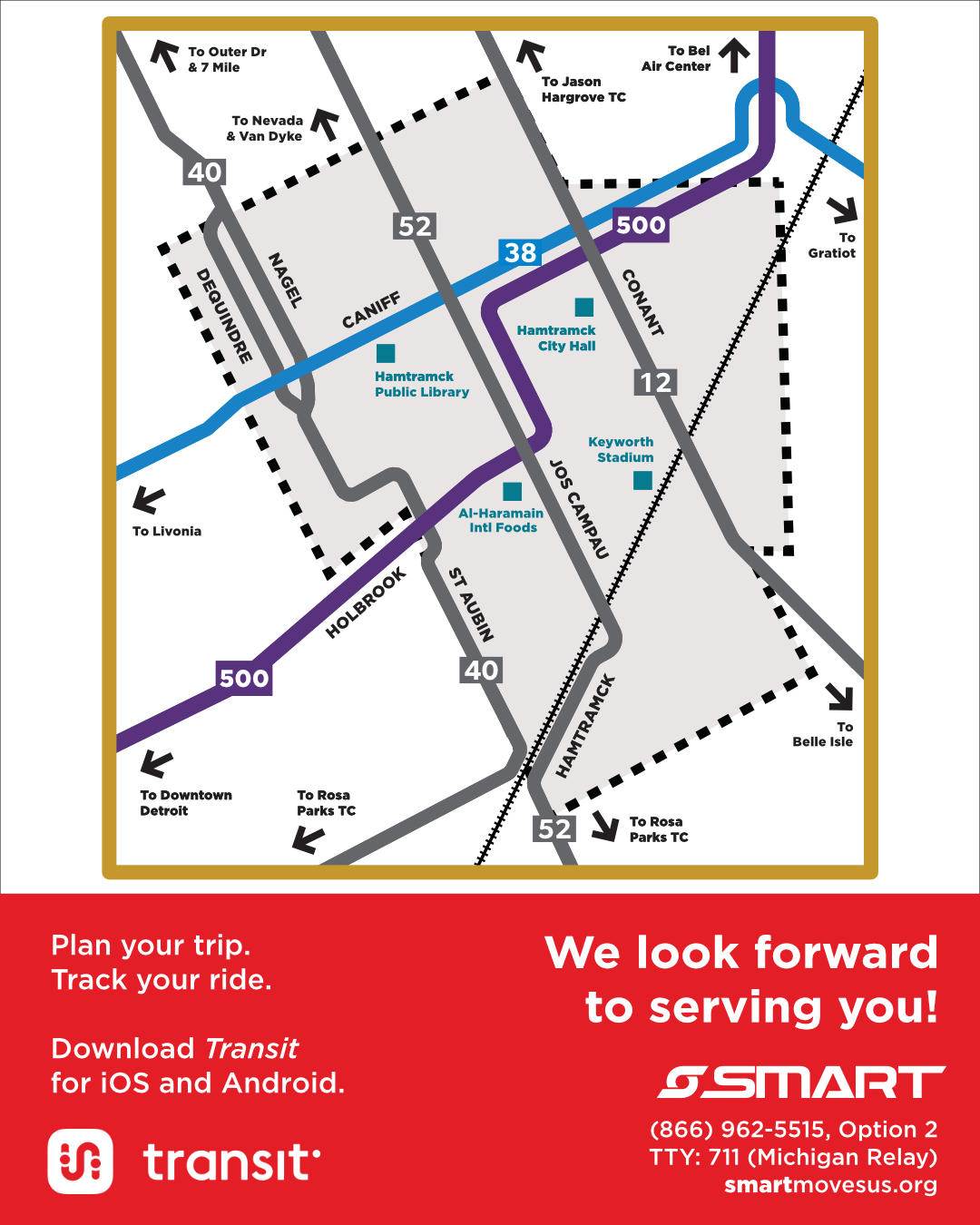
Route 500 enters service Monday morning (Sunday schedule)!
If you want to be on the very first bus:
The southbound departs Bel Air at 8:00am and reaches Hamtramck (Caniff/Buffalo) at ~8:13.
The northbound departs Larned/Griswold at 8:05am and reaches Hamtramck (Holbrook/Lumpkin) at ~8:33.