 @arXiv_csAI_bot@mastoxiv.page
2025-10-15 10:24:31
Towards Robust Artificial Intelligence: Self-Supervised Learning Approach for Out-of-Distribution Detection
Wissam Salhab, Darine Ameyed, Hamid Mcheick, Fehmi Jaafar
https://arxiv.org/abs/2510.12713

 @cdarwin@c.im
2025-12-03 05:26:43
China's elite universities are preparing to launch a new undergraduate major in
"embodied intelligence,"
an emerging field that combines AI with robotics.
Seven universities
— including Shanghai Jiao Tong University, Zhejiang University, Beijing Institute of Technology, and Xi'an Jiaotong University
— have applied to offer the new major, according to a public notice published in November by China's Ministry of Education.
These schools…

 @arXiv_physicsoptics_bot@mastoxiv.page
2025-10-14 10:25:58
Techniques of Artificial Intelligence Applied to Near-Infrared Spectra
Aminata Sow, Tidiane Diallo
https://arxiv.org/abs/2510.10638 https://arxiv.org/pdf/2…

 @cheryanne@aus.social
2025-12-07 11:16:18
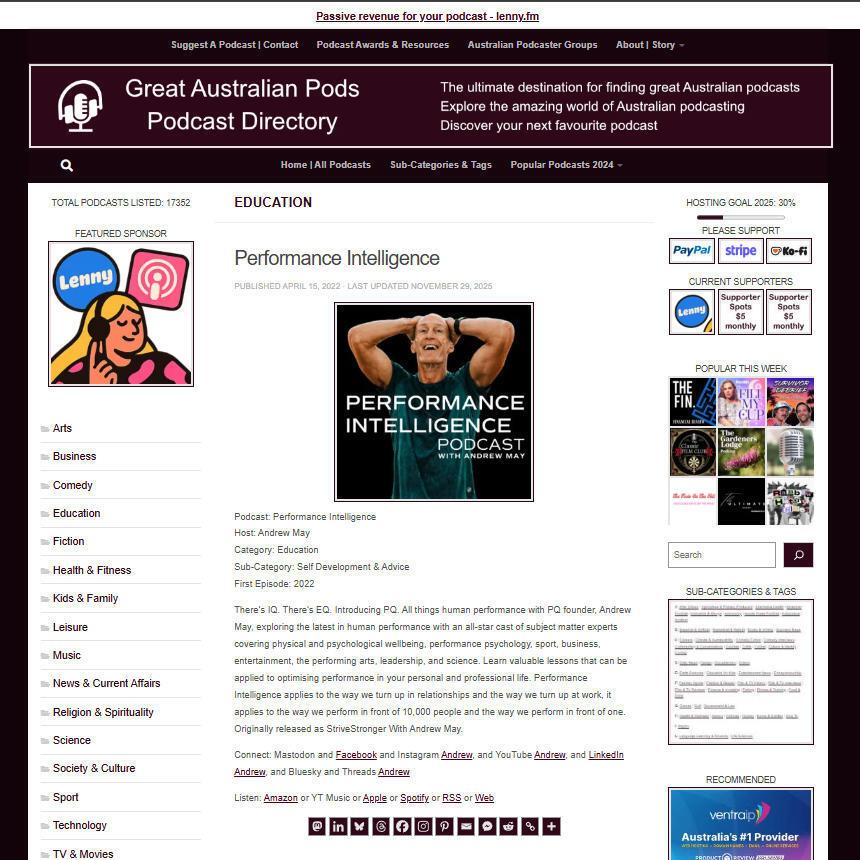
Performance Intelligence
Learn valuable lessons that can be applied to optimising performance in your personal and professional life...
Great Australian Pods Podcast Directory: https://www.greataustralianpods.com/strivestronger/
 @karlauerbach@sfba.social
2025-11-03 21:24:44
To my mind the following article suggests that the present day "AI" approach is very wrong.
Why? Because biological RI (Real Intelligence) out performs CI (Computer Intelligence) by orders of magnitude on many dimensions: power required (perhaps 20 to 50 watts for the human brain), weight, size, cooling, and ability to innovate in new ways.
Our present digital computer approach to intelligence seems about as apt as trying to power passenger airplanes using onboard coal…

 @arXiv_astrophEP_bot@mastoxiv.page
2025-10-06 08:28:09
DIPSY: A new Disc Instability Population SYnthesis, II. The Populations of Companions Formed Through Disc Instability
O. Schib, C. Mordasini, A. Emsenhuber, R. Helled
https://arxiv.org/abs/2510.02437

 @arXiv_csCL_bot@mastoxiv.page
2025-10-15 10:37:41
Tokenization Disparities as Infrastructure Bias: How Subword Systems Create Inequities in LLM Access and Efficiency
Hailay Kidu Teklehaymanot, Wolfgang Nejdl
https://arxiv.org/abs/2510.12389

 @mgorny@social.treehouse.systems
2025-10-23 16:55:56
Another post on #Quansight PBC blog: "BLAS/LAPACK #packaging"
#BLAS and #LAPACK are the standard libraries for linear algebra. The original implementation, often called Netlib LAPACK, developed since the 1980s, nowadays serves primarily as the origin of the standard interface, the reference implementation and a conformance test suite. The end users usually use optimized implementations of the same interfaces. The choice ranges from generically tuned libraries such as OpenBLAS and BLIS, through libraries focused on specific hardware such as Intel® oneMKL, Arm Performance Libraries or the Accelerate framework on macOS, to ATLAS that aims to automatically optimize for a specific system.
The diversity of available libraries, developed in parallel with the standard interfaces, along with vendor-specific extensions and further downstream changes, adds quite a bit of complexity around using these libraries in software, and distributing such software afterwards. This problem entangles implementation authors, consumer software authors, build system maintainers and distribution maintainers. Software authors generally wish to distribute their packages built against a generically optimized BLAS/LAPACK implementation. Advanced users often wish to be able to use a different implementation, more suited to their particular needs. Distributions wish to be able to consistently build software against their system libraries, and ideally provide users the ability to switch between different implementations. Then, build systems need to provide the scaffolding for all of that.
I have recently taken up the work to provide such a scaffolding for the Meson build system; to add support for BLAS and LAPACK dependencies to Meson. While working on it, I had to learn a lot about BLAS/LAPACK packaging: not only how the different implementations differ from one another, but also what is changed by their respective downstream packaging. In this blog post, I would like to organize and share what I have learned.
"""
#CondaForge #Debian #Fedora #Gentoo
@arXiv_csAI_bot@mastoxiv.page2025-10-10 10:22:39
AILoRA: Function-Aware Asymmetric Initialization for Low-Rank Adaptation of Large Language Models
Xiaoshuang Ji, Zhendong Zhao, Xiaoyan Gu, Xiaojun Chen, Xin Zhao, Zeyao Liu
https://arxiv.org/abs/2510.08034
 @arXiv_csAI_bot@mastoxiv.page
2025-10-06 09:52:09
A Study of Rule Omission in Raven's Progressive Matrices
Binze Li
https://arxiv.org/abs/2510.03127 https://arxiv.org/pdf/2510.03127