 @qbi@freie-re.de
2026-09-17 10:55:51
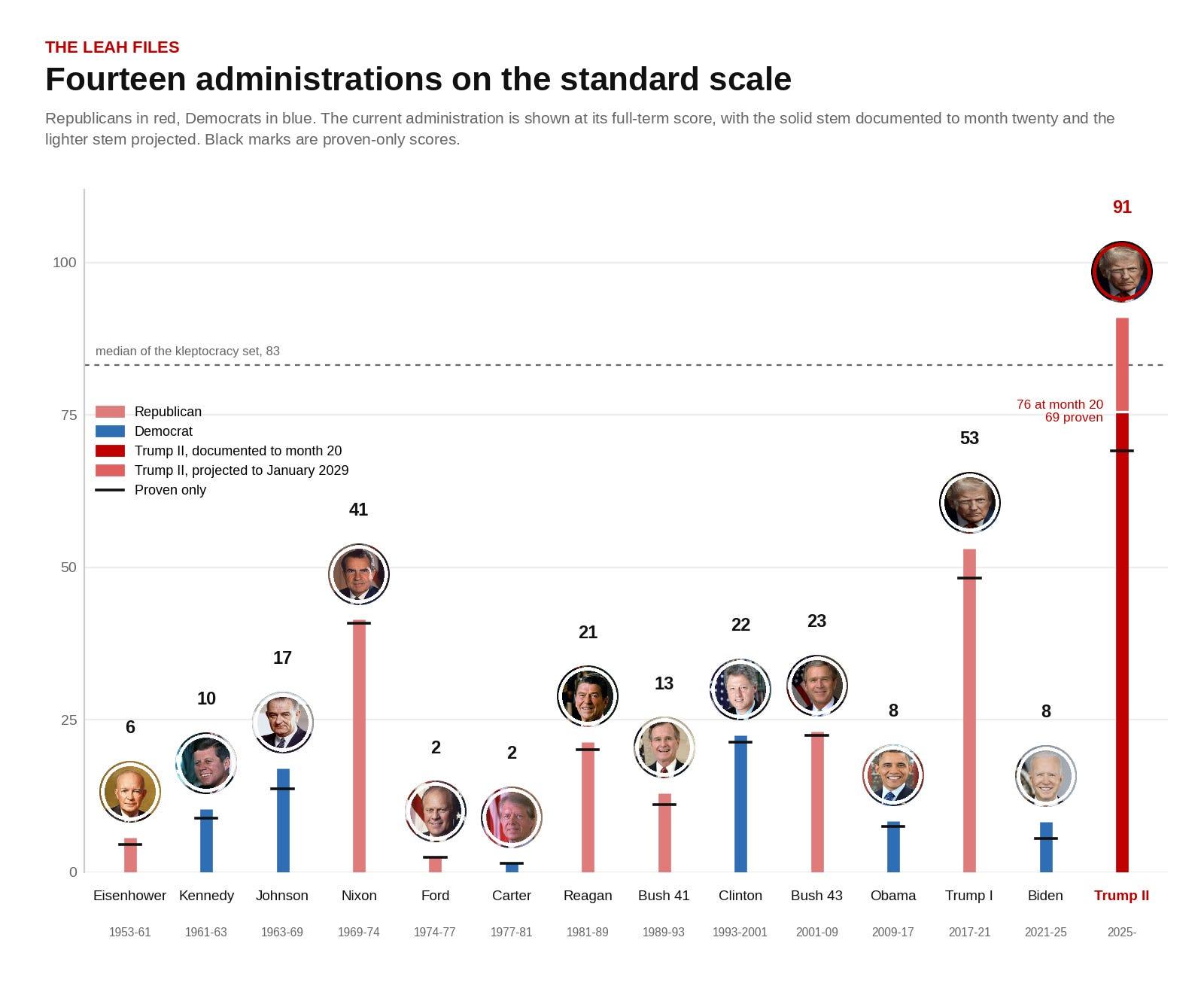
Wie korrupt ist #Trump?
Hier hat sich jemand die Definition der UN hergenommen und das in ein Modell gegossen. Damit wurden dann die Präsidenten der #USA verglichen. Der Vergleich ging dann auch noch in Richtung Marcos, Suharto und anderer.
Wenig überraschend ist die aktuelle Präsidentschaft mit Absta…
 @heiseonline@social.heise.de
2026-08-18 12:23:03

 @seeingwithsound@mas.to
2026-07-18 13:35:47
Non-invasive optical stimulation for induction of auditory perception https://www.eurekalert.org/news-releases/1136516 "It may also open new avenues for sensory substitution devices"
Optical induction of auditory perception via cochlear stimulation in Mongolian gerbils …

 @arXiv_mathST_bot@mastoxiv.page
2026-08-17 07:46:18
Converse bounds for multiple graph alignment and correlation detection based on last matching
Taha Ameen, Bruce Hajek
https://arxiv.org/abs/2608.14450 https://arxiv.org/pdf/2608.14450 https://arxiv.org/html/2608.14450
arXiv:2608.14450v1 Announce Type: new
Abstract: The paper focuses on information theoretic converse bounds for the alignment of $m$ correlated graphs and for the detection of correlation among $m$ graphs. A simple idea for $m\geq 3$ is that if the alignment of $m-1$ of the graphs is revealed as extra information (by a genie for example) then it is still necessary to produce the alignment between the one remaining graph and the others, i.e. the last matching must be accomplished. For both Gaussian and Erdos-Renyi models, the last-matching problem is equivalent to one with two observed graphs, providing a path to extend converse bounds for $m=2$ to larger $m$. While the method is rather obvious for alignment, we show that the method can also be used to derive converse bounds for weak detection of correlation.
toXiv_bot_toot
 @hanno@mastodon.social
2026-07-18 19:36:43
I suggest if you find a remote code execution vuln in the most popular CMS system in the world and make a web page for it, expect some traffic... https://wp2shell.com/ is currently down...
In other news, if you use Wordpress and have disabled security-autoupdates, you shouldn't have done that. But if you have, …
 @aka_pugs@mastodon.social
2026-08-17 01:39:24
Behold the #SunMicrosystems SunLink Communications Processor - released in 1985. This one sits on a VME-Multibus adapter.
It was a Multibus card OEM'd from Systech of San Diego (they still exist!). I used their VRTX RTOS just as a boot loader and wrote my own code for the board.
1/6

 @Mediagazer@mstdn.social
2026-07-17 13:35:53
DHS announces plans to shorten visas for foreign journalists in the US from up to 5 years to 240 days and cut those for Chinese journalists to 90 days (Edward Helmore/The Guardian)
https://www.theguardian.com/us-news/2026/jul/17/trump-administrat…

 @tschfflr@fediscience.org
2026-07-17 17:10:52
"is there (still) a lot of use of "signage" emojis like 🏪 or even more abstract 🛅?" - These complex ones are not so frequently used. BUT emojis are often used for signs in real life (= meat world, not digitally). I have a huge collection of photos I put together with the help of students. I think emojis are particularly good for this because such signs are often about rules, what we're not allowed to do or supposed to do. And emojis "soften" this face-threat (being told what to do) a bit, by being cute and colorful and generally perceived as positive. #emojis #linguistics #WorldEmojiDay
 @heiseonline@social.heise.de
2026-09-14 12:18:04
 @arXiv_mathST_bot@mastoxiv.page
2026-08-17 07:39:50
Generalization Error Estimation for Primal--Dual Algorithms in Non-Smooth Regression
Kai Tan, Pierre C Bellec
https://arxiv.org/abs/2608.13870 https://arxiv.org/pdf/2608.13870 https://arxiv.org/html/2608.13870
arXiv:2608.13870v1 Announce Type: new
Abstract: This paper studies trajectory-wise estimation of generalization error for primal--dual algorithms in non-smooth regression. Motivating examples include \(\ell_1\)-penalized least absolute deviations regression and square-root Lasso regression, where the data-fitting loss is non-differentiable and existing risk estimators for gradient-type optimization paths do not apply directly. We develop a general recursive framework that includes the Chambolle--Pock algorithm and related primal--dual splitting methods. We estimate risk by correcting each in-sample fitted value with a weighted combination of past dual iterates. The ideal weights are Stein derivative contractions and depend on the design covariance. We construct replacement weights from observable derivative contractions of the fitted-signal trajectory, yielding a covariance-free, data-driven correction. For high-dimensional Gaussian designs and fixed finite iteration horizon, we prove finite-sample guarantees for both estimators. For square-root ridge, we further establish a matched-Gaussian universality result beyond Gaussian designs. Numerical experiments show that the proposed estimators accurately track the out-of-sample risk along finite optimization paths.
toXiv_bot_toot