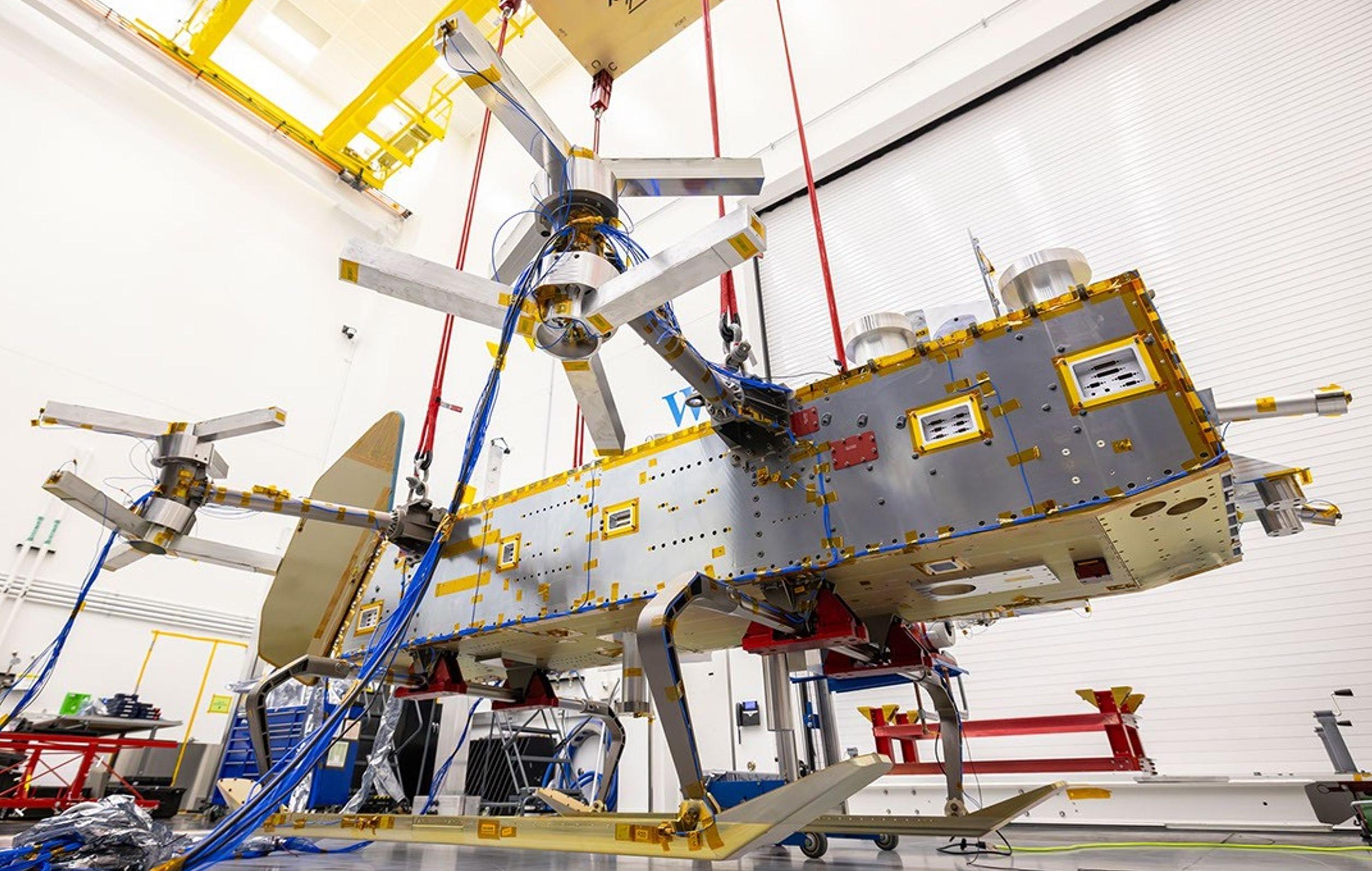
NASA’s #Dragonfly is starting to look less like a collection of spacecraft parts and more like the rotorcraft that will fly across the surface of Titan, Saturn’s hazy moon: https://science.nasa.gov/blogs/dragonfly/2026/07/09/nasas-dragonfly-clears-key-tests-as-titan-rotorcraft-takes-shape/ - the mission reached a major milestone on June 29, when the Dragonfly team at the Johns Hopkins Applied Physics Laboratory (APL) in Laurel, Maryland, delivered the nearly 13-foot-long fuselage for the next phase of spacecraft integration ahead of schedule.
from my link log —
Symmetries in boolean scans with APL.
https://ap29600.github.io/boolean_scans.html
saved 2026-08-27 https://dota…
Basic is a high level languish. APL is a high level anguish.
NASA’s nuclear Dragonfly copter to search for signs of life on Titan:
‘A lot’s riding on it’
The Dragonfly spacecraft,
a $3.3-billion nuclear-powered
space-copter,
has survived a decade of uncertain budgets and a shift in NASA priorities
to become the space agency’s last, large-scale planetary science mission,
scheduled to blast off in July 2028 bound for Saturn’s largest moon.
Over the next few months, workers at APL will bolt on eight three…
How the fly holds a single goal: normalization, not selection, in Drosophila FC2
Gioele Nanni, Christopher Lee
https://arxiv.org/abs/2607.18969 https://arxiv.org/pdf/2607.18969 https://arxiv.org/html/2607.18969
arXiv:2607.18969v1 Announce Type: new
Abstract: A walking fly steers toward a goal direction, held as a bump of activity across the FC2 neurons of the fan-shaped body. These neurons also inhibit one another over distance, more strongly the farther apart they are, a feedback proposed to keep the fly on a single goal. We asked, from the connectome, what circuit produces this inhibition, and whether it lets FC2 actively choose one goal among competitors (a winner-take-all) or simply keeps a goal set elsewhere as one clean bump. Tracing the wiring in a single FlyWire brain, we find the inhibition is almost entirely global: four FB5A cells inhibit every FC2 neuron roughly equally, with a smaller, distance-dependent contribution from hDelta interneurons and a negligible direct component. A ring-attractor winner-take-all (the kind the compass uses) requires local recurrent excitation that the FC2 wiring lacks, so this geometry cannot build one; and across a range of dynamical models, including a spiking network, no version of the circuit locks onto a winner at the connectome-scaled reference coupling. FC2 therefore normalizes an externally set goal rather than selecting it, with FB5A likely acting as the global normalizer, much as the APL neuron does in the mushroom body. We are explicit about two open points: a different mechanism, mutual inhibition between two competing goals (which hDelta supplies), could in principle select at very strong coupling, and we bound rather than exclude it; and FB5A's inhibitory identity is a low-confidence prediction of the connectome's transmitter classifier, not yet measured, and likely not GABAergic. We then ask where the goal is actually set: the connectome nominates an upstream hDelta network and rules out the leading proposed alternative, whose neurons supply under 0.2% of FC2's input. Finally, we propose a direct experiment, silencing FB5A while imaging FC2, that would test the account.
toXiv_bot_toot
 @cosmos4u@scicomm.xyz