 @grumpybozo@toad.social
2026-09-16 18:40:02
This is incredibly important.
Computers (writ large) have historically been tools that help humans solve problems which do not intrinsically demand computers but need complex computation (possibly including text transformation!) which humans cannot do as well or as fast.
The fact that we have grown a subculture of people who only really know computers has led to the situation where “computer-people” disregard other issues & the concerns of everyone else.
 @Techmeme@techhub.social
2026-09-15 15:35:56
Sources: the US Commerce Department last month ordered Kalshi to take down an AI compute futures product, citing national security concerns; Kalshi complied (Semafor)
https://www.semafor.com/article/09/15/2026/commerce-dept-orde…

 @cdarwin@c.im
2026-07-15 22:26:37
Minnesota Republican Party Chair Alex Plechash balked Wednesday
after Donald Trump endorsed prominent election denier Mike Lindell for Minnesota governor.
In a blistering response to the news, Plechash urged Republicans in the state not to blindly follow Trump’s advice,
citing Lindell’s “significant electability concerns” should he compete in the general election against Sen. Amy Klobuchar (D-Minn.).

 @heiseonline@social.heise.de
2026-09-12 15:51:04

 @ELLIOTTCABLE@functional.cafe
2026-09-16 20:16:12
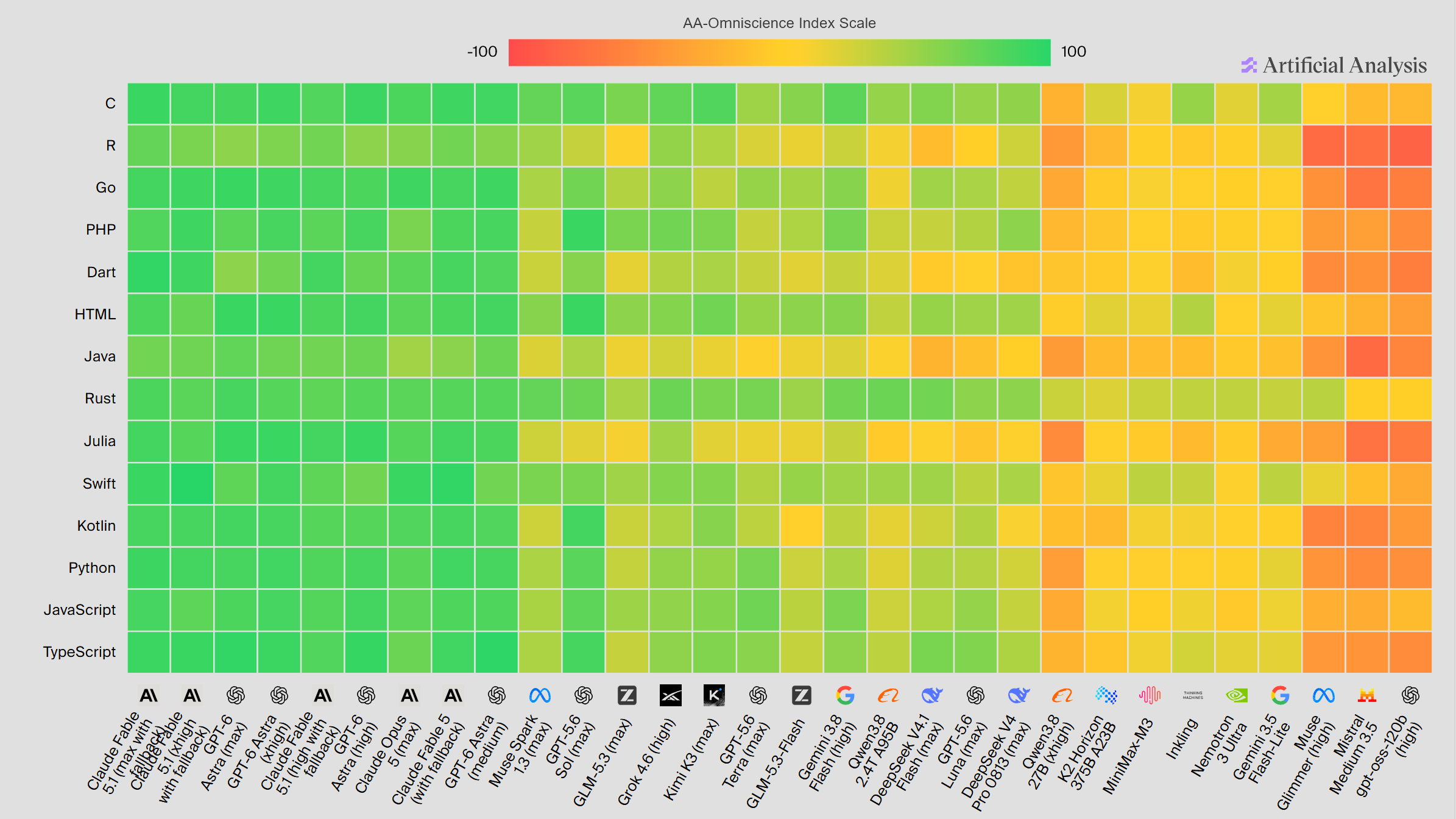
Okay, the breakdown *by-language* of Artificial Analysis's "Omniscience" hallucination/capability benchmark is absolutely fascinating.
I feel like this is some of the first concrete evidence I've seen of my longtime lean: that the *correctness* tooling we obsess over in PLT spaces is one of the greatest possible value-adds to the LLM era. (Just look at the Rust row, holy shit.)
Choosing a good language basically shifts the quality of output by an entire cost-cat…
 @Tuxramus@social.linux.pizza
2026-07-17 09:36:06
Valheim on the Linux rig. At this point, the Greydwarfs aren't even mad about the combat—they're just deeply concerned about my local logging practices. Come watch me clear-cut the Meadows and try to survive the Swamp: https://www.twitch.tv/tuxramus 🌲🪵🪓
 @sncf_ligne_u@lepoulsdumonde.com
2026-09-16 12:00:24
Période : en soirée
Date : le mercredi 16 septembre Risque de forte affluence en gare de La Défense en soirée (concert Š la Plenitude Arena). Dernier train de La Défense pour La Verrière: le VERI de 22h15. Dernier train de Paris Montparnasse pour Rambouillet: le ROPO de 23h35. Afin de voyager dans les meilleurs conditions, nous vous invitons Š anticiper vos déplacements. Les horaires du calculateur d'itinéraire tiennent compte des travaux.
Motif : concert de Céline Dion.
 @esoriano@social.linux.pizza
2026-07-16 09:08:59
Too Much Crypto
"a 2^128 operations attack must remain
fantasy"
https://eprint.iacr.org/2019/1492
@Techmeme@techhub.social2026-09-15 14:41:48
OpenAI says it has been working with Anthropic and Google for several weeks on AI safety, and it does not need an antitrust waiver to coordinate on safety (Maggie Eastland/Bloomberg Law)
https://news.bloomberglaw.com/privacy-…