@… the already improved UX looks good, to me.
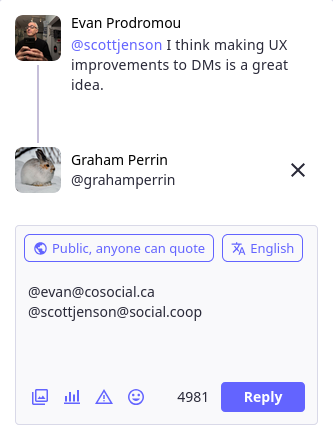
When drafting a reply to a public toot, the word 'Public' is prominent (first screenshot).
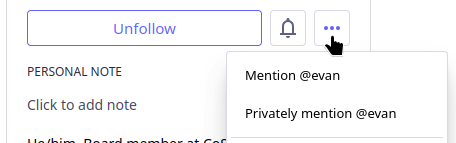
When drafting a mention, the separation is clear (second shot).
Without being blasé about privacy: if a person accidentally publishes in either of those contexts, it's human error.
Magically turning people's old scalar contexts into list contexts is a
recipe for several kinds of disaster.
-- Larry Wall in <199709291631.JAA08648@wall.org>
This is sage advice for contexts far beyond the original thread. https://dice.camp/@artemis/116213813409319708
RE: https://mastodon.social/@leibnizopenscience/116062503994538563
I think some of these points are also worth considering in teaching contexts and in guidelines for term papers/written exams.
Fork, Explore, Commit: OS Primitives for Agentic Exploration
Cong Wang, Yusheng Zheng
https://arxiv.org/abs/2602.08199 https://arxiv.org/pdf/2602.08199 https://arxiv.org/html/2602.08199
arXiv:2602.08199v1 Announce Type: new
Abstract: AI agents increasingly perform agentic exploration: pursuing multiple solution paths in parallel and committing only the successful one. Because each exploration path may modify files and spawn processes, agents require isolated environments with atomic commit and rollback semantics for both filesystem state and process state. We introduce the branch context, a new OS abstraction that provides: (1) copy-on-write state isolation with independent filesystem views and process groups, (2) a structured lifecycle of fork, explore, and commit/abort, (3) first-commit-wins resolution that automatically invalidates sibling branches, and (4) nestable contexts for hierarchical exploration. We realize branch contexts in Linux through two complementary components. First, BranchFS is a FUSE-based filesystem that gives each branch context an isolated copy-on-write workspace, with O(1) creation, atomic commit to the parent, and automatic sibling invalidation, all without root privileges. BranchFS is open sourced in https://github.com/multikernel/branchfs. Second, branch() is a proposed Linux syscall that spawns processes into branch contexts with reliable termination, kernel-enforced sibling isolation, and first-commit-wins coordination. Preliminary evaluation of BranchFS shows sub-350 us branch creation independent of base filesystem size, and modification-proportional commit overhead (under 1 ms for small changes).
toXiv_bot_toot
the 2010 smartphone was too inefficient with HTML
the 2010 smartphone needed a distinct simplified m-dot web site
the 2010 smartphone needed a proprietary app store to run native software
it was impossible to make efficient HTML web sites that worked in multiple contexts
the 2026 agents are too inefficient with HTML
the 2026 agents say HTML is too complex and burns too many tokens
the 2026 agents *need* markdown
it is impossible to make efficient HTML web …
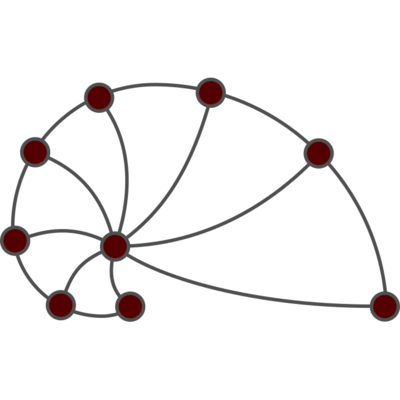
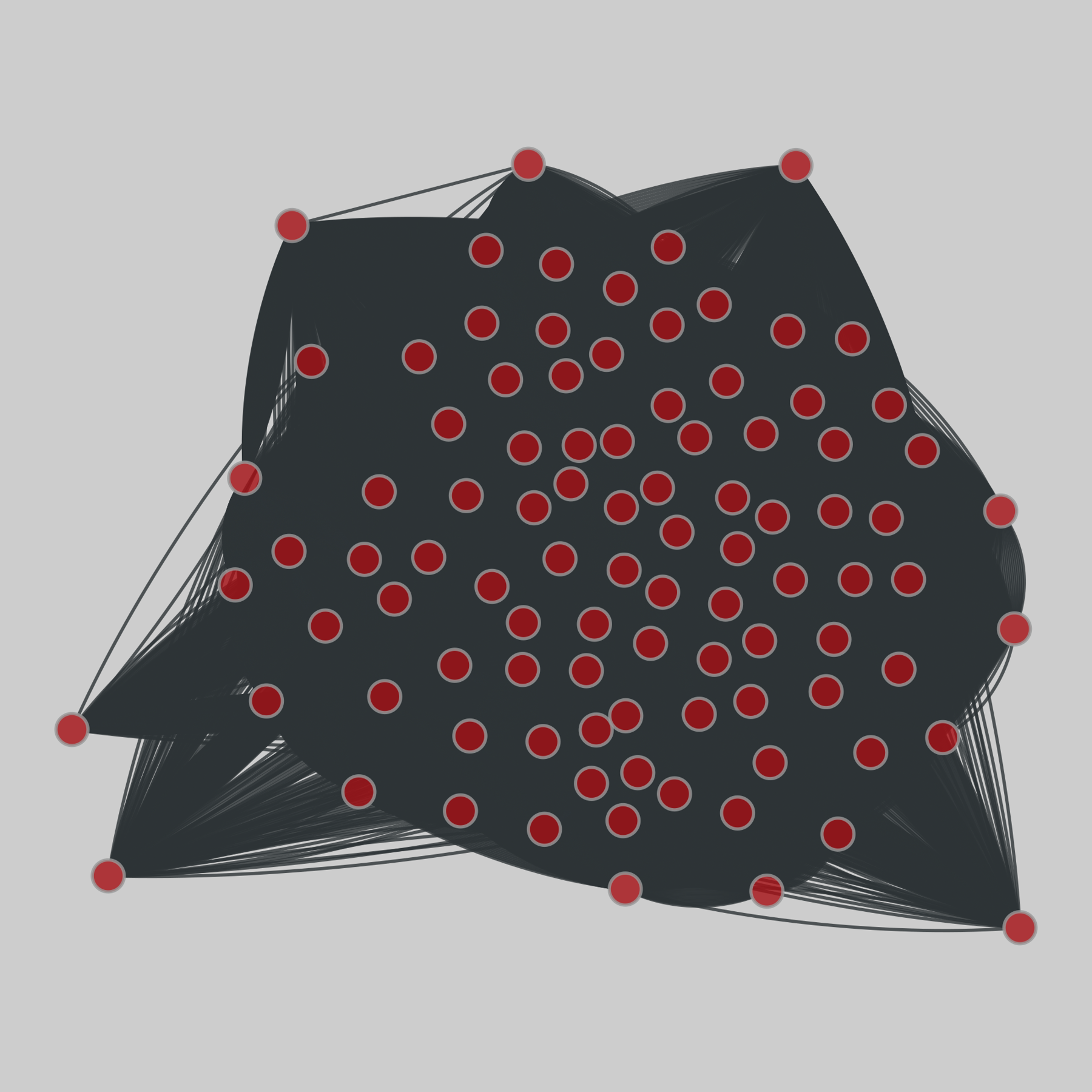
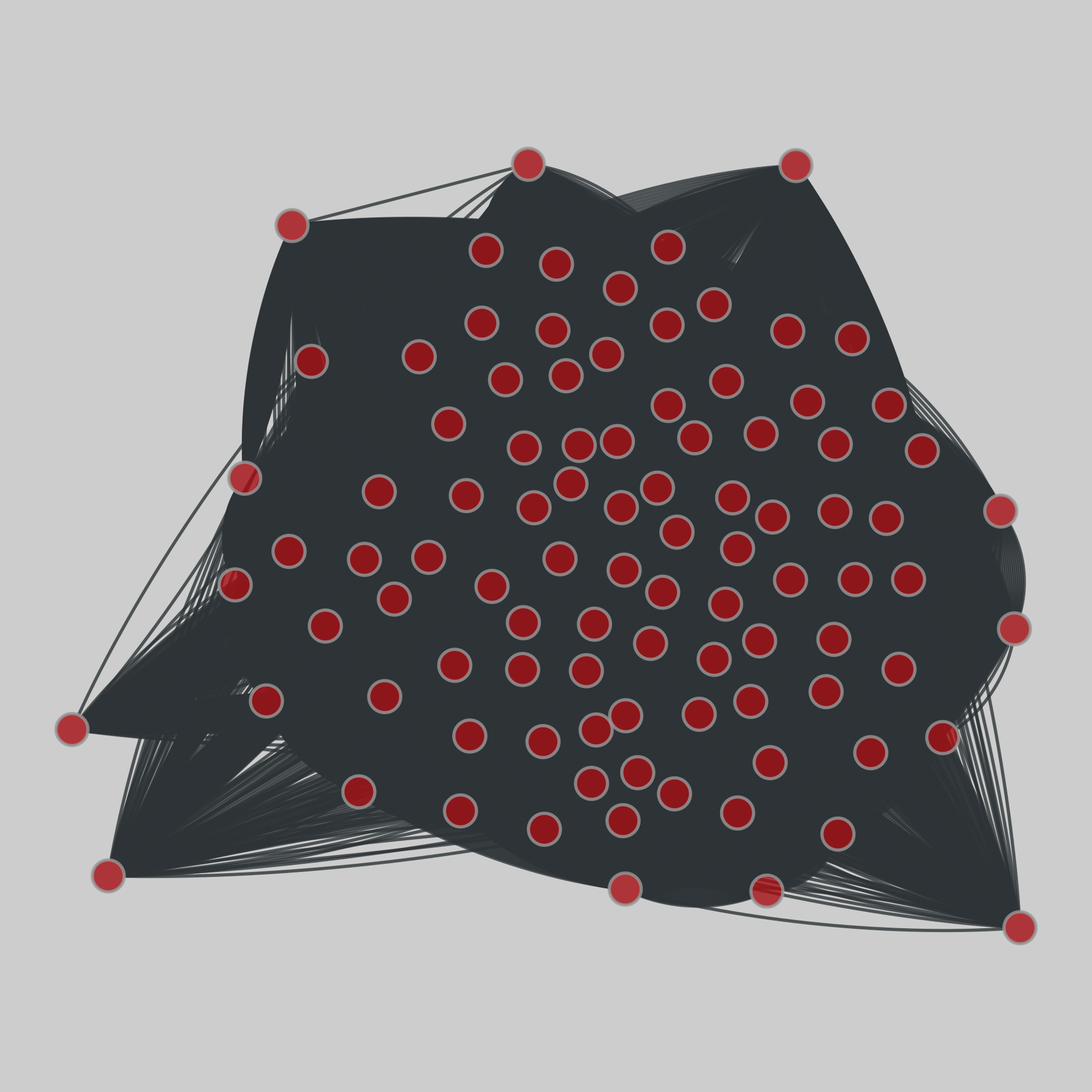
sp_colocation: Social co-locations (2018)
Network of colocations between peoople, based on the information on which RFID readers received information from the RFID tags. Namely, we define two individuals to be in co-presence if the same exact set of readers have received signals from both individuals during a 20s time window.
This network has 100 nodes and 394247 edges.
Tags: Social, Offline, Unweighted, Weighted, Temporal, Metadata
CFP: Ethos in Contemporary Contexts: Authority, Identity, and Trust in Contemporary Rhetoric
https://ift.tt/0fqc1Z3
updated: Tuesday, March 10, 2026 - 4:44pmfull name / name of organization: Craig A. Meyercontact…
via Input 4 RELCFP
"Even in 'modern' contexts, people do find in nature and in natural processes, quite routinely, an eternal (and often cyclical) story of hope. There is a kind of redemption in seeing heaven in a wildflower."
—Lav Kanoi ’24 Ph.D. writing in the new issue of Reflections, in his piece titled "A Climate of Hope Where Religion, Ecology, and the Arts Meet"
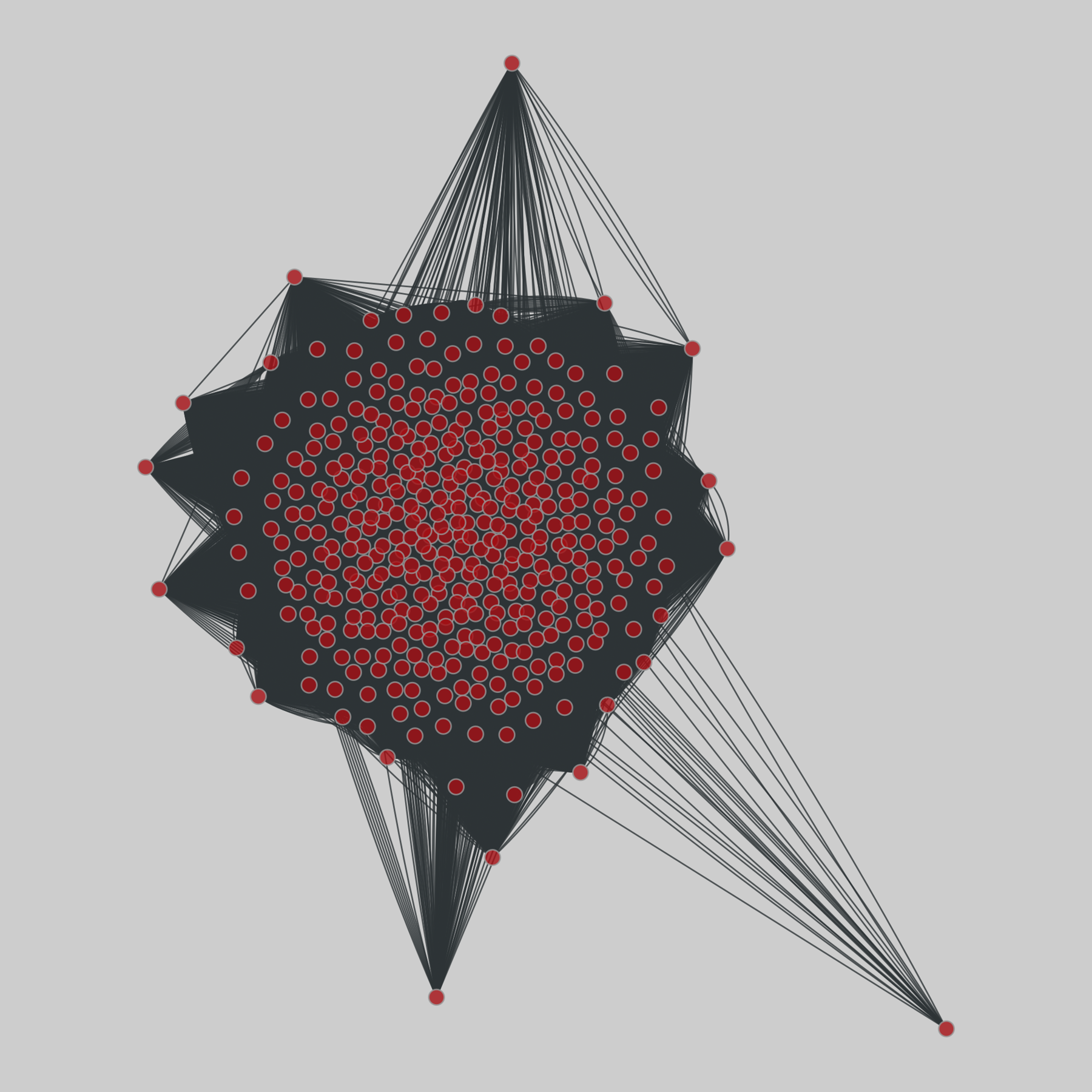
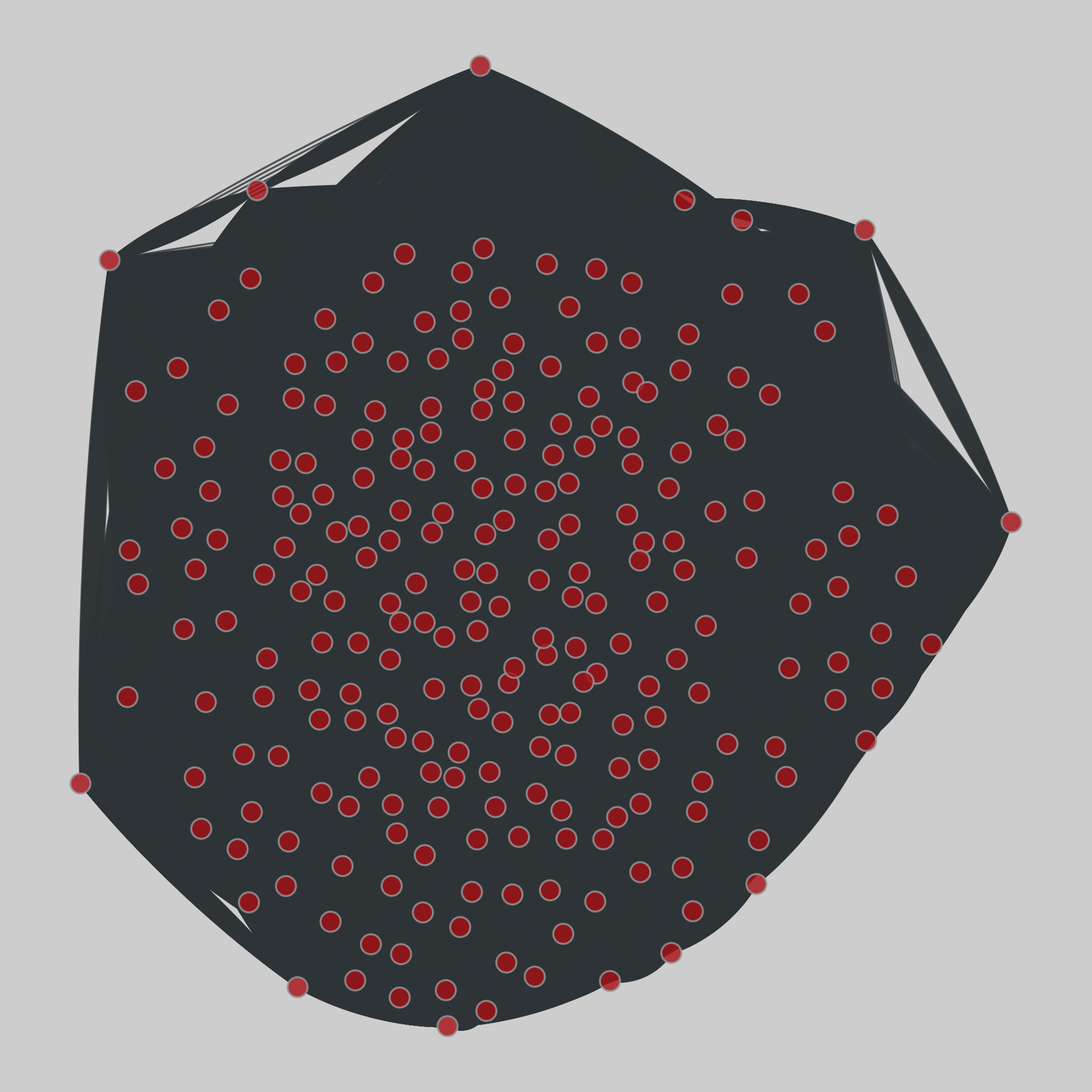
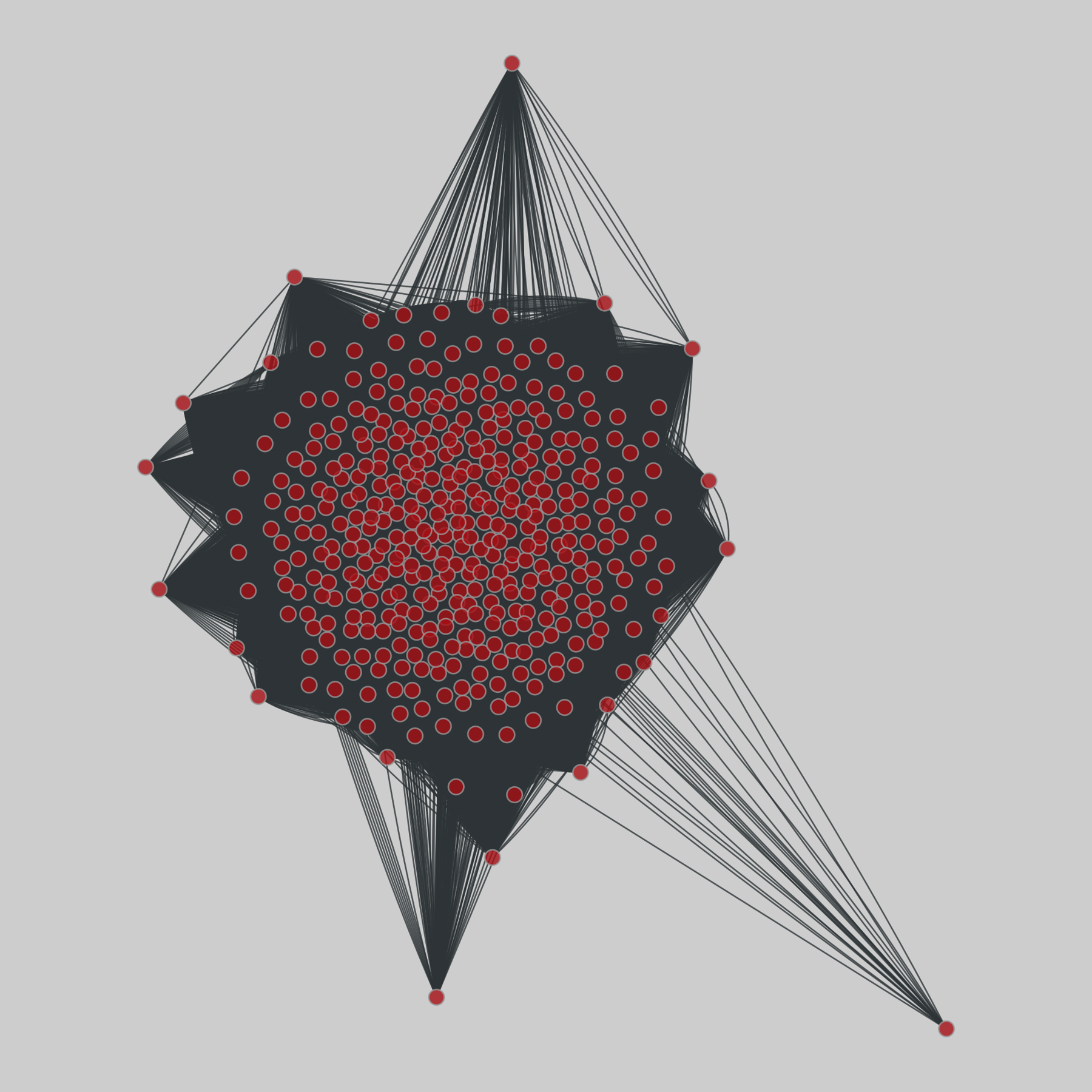
sp_colocation: Social co-locations (2018)
Network of colocations between peoople, based on the information on which RFID readers received information from the RFID tags. Namely, we define two individuals to be in co-presence if the same exact set of readers have received signals from both individuals during a 20s time window.
This network has 403 nodes and 1417485 edges.
Tags: Social, Offline, Unweighted, Weighted, Temporal, Metadata
…sometimes there’s •not• a clear standard way. Sometimes you need flexibility. For example, a lot of what makes UI programming hard is layout: you have to make your own very specific application look good on a variety of devices and screens, which means coming up with an •algorithm• for adjusting your design for all those different contexts.
That’s an intrinsically hard problem that requires design chops and nuance and contextual knowledge. Attempts to abstract the decisions out of that problem have been stubbornly unsuccessful. (How many layout engines are out there now?)
CFP: Ethos in Contemporary Contexts: Authority, Identity, and Trust in Contemporary Rhetoric
https://ift.tt/0fqc1Z3
updated: Tuesday, March 10, 2026 - 4:44pmfull name / name of organization: Craig A. Meyercontact…
via Input 4 RELCFP
sp_colocation: Social co-locations (2018)
Network of colocations between peoople, based on the information on which RFID readers received information from the RFID tags. Namely, we define two individuals to be in co-presence if the same exact set of readers have received signals from both individuals during a 20s time window.
This network has 242 nodes and 6594492 edges.
Tags: Social, Offline, Unweighted, Weighted, Temporal, Metadata
CFP: Ethos in Contemporary Contexts: Authority, Identity, and Trust in Contemporary Rhetoric
https://ift.tt/0fqc1Z3
updated: Tuesday, March 10, 2026 - 4:44pmfull name / name of organization: Craig A. Meyercontact…
via Input 4 RELCFP
Inter-detector differential fuzz testing for tamper detection in gamma spectrometers
Pei Yao Li, Jayson R. Vavrek, Sean Peisert
https://arxiv.org/abs/2602.00336 https://arxiv.org/pdf/2602.00336 https://arxiv.org/html/2602.00336
arXiv:2602.00336v1 Announce Type: new
Abstract: We extend physical differential fuzz testing as an anti-tamper method for radiation detectors [Vavrek et al., Science and Global Security 2025] to comparisons across multiple detector units. The method was previously introduced as a tamper detection method for authenticating a single radiation detector in nuclear safeguards and treaty verification scenarios, and works by randomly sampling detector configuration parameters to produce a sequence of spectra that form a baseline signature of an untampered system. At a later date, after potential tampering, the same random sequence of parameters is used to generate another series of spectra that can be compared against the baseline. Anomalies in the series of comparisons indicate changes in detector behavior, which may be due to tampering. One limitation of this original method is that once the detector has `gone downrange' and may have been tampered with, the original baseline is fixed, and a new trusted baseline can never be established if tests at new parameters are required. In this work, we extend our anti-tamper fuzz testing concept to multiple detector units, such that the downrange detector can be compared against a trusted or `golden copy' detector, even despite normal inter-detector manufacturing variations. We show using three NaI detectors that this inter-detector differential fuzz testing can detect a representative attack, even when the tested and golden copy detectors are from different manufacturers and have different performances. Here, detecting tampering requires visualizing the comparison metric vs. the parameter values and not just the sample number; moreover this baseline is non-linear and may require anomaly detection methods more complex than a simple threshold. Overall, this extension to multiple detectors improves prospects for operationalizing the technique in real-world treaty verification and safeguards contexts.
toXiv_bot_toot
sp_colocation: Social co-locations (2018)
Network of colocations between peoople, based on the information on which RFID readers received information from the RFID tags. Namely, we define two individuals to be in co-presence if the same exact set of readers have received signals from both individuals during a 20s time window.
This network has 100 nodes and 394247 edges.
Tags: Social, Offline, Unweighted, Weighted, Temporal, Metadata
sp_colocation: Social co-locations (2018)
Network of colocations between peoople, based on the information on which RFID readers received information from the RFID tags. Namely, we define two individuals to be in co-presence if the same exact set of readers have received signals from both individuals during a 20s time window.
This network has 403 nodes and 1417485 edges.
Tags: Social, Offline, Unweighted, Weighted, Temporal, Metadata
 @chiraag@mastodon.online