 @Dragofix@veganism.social
2026-04-25 01:37:36
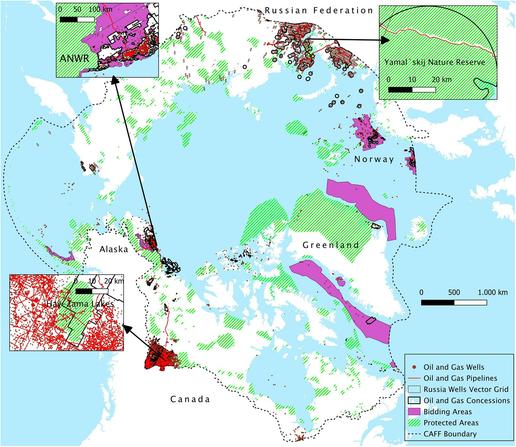
Beneath Arctic ice, a vast fossil fuel footprint is colliding with Indigenous lands and wildlife #Arctic
 @arXiv_qbioPE_bot@mastoxiv.page
2026-03-24 08:40:52
Pattern Formation in a Spatial Public Goods Dilemma due to Diffusive or Directed Motion
Yuxuan Zhao, Kaisheng Zhu, Yefei Zhang, Daniel B. Cooney
https://arxiv.org/abs/2603.21025 https://arxiv.org/pdf/2603.21025 https://arxiv.org/html/2603.21025
arXiv:2603.21025v1 Announce Type: new
Abstract: The costly provision of public goods serves as a model problem for the evolution of cooperative behavior, presenting a social dilemma between the collective benefits of shared resources and the individual incentive to free-ride in resource production. The spatial structure of populations can also impact cooperation over public goods, as diffusion of public goods and intentional motion of individuals towards regions with greater resources can interact with population and public goods dynamics to produce heterogeneous patterns in the spatial distribution of strategies and resources. In this paper, we build off a model introduced by Young and Belmonte for the reaction dynamics of interacting individuals and explicit public good, deriving a system of PDEs that describes the spatial profiles of strategies and the public good in the presence of both diffusive motion of individuals and resources and chemotaxis-like directed motion of individuals in response to gradients in the concentration of public goods. Through linear stability analysis, we show that spatial patterns in strategic and public goods profiles can emerge due to either Turing instability with high defector diffusivity or a directed-motion instability through strong sensitivity of cooperators towards increasing resource concentration. We further explore the emergent spatial patterns with a mix of weakly nonlinear stability analysis and numerical simulation, showing that diffusion-driven instability appears to increase cooperation and public goods across the spatial domain, while directed motion of cooperators towards regions with great public goods provision tends to decrease cooperation and environmental quality across the environment.
toXiv_bot_toot
 @tanyakaroli@expressional.social
2026-04-18 09:19:46
Jeg har dŸjet med lidt ondt i halsen det meste af ugen men har klaret mig med tidlige sengetider og halspastiller. I går fik jeg så rŸde kinder og blanke Ÿjne og valgte at aflyse en frokostaftale i dag.
ForelŸbig er det ikke slemt, bare lidt stoppet næse og mathed, så jeg stornyder lige nu at have meldt mig ud af alting og IKKE skulle noget overhovedet!
Det er lidt tankevækkende hvor rart det fŸles 🤔
 @seeingwithsound@mas.to
2026-02-19 14:17:14
The adjacent case https://barnes7.substack.com/p/the-adjacent-case "What is it like to be blind?", "The label 'visual cortex' names a developmental default, not a functional destiny", "Sensory substitution sharpens the point."

 @_tillwe_@mastodon.social
2026-02-05 16:47:28
Unser Parl. GF Daniel Lede Abal zum SPD-Stunt "AfD-Verbot" (leider nur auf Instagram):
https://www.instagram.com/ledeabal/p/DUYNas5DB1T/

 @smashtie@mas.to
2026-02-07 12:56:03
The problem with downhill skiing, not usually mentioned by the commentators, is the "bib bias". The best athletes get a random bib from 5-15, which is the sweet spot: surface snow has been scraped, but not broken up, and prior runners have set a line and given critical information about where the bumps are to team mates. So your chance of winning if you are not top 10 is significantly lower. Which seems a bit unfair.
@seeingwithsound@mas.to2026-04-12 11:29:32
Pathways: Prof. Lauren Ayton's journey from the clinic to the future of sight restoration https://www.bionic-vision.org/research-spotlights/lauren-ayton-journey-clinic-future-sight-restoration Interview with Lauren Ayton; "…
