 @arXiv_mathST_bot@mastoxiv.page
2026-08-17 07:39:50
Generalization Error Estimation for Primal--Dual Algorithms in Non-Smooth Regression
Kai Tan, Pierre C Bellec
https://arxiv.org/abs/2608.13870 https://arxiv.org/pdf/2608.13870 https://arxiv.org/html/2608.13870
arXiv:2608.13870v1 Announce Type: new
Abstract: This paper studies trajectory-wise estimation of generalization error for primal--dual algorithms in non-smooth regression. Motivating examples include \(\ell_1\)-penalized least absolute deviations regression and square-root Lasso regression, where the data-fitting loss is non-differentiable and existing risk estimators for gradient-type optimization paths do not apply directly. We develop a general recursive framework that includes the Chambolle--Pock algorithm and related primal--dual splitting methods. We estimate risk by correcting each in-sample fitted value with a weighted combination of past dual iterates. The ideal weights are Stein derivative contractions and depend on the design covariance. We construct replacement weights from observable derivative contractions of the fitted-signal trajectory, yielding a covariance-free, data-driven correction. For high-dimensional Gaussian designs and fixed finite iteration horizon, we prove finite-sample guarantees for both estimators. For square-root ridge, we further establish a matched-Gaussian universality result beyond Gaussian designs. Numerical experiments show that the proposed estimators accurately track the out-of-sample risk along finite optimization paths.
toXiv_bot_toot
 @toxi@mastodon.thi.ng
2026-07-03 11:12:20
07:16 AM
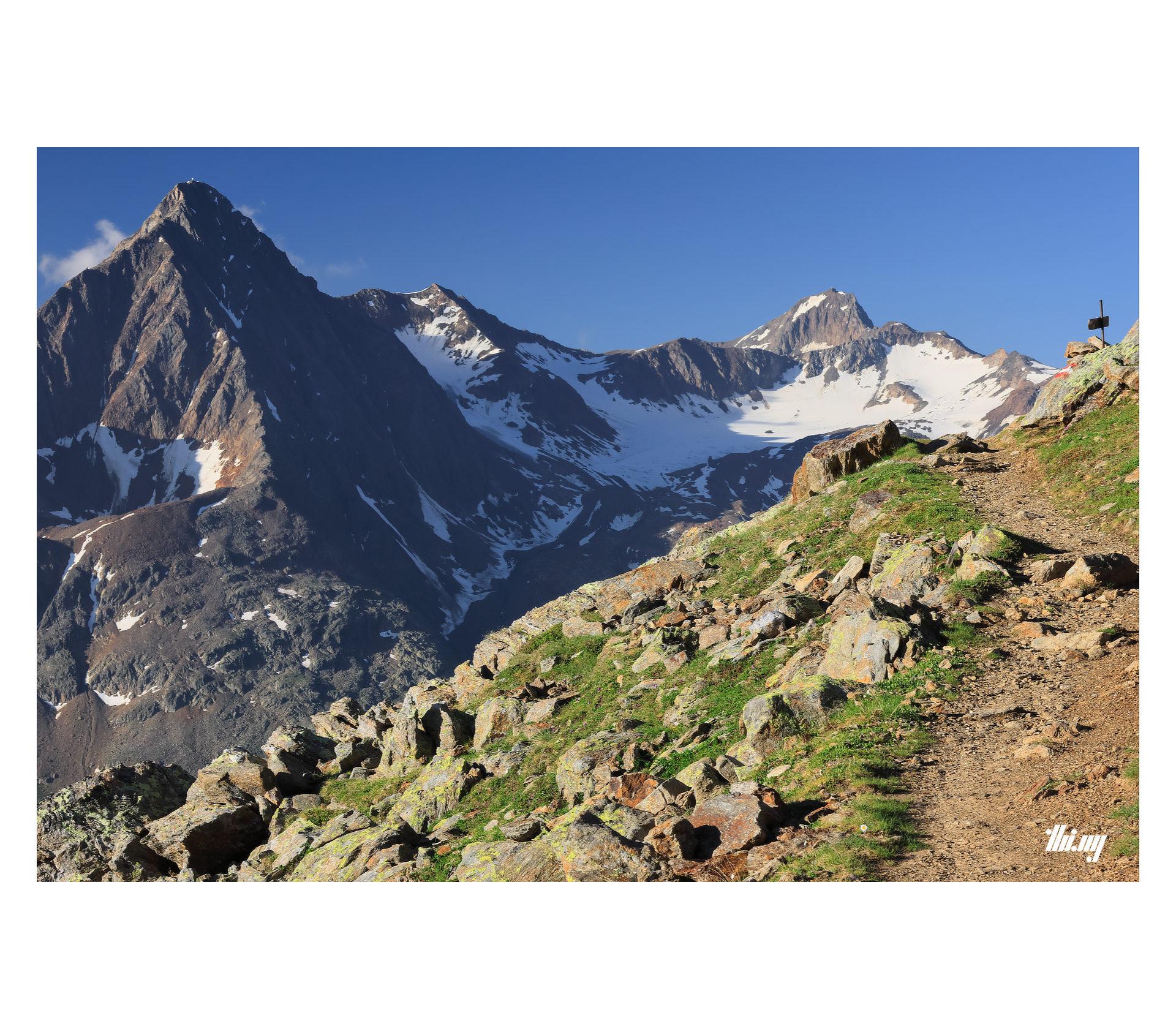
What a morning and long day it was last week! Was already out & about for 3 hours when I got to this place, earlier mostly taking hundreds of images of the nearby (~500m away) Breslauer Hut and vicinity during sunrise... The first large (and loud) group of people already got up at 4AM, getting ready for climbing Wildspitze, another group left an hour later, as did I. Maintenance/repair works on the hut continued at 08:30, taking lots more pictures to document, interviewin…

 @hex@kolektiva.social
2026-07-02 07:40:30
There is more to #SolarPunk than solar panels and bikes. What we are talking about is being part of a living world. The hegemonic culture is one of hierarchical domination.
But many of the the cultures that hegemony suppresses bring a vibrancy to life. I don't buy yeast from the store, sealed in a plastic packet, a coffin for a living thing. I feed my sourdough. I am obligated to it, in a relationship with it, as the culture is reliant on me for it's survival. It speaks to me, with smell and color. I must pay attention. I have to learn it's nature, how it grows and eats at different temperatures informed by different times of the year. Mushrooms, yeast, kiefer, plants, independent things, things I can't control, life that is intertwined with my own.
But even my #bicycle speaks to me, which is something I hadn't considered until reading this and thinking about that framing.
It is not simply that "we need a different economic system." What we are talking about is a fundamentally different interpretation and experience of the world, from the hierarchical structure of death to a web of life, where even "inanimate" things become imbued with agency.
https://substack.com/app-link/post?publication_id=2936873&post_id=151655646
 @datascience@genomic.social
2026-09-09 10:00:01
The {esquisse} package makes it easy to plot your data in different ways with a drag and drop interface: #rstats

 @arXiv_csHC_bot@mastoxiv.page
2026-08-12 08:23:23
Automatic Field-of-View Adjustment for a View-Expansive Microscope via LSTM-Based Gaze and Pipette Motion Interpretation
Kenta Yokoe, Takuya Hara, Tadayoshi Aoyama
https://arxiv.org/abs/2608.10401 https://arxiv.org/pdf/2608.10401 https://arxiv.org/html/2608.10401
arXiv:2608.10401v1 Announce Type: new
Abstract: Intracytoplasmic sperm injection (ICSI) operators frequently adjust the field-of-view (FOV) during procedures, which interrupts workflow and increases procedure time. Conventional microscopes require manual objective lens switching and illumination adjustments to achieve different FOV sizes. We propose an AI-based automatic FOV adjustment method integrated with a view-expansive microscope. This microscope enables the simultaneous acquisition of a large FOV and high-resolution images using a single objective lens through multiview imaging with galvanometer mirrors and high-speed vision, thereby eliminating the need for physical lens exchanges. Our method utilizes a long short-term memory (LSTM) model to predict the appropriate FOV size based on real-time analysis of the pipette's position and velocity, combined with the operator's gaze position. The AI model is trained using ICSI procedure data from an expert with over five years of micromanipulation experience. Experimental evaluation with novice operators reveals that the proposed automatic FOV adjustment system significantly improves the ICSI procedure speed, reducing the average task completion time from 60.5 to 48.0 s (p < 0.001). The experiments also demonstrate that this improvement enables novice operators to achieve ICSI working speeds equivalent to those of expert operators.
toXiv_bot_toot
 @tiotasram@kolektiva.social
2026-09-15 07:31:34
Wish inspiration hadn't struck right at 1 a.m. when I have to teach tomorrow, but we'll see if I can get back to sleep now that I'm done with a draft of this story. Glad to have my first entry in my "incredulous young historians of the future" series actually written instead of just imagined. There are surely some typos ahead...
#SciFi #Writing #Technology #ShortStory
"The Age of Progress", a short story by Tiota Sram.
"Your assignment", said the teacher, "is to describe why the progressive vision of technology that gives us the name 'Age of Progress' today failed, and why it was actually a pessimistic view of technology. Your study guides have links to a few sources, but as usual you should synthesize information from at least two knowledge systems, and one of those shouldn't be family-based."
"Ugh", said Ye'xik, "this is gonna be tricky. Wasn't the whole problem with the Age of Progress that they were too optimistic about technology?"
"Well, they did talk a lot about the end of the world and extinction, and I did almost happen, right?" said Finan.
"Yeah, that's gotta count as pessimism, doesn't it?" Gedi chimed in.
"Well..." said Hallavia, with their usual deliberate tone, "I think it's not that simple, or at least it doesn't have to be."
The four of them were walking outside to have lunch, pondering the new assignment from this cycle's history and culture teacher. A brief silence fell as they pondered the Age of Progress.
"Maybe we should look at it through another history system?" offered Finan. "I mean, we've been learning about knowledge systems and lenses, and the 'Ages' lens of just one perspective with its own distortions, right?"
"My mab is working with my omeh on an oral history right now", said Gedi, "maybe I can use that as my second knowledge system? I'll see what they have to say about it!"
"We shouldn't all use the same knowledge systems though", said Ye'xik. "I think there's a bit of a thesis/antithesis thing going on here too? Like we were learning in ideas class?"
"Wait, I missed ideas last week", said Gedi, what's an antithesis?"
"It's just an opposite, really", said Ye'xik. "You take the thesis statement and construct any statement that contradicts it. The two form a pair, and then you can try to find a synthesis that combines both ideas."
"I didn't really get that part", Finan interrupted, "like, if they're contradictory, how could they be expressed together? Wouldn't you need to pick one that's true?... wait I guess maybe if you mixed different knowledge systems? But then would they really be contradictory?"
The group fell silent for a moment in thought.
Hallavi spoke up: "Incommensurate isn't the same as contradictory, I think. That's what it would be if you had two truths from different knowledge systems that didn't fit. Plus... not all knowledge systems have a concept of truth, or of contradiction?"
The group pondered this for a bit more.
"I think maybe there's lots of ways to be contradictory, even in a very logic-hungry knowledge system", said Gedi. "Then if your thesis and antithesis contradict in one way, you could find another sort out 'axis' in which they don't, and state your synthesis from there?"
"Oh, that makes sense", said Ye'xik.
"Anyways what were you saying about the Age of Progress, Ye'xik?" said Gedi.
"Wait", interrupted Hallavi, "Did that mashes sense to you, Finan?"
Finan had been silent, looking down at their feet, but replied "Oh yeah, thanks for checking Hallavi! I think I got the part about synthesis now, thanks Gedi. I was just thinking about optimism and pessimism more. Is that where you were going with this, Ye'xik?"
"Haha, yeah Finan, you got it", said Ye'xik. "Since optimism and pessimism can be opposites, does the teacher actually want us to form a synthesis of them?"
"Oh..." muttered Gedi, "that's a good idea."
"I think..." began Hallavi, pausing to collect their thoughts, "I think the teacher would have told us that, though. Obviously it's not a wrong way to approach this assignment because it incorporates pessimism, but teachers usually aren't too tricky. I think it's okay to be literal about the pessimism thing. And I think I have an idea..."
When Hallavi remained silent for a moment, Ye'xik opened their mouth to speak, but then looked at Hallavi and closed it again. Finan and Gedi were looking at Hallavi too. They pushed through the doors out to the meadow, and settled in their usual place to sit, pulling lunches out of their bags. Hallavi finally spoke up while the others were chewing: "The Age of Progress lasted from the Enlightenment to the Dim Times, and they believed that technology would always get better, no matter what. That's the progressive vision of technology our teacher was talking about. They thought it could solve any problem, and they wouldn't have to worry about weapons or extinctions or the climate or pollution or any of that stuff, because technology would eventually come up with a solution. They looked at the technology that solved problems like diseases or overcame engineering challenges and extrapolated too broadly, basically. That's the idea they had?"
The other three were all nodding their heads, knowing Hallavi needed room to think and put words together.
Hallavi continued: "So it seems like it's optimistic, because they thought it could do anything. But they were thinking about technology like I just talked about it: like an 'it' that could 'do'. That's not what we've been learning in our technology class. Invention is a social phenomenon, and technologies have both material and social bases, not to mention communities of practice and knowledge maintenance. So I think the idea of technological progress divorced from social participation is pessimistic, because it mythologizes technology in a way that makes it seem uncontrollable."
"Huh" said Gedi and Finan while at the same time Ye'xik said "mhmm".
Hallavi looked up shyly at the rest of them, but they were all looking back with admiration.
"I think you're right, Hallavi", said Ye'xik. "Or at least, that's probably what the teacher wanted us to puzzle out. Good thing they asked us to include two knowledge systems so we can each have our own perspectives to contribute, otherwise you'd go first and our presentations would all just be 'What Hallavi said'".
Hallavi blushed but Finan laughed "Hah! You're right and that Ye'xik."
Gedi was looking at their sandwich with some intensity. They looked at Hallavi then back at their sandwich. "It's like they thought they were strapped to an out-of-control rocket, when you put it that way", they said. "It must have been scary, really, to believe that technology was almost an entity, changing in an inevitable way. That word 'inevitable' really takes all the human agency out of it, doesn't it. And even though they kept saying that technology would inevitably solve problems, look at what the technologies they invented actually did!"
Finan shuddered. He added, "Really, it was their dominators who were saying it was inevitable wasn't it? Back then it wasn't like today where historians travel and sample all kinds of ideas, so the primary sources we're reading are almost all from dominators, right?"
Ye'xik responded "Yeah, I keep forgetting to account for that. It was such a weird and horrible time, it's kinda hard to believe everything we read and hear sometimes."
Gedi picked up the thread again "That makes it worse, right? All those dominators saying the stuff they're doing is inevitable, and lying to everyone's faces about it being progress and wonderful stuff, meanwhile two thirds of it is the most awful stuff there's ever been, I mean they could have literally killed everyone and ruined the whole planet, and they almost did."
"They did actually crush a lot of cultures beyond recognition so the survivors had to rebuild with only weak ties to their old traditions", said Hallavi with a quiet intensity.
They all were silent for a moment, pondering the horrors of a bygone age.
Finan broke the silence: "That's a terrible kind of pessimism, to believe that technologcal 'progress' is inevitable, at a time when most people are dominators somewhere in a hierarchy and the ones on top constantly talk about how technologies like medicines will 'save' the world while mostly inventing new technologies of violence. Everyone must have understood what they really meant based on the technologies they were actually developing and investing into. I think I still don't understand how the Age of Progress and the Dim Times could even happen".
"Yeah, and the pessimism is only part of our assignment", signed Ye'xik. "We still have to describe why the progressive vision failed, although I think maybe you just did a lot of that, Finan".
A gloom descended briefly, until Gedi said "Well, this assignment is supposed to take a week or two, right? Thanks to Hallavi we've already cracked the crux, I think, so we don't need to ruminate too much right this moment about ancient history, and we know things turned out okay in the end. Let's finish lunch and go climb a tree!"
 @arXiv_statCO_bot@mastoxiv.page
2026-08-14 07:49:17
Hierarchical Bayesian Calibration with Bayesian Committee Machine
Sebastian Heinekamp, David M. Higdon, Andreas Adelmann
https://arxiv.org/abs/2608.12603 https://arxiv.org/pdf/2608.12603 https://arxiv.org/html/2608.12603
arXiv:2608.12603v1 Announce Type: new
Abstract: Calibrating computational models to experimental data is a core task in applied statistics, especially in scientific domains, where physical experiments are costly and simulations play a central role in design and inference. Motivated by uncertainty quantification challenges in particle accelerator experiments, we develop and evaluate a Hierarchical Bayesian Calibration framework. In contrast to standard Bayesian calibration, certain inputs - such as beam injection amplitude - must be estimated separately for each experiment. We adopt the Kennedy-O'Hagan formulation and extend it with a hierarchical prior structure to model the distribution of experiment-specific calibration parameters, thus borrowing strength and improving generalisation across repeated experiments. A key methodological challenge arises from the need to evaluate a large number of forward simulations, which renders conventional Markov chain Monte Carlo approaches computationally prohibitive. To address this, we leverage the Bayesian Committee Machine as a scalable modelling strategy for Gaussian Process emulators. The BCM provides a principled divide-and-conquer approach, enabling parallel inference and reducing computational cost without requiring problem-specific tuning of the emulator approximation. Posterior sampling is performed using the No-U-Turn Sampler, supported by automatic differentiation in Julia, which removes the need for analytic gradient derivation and facilitates flexible model specification. We assess the proposed framework using established benchmark problems and simulated data from the Argonne Wakefield Accelerator. The results demonstrate substantial computational savings and robust calibration performance, highlighting the applicability of the method to large-scale scientific modelling problems.
toXiv_bot_toot
@arXiv_mathST_bot@mastoxiv.page2026-08-13 08:00:11
Empirical likelihood confidence regions for ordered bivariate means
Naresh Garg
https://arxiv.org/abs/2608.12174 https://arxiv.org/pdf/2608.12174 https://arxiv.org/html/2608.12174
arXiv:2608.12174v1 Announce Type: new
Abstract: Let $\boldsymbol{X}_i=(X_{1i},X_{2i})^\top$ be independent and identically distributed observations with mean $\boldsymbol{\mu}=(\mu_1,\mu_2)^\top$ constrained by $\mu_1\leq\mu_2$. We study empirical-likelihood inference for a fixed mean vector and distinguish it from the previously known test of equality against an ordered alternative. At a fixed interior point, the constrained empirical likelihood ratio has the usual $\chi^2_2$ limit. At a fixed boundary point $(m,m)^\top$, its limit is the chi-bar-square distribution $\tfrac12\chi^2_1 \tfrac12\chi^2_2$. By contrast, profiling the unknown common mean in the equality-versus-order test yields $\tfrac12\chi^2_0 \tfrac12\chi^2_1$, the $k=2$ ordered-mean case of El Barmi (1996). We give an exact reduction of the latter statistic to the empirical likelihood of the paired differences, establish the localization step needed for the fixed-boundary expansion, and derive a local-to-boundary limit showing that interior calibration is not uniform over $n^{-1/2}$-neighborhoods of the boundary. Monte Carlo experiments under Gaussian, Student $t_5$, and shifted log-normal sampling examine fixed, boundary, and local regimes with explicit numerical-failure accounting. Illustrative paired-data analyses show the practical distinction between fixed-candidate confidence regions, directional equality tests, and ordinary scalar empirical-likelihood intervals truncated to the nonnegative parameter space.
toXiv_bot_toot
@arXiv_csHC_bot@mastoxiv.page2026-08-12 08:26:35
ProtoGIB-Workload: Learning Workload-Specific Neural Topology Prototypes across Subjects
Yuzhe Zhang, Yixi Zhang, Shengdian Jiang, Chengxi Xie, Jihong Wang, Huan Liu, Man Yao, Minnan Luo, Chao Shen
https://arxiv.org/abs/2608.10647 https://arxiv.org/pdf/2608.10647 https://arxiv.org/html/2608.10647
arXiv:2608.10647v1 Announce Type: new
Abstract: Reliable electroencephalography (EEG)-based mental workload recognition is crucial for adaptive human-centered systems, yet practical deployment requires models to generalize to users unseen during training. Although functional connectivity graphs are widely adopted to capture workload-related neural interactions, they inherently entangle task-relevant structures with subject-specific physiological traits and sample-level noise. This entanglement often leads models to learn structural shortcuts, severely degrading cross-subject generalization. To address this, we propose ProtoGIB-Workload, a novel framework that explicitly regularizes and aligns graph structures for subject-independent workload recognition. Our approach introduces a Stochastic Graph Information Bottleneck (SGIB) to compress dense correlation priors into compact, task-relevant subgraphs, filtering out input-related redundancy. Crucially, to prevent the retention of subject-specific spurious edges, we propose a Class-Conditional Topology Stabilizer (CTS). Leveraging the fixed electrode coordinates of EEG data, CTS operates directly on graph-generation probabilities to encourage consistent edge-generation statistics across different subjects sharing the same workload class. Extensive experiments on two public EEG workload datasets and one in-house EEG cognitive load dataset of air traffic controllers under strict leave-one-subject-out (LOSO) protocols demonstrate that ProtoGIB-Workload significantly outperforms state-of-the-art temporal and graph-based baselines, improving the cross-subject Macro-F1 score by an average of 5.15% (up to 6.34%). Further analyses confirm that our method successfully extracts stable, cross-subject consistent neural connectivity patterns.
toXiv_bot_toot
 @arXiv_econGN_bot@mastoxiv.page
2026-08-11 08:09:38
Price Responses of Rwandan Tungsten Exports under Conflict Minerals Regulation
Haruka Nagamori, Kazuhiko Nishimura
https://arxiv.org/abs/2608.08690 https://arxiv.org/pdf/2608.08690 https://arxiv.org/html/2608.08690
arXiv:2608.08690v1 Announce Type: new
Abstract: Section 1502 of the Dodd--Frank Act, enacted in 2010, requires U.S.-listed companies using tin, tantalum, tungsten, and gold (3TG) from the Democratic Republic of the Congo and adjoining countries to disclose information on the minerals' origins. Concerns have been raised that the regulation may have induced a de facto embargo through avoidance of sourcing from the covered region. However, how the price responsiveness of mineral exports evolved under changing institutional and market conditions remains insufficiently understood. Since tungsten production in the covered region is concentrated almost entirely in Rwanda, this study examines the price responsiveness of Rwandan tungsten exports from January 2009 to December 2023.
Because missing export quantity data prevent continuous observation of export unit values, we apply the identification approach of Nakano and Nishimura (2025), combining monthly mirror trade data from UN Comtrade with exchange rates and a world average price. An importer fixed-effects model is estimated using export value as the dependent variable, with the sample divided into four periods according to changes in the institutional and market environment.
The results reveal substantial temporal variation in price responsiveness. A statistically significant negative price response is observed in Period 1 ($\eta=-20.814$, $p<0.01$), disappears in Period 2 ($\eta=1.814$, $p>0.10$), reappears in Period 3 ($\eta=-5.277$, $p<0.01$), and disappears again in Period 4 ($\eta=0.440$, $p>0.10$). Coefficient-difference tests confirm significant changes between Periods 1 and 2 ($p=0.0021$) and between Periods 3 and 4 ($p=0.0006$). These findings suggest that the price responsiveness of Rwandan tungsten exports varied substantially over time rather than following a uniform trajectory after the regulation.
toXiv_bot_toot