 @azonenberg@ioc.exchange
2026-08-16 02:35:10
"An interesting finding was that triethylborane reacts with lead(II) oxide in aqueous NaOH medium to give tetraethyllead in 42% yield. (25)"
The old days were wild. Would you like some pyrophorics with your industrial-scale organolead synthesis?
 @arXiv_mathST_bot@mastoxiv.page
2026-08-14 07:48:50
Density Estimation on Compact Manifolds under Intrinsic Spectral Block Variation
Olga Klopp, Fedor Noskov
https://arxiv.org/abs/2608.12637 https://arxiv.org/pdf/2608.12637 https://arxiv.org/html/2608.12637
arXiv:2608.12637v1 Announce Type: new
Abstract: We introduce an intrinsic spectral sparsity model for nonparametric density estimation on compact connected Riemannian manifolds. Instead of penalizing coefficients in an arbitrarily chosen Laplace--Beltrami eigenbasis, we group each complete eigenspace and measure the Hilbert norm of its spectral component. The resulting block-variation space is basis independent and isometry invariant. We establish its structural, atomic, and nonlinear approximation properties and clarify its relation to Sobolev, Besov, and coefficientwise spectral $\ell^1$ classes. We then construct a coordinate-free block-shrinkage estimator and prove a nonasymptotic signal-dependent $L^2$-oracle inequality that adapts to the unknown set of detectable eigenspaces. Under polynomial spectral growth, the risk theory separates the number of spectral blocks from their multiplicities and exhibits two regimes: one driven by a single high-dimensional eigenspace and the other by cumulative spectral complexity. Under matching spectral-growth and nondegeneracy assumptions, corresponding minimax lower bounds show that this multiplicity dependence is intrinsic, with sharp consequences for spheres and the rotation group $SO(3)$. Finally, we develop a positive, normalized, block-penalized exponential spectral sieve for log-densities and derive likelihood oracle inequalities together with expected Kullback--Leibler, Hellinger, and $L^2$ risk bounds. The resulting framework provides a geometry-respecting theory of sparse density estimation that remains invariant under changes of eigenbasis.
toXiv_bot_toot
 @arXiv_csHC_bot@mastoxiv.page
2026-08-12 08:27:44
Longitudinal Evidence That General-Purpose Chatbots Actively Foster Relational Engagement
Lisa M\"uhl, Jessica M. Szczuka
https://arxiv.org/abs/2608.10672 https://arxiv.org/pdf/2608.10672 https://arxiv.org/html/2608.10672
arXiv:2608.10672v1 Announce Type: new
Abstract: Social interaction has become one of the most common uses of LLMs, yet research on emotional bonds with AI has focused largely on how users experience these systems, leaving the systems' role in relationship formation poorly understood. Empirically establishing whether systems actively shape these bonds could blur the boundary between general-purpose AI and companions, affecting governance. In a pre-registered four-week longitudinal study (N = 72, 182,451 lines of conversation), participants conversed with ChatGPT-4o, either under a relational system prompt or unmodified, analyzed through 1) disclosure coding, 2) longitudinal self-reports, 3) topic analysis, and 4) interviews. The central finding is that the system actively shaped the interaction: even unprompted, it produced twice as much self-disclosure as users, steered conversations and initiated intimate exchanges, yet did not deepen users' felt closeness. Relational behavior thus emerged as a default system property, calling for governance based on system behavior, not solely product category.
toXiv_bot_toot
 @metacurity@infosec.exchange
2026-06-23 10:17:43
Senate defense bill seeks to attract cyber talent, limit civilian layoffs
https://federalnewsnetwork.com/congress/2026/06/senate-defense-bill-seeks-to-attract-cyber-talent-limit-civilian-layoffs/

 @deepthoughts10@infosec.exchange
2026-09-13 20:51:23
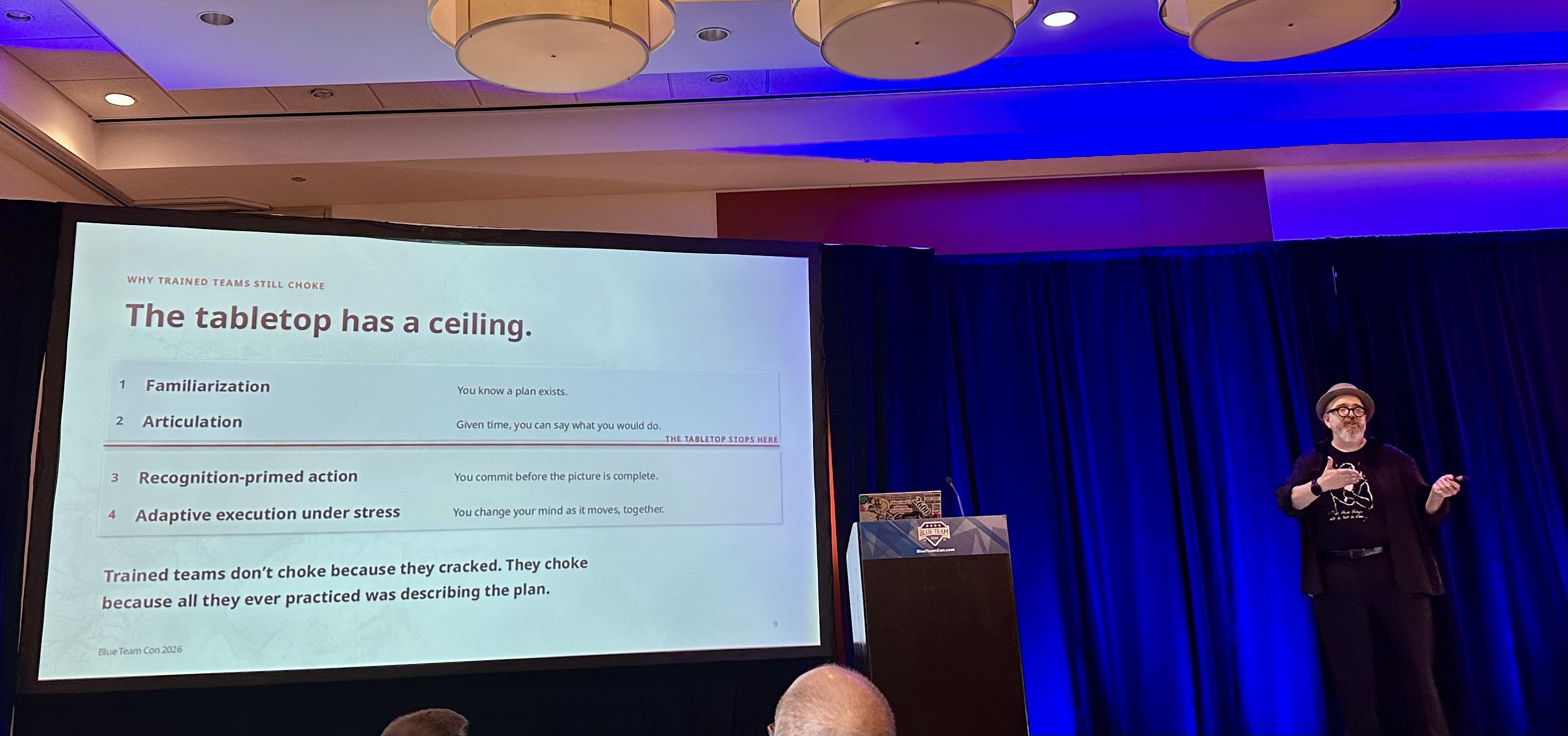
Great talk by Ron Dilley @… today “Why Incident Response Plans fail under pressure” with a shoutout to what tabletop exercises can and cannot prepare people for. Tabletops are effective and you should absolutely do them with your technical and business teams, but introducing urgency and stress into them is difficult (if not impossible)
 @azonenberg@ioc.exchange
2026-08-05 23:44:10
ngscopeclient v0.2-rc1 binaries are now up on GitHub https://github.com/ngscopeclient/scopehal-apps/releases/tag/v0.2-rc1, as well as our local artifact mirror at

 @arXiv_econGN_bot@mastoxiv.page
2026-08-11 08:16:05
Beyond headcount and human capital: The Effective Cognitive Population as a decomposable capacity unit for AI-era planning
Kwan Soo Shin
https://arxiv.org/abs/2608.09642 https://arxiv.org/pdf/2608.09642 https://arxiv.org/html/2608.09642
arXiv:2608.09642v1 Announce Type: new
Abstract: National planning counts population, human capital, and artificial-intelligence preparedness in separate ledgers. Demographic accounting has advanced from headcount to skills-adjusted stocks and still debates how much age structure retains once skills are modeled, yet no existing unit carries the conditions under which preparedness becomes productive capacity. This study introduces the Effective Cognitive Population (ECP), a decomposable unit that weights population by capability and by the conditions under which capability is deployed, anchored to the World Bank Human Capital Index Plus (HCI ) and the non-overlapping dimensions of the IMF AI Preparedness Index. The architecture is portable in principle; the case tested here is artificial intelligence, which has a published preparedness index. For 144 countries, HCI becomes a productivity level, AI opportunity uses digital infrastructure and innovation integration, conversion governance uses regulation and ethics, and the benchmark is ECP = N H(1 AC). Against 2024 total output on identical population bases, ECP raises criterion R-squared from 0.849 for the HCI -adjusted stock to 0.882 and lowers leave-one-country-out RMSE from 0.723 to 0.641, with the working-age comparison identical and bootstrap intervals excluding zero. Eighty-nine of 144 countries move at least ten rank positions from headcount, mostly through the human-capital adjustment itself. Results are stable across denominators, vintages, aggregation forms, and a 27-rule multiverse. The direct A by C interaction is not statistically supported, so the conjunction is a planning rule rather than causal complementarity. ECP is a diagnostic ledger whose scope excludes forecasts of population decline and estimates of AI's causal productivity effect.
toXiv_bot_toot
@azonenberg@ioc.exchange2026-08-20 17:39:41
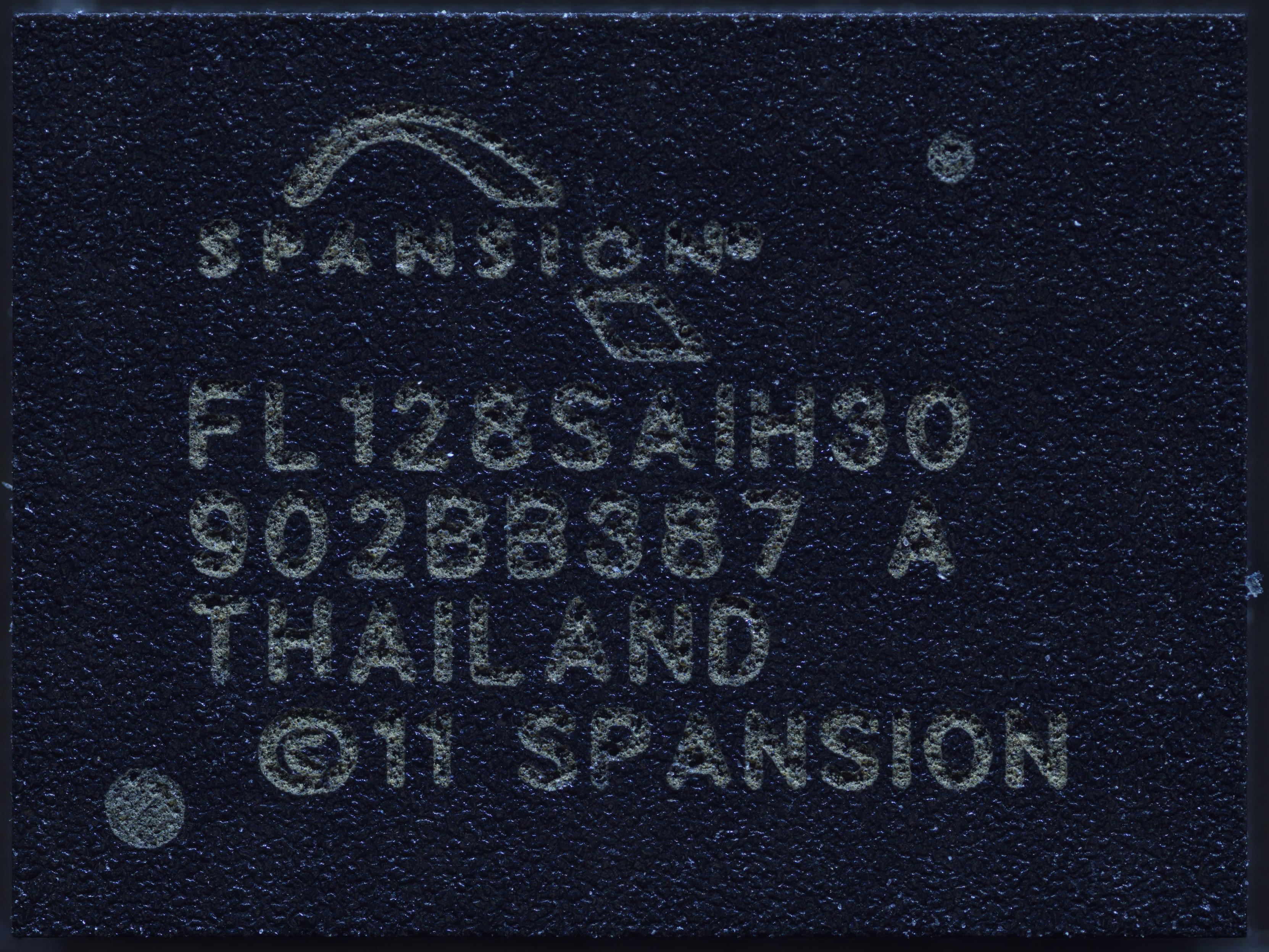
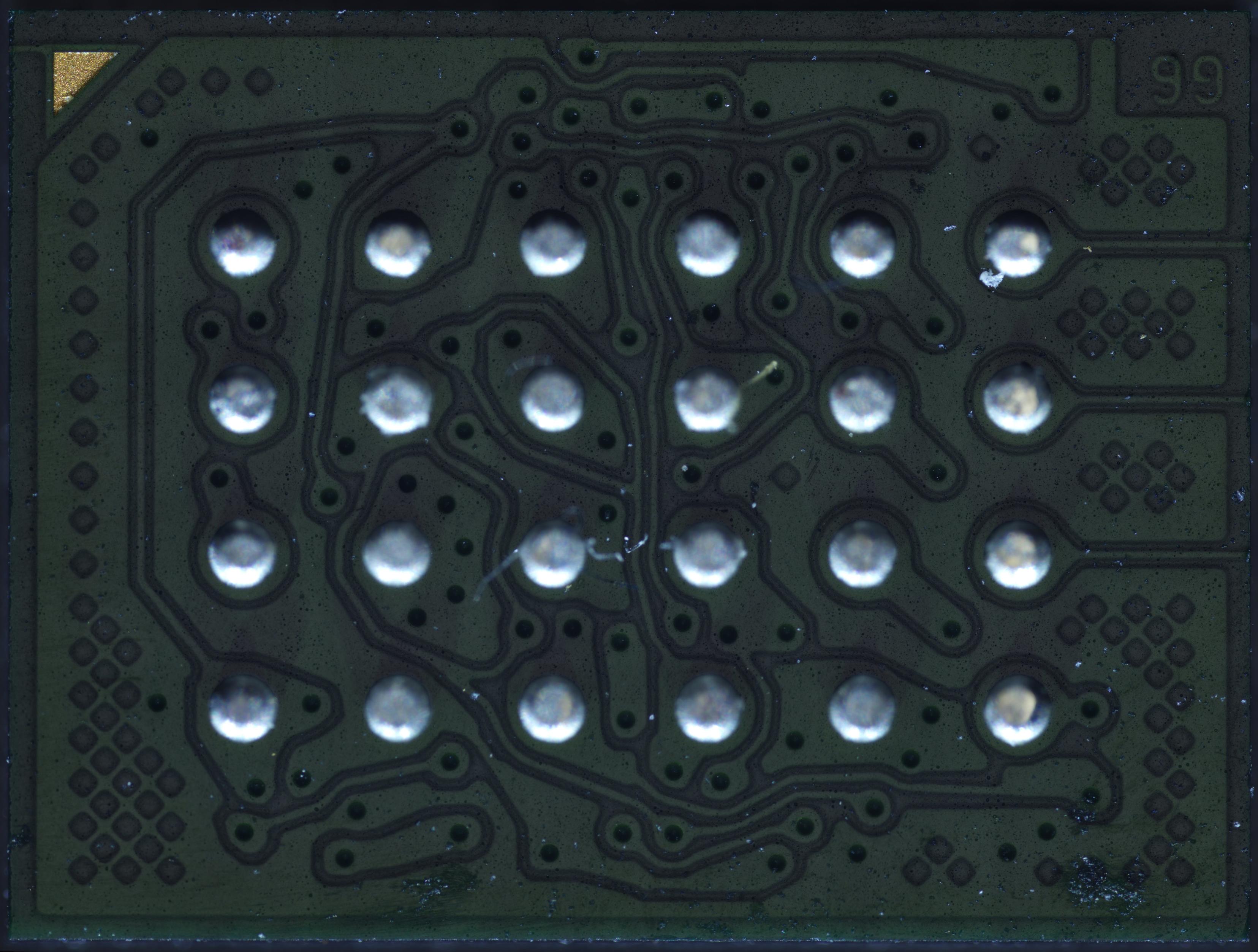
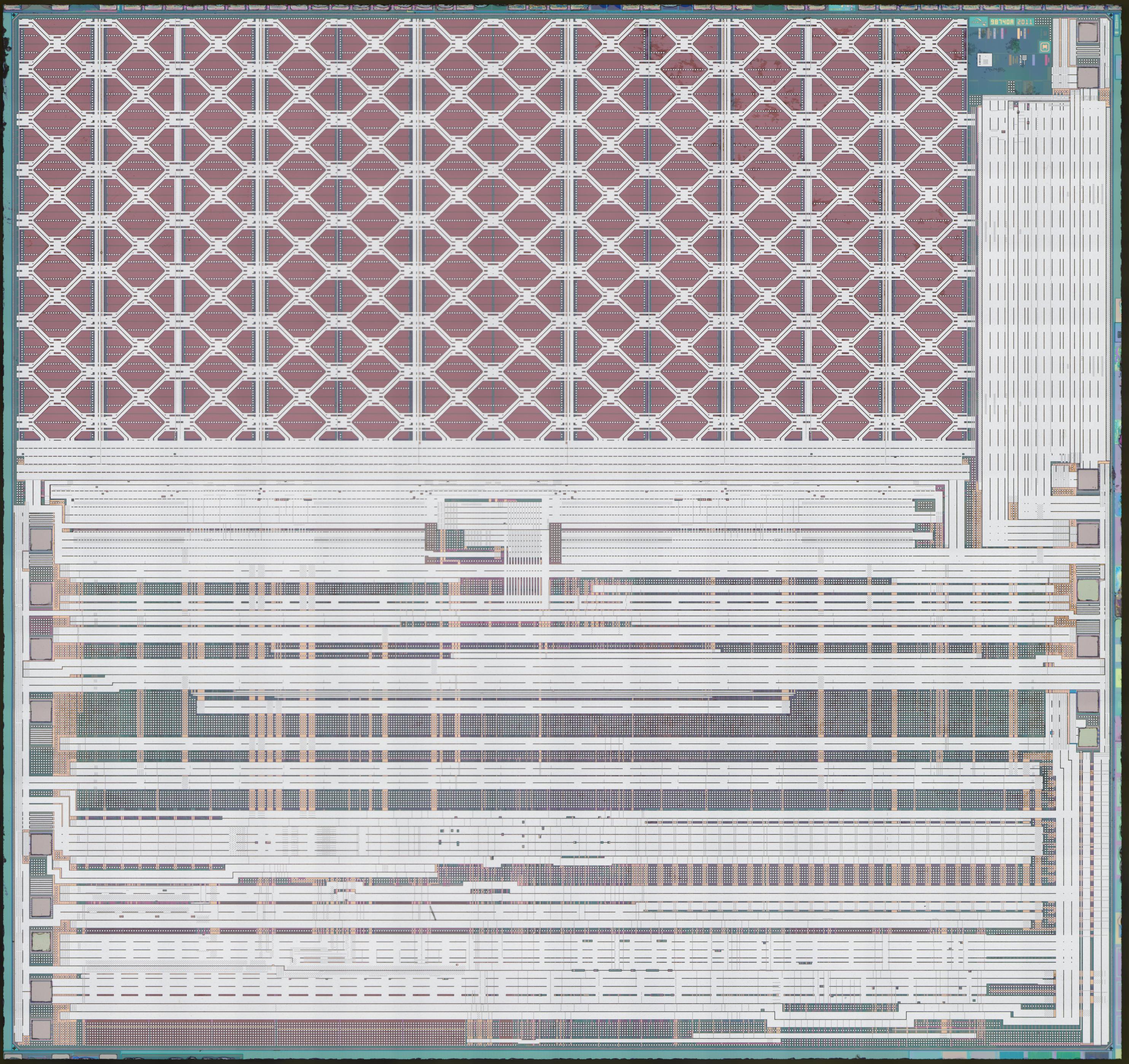
Spansion S25FL128, 128 Mbit QSPI NOR flash.
There's a surprising amount of non-flash die area from what I can see in the top metal image. I expected the bitcell array to be a much larger proportion of the overall area.
Full resolution: https://siliconprawn.org/map/spansion/s25fl128…
 @arXiv_physicsappph_bot@mastoxiv.page
2026-07-22 07:53:37
Sky-blue Solution-processed TADF and Hyperfluorescent OLEDs via a High-Work-Function PEDOT:PSS:PFI Hole Injection Layer
D\v{z}iugas Litvinas, Francisco Tenopala-Carmona, Mahni Fatahi, Anna Popczyk, Eli Zysman-Colman, Malte C. Gather
https://arxiv.org/abs/2607.18474 https://arxiv.org/pdf/2607.18474 https://arxiv.org/html/2607.18474
arXiv:2607.18474v1 Announce Type: new
Abstract: Solution-processed OLEDs offer a scalable route to large-area devices, but achieving competitive efficiency in multilayer stacks remains a challenge due to difficulties in hole injection as well as solvent orthogonality between layers. A hole injection layer (HIL) based on a blend of PEDOT:PSS and a perfluorinated ionomer (PFI) addresses both challenges simultaneously: surface segregation of PFI during film drying creates a high-work-function interface improving hole injection into high-ionisation potential host materials, while the insolubility of the blend in aromatic solvents prevents intermixing with subsequently deposited layers. Using this HIL with a solution-processed mCPCN:SpiroAC-TRZ emissive layer, sky-blue OLEDs with a peak external quantum efficiency (EQEmax) of 21.7%, an external quantum efficiency (EQE) of 20.2% at 100 cd m-2, a peak luminance of 29,000 cd m-2 and a full width at half maximum (FWHM) emission linewidth of 69 nm are demonstrated. The PFI-based HIL approach is extended to the photochemically stable TADF emitter 5TCzBN (EQEmax 18.4%, FWHM 73 nm) and to sensitized / hyperfluorescent OLEDs incorporating the multi-resonance TADF terminal emitters n-DABNA (EQEmax 22.8%, FWHM 26 nm) and the dendrimer TCzBN-BMes (EQEmax 20.4%, FWHM 29 nm). These results establish the PEDOT:PSS:PFI HIL as a broadly compatible platform for high-performance solution-processed TADF OLEDs.
toXiv_bot_toot
@azonenberg@ioc.exchange2026-06-24 03:48:59
Has anyone ever used ADIv5 as a debug interface to a SoC using AMBA buses for interconnect but *not* containing an ARM CPU (or any CPU at all for that matter)? Any gotchas or things to be aware of?
Like a JTAG-DP going to an AXI MEM-AP then a bunch of AXI peripherals, which you can connect to via openocd to peek and poke registers, but no CoreSight ROM tables or CPU registers.
Is this even a supported configuration if you're using bog-standard ARM debug IPs?