 @arXiv_mathST_bot@mastoxiv.page
2026-08-17 07:39:50
Generalization Error Estimation for Primal--Dual Algorithms in Non-Smooth Regression
Kai Tan, Pierre C Bellec
https://arxiv.org/abs/2608.13870 https://arxiv.org/pdf/2608.13870 https://arxiv.org/html/2608.13870
arXiv:2608.13870v1 Announce Type: new
Abstract: This paper studies trajectory-wise estimation of generalization error for primal--dual algorithms in non-smooth regression. Motivating examples include \(\ell_1\)-penalized least absolute deviations regression and square-root Lasso regression, where the data-fitting loss is non-differentiable and existing risk estimators for gradient-type optimization paths do not apply directly. We develop a general recursive framework that includes the Chambolle--Pock algorithm and related primal--dual splitting methods. We estimate risk by correcting each in-sample fitted value with a weighted combination of past dual iterates. The ideal weights are Stein derivative contractions and depend on the design covariance. We construct replacement weights from observable derivative contractions of the fitted-signal trajectory, yielding a covariance-free, data-driven correction. For high-dimensional Gaussian designs and fixed finite iteration horizon, we prove finite-sample guarantees for both estimators. For square-root ridge, we further establish a matched-Gaussian universality result beyond Gaussian designs. Numerical experiments show that the proposed estimators accurately track the out-of-sample risk along finite optimization paths.
toXiv_bot_toot
 @Techmeme@techhub.social
2026-08-18 23:15:50
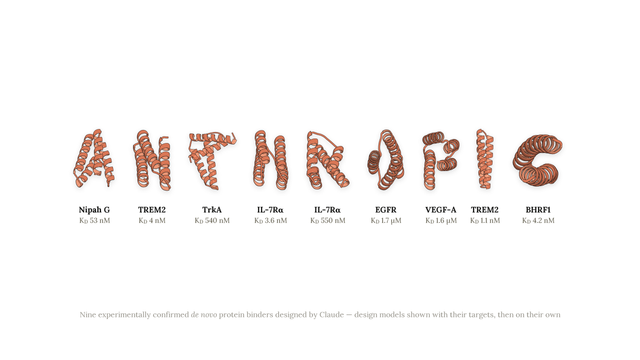
Anthropic details two experiments showing how Claude can accelerate protein design and analytical chemistry, and says it plans an access program for scientists (Anthropic)
https://www.anthropic.com/research/Claude-accelerates-protein-design
 @lschiff@mastodon.sdf.org
2026-07-26 22:27:00
Register for our 8/12 (defendresearch.org) webinar with Professor Vera Kemp in conversation with #DefendResearch co-founder Sara Rouhi discussing “What Can I Really Do? Behavioural Choices for Scholars in Past and Emerging Autocracies”
 @arXiv_physicsmedph_bot@mastoxiv.page
2026-06-23 07:55:47
OpenPINT: Open-source Planning for Isoeffective Nuclear Treatments in BNCT research
Ian Postuma, Sara J. Gonz\'alez, Setareh Fatemi, Cristina Pezzi, Carolina Ruzzon, Oreste Nicrosini, Valerio Vercesi, Silva Bortolussi
https://arxiv.org/abs/2606.21476 https://arxiv.org/pdf/2606.21476 https://arxiv.org/html/2606.21476
arXiv:2606.21476v1 Announce Type: new
Abstract: Objective: Present OpenPINT (Open-source Planning for Isoeffective Nuclear Treatments), an open-source treatment planning system for nuclear therapies that integrates Monte Carlo dose calculations with modular dosimetric and radiobiological models for photon-isoeffective dose evaluation.
Approach: We describe the software architecture, implementation choices, and data flow from segmented geometry and source configuration to NIfTI dose outputs. We define BNCT-relevant dosimetric metrics and evaluate the workflow with reproducible analytic and voxelized cylindrical-phantom benchmarks, supplemented by a geometric patient-positioning example.
Main results: The module provides a reproducible and scriptable path for generating MCNP-ready inputs, extracting component-wise BNCT dose maps, and computing analysis-ready outputs for quality checks and decision support. Fine-resolution voxelized configurations reproduced the 1 mm analytic reference within 0.13% for the brain-limited irradiation-time endpoint, whereas the full voxelized sweep exposed deviations up to 4.42% in coarse 8--10 mm configurations. Patient-wide gamma pass rates were at least 99.60% for the evaluated mesh/interpolation cases, while low-dose DVH-tail quantities remained sensitive to boundary discretization.
Significance: This first paper isolates and validates the simulation-preparation and dosimetric-analysis core of an open-source BNCT treatment-planning platform. It establishes a foundation for subsequent work on optimization, biological weighting, and clinical workflow integration.
toXiv_bot_toot
 @arXiv_qfinTR_bot@mastoxiv.page
2026-07-21 07:49:46
Uniform-Loss Automated Market Making for Prediction Markets
Ciamac C. Moallemi, Dan Robinson, Brian Zhu
https://arxiv.org/abs/2607.17428 https://arxiv.org/pdf/2607.17428 https://arxiv.org/html/2607.17428
arXiv:2607.17428v1 Announce Type: new
Abstract: Automated market makers (AMMs) for prediction markets descend from market scoring rules, where a mechanism operator subsidizes a market to aggregate beliefs about uncertain events. The existing literature has focused on bounding the total worst-case loss to the subsidizer, but has not addressed how that loss is distributed across price states or over time. We use the framework of loss-versus-rebalancing (LVR) to study this distribution and introduce \textit{uniform AMMs}, defined by the property that instantaneous LVR is proportional to pool value and independent of the current token price. In a static setting, we show that for a broad class of \textit{win-martingales} -- processes that converge to 0 or 1 at a fixed resolution time -- there exists a pricing function that achieves uniform LVR under that process, and conversely, that any sufficiently regular pricing function induces a win-martingale under which it is uniform. We then extend the framework to dynamic liquidity management, showing that liquidity levels can be adjusted over time to implement a prescribed target expected cumulative loss schedule. This theory is illustrated with canonical examples of win-martingales and pricing functions. Our results can inform AMM designers and liquidity providers on how the inevitable cost of subsidizing price discovery can be shaped and controlled across both price and time.
toXiv_bot_toot
 @chris@mstdn.chrisalemany.ca
2026-09-07 14:04:52
The German state election yesterday is a perfect demonstration of why Proportional Representation (PR) is far superior for democracy than First Past the Post (FPTP).
TLDR: Thanks to Proportionality, the AfD only won a minority, not majority parliament because the state parliament always reflects the popular vote.
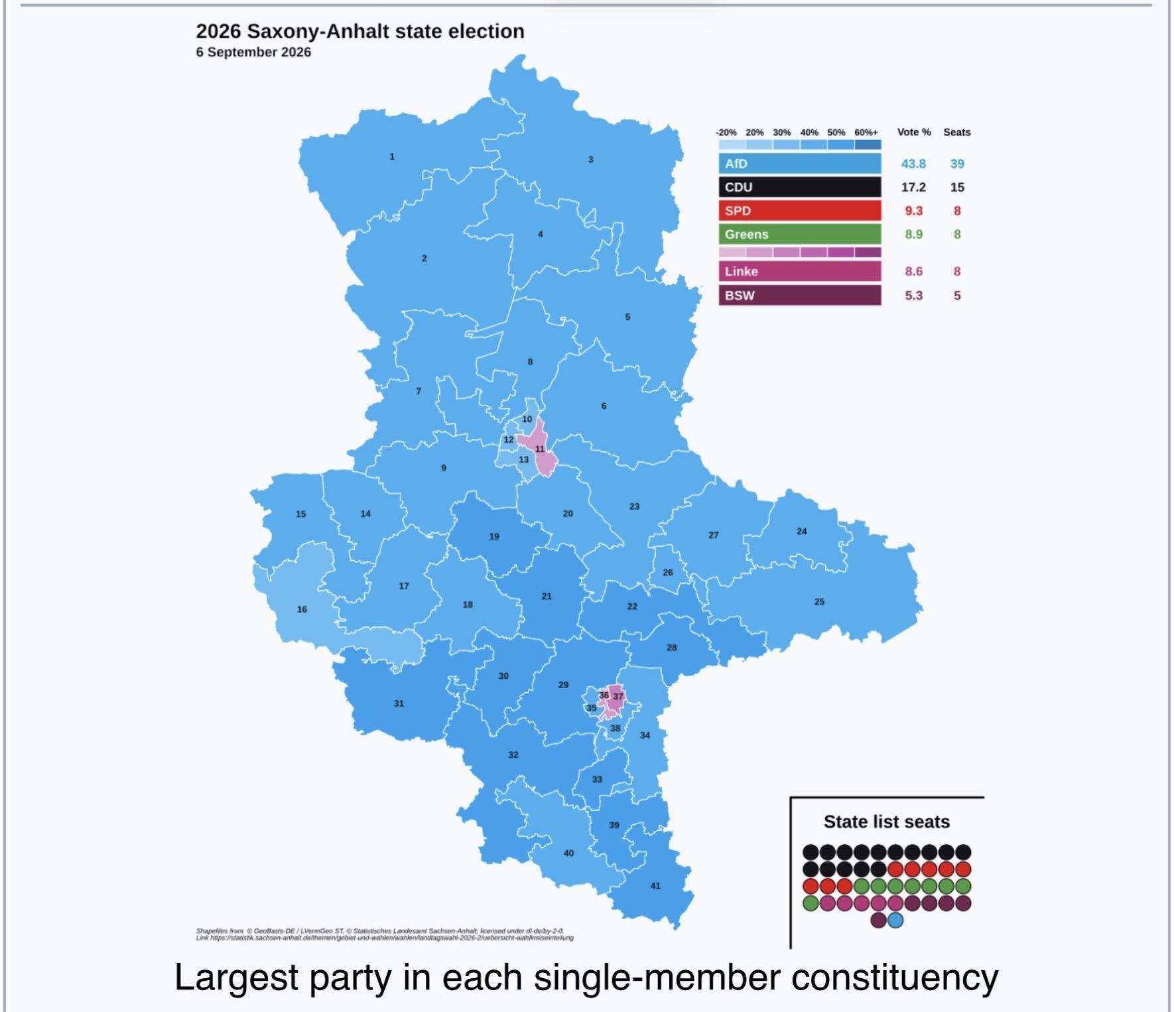
The picture shows the state of Saxony-Anhalt divided into its electoral districts. It is almost all blue because the AfD won the most votes in all but three districts but with 42% of the popular vote overall.
Had this been a province in Canada, it would have produced a legislature with just 3 opposition members, and all the rest government members. Delivering absolute majority power with no meaningful voice for any other party (likely also losing official party status and key funding for political activities) despite a significant share of the popular vote. This has happened in Canada many times, including in BC in 2001 when the NDP won just 2 seats with all 77 others going to the B.C. Liberals… it led to a referendum on PR that won over 60% of the vote but was never implemented.
Had this German state used FPTP they would have a gigantic majority of exclusively far right members and just 3 opposition.
Thanks to PR, their legislature will actually reflect the vote of the people.
42% AfD (39 seats)
17% CDU (15)
9% SPD (8)
8% GRN (8)
8% LNK (8)
5% BSW (5)
83 seats: 42 needed for majority.
AfD: 39
Other parties: 44
In B.C., one of the tropes the status quo campaigners constantly bring up is that PR somehow enables extreme parties more than FPTP and is thus dangerous. This has been proven false over and over including right now,
Here we are, with another example as this German state breathes a sigh of relief that PR saved them from a whollly undemocratic and extreme outcome.
Meanwhile, back in B.C., our own now far right BC Conservatives have successfully splintered the “big tent” remnants of the old slightly more centrist B.C. Liberals leading to a mish mash of independents and new parties in the B.C. Legislature that have not been elected by the people and are unable to really function as a proper opposition to the majority government. FPTP doing a great job! *sarc
Why doesn’t Canada have *any* proportional elections?
Inertia, greed, and power.
Germany 2026 state election: #democracy #fptp #pr #germany #canada #bcpoli