Professor David J. Farber, whose work on academic experimental computer networks helped define the evolution of the early internet, died on February 7 at age 91 (Peter Wayner/New York Times)
https://www.nytimes.com/2026/02/14/technol
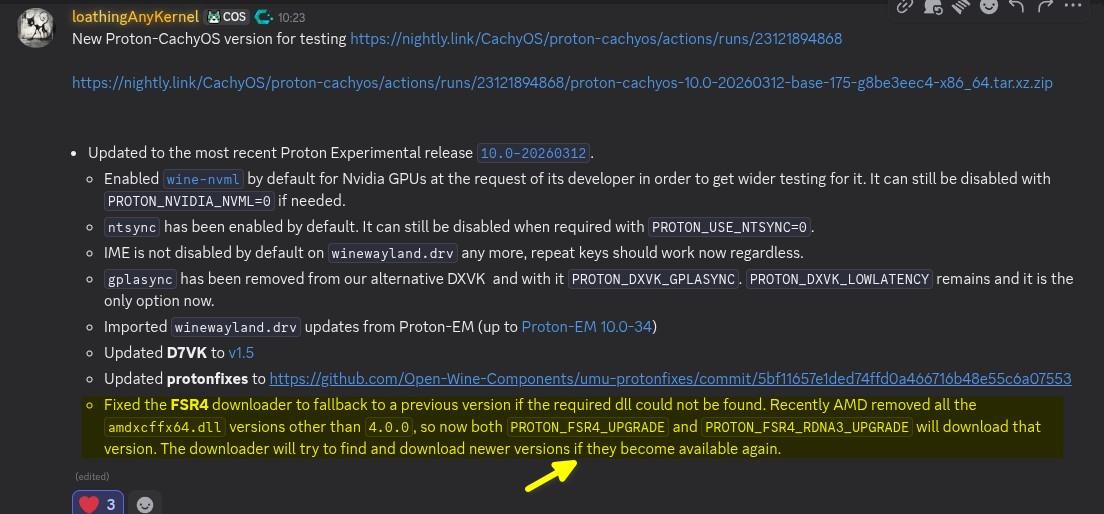
That ominous "if" at the end tells me only that even the Linux community doesn't know why these files were taken down. I could make a breakthrough in my YouTube puddle if I spin up some clickbait video right now 😀
So, The Core (in no particular order):
1. Slackware with nwg-shell Sway, Niri and Mango
2. Gentoo dwm
3. Aurorix, my KDE container spin.
4. FreeBSD 15 with Mango
5. Slackware Flatbrew, a KDE QT6 experimental iso, with Brew and Flatpaks (thnx @… 😉)
All working superbly.
Contemplating a bootc Cosmic spin 😜
I heard if you install Linux, Microsoft stops spying on you. Sounds wild. Apparently, it even comes with this experimental feature called “a Start menu without ads.”
#Linux #Microsoft #Windows
International postdocs: Come to Bochum for a two-week stay to plan a research project and learn how to apply for funding for it in Germany.
I'm available as a host for any topic related to my research interests: digital forensic linguistics, experimental semantics/pragmatics, emojis, (computational analyses of) harmful language, metaphors, discourse, etc.
https://www.research-academy-ruhr.de/programm/researchexplorer/
🔊 #NowPlaying on #BBCRadio3:
#NewMusicShow
- Juliet Fraser's Listen List
The best and latest in cutting-edge and experimental new music including the world premiere of Klaus Lang's emblemata sonantes, a musical imagining of Graz's Eggenberg Palace.
Relisten now 👇
https://www.bbc.co.uk/programmes/m002r3xq
@… hi! Do you have an app for Linux (e.g. Ubuntu and derivatives like ZorinOS)? The only one I found in the software center is called "Tuta (experimental)" 🤔🙏
Clinical And Experimental Ophthalmology Conversations
Each episode discusses a recently published manuscript, highlighting key findings, clinical impact and how new evidence is shaping ophthalmic practice...
Great Australian Pods Podcast Directory: https://www.greataustr…
🔊 #NowPlaying on #BBCRadio3:
#NewMusicShow
- Rhodri Davies's Listen List
Kate Molleson talks to the composer Rhodri Davies about the new music that he's discovering now, and Kate showcases the best and latest in cutting-edge and experimental new music.
Relisten now 👇
https://www.bbc.co.uk/programmes/m002sg0t
China has launched two satellites,
Shijian 29A and 29B,
as part of a technology demonstration
to test new space-based #target-#detection technologies
A Long March 7A carrier rocket took off from the Wenchang Space Launch Center in Hainan province at 6:40 am, December 31, lifting the two satellite…
My Storm's My Ghosts Go Ghost album was this months discovery. I'd say it's in the same vein of experimental hip hop as clipping. and Deathgrips, but chill.
#MorningMusic
https://www.youtube.com/watch?v=R8McQBweTA…
🔊 #NowPlaying on #BBCRadio3:
#NewMusicShow
- Rhodri Davies's Listen List
Kate Molleson talks to the composer Rhodri Davies about the new music that he's discovering now, and Kate showcases the best and latest in cutting-edge and experimental new music.
Relisten now 👇
https://www.bbc.co.uk/programmes/m002sg0t
[1/?]
So this happened while I was up a mountain:
https://www.joshtumath.uk/posts/2026-01-27-try-text-scaling-support-in-chrome-canary/
But the post didn’t have a demo. Last night I made one:
Crosslisted article(s) found for physics.atom-ph. https://arxiv.org/list/physics.atom-ph/new
[1/1]:
- Experimental challenges and prospects for quantum-enhanced energy conversion: Stationary Fano coh...
Ludovica Donati, Francesco Saverio Cataliotti, Stefano Gherardini
#NowPlaying New jazz inflected experimental electric piano from mad genius Psychedelic Soundtrack aka Michael de la Cuesta. So good. https://apophenia-67.bandcamp.com/album/volume-1
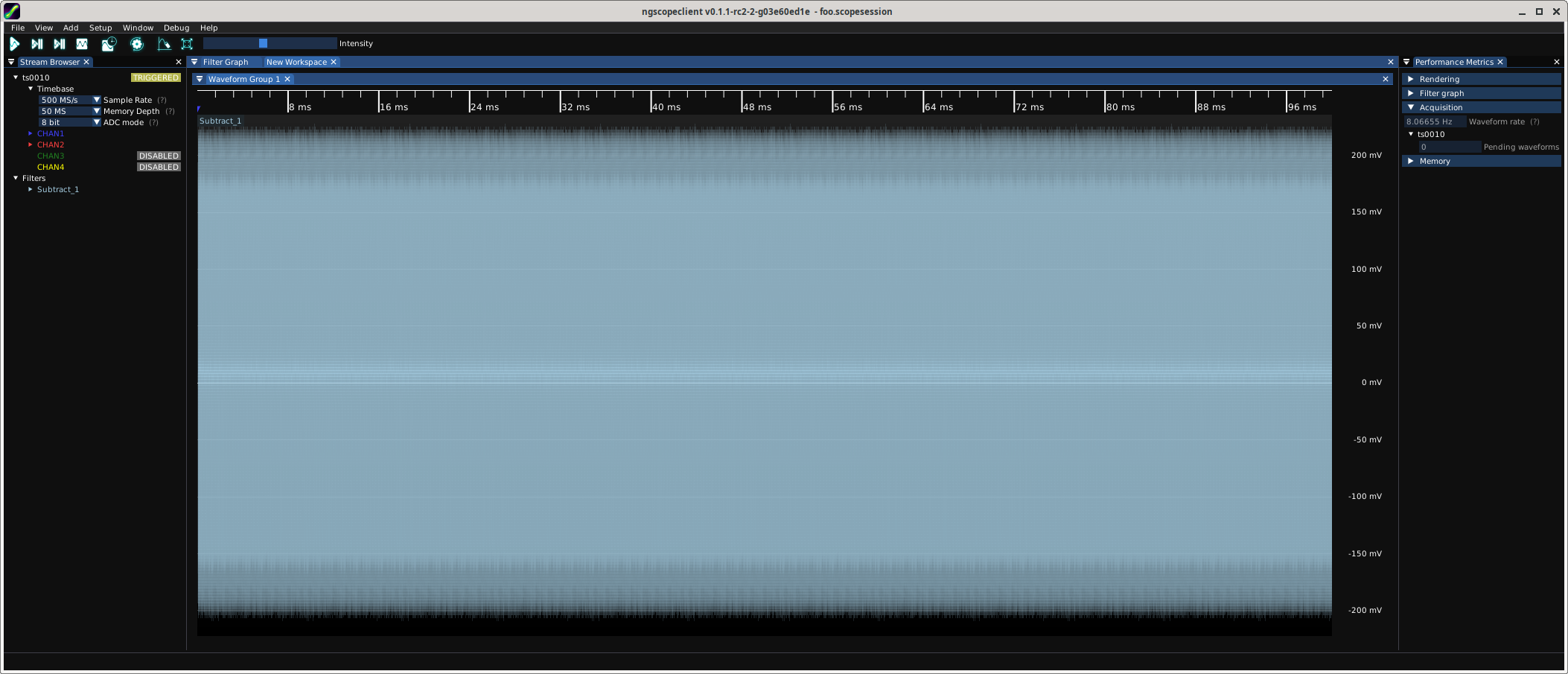
Experimental credit based flow control in TS.NET plus ngscopeclient for reduced buffer bloat and much better performance over LANs.
This is 2x 50M points (100M points per trigger) updating at around 8.3-8.5 Hz over 10/40GbE.
The TS.NET side of this isn't merged and there's still some bugs to chase but it's looking *really* good.
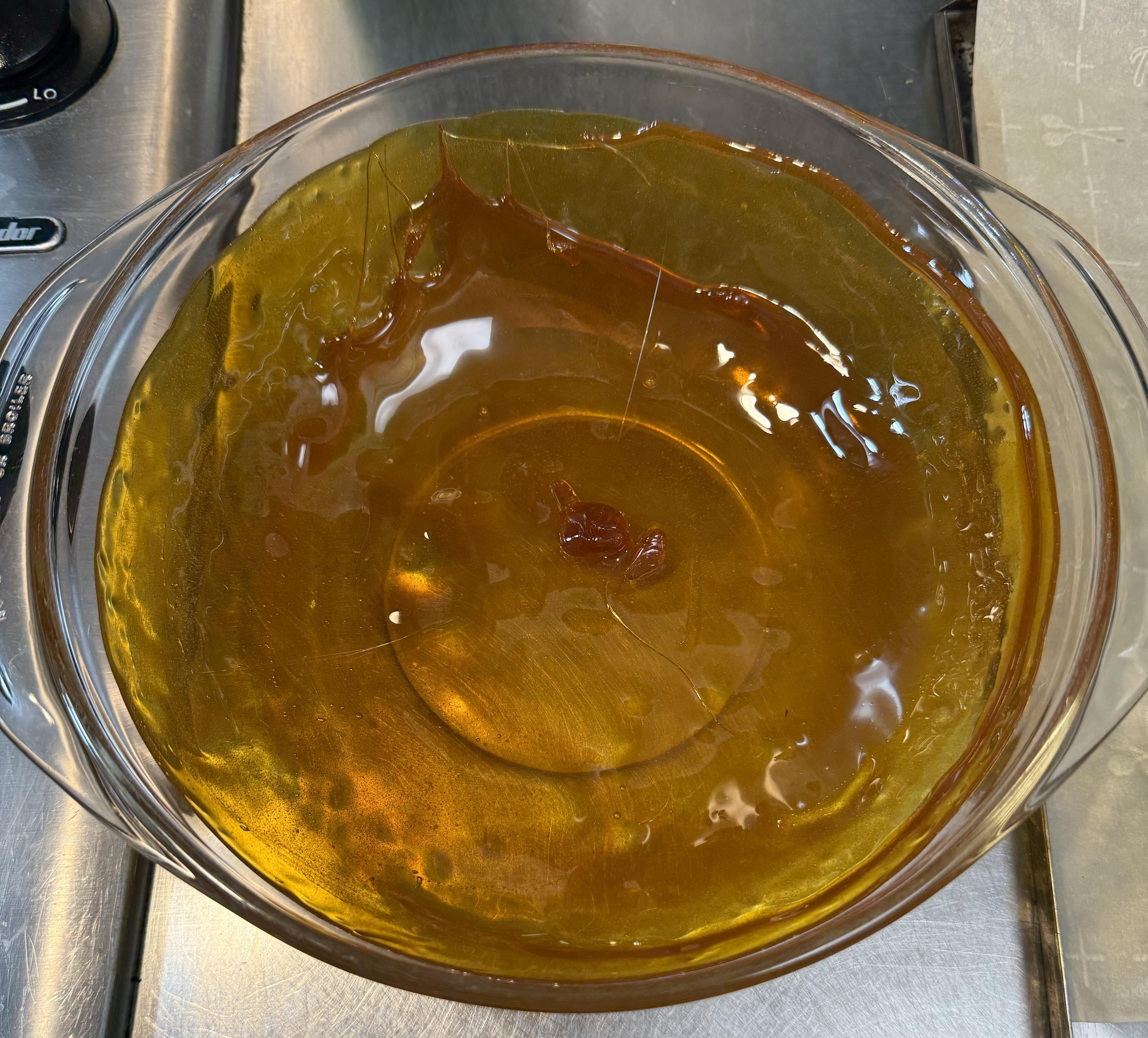
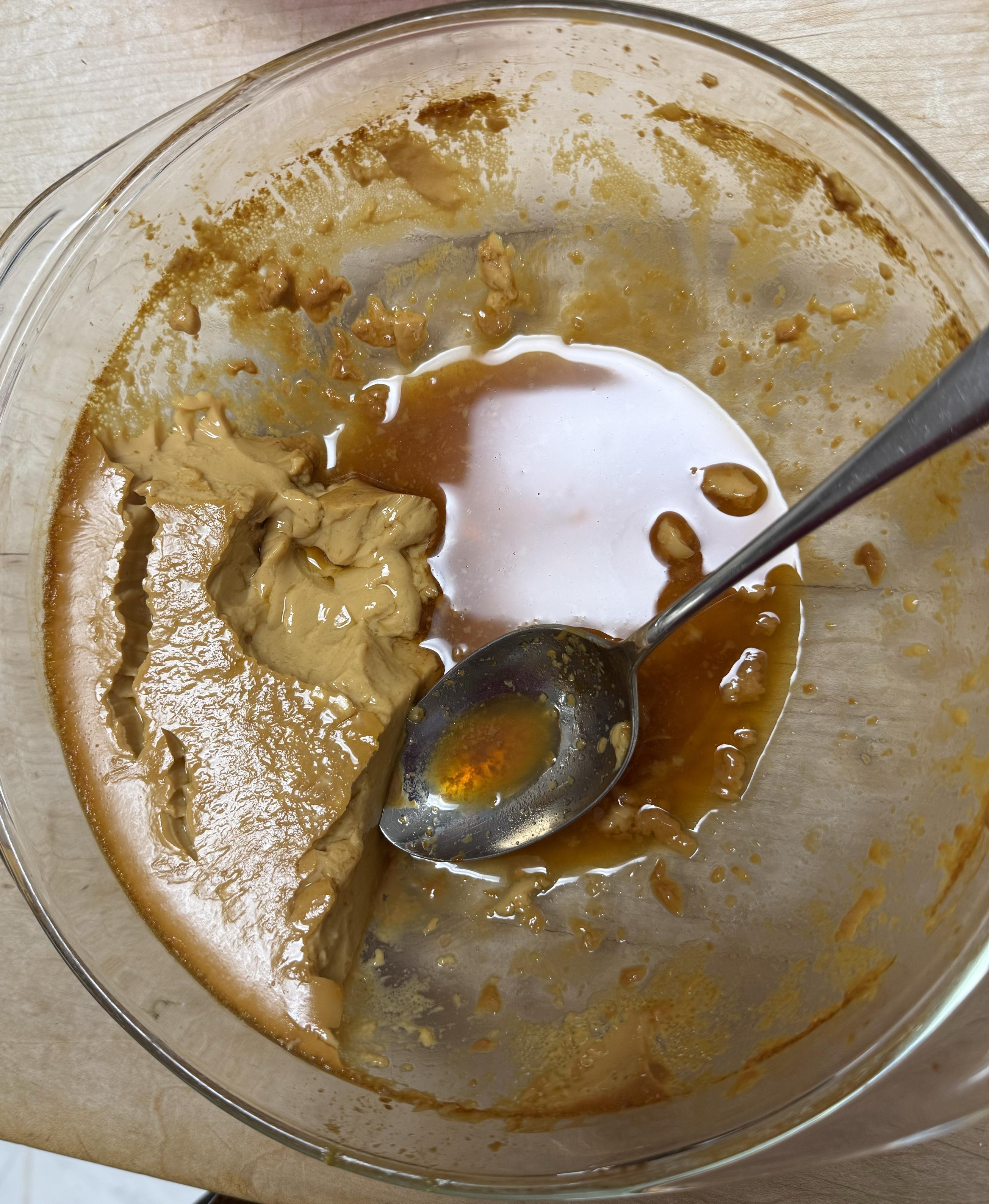
I made an experimental flan, where instead of using sugar in the custard mix, I converted that sugar to caramel (in addition to the caramel coating the bowl) and then dissolved that caramel into the cooling scalded milk.
The experiment was a success, if you like caramel.
I did this one from memory. 1.5c sucrose split into two parts, 4 cups milk, 4 large eggs, 1 yolk, 1/4 t salt, 1 T vanilla, 350-375F, 1 hour in a baño maria, lay a sheet of aluminum foil on it for most of that ti…
PCIe400 generic readout board qualification test
Kevin Arnaud, Antoine Back, Daniel Charlet, Gabriel Degret, Luigi Del Buono, Paolo Durante, Amaury Hervo, Fr\'ed\'eric Hachon, Xavier Lafay, Julien Langou\"et, Renaud Le Gac, Jea-Luc Meunier, Jean-Marc Nappa, Costy Nassif Mattar, Christophe Renard, Guillaume Vouters
https://arxiv.org/abs/2602.01422 https://arxiv.org/pdf/2602.01422 https://arxiv.org/html/2602.01422
arXiv:2602.01422v1 Announce Type: new
Abstract: The PCIe400 is a generic board for high-throughput data acquisition systems in high energy physics experiments. Its purpose is to interface up to 48 bidirectional links, supporting custom protocols at 1 to 26 Gbit/s, to modern commercial back-end links providing 400 Gbit/s bandwidth. It also targets clock distribution with phase determinism below 10 ps peak-to-peak. It has been designed for LHCb LS3 enhancement upgrade with experimental features to prepare LHCb Upgrade II, foreseeing an aggregated throughput of 200 Tbit/s. However, its versatility allows it to be used in several experimental environments. The board embeds Altera's flagship Agilex 7 M-series FPGA with a PCIe Gen 5 interface and an experimental QSFP112 serial interface. We present the results of qualification tests performed on prototype boards and the challenges encountered to meet specifications. Section 1 describes board-level validation, including power-up behavior and peripheral access. Section 2 focuses on high-bandwidth interface qualification through BER measurements. Finally, Section 3 investigates phase determinism in Agilex transceivers, a key requirement for precise clock distribution.
toXiv_bot_toot
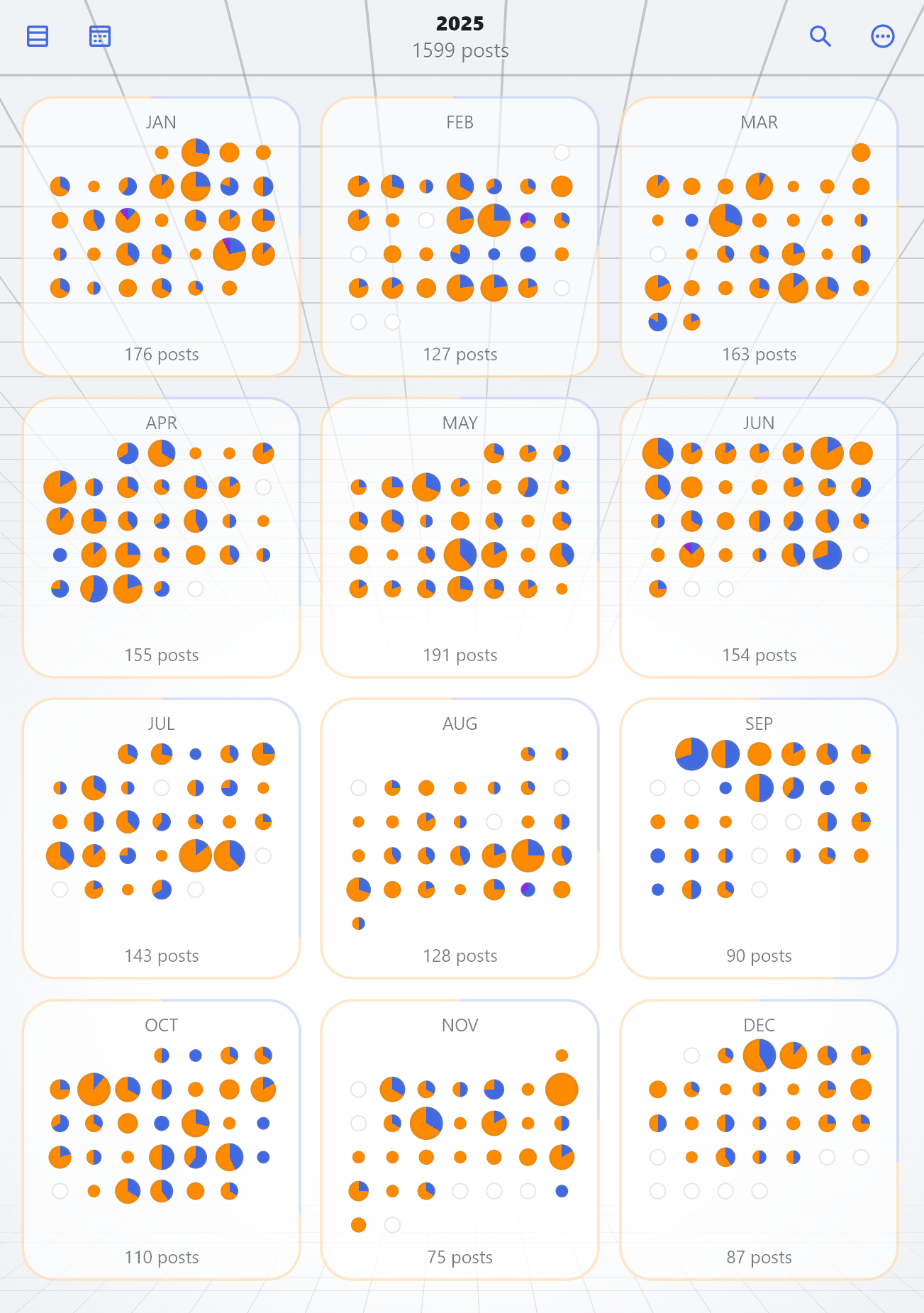
My year in Mastodon, courtesy of an experimental feature in @….
For #MusicWomenWednesday this week, this great new EP by Canada project AEROPLANE JU. This is some strange, almost experimental lo-fi bedroom type stuff. There's guitars, shimmering, sparkling strangeness, and some odd, unique vocals- I just dig the hell out of it. Had to buy this one and her other new single - been playing both of them a lot.
Hey, guess what?
I just saw the first Small Web site (the Kitten Chat example¹ from Kitten²) running at a Web Number³:
https://91.98.66.193/
👉 Update: I’m shutting it down in a few moments so it might not be there when you try it :)
Come say hi (I don’t know how long I’ll keep it on for, will update this when I turn it off.)
🥳
PS. This is only in the ip-address-support branch of Kitten right now and should be considered experimental. Will likely make it in…
Series C, Episode 10 - Ultraworld
ORAC: The idiosyncratic syntax of riddles interests me. They seem to depend for their effect on solecisms and grammatical discrepancies.
VILA: Eh?
ORAC: Do you have another riddle for me to analyze?
https://blake.torpidity.net/m/310/228 B7B4
Welfarist Formulations for Diverse Similarity Search
Siddharth Barman, Nirjhar Das, Shivam Gupta, Kirankumar Shiragur
https://arxiv.org/abs/2602.08742 https://arxiv.org/pdf/2602.08742 https://arxiv.org/html/2602.08742
arXiv:2602.08742v1 Announce Type: new
Abstract: Nearest Neighbor Search (NNS) is a fundamental problem in data structures with wide-ranging applications, such as web search, recommendation systems, and, more recently, retrieval-augmented generations (RAG). In such recent applications, in addition to the relevance (similarity) of the returned neighbors, diversity among the neighbors is a central requirement. In this paper, we develop principled welfare-based formulations in NNS for realizing diversity across attributes. Our formulations are based on welfare functions -- from mathematical economics -- that satisfy central diversity (fairness) and relevance (economic efficiency) axioms. With a particular focus on Nash social welfare, we note that our welfare-based formulations provide objective functions that adaptively balance relevance and diversity in a query-dependent manner. Notably, such a balance was not present in the prior constraint-based approach, which forced a fixed level of diversity and optimized for relevance. In addition, our formulation provides a parametric way to control the trade-off between relevance and diversity, providing practitioners with flexibility to tailor search results to task-specific requirements. We develop efficient nearest neighbor algorithms with provable guarantees for the welfare-based objectives. Notably, our algorithm can be applied on top of any standard ANN method (i.e., use standard ANN method as a subroutine) to efficiently find neighbors that approximately maximize our welfare-based objectives. Experimental results demonstrate that our approach is practical and substantially improves diversity while maintaining high relevance of the retrieved neighbors.
toXiv_bot_toot
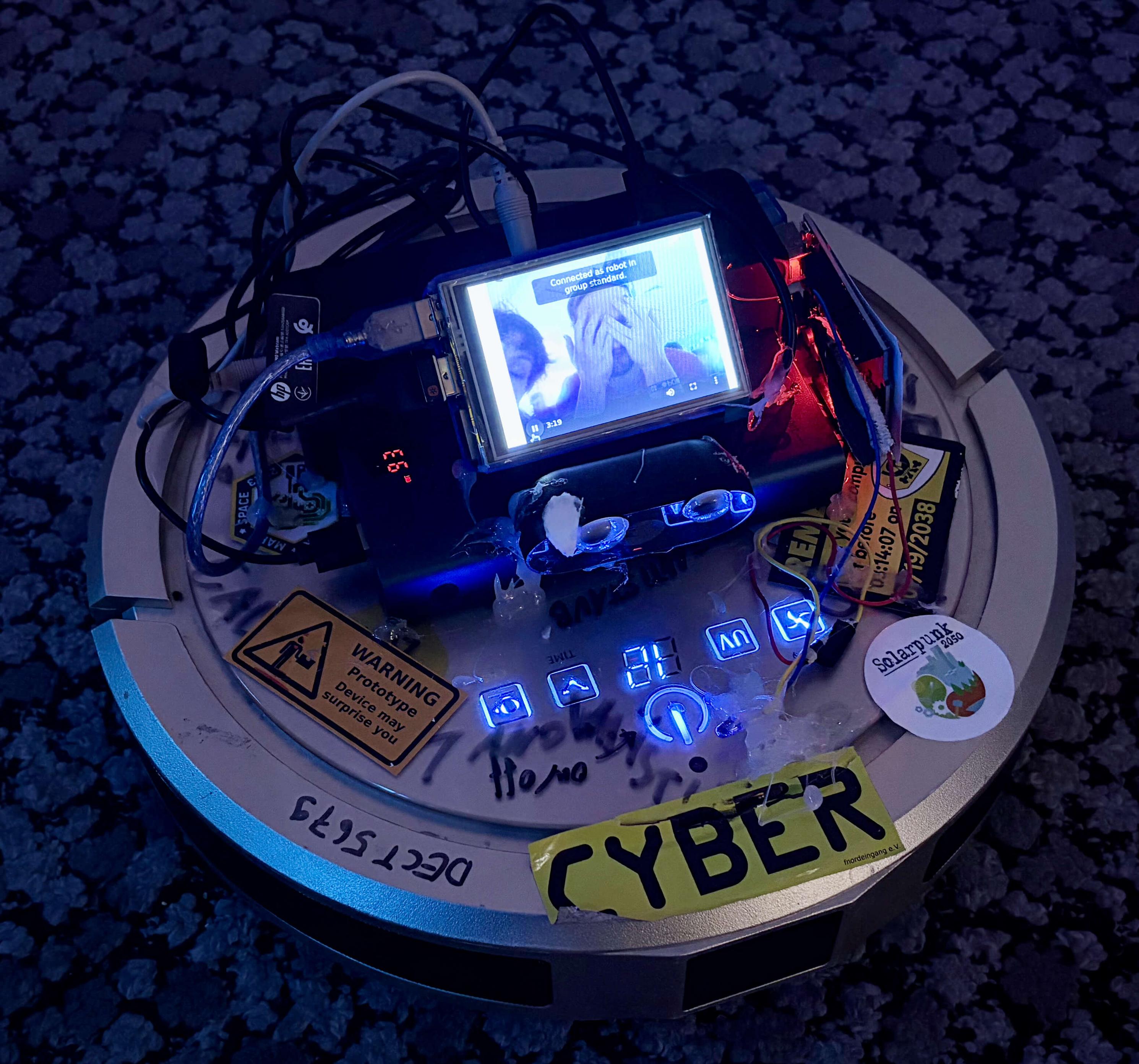
c3-only-things: Short and intense discussion with a vacuum cleaner at the #39c3 late-night shop. Unfortunately, the meowing didn't work. #39c3
What's the current state of XMPP and OpenID Connect? My web search returned that ejabberd is still considering if and how to implement and Prosody has experimental alpha-stage support via a module. I couldn't find anything conclusive in regards to XMPP clients. What's with Gajim(?) and Conversations? Or other clients? Are there any web clients supporting OIDC?
#jabber
This is so niche and yet so relevant to my interests: "Kip is an experimental programming language that combines Turkish grammar rules with a type system. Case endings, vowel harmony, and other Turkish morphological features are an integral part of Kip's type-checking process."
https://github.com/kip-dili/kip/…
Finished “People Like Us” by Jason Mott.
I will admit that there were moments early where I struggled, trying to puzzle out the dual narratives. You have to accept it as experimental writing with a plurality in scope. When I surrendered and just READ, I absolutely loved it!
What is it about? So much. Gun violence. Where home is. America. Race. Writers. Trauma & coping. Time travel. Peacocks.
So much to say, but for spoilers 🤐
5/5 ⭐️ ⭐️ ⭐️ ⭐️ ⭐️
Experimental Validation of HomHBFEM Simulations of Fast Corrector Magnets for PETRA IV
Jan-Magnus Christmann, Laura Anna Maria D'Angelo, Herbert De Gersem, Sven Pfeiffer, Sajjad Hussain Mirza, Adeel Amjad, Lucas Rousselange, Matthias Thede
https://arxiv.org/abs/2602.14824 https://arxiv.org/pdf/2602.14824 https://arxiv.org/html/2602.14824
arXiv:2602.14824v1 Announce Type: new
Abstract: This paper presents experimental validation of the homogenized harmonic balance finite element method (HomHBFEM), which we have developed as a dedicated simulation technique for magnets with fast excitation cycles, in particular the fast corrector (FC) magnets for PETRA IV at DESY. The HomHBFEM allows efficient three-dimensional nonlinear eddy-current simulations of laminated magnets at elevated frequencies with a relatively coarse finite element (FE) mesh and without computationally expensive time-stepping. This is achieved by combining a frequency-domain-based homogenization technique with the harmonic balance FE method. The simulation results for the magnetic flux density along the axis of the FC magnets as a function of frequency and the resulting integrated transfer function (ITF) are compared to Hall probe and search coil measurements of the first prototype FC magnet for PETRA IV. A good agreement between simulated and measured ITFs is achieved for excitation frequencies from 10 Hz to 10 kHz.
toXiv_bot_toot
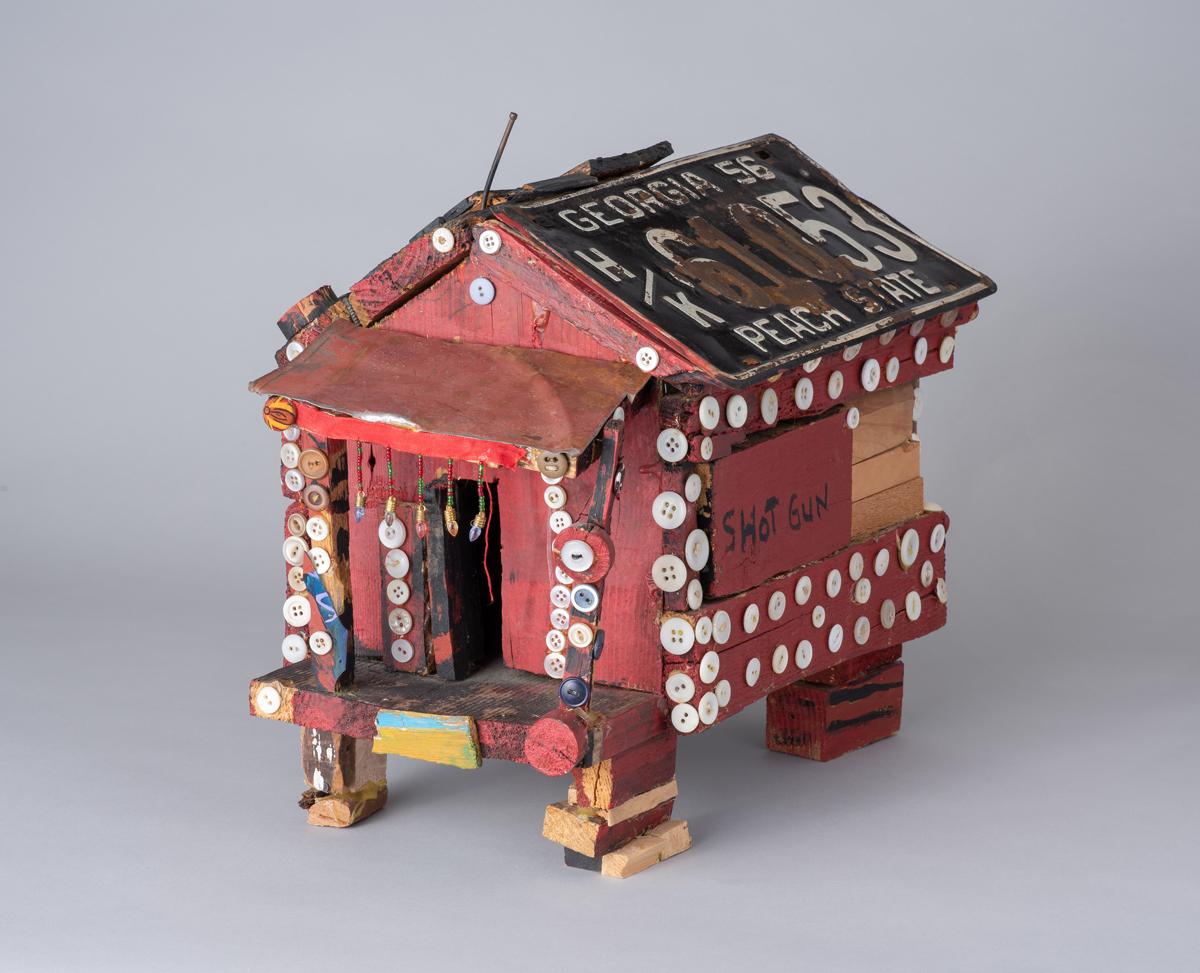
We're happy to be teaming up with the Athenaeum at the Lamar Dodd School of Art (#UniversityOfGeorgia), on a pair of exhibitions focusing on #BeverlyBuchanan. Known nationally as a bold experimental artist who worked in land art and video as well as more familiar forms, she lived in Athe…
🎯 Schema-based input validation via Protobuf strict typing mitigates injection attacks & rejects malformed inputs at serialization layer
📋 Google Cloud contributing gRPC transport package to MCP SDKs - community-backed consistent interoperable deployment for gRPC practitioners
🏢 Spotify already using experimental MCP over gRPC internally - benefits include ease of use, developer familiarity & reduced work building MCP servers
@… I think so many people switched to distributed VCS that enthusiasm for contributing to SVN also dried up. Same reason for many SVN tools being sunset and integrations lacking.
So despite having years to catch up, there's no velocity to get there. The biggest new feature I've seen is shelving, but it's still experimental.
Experimental study of turbulent thermal diffusion of inertial particles in a convective turbulence forced by oscillating grids
E. Elmakies, O. Shildkrot, N. Kleeorin, A. Levy, I. Rogachevskii
https://arxiv.org/abs/2602.22008 https://arxiv.org/pdf/2602.22008 https://arxiv.org/html/2602.22008
arXiv:2602.22008v1 Announce Type: new
Abstract: We investigate the phenomenon of turbulent thermal diffusion of inertial solid particles in laboratory experiments with convective turbulence forced by one or two oscillating grids in the air flow. Turbulent thermal diffusion causes a non-diffusive contribution to turbulent flux of particles described in terms of an effective pumping velocity directed opposite to the gradient of the mean fluid temperature. For inertial particles, this effective pumping velocity depends on the Stokes and Reynolds numbers. In the experiments, fluid velocity and spatial distribution of inertial particles are measured using Particle Image Velocimetry system, and the temperature field is measured in many locations by a temperature probe equipped with 12 thermocouples. Measurements of temperature and particle number density spatial distributions have demonstrated formation of large-scale clusters of inertial particles in the vicinity of the mean temperature minimum due to turbulent thermal diffusion. In the experiments, the effective pumping velocity resulting in formation of large-scale clusters of inertial particles (having the diameter $10 \mu m$) is in 2.5 times larger than that for non-inertial particles (having the diameter $0.7 \mu m$). This is in an agreement with the theoretical predictions.
toXiv_bot_toot
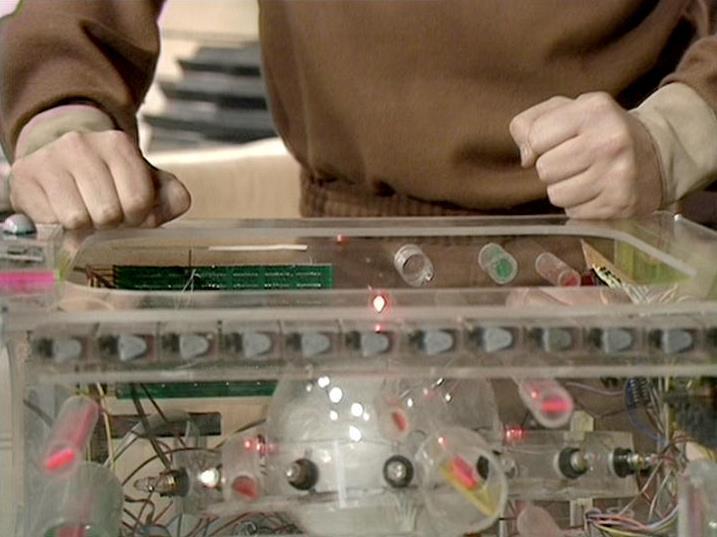
Series C, Episode 04 - Dawn of the Gods
ORAC: The chances are that had the game continued as it should have done, I would have won control of the galaxy on a probability of ten thousand four hundred and fifty to one.
TARRANT: Orac, it was only a game.
https://blake.torpidity.net/m/304/19
Most of you will instantly recognize the 10-second slide whistle loop Steven Stapleton sampled from “The Oimels” for a Nurse With Wound song, but this album isn’t goofy like that. Dark and soulful, it represents a piece of the expanding European free jazz scene in 1970. And it’s in my top 10 albums released by the venerable ECM label. Don’t sleep on this!
🔊 #NowPlaying on #BBCRadio3:
#NewMusicShow
- Too Much Is Never Enough
Kate Molleson presents exclusive recordings of Riot Ensemble, including Alex Paxton's Shrimp BIT Babyface. Plus new releases of the latest in cutting-edge and experimental music.
Relisten now 👇
https://www.bbc.co.uk/programmes/m002qqm2
Beam Test Performance of AstroPix sensor with 120 GeV protons
Bobae Kim, Regina Caputo, Manoj Jadhav, Sylvester Joosten, Carolyn Kierans, Henry Klest, Adrien Laviron, Richard Leys, Jessica Metcalfe, Jared Richards, Nicolas Striebig, Amanda L. Steinhebel, Daniel Violette, Maria Zurek
https://arxiv.org/abs/2602.06084 https://arxiv.org/pdf/2602.06084 https://arxiv.org/html/2602.06084
arXiv:2602.06084v1 Announce Type: new
Abstract: AstroPix is a high-voltage CMOS (HV-CMOS) monolithic active pixel sensor (MAPS) developed for precision gamma-ray imaging and spectroscopy in the medium energy regime, as well as for precise shower imaging and tracking in the Barrel Imaging Calorimeter (BIC) of the Electron Proton/Ion Collider (ePIC) detector at the future Electron-Ion Collider (EIC). We present beam test results of the AstroPix v3 sensor using a 120 GeV proton beam at the Fermilab Test Beam Facility (FTBF), performed as part of the broader experimental campaign for the BIC prototype calorimeter. The sensor's 500 um pixel pitch enabled precise measurement of the beam profile, providing important information for calorimeter performance studies. Using the measured 120 GeV proton data, we measure the energy deposit of minimum ionizing particles and use them to extract the corresponding effective depletion depth.
toXiv_bot_toot
Omg, patently wrong. To begin with, I am the one using the GTX 1650, and my video shows that it's working great even with DLSS, as opposed to the viewer with the AMD problem. And that parrotting nincompoop of an AI wants me to - what? - save time, give technical advice, make some small talk? What a big, smoking hot, pointless pile of b this technology turns out to be.
And I guess Google lets the same fucking stupid LM to determine how to recommend my video to other viewers? Great!<…
On Electric Vehicle Energy Demand Forecasting and the Effect of Federated Learning
Andreas Tritsarolis, Gil Sampaio, Nikos Pelekis, Yannis Theodoridis
https://arxiv.org/abs/2602.20782 https://arxiv.org/pdf/2602.20782 https://arxiv.org/html/2602.20782
arXiv:2602.20782v1 Announce Type: new
Abstract: The wide spread of new energy resources, smart devices, and demand side management strategies has motivated several analytics operations, from infrastructure load modeling to user behavior profiling. Energy Demand Forecasting (EDF) of Electric Vehicle Supply Equipments (EVSEs) is one of the most critical operations for ensuring efficient energy management and sustainability, since it enables utility providers to anticipate energy/power demand, optimize resource allocation, and implement proactive measures to improve grid reliability. However, accurate EDF is a challenging problem due to external factors, such as the varying user routines, weather conditions, driving behaviors, unknown state of charge, etc. Furthermore, as concerns and restrictions about privacy and sustainability have grown, training data has become increasingly fragmented, resulting in distributed datasets scattered across different data silos and/or edge devices, calling for federated learning solutions. In this paper, we investigate different well-established time series forecasting methodologies to address the EDF problem, from statistical methods (the ARIMA family) to traditional machine learning models (such as XGBoost) and deep neural networks (GRU and LSTM). We provide an overview of these methods through a performance comparison over four real-world EVSE datasets, evaluated under both centralized and federated learning paradigms, focusing on the trade-offs between forecasting fidelity, privacy preservation, and energy overheads. Our experimental results demonstrate, on the one hand, the superiority of gradient boosted trees (XGBoost) over statistical and NN-based models in both prediction accuracy and energy efficiency and, on the other hand, an insight that Federated Learning-enabled models balance these factors, offering a promising direction for decentralized energy demand forecasting.
toXiv_bot_toot
Some new music. I think i like it. heres a list of tags from the bottom of the page:-
"Tags
alternative buchla buchla 200e electronic experimental krautrock moog post-punk psychedelic synth United Kingdom"
https://vol88music.bandcamp.com/album/one
Bright Fractional Single and Multi-Solitons in a Prototypical Nonlinear Schr{\"o}dinger Paradigm: Existence, Stability and Dynamics
Robert J. Decker, A. Demirkaya, T. J. Alexander, P. G. Kevrekidis
https://arxiv.org/abs/2602.17175 https://arxiv.org/pdf/2602.17175 https://arxiv.org/html/2602.17175
arXiv:2602.17175v1 Announce Type: new
Abstract: In the present work we explore features of single and pairs of solitary waves in a fractional variant of the nonlinear Schr{\"o}dinger equation. Motivated by the recent experimental realization of arbitrary fractional exponents, upon quantifying the tail properties of such coherent structures, we detail their destabilization when the fractional exponent $\alpha$ acquires values $\alpha<1$ and showcase how the relevant destabilization is associated with collapse type phenomena. We then turn to in- and out-of-phase pairs of such waveforms and illustrate how they generically exist for arbitrary $\alpha$ when we cross the harmonic limit, i.e., for $\alpha>2$. Importantly, we use the parameter $\alpha$ as a ``bifurcation parameter'' in order to connect the harmonic ($\alpha=2$) and biharmonic ($\alpha=4$) limits. Remarkably, not only do we retrieve the instability of all solitonic pairs in the biharmonic case, but showcase a stabilization feature of particular branches of such multipulses that is {\it unique} to the fractional case and does not arise -- to our knowledge -- for integer multi-pulse settings. We explain systematically this stabilization via spectral analysis and expand upon the implications of our results for the potential observability of fractional multipulse solitary waves.
toXiv_bot_toot
Experimental study of turbulent thermal diffusion of inertial particles in a convective turbulence forced by oscillating grids
E. Elmakies, O. Shildkrot, N. Kleeorin, A. Levy, I. Rogachevskii
https://arxiv.org/abs/2602.22008
Proc3D: Procedural 3D Generation and Parametric Editing of 3D Shapes with Large Language Models
Fadlullah Raji, Stefano Petrangeli, Matheus Gadelha, Yu Shen, Uttaran Bhattacharya, Gang Wu
https://arxiv.org/abs/2601.12234 https://arxiv.org/pdf/2601.12234 https://arxiv.org/html/2601.12234
arXiv:2601.12234v1 Announce Type: new
Abstract: Generating 3D models has traditionally been a complex task requiring specialized expertise. While recent advances in generative AI have sought to automate this process, existing methods produce non-editable representation, such as meshes or point clouds, limiting their adaptability for iterative design. In this paper, we introduce Proc3D, a system designed to generate editable 3D models while enabling real-time modifications. At its core, Proc3D introduces procedural compact graph (PCG), a graph representation of 3D models, that encodes the algorithmic rules and structures necessary for generating the model. This representation exposes key parameters, allowing intuitive manual adjustments via sliders and checkboxes, as well as real-time, automated modifications through natural language prompts using Large Language Models (LLMs). We demonstrate Proc3D's capabilities using two generative approaches: GPT-4o with in-context learning (ICL) and a fine-tuned LLAMA-3 model. Experimental results show that Proc3D outperforms existing methods in editing efficiency, achieving more than 400x speedup over conventional approaches that require full regeneration for each modification. Additionally, Proc3D improves ULIP scores by 28%, a metric that evaluates the alignment between generated 3D models and text prompts. By enabling text-aligned 3D model generation along with precise, real-time parametric edits, Proc3D facilitates highly accurate text-based image editing applications.
toXiv_bot_toot
Demonstration of High-Gain Harmonic Lasing in a Terahertz Free-Electron Laser
Yin Kang, Cheng Yu, Yue Wang, Weiyi Yin, Zhangfeng Gao, Hanghua Xu, Hang Luo, Jian Chen, Taihe Lan, Xiaoqing Liu, Jinguo Wang, Huan Zhao, Fei Gao, Liping Sun, YanYan Zhu, Yongmei Wen, Chengcheng Xiao, Yongfang Liu, Yixuan Liu, Xingtao Wang, Jiaqiang Xu, Zheng Qi, Tao Liu, Bin Li, Kaiqing Zhang, Zhen Wang, Chao Feng, Bo Liu, Zhentang Zhao
https://arxiv.org/abs/2602.13743 https://arxiv.org/pdf/2602.13743 https://arxiv.org/html/2602.13743
arXiv:2602.13743v1 Announce Type: new
Abstract: Compact Free-Electron Lasers (FELs) offering broad, continuous spectral tunability are traditionally constrained by fixed-parameter magnetic structures and the necessity for high-energy electron beams. High-gain Harmonic Lasing (HL) has long been proposed as a solution to overcome these limitations; however, a robust experimental verification of this principle has remained absent. Here, we report the first experimental demonstration of high-gain HL. By employing a frequency-tunable electron beam density modulation to dominate the fundamental instability, we achieved sustained FEL amplification at the 3rd and 5th harmonics of the wiggler. The HL mode generated output power comparable to conventional fundamental operation with enhanced stability and narrower spectral bandwidth. Notably, we demonstrate that HL extends the spectral coverage by a factor of two under fixed facility constraints, achieving pulse energies up to 540 {\mu}J. These results establish high-gain HL as a versatile mechanism for advancing compact, wavelength-flexible FEL facilities.
toXiv_bot_toot
End Cover for Initial Value Problem: Complete Validated Algorithms with Complexity Analysis
Bingwei Zhang, Chee Yap
https://arxiv.org/abs/2602.00162 https://arxiv.org/pdf/2602.00162 https://arxiv.org/html/2602.00162
arXiv:2602.00162v1 Announce Type: new
Abstract: We consider the first-order autonomous ordinary differential equation \[ \mathbf{x}' = \mathbf{f}(\mathbf{x}), \] where $\mathbf{f} : \mathbb{R}^n \to \mathbb{R}^n$ is locally Lipschitz. For a box $B_0 \subseteq \mathbb{R}^n$ and $h > 0$, we denote by $\mathrm{IVP}_{\mathbf{f}}(B_0,h)$ the set of solutions $\mathbf{x} : [0,h] \to \mathbb{R}^n$ satisfying \[ \mathbf{x}'(t) = \mathbf{f}(\mathbf{x}(t)), \qquad \mathbf{x}(0) \in B_0 . \]
We present a complete validated algorithm for the following \emph{End Cover Problem}: given $(\mathbf{f}, B_0, \varepsilon, h)$, compute a finite set $\mathcal{C}$ of boxes such that \[ \mathrm{End}_{\mathbf{f}}(B_0,h) \;\subseteq\; \bigcup_{B \in \mathcal{C}} B \;\subseteq\; \mathrm{End}_{\mathbf{f}}(B_0,h) \oplus [-\varepsilon,\varepsilon]^n , \] where \[ \mathrm{End}_{\mathbf{f}}(B_0,h) = \left\{ \mathbf{x}(h) : \mathbf{x} \in \mathrm{IVP}_{\mathbf{f}}(B_0,h) \right\}. \]
Moreover, we provide a complexity analysis of our algorithm and introduce a novel technique for computing the end cover $\mathcal{C}$ based on covering the boundary of $\mathrm{End}_{\mathbf{f}}(B_0,h)$. Finally, we present experimental results demonstrating the practicality of our approach.
toXiv_bot_toot
So Musk bought Twitter for 40 billion and then merged it with his experimental AI company that has never made any money and then sold it to the other company he mostly owns (which exists only due to massive government subsidy) for 250 billion dollars.
This sale based on the ludicrous lie that data-centers might be built in orbit.
It's a living I guess.
https://www.theinformation.com/briefings/elon-musk-says-spacex-acquired-xai
🔊 #NowPlaying on #BBCRadio3:
#NewMusicShow
- Can you hear me now?
Experimental music including Ruth Morley's Reef, Karen Power's Can you hear me now? and a work for worldless chorus written in response to the Russian invasion of Ukraine.
Relisten now 👇
https://www.bbc.co.uk/programmes/m002qgzg
Gamma Imagers for Nuclear Security and Nuclear Forensics: Recommendations based on results from a side-by-side intercomparison
L. E. Sinclair, P. R. B. Saull, A. McCann, A. M. L. MacLeod, N. J. Murtha, A. El-Jaby, G. Jonkmans
https://arxiv.org/abs/2602.00826 https://arxiv.org/pdf/2602.00826 https://arxiv.org/html/2602.00826
arXiv:2602.00826v1 Announce Type: new
Abstract: Nuclear security operations and forensic investigations require the utilization of a suite of instruments ranging from passive gamma spectrometers to high-precision laboratory sample analyzers. Gamma spectroscopy survey is further broken down into wide-area search performed with large-volume scintillator-based mobile survey spectrometers which are integrated with geographic position sensors for mapping and identification of hot zones, and high-precision long-dwell measurements using solid state spectrometers for follow-on characterization to establish isotopic content and ratios. While performing well at detecting the presence, quantity and type of radioactivity, all of these methods have limited ability to determine the location of a source of radioactivity. In recent years, technology advances have resulted in gamma imager devices which can create an image of the distribution of radioactive sources using the gamma emissions which accompany radioactive decay, and overlay this on an optical photograph of the environment. These gamma imaging devices have arisen out of methods developed for medical physics, experimental particle physics, and astrophysics, resulting in a proliferation of different technological approaches. Those responsible for establishing a nuclear security concept of operations, require guidance to choose the proper gamma imager for each of the application spaces in a tiered response. Here the results of an intercomparison of two gamma imagers based on two widely different technologies, semiconductor and scintillator detectors, are presented. The optimal utilization of these imaging technologies in a tiered response is discussed based on the results of the trial. Finally, an outlook on future directions for gamma imaging advances is provided.
toXiv_bot_toot
Formation of Hydroxyl Anion via a 2-Particle 1-Hole Feshbach Resonance in DEA to 2-Propanol: A Joint Experimental and Theoretical Study
Siddique Ali, Meeneskhi Rana, Soumya Ghosh, Narayan Kundu, Aryya Ghosh, Dhananjay Nandi
https://arxiv.org/abs/2602.17325
On the spatial structure and intermittency of soot in a lab-scale gas turbine combustor: Insights from large-eddy simulations
Leonardo Pachano, Daniel Mira, Abhijit Kalbhor, Jeroen van Oijen
https://arxiv.org/abs/2602.23155 https://arxiv.org/pdf/2602.23155 https://arxiv.org/html/2602.23155
arXiv:2602.23155v1 Announce Type: new
Abstract: This work presents a numerical investigation of soot formation in the Cambridge lab-scale gas turbine combustor. Large-eddy simulations (LES) of a swirl-stabilized ethylene flame are performed using the flamelet generated manifold method coupled with a discrete sectional model to account for soot formation, growth, and oxidation. The study aims to elucidate the mechanism governing the spatial structure and intermittency of soot, supported by comparisons with experimental data. The predicted soot distribution agrees well with measurements, with peak concentrations near the bluff body. Flow recirculation is identified as the key mechanism driving soot accumulation in fuel-rich regions, where surface reactions dominate soot mass growth. Soot intermittency arises from fluctuations in the flow field driven by interactions between the flame front and the recirculation vortex. Two soot modeling approaches are evaluated, differing in their treatment of soot model quantities: the first approach employs on-the-fly computation of source terms (FGM-C), while the second uses fully pre-tabulated source terms (FGM-T). Their predictive performance and computational cost are compared in the context of unsteady, sooting flames in swirl-stabilized combustors.
toXiv_bot_toot
Calibratable Disambiguation Loss for Multi-Instance Partial-Label Learning
Wei Tang, Yin-Fang Yang, Weijia Zhang, Min-Ling Zhang
https://arxiv.org/abs/2512.17788 https://arxiv.org/pdf/2512.17788 https://arxiv.org/html/2512.17788
arXiv:2512.17788v1 Announce Type: new
Abstract: Multi-instance partial-label learning (MIPL) is a weakly supervised framework that extends the principles of multi-instance learning (MIL) and partial-label learning (PLL) to address the challenges of inexact supervision in both instance and label spaces. However, existing MIPL approaches often suffer from poor calibration, undermining classifier reliability. In this work, we propose a plug-and-play calibratable disambiguation loss (CDL) that simultaneously improves classification accuracy and calibration performance. The loss has two instantiations: the first one calibrates predictions based on probabilities from the candidate label set, while the second one integrates probabilities from both candidate and non-candidate label sets. The proposed CDL can be seamlessly incorporated into existing MIPL and PLL frameworks. We provide a theoretical analysis that establishes the lower bound and regularization properties of CDL, demonstrating its superiority over conventional disambiguation losses. Experimental results on benchmark and real-world datasets confirm that our CDL significantly enhances both classification and calibration performance.
toXiv_bot_toot
🔊 #NowPlaying on #BBCRadio3:
#20thCenturyRadicals
- Alvin Lucier: Sounds unheard
Kate Molleson and Gillian Moore shine new light on the 'modern' music of the 20th century. This week, Kate explores the experimental sound environments of Alvin Lucier.
Relisten now 👇
https://www.bbc.co.uk/programmes/m002rhrf
Read "How To Survive In A Science Fiction Universe" by Charles Yu, a novel about a time-machine repair-man getting stuck in a loop during his search for his father.
First person narrated, in a fictional universe in which you can travel in time but you can't change anything about the past.
It was fun and an easy read, lots of interludes about the physics of fictional universes and explanations of acausal items causing their own existence, including the book itself that you read in your hands.
Its nice if you'd like something with experimental narrative form twisting the usual story format.
#reading #books #charlesYu
Kelvin wave and soliton propagation in classical viscous vortex filaments
Elio Sterkers, Giorgio Krstulovic
https://arxiv.org/abs/2602.22439 https://arxiv.org/pdf/2602.22439 https://arxiv.org/html/2602.22439
arXiv:2602.22439v1 Announce Type: new
Abstract: Vortex filaments are highly rotating localized structures of fluids that admits several types of excitation. Here, we study them by using numerical simulations of the three-dimensional incompressible Navier-Stokes equations. We first address the propagation of Kelvin waves, helicoidal excitations propagating along the filament, and measure their dispersion relation which turns out to be in good agreement with the original Lord Kelvin predictions. Then, inspired by the connection between vortex line dynamics and an integrable system, we show numerically the existence of solitons propagating along vortex filaments and study the collision of two of such structures. Finally, we show numerically the experimental feasibility of studying vortex solitons in the lab, by proposing an experiment for their generation.
toXiv_bot_toot
Replaced article(s) found for physics.acc-ph. https://arxiv.org/list/physics.acc-ph/new
[1/1]:
- Classical and quantum beam dynamics simulation of the RF photoinjector test bench
Dyatlov, Kobets, Levichev, Maksimov, Nikiforov, Nozdrin, Popov, Sibiryakova, Yunenko, Karlovets
https://arxiv.org/abs/2509.00732 https://mastoxiv.page/@arXiv_physicsaccph_bot/115139328955562484
- First Experimental Demonstration of Beam Storage by Three-Dimensional Spiral Injection Scheme for...
Matsushita, Iinuma, Ohsawa, Nakayama, Furukawa, Ogawa, Saito, Mibe, Rehman
https://arxiv.org/abs/2602.01504 https://mastoxiv.page/@arXiv_physicsaccph_bot/116005767460963446
- Generation of high-OAM ultraviolet twisted light for RF-photoinjector applications
Dyatlov, Dolgintsev, Gerasimov, Kobets, Nazmov, Nozdrin, Sergeev, Shokin, Yunenko, Karlovets
https://arxiv.org/abs/2512.08442 https://mastoxiv.page/@arXiv_quantph_bot/115694829644210242
toXiv_bot_toot
Acoustic Signatures of Pinch-Off Cavities During Water-Entry
Zirui Liu, Tongtong Ding, Mingyue Kuang, Zimeng Li, Junyi Zhao, A-Man Zhang, Shuai Li
https://arxiv.org/abs/2602.22761 https://arxiv.org/pdf/2602.22761 https://arxiv.org/html/2602.22761
arXiv:2602.22761v1 Announce Type: new
Abstract: This study experimentally, numerically, and theoretically investigates the cavity/bubble dynamics and radiated acoustics during the water entry of a centimeter-scale cylindrical projectile with a conical nose. Experiments were conducted in a laboratory tank, employing synchronized high-speed imaging and hydrophone measurements to characterize the cavity closure modes and their resultant acoustic signatures across a range of Froude numbers. The acoustic signal features a weak radiated signal upon impact, followed by significant pressure oscillations spanning more than 20 cycles in the flow field after cavity elongation and pinch-off. A numerical model based on the Finite Volume Method (FVM) successfully captures these physical processes. Subsequently, a semi-theoretical model that incorporates the projectile's boundary effect is developed from potential flow theory. The model not only yields a dominant cavity oscillation frequency that agrees well with experimental data, but also reveals that the boundary effect leads to a cavity oscillation frequency markedly higher than the Minnaert frequency of an equivalent-volume ellipsoidal bubble containing an internal rigid core. The dominant cavity frequency falls nearly linearly with Fr, governed by nose geometry and projectile inertia. This study clarifies the underlying physics connecting cavity dynamics during water entry to underwater acoustic radiation.
toXiv_bot_toot
🔊 #NowPlaying on #BBCRadio3:
#NewMusicShow
- The Art of Sinking
The latest in experimental new music including Ben Nobuto's The Art of Sinking for keyboard and child's voice and an Improvisation from Heiner Goebbels and Raymond MacDonald.
Relisten now 👇
https://www.bbc.co.uk/programmes/m002prfw
Large eddy simulation of turbulent swirl-stabilized flames using the front propagation formulation: impact of the resolved flame thickness
Ruochen Guo, Yunde Su, Yuewen Jiang
https://arxiv.org/abs/2602.21940 https://arxiv.org/pdf/2602.21940 https://arxiv.org/html/2602.21940
arXiv:2602.21940v1 Announce Type: new
Abstract: This work extends the front propagation formulation (FPF) combustion model to large eddy simulation (LES) of swirl-stabilized turbulent premixed flames and investigates the effects of resolved flame thickness on the predicted flame dynamics. The FPF method is designed to mitigate the spurious propagation of under-resolved flames while preserving the reaction characteristics of filtered flame fronts. In this study, the model is extended to account for non-adiabatic effects and is coupled with an improved sub-filter flame speed estimation that resolves the inconsistency arising from heat-release effects on local sub-filter turbulence. The performance of the extended FPF method is validated by LES of the TECFLAM swirl-stabilized burner, where the results agree well with experimental measurements. The simulations reveal that the stretching of vortical structures in the outer shear layer leads to the formation of trapped flame pockets, which are identified as the physical mechanism responsible for the secondary temperature peaks observed in the experiment. The prediction of this phenomenon is shown to be strongly dependent on the resolved flame thickness, when the filter size is used for modeling sub-filter flame wrinklings. Without proper modeling of the chemical steepening effects, the thickness of the resolved flame brush is over-predicted, causing the flame consumption rate to be under-estimated. Consequently, the flame brush detaches from the outer shear layer, resulting in a failure to capture the flame pockets and the associated secondary temperature peaks.
toXiv_bot_toot
A minimal wake-vortex model explains formation flight of flapping birds
Olivia Pomerenk, Kenneth S. Breuer
https://arxiv.org/abs/2602.22043 https://arxiv.org/pdf/2602.22043 https://arxiv.org/html/2602.22043
arXiv:2602.22043v1 Announce Type: new
Abstract: Collective patterns of motion emerge across biological taxa: insects swarm, fish school, and birds flock. In particular, large migratory birds form strikingly ordered V-shaped formations, which experiments and direct numerical simulations have demonstrated provide substantial energetic benefits during long-distance flight. However, the precise aerodynamic and morphological mechanisms underlying these benefits remain unclear. In this work, we develop a reduced-order model of the wake-vortex interactions between two flapping birds flying in tandem. The model retains essential unsteady flapping dynamics while remaining computationally tractable. By optimizing over a six-dimensional state space, which comprises the follower's three-dimensional relative position and three independent flapping parameters, we identify the energetically optimal leader-follower configuration of northern bald ibises. The predicted optimum agrees quantitatively with live-bird measurements. Because of its simplicity, the model allows for direct interrogation of the physical mechanisms responsible for this optimum. In particular, it isolates precisely how the follower's wing kinematics interact with the leader's wake to enhance aerodynamic efficiency. The model predicts an 11% reduction in total mechanical power for a follower in formation flight -- consistent with experimental estimates -- and shows that this saving arises from reductions in both induced and profile power, dominated by decreased profile power enabled primarily through reduced flapping amplitude and, secondarily, reduced upstroke flexion. These results provide a mechanistic explanation for the structure of V-formations and offer new insight into the aerodynamic principles governing collective flight.
toXiv_bot_toot
🇺🇦 #NowPlaying on BBCRadio3's #NewMusicShow
Cergio Prudencio & Orquesta Experimental de Instrumentos Nativos:
🎵 Lamento
#CergioPrudencio #OrquestaExperimentaldeInstrumentosNativos
🇺🇦 #NowPlaying on BBCRadio3's #NightTracks
Cergio Prudencio, Orquesta Experimental de Instrumentos Nativos & Cergio Prudencio:
🎵 Cantos de Tierra (extract)
#CergioPrudencio #OrquestaExperimentaldeInstrumentosNativos
 @Techmeme@techhub.social
















































![YouTube offering me to use AI suggested answers to viewers comment and sounding like a moron.
@j.a7299 • 5 hours ago
How did u get it to work, my game freezes less than a minute in.
Im on nobara linux
6900xt
5600x
32 gb ram
KDE plasma latest version
Latest mesa drivers
Tried proton versions: ge, cachy (latest), experimental
Reply
0 replies
Replies [to be] made with AI:
Suggestion 1:
The 1650 isn't very powerful to begin with, so perhaps that's why you're having issues, especially w…](https://cdn.masto.host/socialpetertoushkoveu/media_attachments/files/115/778/620/339/960/813/original/bea8fa4113b0b651.jpg)