 @Dragofix@veganism.social
2025-12-29 21:08:07
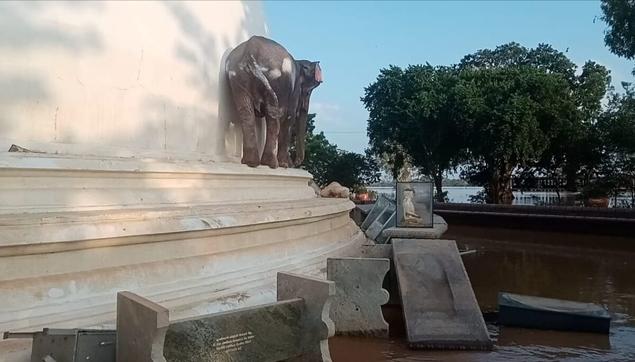
Beyond human loss, floods from Cyclone Ditwah devastate Sri Lanka’s wildlife https://news.mongabay.com/2025/12/beyond-human-loss-floods-from-cyclone-ditwah-devastate-sri-lankas-wildlife/
 @arXiv_csHC_bot@mastoxiv.page
2025-10-13 08:44:20
MLLM as a UI Judge: Benchmarking Multimodal LLMs for Predicting Human Perception of User Interfaces
Reuben A. Luera, Ryan Rossi, Franck Dernoncourt, Samyadeep Basu, Sungchul Kim, Subhojyoti Mukherjee, Puneet Mathur, Ruiyi Zhang, Jihyung Kil, Nedim Lipka, Seunghyun Yoon, Jiuxiang Gu, Zichao Wang, Cindy Xiong Bearfield, Branislav Kveton
https://

 @arXiv_csLG_bot@mastoxiv.page
2025-10-02 11:10:01
A Practitioner's Guide to Multi-turn Agentic Reinforcement Learning
Ruiyi Wang, Prithviraj Ammanabrolu
https://arxiv.org/abs/2510.01132 https://arxiv.o…

 @paulbusch@mstdn.ca
2025-11-11 13:08:08
Good Morning #Canada
Before #WWII, Canada could still be considered a tiny nation in terms of our influence on world affairs. But after the conflict broke out, we contributed well beyond expectations and our navy was an example. The Royal Canadian Navy (RCN) started the war with only 13 vessels, but when WWII ended, we had the 4th largest navy in the world. By 1945 the RCN had 450 ships in all, plus many smaller auxiliary units. This 1945 figure breaks down as follows: 2 cruisers, 17 destroyers, 68 frigates, 112 corvettes, 67 minesweepers, 12 escort ships, 75 Fairmile motor launches. During WWII, Canadian shipyards built a total of 4,047 naval vessels and 410 merchant ships for a grand total of 4,457 ships. The naval vessels included over 300 anti-submarine warships, as well as thousands of landing craft, escort ships, minesweepers, and tugs.
#CanadaIsAwesome #RemembranceDay
https://www.britannica.com/topic/Royal-Canadian-Navy/Second-World-War