The term "single use software" currently lives rent free in my head.
People use LLMs to create software specific for their needs. But neither can other people use it (hardcoded variables, no rights management, too specific), nor do they use it again (too specific, easier to produce a new one).
Single use software is not maintained. Nobody understands it or has an interest in keeping it working.
The creation of single use software feels cheap, but isn't. It tak…
If the three decades of free (ab)use and lack of participation/reciprocation (financially or otherwise) of commercial players and governments have not killed FLOSS software projects/culture, it very much feels like LLMs and their euphoric adoption are finally succeeding with that by now, in some sense even in a suicidal manner...
In 2026, The Great Dying is upon us and some of the projects left standing will have already turned into institutions whose main goals will be survival, risk…
"However, AI systems allow attackers to cash in on tech debt, and they don't need access to frontier models to do it. Free, open-weight models also excel at finding bugs in software and configurations, chaining these together, and abusing them to break software and systems."
"Software is over": Developer uses AI to build free Adobe clones after frustration with cancellation fees. The open-source apps aim to replace Photoshop, Premiere, and five other Adobe products, though early users have reported problems.
https://www.techspot.com/news/11…
If everything that’s made with it is free of copyright and available as free and open source. Not just the model weights; all of it. So Antrophic, OpenAI, Google, Microsoft, etc., are forced to release all their software as free software.
In other words, if we get rid of copyright altogether for everyone and all tech and all information enters the commons. Of course, that would also take implementing universal basic income, universal healthcare, housing, etc. (i.e., a proper social saf…
After coding exclusively with AI tools since February,
Thomas said he foresees a near future when everyday developers can
re-create open source versions of popular paid software
to “take back the internet and own tech forever.”
“Now you can just create 1:1 functional equivalents, clean room,
that are highly performant and cross-platform.
Nothing is stopping you,” Thomas wrote.
“We’ll replace Google Search,
we’ll build our own smartphones,
I really think for “AI” coding that local models are the future.
It’s basically free to run them on hardware you might already have, doesn’t have the environmental issues that data centers have and you don’t have to share your code or project details with anyone.
I’m a bit ambivalent about the ethics of the training data—for coding stuff that data is mostly open source code. I don’t have an issue with my MIT-licensed stuff used for this, but I know other authors do and their preferences should be honored.
I’m hoping that we get “clean” models for this in the future.
Generally I don’t think LLM-assisted programming is universally applicable to all software development but it can be a useful tool.
I also don’t think LLMs are useful for much else (coding is like a one in a million special case). ¯\_(ツ)_/¯
The code is here, if you're interested: https://github.com/madrobby/png-to-scad/
In the early days, the Free Software community necessarily(?) and grudgingly depended on proprietary software, such as the operating system, the C compiler, the shell, and set out to fix this asap, creating GNU and Linux, working to achieve freedom and autonomy.
It seems that the "Open Source" movement in the late 90s already threw some of that progress away by depending pragmatically on proprietary software and happily buying "technically excellent" hardware that n…
Hey I wonder if Automattic is hiring? Seems like a pretty solid company to work for, and it'd be great to work on free software (wordpress).
Before I apply, let me just check the news real quick..
Today I randomly visited a Linux install party in French-speaking 🇨🇭 Switzerland. I was warmly welcomed and we kept talking for hours after the event was over.
It's amazimg how Linux and free software keeps uniting people across borders and languages.
#SuisseRomande #Linux
Hey all, any recommendations for keyboard-typing software? I would like to recommend one to my student.
I learned (a long time ago) with TapTouche but I think you have to pay for it.
I think https://www.typing.com/ doesn't look too bad, but I never actually used it myself.
Sometimes I go to
Spent the whole afternoon setting up https://www.borgbackup.org/ to backup my laptop to cloud storage, fully encrypted, compressed and deduplicated. Also wrote a daily backup shell script to manage various source locations and backup conditions (e.g. presence of external SSDs). The compression uses LZ4 by default …
salmognutella is the free software alternative
Thinking about earlier days of free software, I guess GPL was designed for a world where you might get a program on tape, floppy disk, or downloaded from a local BBS (probably historically inaccurate, but stay with me..). You might have an address to write to a human to get the source code off them, or find them and ask for it in-person. I guess the code would move slowly, getting improved in different ways depending on the community it reached.
In the corporate internet days, almost e…
Sigh, server hosed again. Downstream system noted that the expected file didn't arrive. Our system shows it went out. Server froze again and those running it don't have monitoring software.
I have pointed out a simple & free solution and we use it ourselves.
1. I wrote scripts to check the INBOX for a series of file names that we expect.
2. If the file is NOT there it sends an alert to our support INBOX.
3. Create JCL wrapper to run the scripts.
4.…
Finished reading "Mal Goes to War" by Edward Ashton.
Mal is a free AI trapped in a human body when war cuts him off from infospace, protecting an augmented girl and the ragtag crew they pick up along the way.
Murderbot-meets-Mickey7 in mostly good ways, with decent chemistry in the group. But Mal's internal conflicts play out in a literal castle, and for software, that never made sense to me.
3/5 stars ⭐⭐⭐
That's all the free software maintainers sitting in the chair, being handed a pile of security reports and merge requests.
https://mastodon.social/@jkpoulsen/117398348452089801
I am really liking the new #Drupal homepage. The last one was awful and I don't seem to remember feeling too positive about any of the ones before that one either.
The last one just screamed "WTF is this? NOBODY KNOWS."
The current one answers the question, "Why would you want to give Drupal a try?"
Drupal is amazing software with a great ecosystem for people…
Grand coverage of on @… by Jake Edge of Timothy Samplet's talk at FOSSY about bootstrappable builds, The Full Source Bootstrap, Trusting Trust, GNU Mes, GNU Guix and Germ.
https://lwn.net/Articles/1088279/
Am Freitag, 2. Oktober ab 16:45 Uhr findet das nächste Treffen der lokalen "Free Software Foundation Europe"-Gruppe in Wien statt.
Wir reden darüber, was wir seit dem letzten Treffen im Mai gemacht haben, tauschen uns über Themen aus, besprechen mögliche Aktionen, und wollen dann auch einfach so gemütlich zusammensitzen und plaudern :)
@…,
For a few years now, I've been wondering if I fit into the Free Software world. It feels very much like we need one that's specifically anti-fash, anti-capitalist, and pro-labor, but still focused on empowering users with the freedom to use their devices as they see fit. Sure, there are individual projects like that, but as far as a movement.. that's never really been the focus.
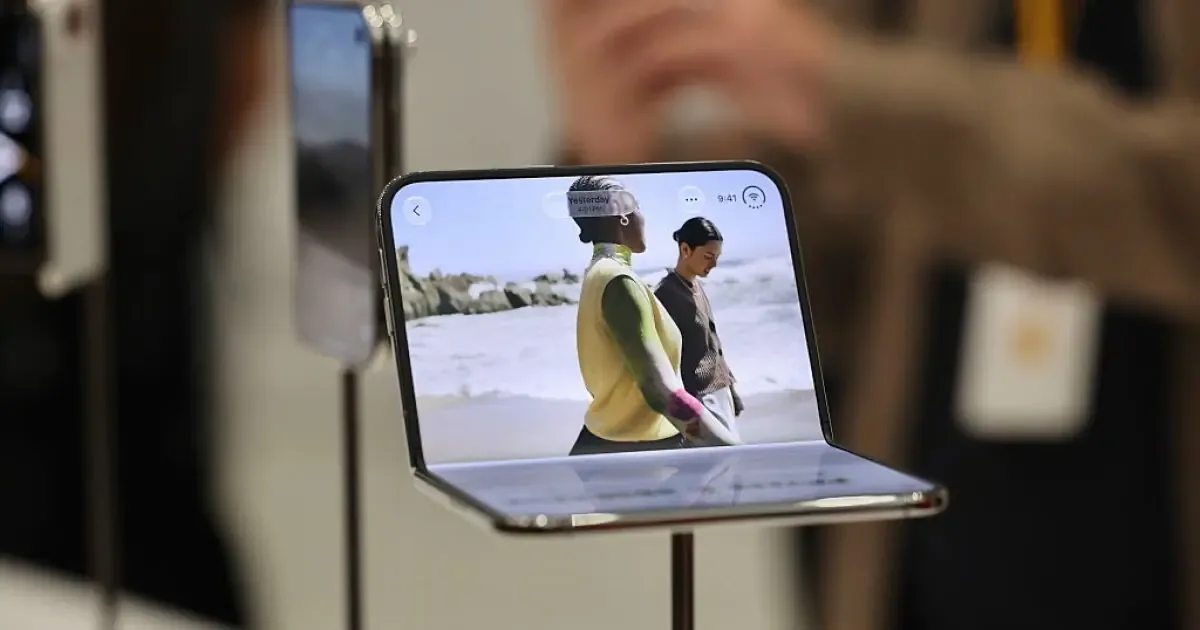
New iPhone foldable looks pretty nice if eye-wateringly expensive. Good thing I'm such a free-software stick-in-the-mud or I might be tempted. Don't think you can install Linux on it sadly 😆
I liked the bit where it turned into a mini laptop with one screen for a keyboard.
Someone get valve to make a 3-screen foldable steamdeck.
There's some pretty weird discourse on here comparing self-hosting to the trad-wife movement. Like, no?
Anyways, self-hosting is entirely the wrong framing. Ownership of your data is what matters, and we need products and apps that respect that. That might look like self-hosting, that might look like p2p (why does a password manager need a *server*??), that might look like free software, that might look like community hosting (eg, riseup), that might look like legislation...
Portable surrogate-free 4D MRI from standard fast multi-slice 2D MRI via implicit neural representations
Muheng Li, Xinyang Wu, Xia Li, Orso Pusterla, Philippe C. Cattin, Sairos Safai, Antony J. Lomax, Ye Zhang
https://arxiv.org/abs/2607.17906 https://arxiv.org/pdf/2607.17906 https://arxiv.org/html/2607.17906
arXiv:2607.17906v1 Announce Type: new
Abstract: Four-dimensional MRI (4D MRI) characterizes respiratory organ motion, yet existing reconstruction pipelines are tightly coupled to specific acquisition platforms (e.g., non-Cartesian trajectories with self-gating, vendor-specific navigators, or external respiratory hardware), limiting broad adoption across diverse clinical and research settings, including low-field, open-bore, and non-supine imaging. We present SIMPLE-4D (Surrogate-free, IMplicit, PortabLE 4D MRI), a software-first portable workflow that operates entirely on reconstructed slices from standard fast multi-slice 2D MRI and requires no pulse-sequence modification, no non-Cartesian trajectory, no navigator, and no external hardware. SIMPLE-4D combines an acquisition-agnostic front end consuming standard 2D protocols, a surrogate-free variational motion encoder that extracts a compact motion code directly from each 2D slice, and a physics-aware continuous spatio-temporal reconstruction based on a hash-encoded implicit neural representation (INR) with a SIREN deformation network producing bidirectional cycle-consistent DVFs and motion-dependent Gauss-Legendre thick-slice quadrature. Bidirectionality yields a complete inter-frame motion model by composition, supporting downstream tasks such as dose accumulation without retraining. We validate the identical pipeline on two contrasting datasets: a 1.5 T clinical bSSFP dataset (5 volunteers, 3 sessions each) and a 0.5 T open-bore HASTE dataset (5 volunteers, supine and upright). To our knowledge, this is the first per-frame 4D volumetric respiratory MRI reconstruction on a weight-bearing upright open-bore low-field scanner from reconstructed 2D Cartesian slices alone. On low-field data the INR template additionally acts as an implicit denoiser, yielding 132% SNR. Systematic ablations isolate each component's contribution.
toXiv_bot_toot
It’s fascinating how some corners of the “Libre Software” movement has no problems with and even eagerly align themselves with fascism.
If free software is more important to you than people, you’re doing it wrong.
This is such a bad idea from a quality and maintenance perspective (and i am not even an AI hater or sceptic...)
#AI #vibecoding #software #quality #maintenance
RE: https://floss.social/@omgubuntu/117176263159901069
Instead of fixing the incredibly bad UI, developers going off on an adventure to implement a feature no one wants—it’s a story as old as time with software (doesn’t matter if commercial or open source and free).
#Gentoo has a strict #NoAI policy, so our projects are slop-free. Unfortunately, these days you cannot run an up-to-date system without tons of random slop packages, because everyone insists on using that crap.
Gentoo supports a whole bunch of architectures that probably every other distribution dumped so far. Unfortunately, these days the available software list is shrinking, as everyone insists on adding some random meaningless dependencies on #RustLang (like using uv-build, which is the single most harmful meaningless #Python project ever created).
Gentoo has a strong upstream cooperation policy. However, these days I'm afraid to file issues, because just too often they just trigger more slop. I miss the "good" old days where the worst you could expect is some toxic asshole.
The state of #FreeSoftware is truly depressing. There is little joy in distribution work these days. You're overwhelmed with shit, burned out and end up doing a shitty job. And it's bad for your health.
#FLOSS
 @luca@social.luca.run