Triaxiality of the Milky Way dark matter halo and the microlensing optical depth towards the Large Magellanic Cloud
J. Garc\'ia-Bellido, M. R. S. Hawkins
https://arxiv.org/abs/2609.08988 https://arxiv.org/pdf/2609.08988 https://arxiv.org/html/2609.08988
arXiv:2609.08988v1 Announce Type: new
Abstract: The microlensing optical depth towards the Large Magellanic Cloud (LMC), $\tau_{\rm LMC}$, bounds the compact-object fraction of the Galactic dark matter halo, but is almost always evaluated for a spherical halo. We compute it for triaxial haloes and show that the shape dependence is carried entirely by the projection of the line of sight onto the halo principal axes: for a scale-free halo $\rho\propto R^{-\alpha}$ at fixed local density it factorises exactly as $\tau/\tau_{\rm sph}=S_\odot^{\alpha}\langle S^{-\alpha}\rangle_w$, with $S(\Omega)$ the ellipsoidal shape function. The LMC lies only $0\fdg78$ from perpendicular to the Sun-Galactic Centre line, making it a near-optimal probe of in-plane elongation and a poor probe of vertical flattening. For the halo shapes favoured by \textit{Gaia} we find $\tau_{\rm LMC}/\tau_{\rm sph}=0.95$--$1.15$ at fixed local density, $1.57$ for the Law-Majewski logarithmic potential, and $0.67$--$1.54$ when the major-axis azimuth is left free. For the Einasto halo required by the declining \textit{Gaia} DR3 rotation curve, truncation near $25\kpc$ is offset by the larger local density it implies and $\tau$ falls by only $7$--$15$ per cent; but the median lens distance moves inwards from $13.4$ to $8.5\kpc$, where the logarithmic slope is steep and rising, amplifying the shape sensitivity: the \textit{Gaia} RR~Lyrae enhancement grows from $15$ to $23$ per cent and the orientation-free range widens to $0.62$--$1.62$. The systematic on the inferred MACHO or primordial-black-hole fraction is two-sided, of order $\pm15$ per cent for the measured shapes and a factor $2.6$ under full orientation freedom, exceeding the statistical errors of the EROS-2 and OGLE bounds.
toXiv_bot_toot
Voor wie in de buurt is van Deventer: festival de Pit is weer supergezellig. Hotel Gaia
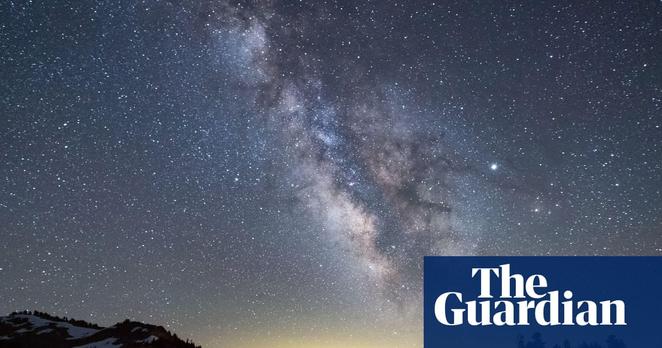
Astronomers hypothesized that the Milky Way was flipped on its side following a direct hit from a wayward galaxy long before the solar system was born.
The cataclysmic collision is thought to have taken place about 10bn years ago
when the Milky Way was struck head-on by an incoming dwarf dubbed the Gaia Sausage.
The Milky Way tore the interloper to shreds and absorbed its stars,
but the chaos unleashed in the event probably flipped the entire disc of the Milky Way by m…
If this isn't evidence for the Gaia hypothesis, I don't know what would be. It's literally an induced, prophylactic immune response to one of the most unsustainable food systems humans have. Now if we could just have a highly contagious, otherwise symptomless STD that (after a variable incubation period) caused sterility and a distinctive facial scar for any human attempting to use a car or lorry...
Closed-Form of the Local Galactic Potential and Stellar Distribution Function from Gaia DR3
Indranil Das, Adam Kamoski, Dora Demiri, Brianna Isola, Hanieh Karimi, Dmitrii S. Zagorulia
https://arxiv.org/abs/2609.09011 https://arxiv.org/pdf/2609.09011 https://arxiv.org/html/2609.09011
arXiv:2609.09011v1 Announce Type: new
Abstract: The local dark matter density determines the strength of the signal expected in direct-detection experiments, yet published estimates from stellar motions disagree by more than their errors, and the most recent machine-learning analysis of Gaia data finds a local density consistent with zero. According to Jeans' theorem, a distribution function built from integrals of motion satisfies the collisionless Boltzmann equation (CBE) trivially for any choice of potential, so a search that simultaneously fits the distribution function and the potential to the CBE identifies neither. Our pipeline instead estimates the distribution function in isolation, linearizing the equation in terms of accelerations and allowing for direct measurement of the local force field, and then fits closed forms to that field via symbolic regression. Throughout, we find that the usable information lies not in the CBE residual but in the stellar number counts, the observable most distorted by survey selection. Along the vertical profile, our recovered potential agrees with the classical self-gravitating isothermal disc.
toXiv_bot_toot
People talking to an American audience about global warming:
For the love of Gaia, use °F, not °C!
Save the world first. Get the USA on SI later.
#GlobalWarming #ClimateChange #USA
🇺🇦 #NowPlaying on KEXP's #JazzTheatre
Gaia Wilmer:
🎵 Aqui e Agora
#GaiaWilmer
Crosslisted article(s) found for astro-ph.GA. https://arxiv.org/list/astro-ph.GA/new
[3/3]:
- Physical Law Ecology: mapping multi-mechanism ecologies as the zeroth step of data-driven scienti...
Xiongheng Bian, Xiangyu Cui, Ma Feng, Xiaoyan Shen
https://arxiv.org/abs/2609.08536 https://mastoxiv.page/@arXiv_csSC_bot/117240025268605332
- Radial velocity follow-up of \textit{Gaia} astrometric substellar companions: six confirmed brown...
Marcus L. Marcussen, et al.
https://arxiv.org/abs/2609.08590 https://mastoxiv.page/@arXiv_astrophEP_bot/117240226771261973
- Compton-induced HE -- VHE $\gamma$-rays from pair cascade emissions in the SEDs of radio galaxies...
Mfuphi Ntshatsha, Markus B\"ottcher, Soebur Razzaque
https://arxiv.org/abs/2609.08787 https://mastoxiv.page/@arXiv_astrophHE_bot/117240359289783489
- Why Azimuthal Averaging Works in Halo Lensing: Symmetry and Power Counting for Nonlinear Shear an...
Keiichi Umetsu (ASIAA)
https://arxiv.org/abs/2609.08825 https://mastoxiv.page/@arXiv_astrophCO_bot/117240273367442521
- An analysis of four stellar rings
E. Paunzen, et al.
https://arxiv.org/abs/2609.08942 https://mastoxiv.page/@arXiv_astrophSR_bot/117240320949854065
- Open Clusters as Laboratories for Cool Star Evolution: Highlights from the Cool Stars 23 Splinter...
Deepak Chahal, et al.
https://arxiv.org/abs/2609.09026 https://mastoxiv.page/@arXiv_astrophSR_bot/117240331173721683
- Detection of episodic Ultra-fast Outflows in the Low-luminosity quasar Mrk 205 using XMM-Newton data
Victoria-Ceballos, Longinotti, Krongold, Lanzuisi, Gudi\~no, Lara-DI
https://arxiv.org/abs/2609.09028 https://mastoxiv.page/@arXiv_astrophHE_bot/117240376393874183
- TILING I: Field-level Bayesian reconstruction of cosmological initial conditions during the epoch...
Nikolaos Triantafyllou, Andrei Mesinger, Steven Murray, Samuel Gagnon-Hartman
https://arxiv.org/abs/2609.09102 https://mastoxiv.page/@arXiv_astrophCO_bot/117240294995454169
- Sizing the Universe with DESI Galaxy Sizes: Plain Fundamentals of Fundamental-Plane Lensing
Kun Xu, et al.
https://arxiv.org/abs/2609.09151 https://mastoxiv.page/@arXiv_astrophCO_bot/117240322128412863
toXiv_bot_toot
Replaced article(s) found for math.DG. https://arxiv.org/list/math.DG/new
[1/3]:
- Family index for Fredholm extensions of semi-Fredholm operators
Marina Prokhorova
https://arxiv.org/abs/2401.16060 https://mastoxiv.page/@arXiv_mathDG_bot/111843359116350796
- Constructing stable Hilbert bundles via Diophantine approximation
Yucheng Liu, Biao Ma
https://arxiv.org/abs/2501.15784
- Ricci Solitons of Left-Invariant Metrics on Lie Groups with Derived Algebra of Dimension at Most Two
Hamid Reza Salimi Moghaddam
https://arxiv.org/abs/2601.10730 https://mastoxiv.page/@arXiv_mathDG_bot/115920688396400257
- Mass and rigidity in almost K\"ahler geometry
Partha Ghosh
https://arxiv.org/abs/2603.08627 https://mastoxiv.page/@arXiv_mathDG_bot/116204063956883755
- Classifying Slice-Regular Polynomials via Group Actions on the Twistor Space
Chunlin Liu, Giovanni Moreno, Haipan Shi
https://arxiv.org/abs/2605.22788 https://mastoxiv.page/@arXiv_mathDG_bot/116617182455085202
- $G_2$ and the Maximally Symmetric (3, 8) Distribution with 6-Dimensional Square
Nicklas Day, Boris Doubrov, Igor Zelenko
https://arxiv.org/abs/2605.25910 https://mastoxiv.page/@arXiv_mathDG_bot/116639966776117301
- Cohn--Vossen-Type Inequalities for Three-Manifolds and Locally Conformally Flat Manifolds
Jialong Deng
https://arxiv.org/abs/2606.01368 https://mastoxiv.page/@arXiv_mathDG_bot/116679534951132380
- From Gradient Descent to Potential Theory: A Geometric Dictionary for Binary Classification
Catalin Vasii
https://arxiv.org/abs/2607.00988 https://mastoxiv.page/@arXiv_mathDG_bot/116849328935224137
- A sharp relative comparison inequality for conformal fillings of Poincar\'e--Einstein manifolds
Nan Wu
https://arxiv.org/abs/2607.13742 https://mastoxiv.page/@arXiv_mathDG_bot/116928601640640156
- A degenerate free boundary minimal annulus and non-uniqueness in spherical caps beyond the hemisp...
Alexander Pigazzini
https://arxiv.org/abs/2607.23534 https://mastoxiv.page/@arXiv_mathDG_bot/116996542129550830
- Special Lagrangians with multiple isolated singularities
Bryan Dimler, Filippo Gaia
https://arxiv.org/abs/2607.26302 https://mastoxiv.page/@arXiv_mathDG_bot/117007805427278588
- Demailly-Koll\'ar continuity on klt pairs, and applications to alpha and delta invariants
Tam\'as Darvas, Kewei Zhang
https://arxiv.org/abs/2608.23505 https://mastoxiv.page/@arXiv_mathDG_bot/117155289132945927
toXiv_bot_toot
Estimating stellar metallicities from Gaia DR3 XP data using LAMOST DR10
Divyansh Srivastava, Andrzej Niedzielski, Rodolfo Smiljanic
https://arxiv.org/abs/2607.18707 https://arxiv.org/pdf/2607.18707 https://arxiv.org/html/2607.18707
arXiv:2607.18707v1 Announce Type: new
Abstract: Gaia DR3 provides astrophysical parameters for hundreds of millions of stars, but the metallicities [M/H] from its GSP-Phot module suffer from systematic biases. We estimate stellar metallicities from Gaia DR3 data using the homogeneous spectroscopic iron abundances [Fe/H] of LAMOST DR10 as training labels. We cross-matched LAMOST DR10 with Gaia DR3 and trained a gradient-boosted decision-tree regressor (XGBoost) on 1.20 million AFGK stars using only Gaia-derived inputs and proxies. We validated the estimates on held-out LAMOST stars, GALAH DR4, APOGEE DR17, and 46 open clusters, and applied the model to measure the radial metallicity gradient of the Milky Way disk. On the held-out test set, the model achieves a mean absolute error of 0.052 dex and $R^2=0.94$ with negligible bias, compared with 0.242 dex for GSP-Phot on the same stars. The estimates transfer well to external surveys, with mean absolute errors of 0.066 dex for GALAH and 0.068 dex for APOGEE. For open clusters, the median difference between our estimated [Fe/H] and spectroscopic values is 0.041 dex, smaller than both GSP-Phot (0.248 dex) and a previous APOGEE-trained XGBoost model (0.067 dex). Applied to the Galactic disk, our model recovers a broken thin-disk radial gradient, with inner and outer slopes of $ 0.119$ and $-0.058\,\mathrm{dex\,kpc^{-1}}$, respectively, and a break near 5.9 kpc, as well as an open-cluster gradient of $-0.066\,\mathrm{dex\,kpc^{-1}}$; both agree with previous high-resolution spectroscopic studies. Our [Fe/H] estimates are accurate to 0.05-0.07 dex for AFGK stars with $[\mathrm{Fe/H}]\gtrsim-2.5$; below this limit, the predictions should be treated as lower bounds. The catalogue and trained model are publicly available on Zenodo and are suitable for chemical studies of the Milky Way.
toXiv_bot_toot
Crosslisted article(s) found for astro-ph.GA. https://arxiv.org/list/astro-ph.GA/new
[2/2]:
- Black hole spin-mass correlation and vector resonant relaxation in gaseous star clusters: the ori...
Zacharias Roupas
https://arxiv.org/abs/2607.17869 https://mastoxiv.page/@arXiv_astrophHE_bot/116957032963268485
- Probabilistic Stellar Age Estimation for Gaia XP Stars with NGBoost
Xiaokun Hou, Wenbo Wu, Gang Zhao, Haining Li, Jingkun Zhao
https://arxiv.org/abs/2607.17932 https://mastoxiv.page/@arXiv_astrophSR_bot/116957078940405562
- Quantifying the Information Gain from Future High-Precision Radius Measurements for Identifying T...
Bao-An Li, Xavier Grundler
https://arxiv.org/abs/2607.18124 https://mastoxiv.page/@arXiv_astrophHE_bot/116957067172819543
toXiv_bot_toot
Crosslisted article(s) found for astro-ph.GA. https://arxiv.org/list/astro-ph.GA/new
[1/2]:
- From Triadic Interactions to Kolmogorov Scaling: A Deterministic, Scale-Resolved Formulation of E...
Erik Bertram
https://arxiv.org/abs/2607.16381 https://mastoxiv.page/@arXiv_physicsfludyn_bot/116956890026314972
- Dynamical friction in stratified stellar envelopes
Damien Gagnier
https://arxiv.org/abs/2607.16422 https://mastoxiv.page/@arXiv_astrophSR_bot/116956909457047933
- Simultaneous radio, optical and X-ray monitoring of hard X-ray selected AGN: a variability study
L. Hern\'andez-Garc\'ia, F. Panessa, D. Williams-Baldwin, P. Ar\'evalo, A. M. Mu\~noz Arancibia
https://arxiv.org/abs/2607.16423 https://mastoxiv.page/@arXiv_astrophHE_bot/116956887664818723
- Origin of the Sloshing Spiral in the Abell 2107 Galaxy Cluster
Muhammed K{\i}yami Erdim
https://arxiv.org/abs/2607.16496 https://mastoxiv.page/@arXiv_astrophCO_bot/116956868365097623
- Determination of [Fe/H] in Fundamental mode Classical Cepheids from Gaia DR3 light curve Fourier ...
Roberto Molinaro, et al.
https://arxiv.org/abs/2607.16775 https://mastoxiv.page/@arXiv_astrophSR_bot/116956927940159880
- Escaped White Dwarf Candidates from Open Clusters
Huahui Yan, David R. Miller, Jingkun Zhao, Jincheng Guo, Chengyuan Li
https://arxiv.org/abs/2607.16815 https://mastoxiv.page/@arXiv_astrophSR_bot/116956930692481290
- Magnetic fields in Massive Star-Forming Regions (MagMaR). VIII. Magnetic field overrun by gravity...
M. Fern\'andez-L\'opez, et al.
https://arxiv.org/abs/2607.17160 https://mastoxiv.page/@arXiv_astrophSR_bot/116956996786764707
- Optically Thick Outflow Driven by Supercritical Accretion May Explain Little Red Dots
Jun-Rong Liu, Hua Feng, Luis C. Ho
https://arxiv.org/abs/2607.17448 https://mastoxiv.page/@arXiv_astrophHE_bot/116956954089426787
- Binary White Dwarfs as Gravitational Wave Sources for LISA
Sreeta Roy, Surajit Kalita, Tomasz Bulik, Dorota Gondek-Rosi\'nska
https://arxiv.org/abs/2607.17787 https://mastoxiv.page/@arXiv_astrophSR_bot/116957044926341801
- Intracluster light and dark matter halo shapes reflect common assembly, not mutual coupling: shap...
Martin, Hatch, Cui, Fernandez, Bah\'e, Fischer, Montes, Pearce, Sabiu, Yepes, Yoo
https://arxiv.org/abs/2607.17792 https://mastoxiv.page/@arXiv_astrophCO_bot/116956974931041178
toXiv_bot_toot
 @arXiv_astrophGA_bot@mastoxiv.page