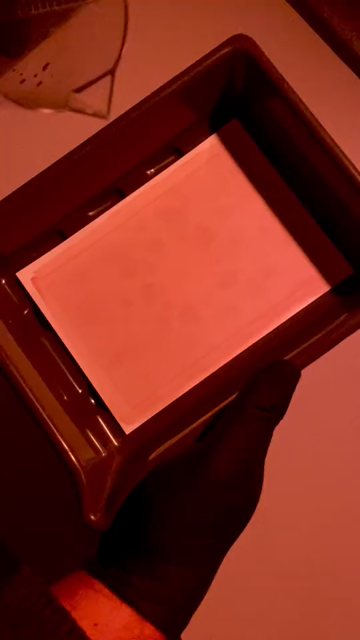
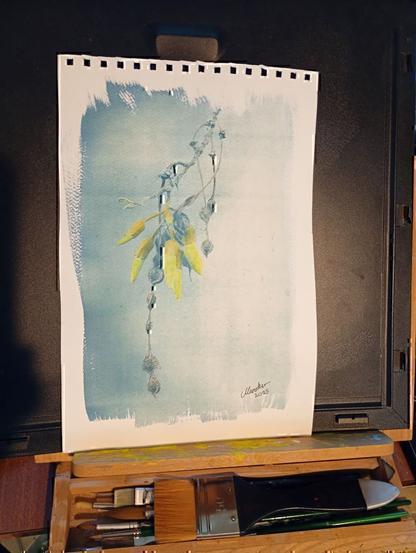
I don't think I'll ever tire of these magic moments when a print first appears almost out of nowhere when pouring developer over it...
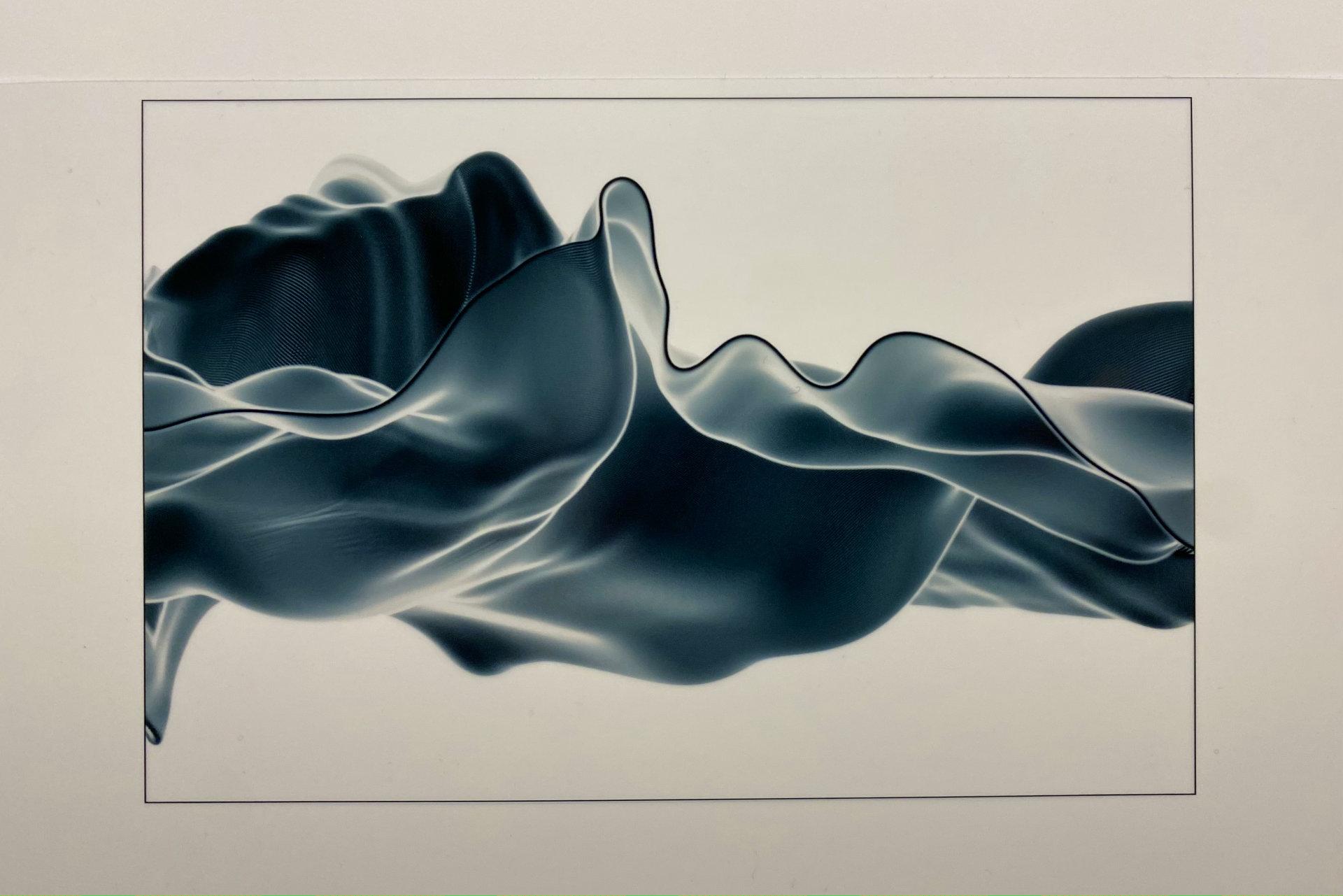
(The image is another one of my ancient art pieces from 2010/11, a rendered detail of the skeleton of one of the generative characters made for a collection of 100 3D printed sculptures)
Thanks to @… for being m…
'It is 2025, and seemingly everyone wants us in the humanities to do stuff “with AI,” informed not by what the technology avails but by the hopes it encodes.' Sonja Drimmer on 🔥on Art Forum
https://www.artforum.com/features/generative-ai-st…
🍮 Wissen zum Nachtisch: 🍨
Immer mehr Menschen sehen sich im beruflichen Umfeld genötigt, mit generativer #KI zu arbeiten.
Besonders Großunternehmen „überrollen“ damit ihre #Mitarbeiter. Es wird eine Art
🍮 Wissen zum Nachtisch: 🍨
Immer mehr Menschen sehen sich im beruflichen Umfeld genötigt, mit generativer #KI zu arbeiten.
Besonders Großunternehmen „überrollen“ damit ihre #Mitarbeiter. Es wird eine Art
I think it's time for some #FollowFriday action once again. Today, let's focus on computational/algorithmic/generative art/design practitioners (not AI art :)
An entirely incomplete list, in A-Z order:
@…
🍮 Wissen zum Nachtisch: 🍨
Immer mehr Menschen sehen sich im beruflichen Umfeld genötigt, mit generativer #KI zu arbeiten.
Besonders Großunternehmen „überrollen“ damit ihre #Mitarbeiter. Es wird eine Art
Weighted Stochastic Differential Equation to Implement Wasserstein-Fisher-Rao Gradient Flow
Herlock Rahimi
https://arxiv.org/abs/2512.17878 https://arxiv.org/pdf/2512.17878 https://arxiv.org/html/2512.17878
arXiv:2512.17878v1 Announce Type: new
Abstract: Score-based diffusion models currently constitute the state of the art in continuous generative modeling. These methods are typically formulated via overdamped or underdamped Ornstein--Uhlenbeck-type stochastic differential equations, in which sampling is driven by a combination of deterministic drift and Brownian diffusion, resulting in continuous particle trajectories in the ambient space. While such dynamics enjoy exponential convergence guarantees for strongly log-concave target distributions, it is well known that their mixing rates deteriorate exponentially in the presence of nonconvex or multimodal landscapes, such as double-well potentials. Since many practical generative modeling tasks involve highly non-log-concave target distributions, considerable recent effort has been devoted to developing sampling schemes that improve exploration beyond classical diffusion dynamics.
A promising line of work leverages tools from information geometry to augment diffusion-based samplers with controlled mass reweighting mechanisms. This perspective leads naturally to Wasserstein--Fisher--Rao (WFR) geometries, which couple transport in the sample space with vertical (reaction) dynamics on the space of probability measures. In this work, we formulate such reweighting mechanisms through the introduction of explicit correction terms and show how they can be implemented via weighted stochastic differential equations using the Feynman--Kac representation. Our study provides a preliminary but rigorous investigation of WFR-based sampling dynamics, and aims to clarify their geometric and operator-theoretic structure as a foundation for future theoretical and algorithmic developments.
toXiv_bot_toot
Prepping a digital negative of one of my old generative art projects (from 2008) for #Kallitype printing tomorrow. The form is actually _not_ 3D, but merely the time trace of a 2D physics sim of a single line (over hundreds of frames) and using spatial velocity deltas as metric for creating faux shading...
This sentiment expressed by @… below and the aspect of slowing down is also very much part of my own reasoning for getting back into analog print making. The other large part is the conceptual overlap with (and my love of) process-based art in general. It was exactly that what has drawn me to generative/algorithmic/procedural/kinetic approaches/concepts for most of my l…
 @toxi@mastodon.thi.ng