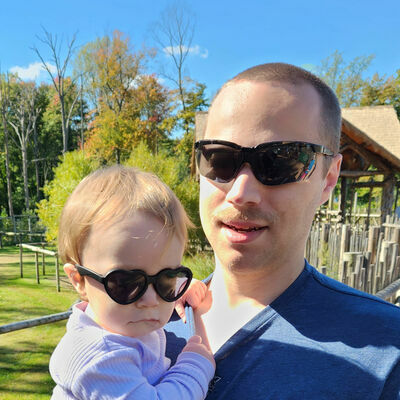
Der Assistenzhund 🐕🦺meiner Frau reagiert auf das Geräusch des Paketscanners der Postboten.
Heute hat die Botin in Hörweite der Kamera das Paket gescannt - und ich danach das Audio analysiert.
2600 Hz, 3000 4000 Hz und ein Träller aus 4450 und 1880 Hz
Töne sauber wieder erzeugt - falls es mal jemand auch braucht um den Hund zu desensibilisieren, gibt's den Knopf nun hier
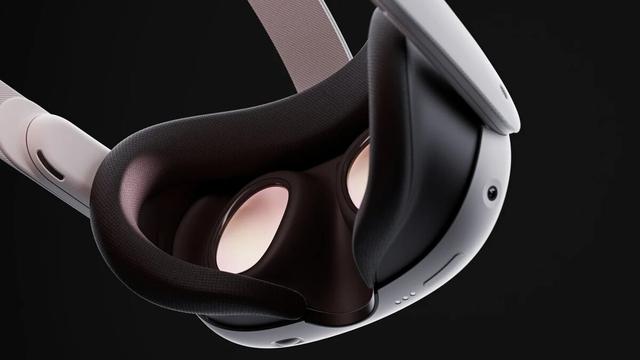
Meta Quest 3: Display unterstützt jetzt bis 207 Hz
Meta Quest 3 unterstützt jetzt Bildwiederholraten weit über 120 Hz. Die Neuerung könnte eine Reaktion auf die wohl bald erscheinende Steam Frame sein.
https://www.
🎥 #Capptivo is a free, open-source screen recorder that turns raw captures into polished demos — a #MIT-licensed alternative to Screen Studio and Cursorful
🖱️ It records a 60 Hz cursor click track alongside the video, then auto-suggests zoom fragments from where you actually clicked
…
Replaced article(s) found for physics.atom-ph. https://arxiv.org/list/physics.atom-ph/new
[1/1]:
- Electrometry of extremely-low frequencies from kHz to sub-Hz with a Rydberg-atom sensor
Aveek Chandra, Narongrit Paensin, Rainer Dumke
Time to work on a ngscopeclient performance bottleneck that was bugging me a while ago.
Ever since I did the demo of four ThunderScopes running full-rate FFTs, I've been mad that I couldn't waterfall at the same speed.
Time to fix that.
Baseline: 20M point FFT downsampled to 512K points for waterfall (default is 128K but I wanted to go higher to stress it and make bottlenecks more obvious). Real time is 50 Hz, runs at 40 Hz. FFT takes 2.59 ms, waterfall about 8 on m…
Welp, I need to re-record the ngscopeclient 100baseT1 demo video lol.
After some tuning, I can now run the TX *and* RX protocol decodes , and constellation diagrams, in real time. The only thing I can't do is eye patterns of both lanes (that slows it down from 12.5 to around 11.75 Hz refresh rate)
I’d still suggest a light EQ dip around 500 Hz and a high shelf boost around 8-10 kHz to help compensate for the Royal Albert Hall’s challenging acoustics and bring the solo violin forward a bit more. 😉
How effective normal stress oscillations advance failure in fault gouge: frequency dependence, non-failure window, and the role of dilation
Pritom Sarma, Einat Aharonov, Renaud Toussaint, Stanislav Parez
https://arxiv.org/abs/2607.01448 https://arxiv.org/pdf/2607.01448 https://arxiv.org/html/2607.01448
arXiv:2607.01448v1 Announce Type: new
Abstract: Cyclic pore-pressure or normal stress variations arise both in relation to natural earthquakes and in engineered subsurface systems, yet their effect on fault stability remains poorly constrained at the grain scale. Here we numerically model, using a coupled Discrete Element--fluid dynamics model, the response of a sheared, fluid-saturated or dry, gouge-filled fault to effective normal stress oscillations over a wide frequency range (0.5-10000 Hz). The effective normal stress is oscillated either by cycling the pore-pressure or by directly cycling the normal stress, while keeping the stress state below the Mohr-Coulomb threshold measured in continuous loading. Despite this sub-critical loading, we observe failure across most frequencies, with a non-monotonic frequency dependence. A distinct non-failure window emerges at intermediate frequencies (30-200 Hz), bounded by failure at both lower and higher frequencies; the system exhibits four regimes from cyclic failure-and-arrest to continuous sliding. Pore-pressure and normal stress oscillations produce the same regime structure, confirming that they act as equivalent forcings via Terzaghi's principle, with fluid coupling adding only a delay due to dilatant hardening. Sub-critical failure arises from dilation-induced strength deterioration via two mechanisms: (i) low-frequency cycles allow sufficient time for shear-driven ratcheting dilation, while (ii) high-frequency cycles induce dynamic dilation (acoustic fluidization) via amplified seepage forces, stress gradients and inertial forces. The intermediate non-failure window represents the gap between these mechanisms. These results identify frequency as a controlling parameter for failure in granular materials, with implications for dynamic earthquake triggering and cyclic injection protocols.
toXiv_bot_toot
Ostatnio mocno siedzę w specyfikacjach, recenzjach itp. telefonów z ekranem do 6.3", bo dla mnie to idealny rozmiar dla telefonu, i muszę przyznać, że na papierze zdecydowanie najlepiej wygląda #Xiaomi 17.
- Spełnia mój wymóg rozmiaru
- Ma chyba aktualnie najmocniejszy procesor na rynku od Snapdragona
- Bateria Si-Car 7000 mAh 🤯 (aczkolwiek w testach podobno wypada raczej przeciętnie, bo przegrywa z mniejszą w S26) i do tego ładowanie 100W, więc podobno do fulla w 45 minut, a do 80% to w kilka dosłownie
- ekran oczywiście 120 Hz, ale co ciekawe że ściemnianiem PWM (3840 Hz)
- może pracować na dwóch częstotliwościach Wi-Fi na raz (2.4 5 GHz)
Na minus oczywiście nakładka i syf z nią związany.
AI-based single-shot structured-light depth reconstruction for real-time laparoscopic surgical guidance
Wayne Wonseok Rodgers, Xiangyi Le, Seonghoon Jang, Shuwen Wei, Justin Opfermann, Michael Kam, Axel Krieger, Jin U. Kang
https://arxiv.org/abs/2608.05109 https://arxiv.org/pdf/2608.05109 https://arxiv.org/html/2608.05109
arXiv:2608.05109v1 Announce Type: new
Abstract: Significance. Accurate intraoperative depth perception is important for autonomous and semi-autonomous robotic laparoscopic surgery. Conventional fringe projection profilometry can achieve millimeter-scale accuracy but often requires multi-shot acquisition, digital-micromirror-device projection, and projector-camera synchronization, complicating integration into compact laparoscopic systems.
Aim. To develop a synchronization-free, single-shot depth-sensing platform using a passive LED-illuminated binary mask and a VQ-VAE prior with a custom U-Net depth head.
Approach. A compact projection module was coupled to one channel of a dual-channel laparoscope, while the second channel imaged the fringe-illuminated target. A Zivid 3D camera acquired reference depth for 722 paired phantom images. Zivid depth maps were reprojected into the SSLE image frame for supervised training and evaluation. The VQ-VAE encoded each input into a discrete latent representation, and a latent-space U-Net predicted depth without a separate mask-prediction branch.
Results. Using a fixed train/validation/test split, the proposed model achieved an MAE of 3.70 mm, AbsRel of 0.0326, delta=1.1 accuracy of 0.962, and delta=1.1^2 accuracy of 0.970. It achieved lower MAE than the dual U-Net MaskNet DepthNet baseline and outperformed off-the-shelf monocular depth models in MAE, AbsRel, and threshold accuracy. The pipeline operated at 26.0 Hz over 301 consecutive frames on an NVIDIA A100 GPU.
Conclusions. The LED-illuminated binary-pattern platform with latent-space depth reconstruction enables synchronization-free, video-rate endoscopic depth estimation. Results demonstrate Zivid-referenced phantom reconstruction without an explicit segmentation stage, while emphasizing the importance of dataset size and SSLE-Zivid calibration accuracy.
toXiv_bot_toot
Хозяйке на заметку.
В связи с тем, что купленный 10 лет назад LG 27TP600-W (4k, 60Hz, IPS) уплыл по цветам в страну вечного некалибруемого, но теплого цвета при пригасших лампах, заменил его на Philips 27M2N6501L/00 (1440p, 240 Hz, AMOLED).
Я раньше думал, что разрешение важнее, но нет, 260 герц сильно больше 60 и AMOLED сильно лучше IPS.
Есть ЛОС c точно такой же матрицей чуть-чуть дешевле, но он хуже сделан и без обязательного для меня VESA mount.
 @floheinstein@chaos.social