 @chris@mstdn.chrisalemany.ca
2026-07-17 15:48:58
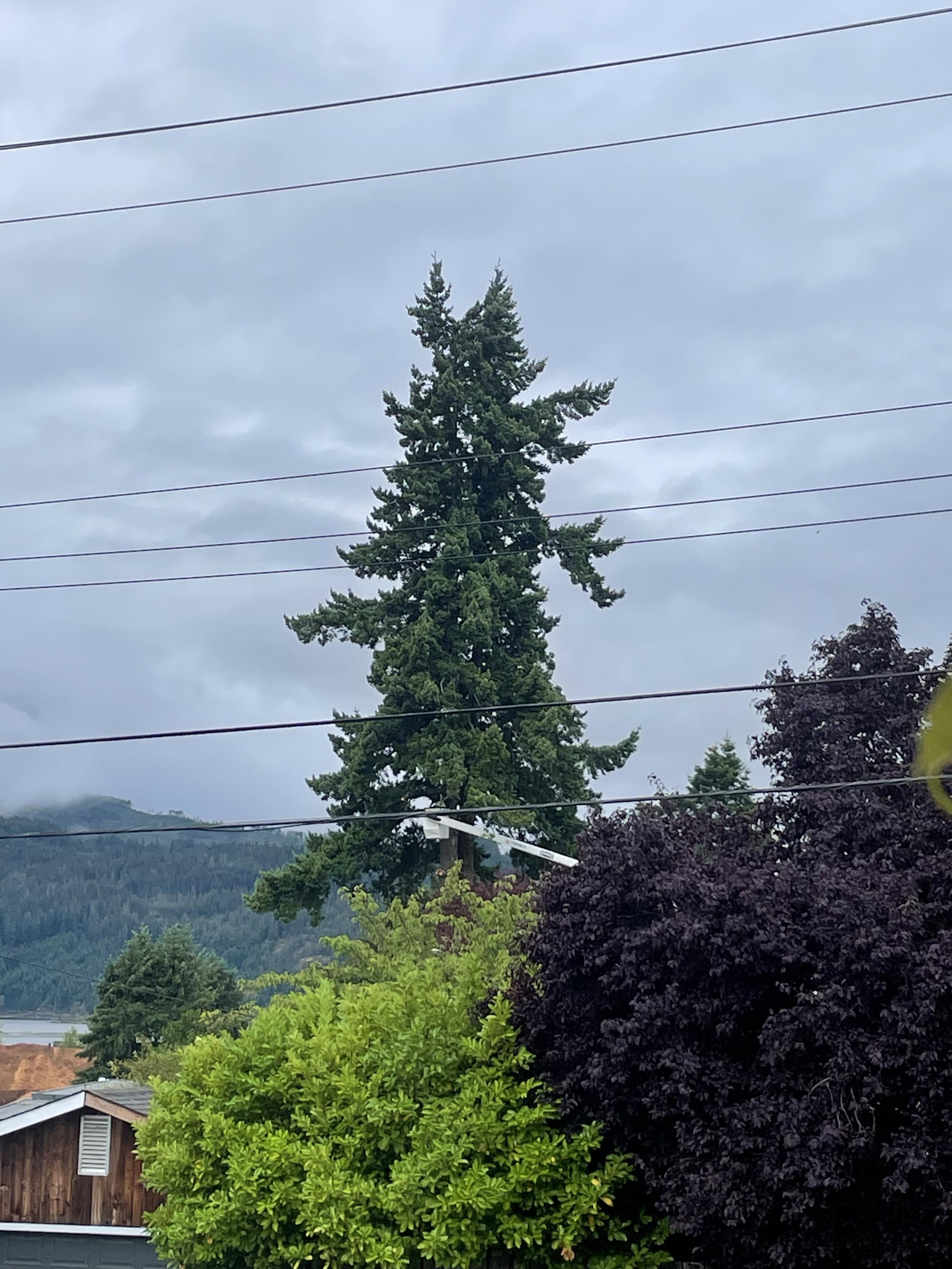
I knew this day would come. The chainsaw has been going all morning. (Even though there is lightning in the area!!)
The former Alberni High School (1920-1952) and Redford Elementary School (1980s) has had a large fir tree on its property likely for that entire time… The tree is at least 80-100 years old.
It was sold a few years ago. I am not speaking ill of the First Nations developer because I actually appreciate what they have done at the property and agree with the development.
This is a failure of City policy not protecting important trees and public spaces that continue to be lost in the City. They provide shade, habitat, and public enjoyment. They are not rotten, they are not at risk of falling or blowing down in a storm.
I don’t understand why people are afraid of trees. 🌲
😢
#trees #portalberni
 @arXiv_condmatsoft_bot@mastoxiv.page
2026-08-13 07:41:35
Spatially heterogeneous relaxational dynamics and the evolution of recoverable strain following flow cessation of a ductile nanocolloidal glass
Chloe W. Lindeman, James J. Griebler, Penelope Grace Kovakas, Miaoqi Chu, Qingteng Zhang, Suresh Narayanan, James L. Harden, Simon A. Rogers, Robert L. Leheny
https://arxiv.org/abs/2608.11470 https://arxiv.org/pdf/2608.11470 https://arxiv.org/html/2608.11470
arXiv:2608.11470v1 Announce Type: new
Abstract: We report a combined rheology and x-ray photon correlation spectroscopy (XPCS) study of the structural and mechanical relaxation of a ductile, nanocolloidal glass following the cessation of shear flow. After the glass is sheared to 300% strain at various shear rates and then held at fixed strain, the stress undergoes a protracted, quasi-logarithmic decay with hold time that depends weakly on the initial strain rate. Recovery rheology measurements reveal that this stress relaxation is accompanied by a logarithmic decrease in the elastic component of the recoverable strain; hence, the rates of decrease of the stress and recoverable strain are proportional. XPCS measurements during the stress relaxation reveal dynamics dominated by a convection-like backflow that is divided into two dynamically distinct regions indicative of banded motion. In one region, the flow can be modeled by an affine strain, while in the other region the glass moves as a plug while undergoing slow, glassy relaxation. The rates of these dynamics approximately track the rate of loss of recoverable strain, indicating this motion is the predominant microscopic mechanism driving the conversion of recoverable to unrecoverable strain during stress relaxation. In contrast, XPCS measurements during strain recovery reveal purely affine flow with no evidence of heterogeneity and with strain rates that agree quantitatively with the rheometry measurements. Together, these results provide a unified microscopic picture connecting the evolving internal dynamics of a ductile glass to its macroscopic mechanical relaxation following flow cessation.
toXiv_bot_toot