 @midtsveen@social.linux.pizza
2025-11-16 12:28:17
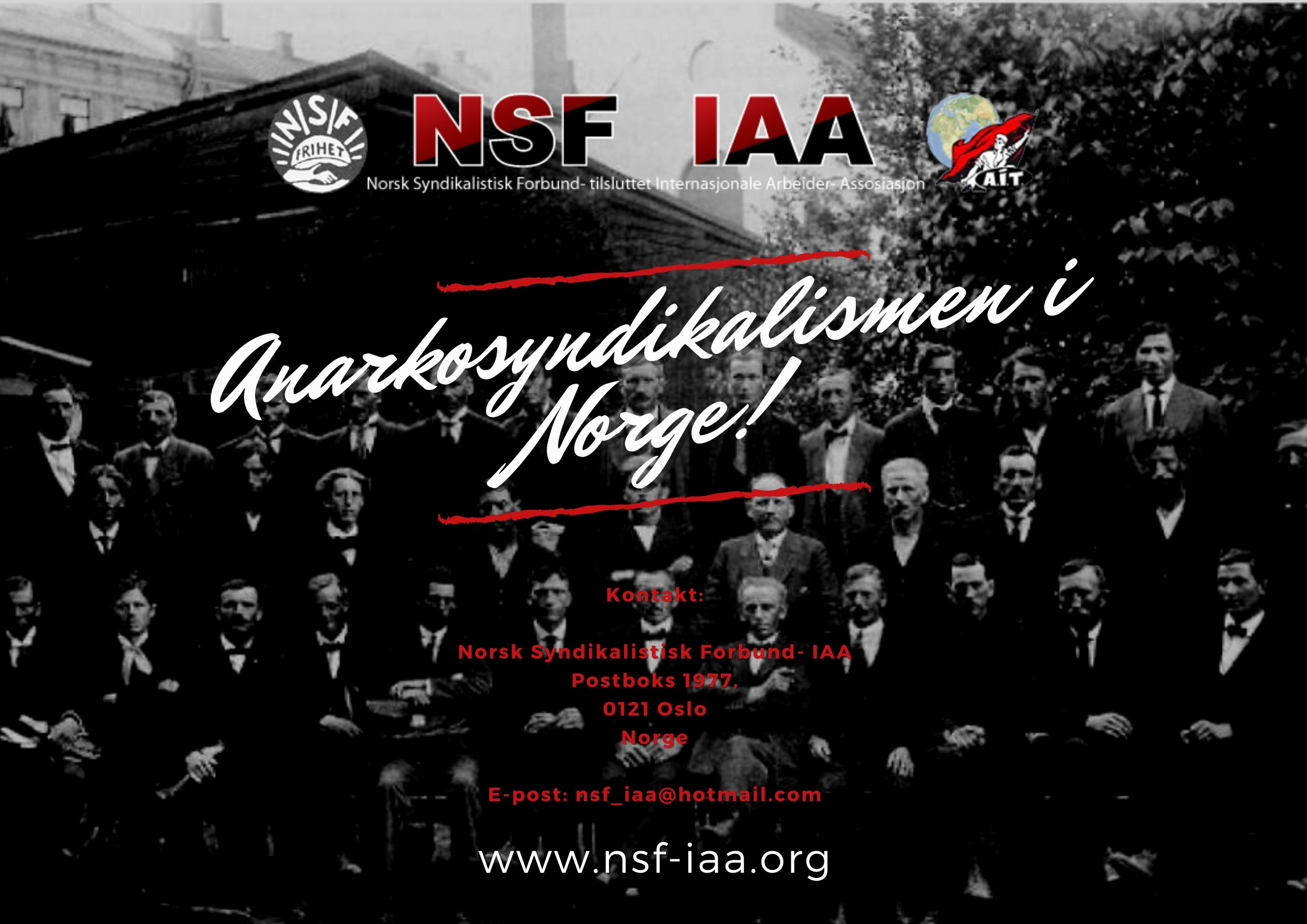
Store Norske Leksikon skrev at Norsk Syndikalistisk Forbund ble opplŸst i 1973, men heldigvis er de fortsatt her i dag, takk og pris for det, og for at jeg kunne opplyse dem om det!
NSF-IAA på Store Norske Leksikon:
https://snl.no/Norsk_Syndikalistisk_F%C3¸derasjon
 @Mediagazer@mstdn.social
2025-11-16 03:21:14
An interview with Country Life EIC Mark Hedges on 1K print issues under his tenure, expanding the magazine's online presence, subscriptions vs. ads, and more (Charlotte Tobitt/Press Gazette)
https://pressgazette.co.uk/publishers/

 @arXiv_csGT_bot@mastoxiv.page
2025-12-10 07:45:10
Selling Privacy in Blockchain Transactions
Georgios Chionas, Olga Gorelkina, Piotr Krysta, Rida Laraki
https://arxiv.org/abs/2512.08096 https://arxiv.org/pdf/2512.08096 https://arxiv.org/html/2512.08096
arXiv:2512.08096v1 Announce Type: new
Abstract: We study methods to enhance privacy in blockchain transactions from an economic angle. We consider mechanisms for privacy-aware users whose utility depends not only on the outcome of the mechanism but also negatively on the exposure of their economic preferences. Specifically, we study two auction-theoretic settings with privacy-aware users. First, we analyze an order flow auction, where a user auctions off to specialized agents, called searchers, the right to execute her transaction while maintaining a degree of privacy. We examine how the degree of privacy affects the revenue of the auction and, broadly, the net utility of the privacy-aware user. In this new setting, we describe the optimal auction, which is a sealed-bid auction. Subsequently, we analyze a variant of a Dutch auction in which the user gradually decreases the price and the degree of privacy until the transaction is sold. We compare the revenue of this auction to that of the optimal one as a function of the number of communication rounds. Then, we introduce a two-sided market - a privacy marketplace - with multiple users selling their transactions under their privacy preferences to multiple searchers. We propose a posted-price mechanism for the two-sided market that guarantees constant approximation of the optimal social welfare while maintaining incentive compatibility (from both sides of the market) and budget balance. This work builds on the emerging line of research that attempts to improve the performance of economic mechanisms by appending cryptographic primitives to them.
toXiv_bot_toot
 @fell@ma.fellr.net
2026-01-13 23:49:11
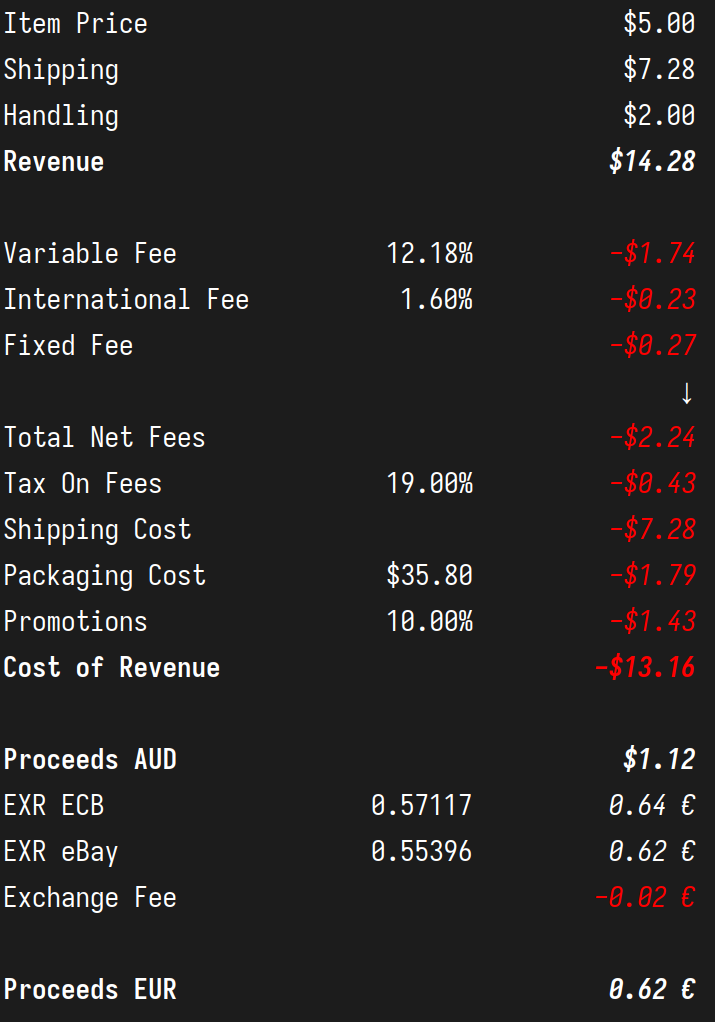
In case you ever wondered what it costs to sell an item on Ebay Australia but with a German Ebay account. Yes, that's entirely possible and the system handles it all beautifully. Kudos to the programmers who had to work this out.
As you can probably see, I'm not doing this for profit, but for fun and to prevent waste.
Are you into old Pokémon stuff? Everything is $5 now: …
 @arXiv_mathOC_bot@mastoxiv.page
2025-11-14 10:04:30
Verification of Sequential Convex Programming for Parametric Non-convex Optimization
Rajiv Sambharya, Nikolai Matni, George Pappas
https://arxiv.org/abs/2511.10622 https://arxiv.org/pdf/2511.10622 https://arxiv.org/html/2511.10622
arXiv:2511.10622v1 Announce Type: new
Abstract: We introduce a verification framework to exactly verify the worst-case performance of sequential convex programming (SCP) algorithms for parametric non-convex optimization. The verification problem is formulated as an optimization problem that maximizes a performance metric (e.g., the suboptimality after a given number of iterations) over parameters constrained to be in a parameter set and iterate sequences consistent with the SCP update rules. Our framework is general, extending the notion of SCP to include both conventional variants such as trust-region, convex-concave, and prox-linear methods, and algorithms that combine convex subproblems with rounding steps, as in relaxing and rounding schemes. Unlike existing analyses that may only provide local guarantees under limited conditions, our framework delivers global worst-case guarantees--quantifying how well an SCP algorithm performs across all problem instances in the specified family. Applications in control, signal processing, and operations research demonstrate that our framework provides, for the first time, global worst-case guarantees for SCP algorithms in the parametric setting.
toXiv_bot_toot
@arXiv_csGT_bot@mastoxiv.page2025-12-08 08:03:50
Strategyproof Tournament Rules for Teams with a Constant Degree of Selfishness
David Pennock, Daniel Schoepflin, Kangning Wang
https://arxiv.org/abs/2512.05235 https://arxiv.org/pdf/2512.05235 https://arxiv.org/html/2512.05235
arXiv:2512.05235v1 Announce Type: new
Abstract: We revisit the well-studied problem of designing fair and manipulation-resistant tournament rules. In this problem, we seek a mechanism that (probabilistically) identifies the winner of a tournament after observing round-robin play among $n$ teams in a league. Such a mechanism should satisfy the natural properties of monotonicity and Condorcet consistency. Moreover, from the league's perspective, the winner-determination tournament rule should be strategyproof, meaning that no team can do better by losing a game on purpose.
Past work considered settings in which each team is fully selfish, caring only about its own probability of winning, and settings in which each team is fully selfless, caring only about the total winning probability of itself and the team to which it deliberately loses. More recently, researchers considered a mixture of these two settings with a parameter $\lambda$. Intermediate selfishness $\lambda$ means that a team will not lose on purpose unless its pair gains at least $\lambda s$ winning probability, where $s$ is the individual team's sacrifice from its own winning probability. All of the dozens of previously known tournament rules require $\lambda = \Omega(n)$ to be strategyproof, and it has been an open problem to find such a rule with the smallest $\lambda$.
In this work, we make significant progress by designing a tournament rule that is strategyproof with $\lambda = 11$. Along the way, we propose a new notion of multiplicative pairwise non-manipulability that ensures that two teams cannot manipulate the outcome of a game to increase the sum of their winning probabilities by more than a multiplicative factor $\delta$ and provide a rule which is multiplicatively pairwise non-manipulable for $\delta = 3.5$.
toXiv_bot_toot