If local police enforced traffic law against #ICE their whole operation would pretty much stop, seriously, for moving violations alone. Most egregiously, they routinely blow through red lights and stopsigns. This is common knowledge among people observing ICE.
Now ICE reportedly caused a serious crash in St Paul that, because the ICE agent also went to the hospital, may be the first absolutely k…
These proposals were common knowledge in Bulgaria. I remember the oldtimers being disgusted how desperately in love was the regime with the Soviets, while the Bulgarian economy had been crashing constantly way into the 1980s (which was a not that common knowledge because it was kept in secret from the population that didn't perish in prisons and work camps). Fully incompetent, servile scum in full power for 45 years straight.
Why did the USSR Refuse to Annex Bulgaria?
Here in Minneapolis it’s been widespread common knowledge that ICE agents are getting paid per head they bring in, no matter how incorrectly, no matter the actual immigration status of the person they kidnapped, no matter how carelessly or violently they do it.
It’s nice to see this confirmed in print.
“It was common knowledge that World War V started in a defective twenty-cent Molecular Circuit Matrix in a newly-installed firecontrol computer four miles below Cheyenne Mountain, Wyoming.”
…
Demon
By John Varley
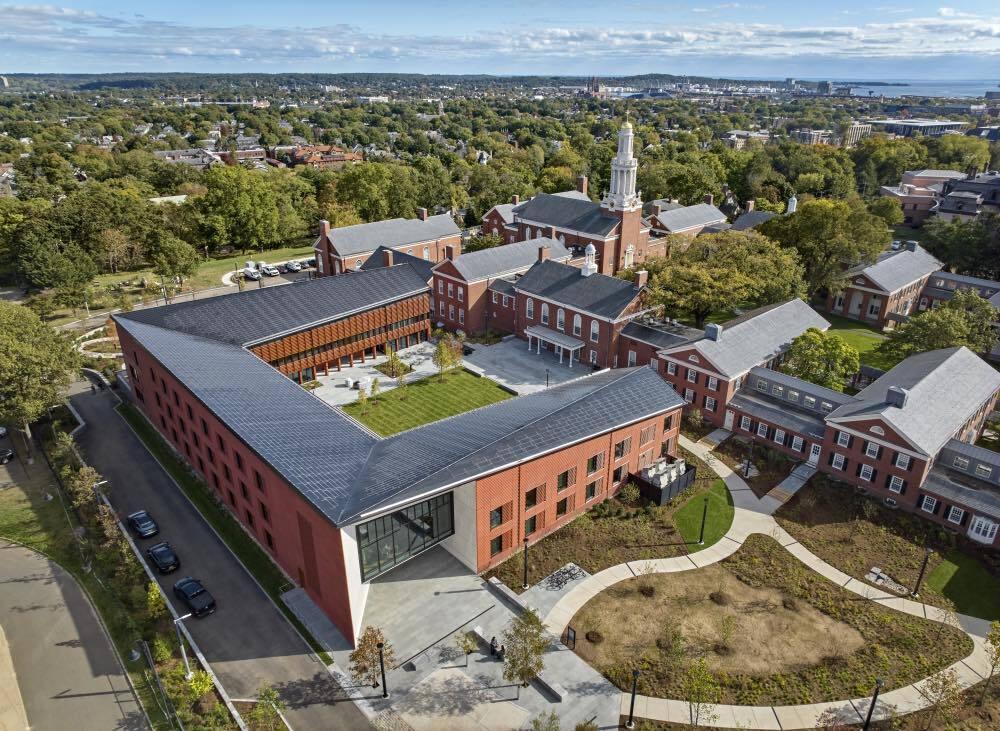
Yale Divinity School contributes powerfully to the nation’s strength and the common good. We do this through the religiously trained leaders we send into churches and communities across America, through the direct provision of educational resources to lay leaders and lifelong learners, and through the creation of deeper knowledge of God and the application of theology to the pressing issues of our day.
Learn more at our newly published impact report.
From Isolation to Integration: Building an Adaptive Expert Forest for Pre-Trained Model-based Class-Incremental Learning
Ruiqi Liu, Boyu Diao, Hangda Liu, Zhulin An, Fei Wang, Yongjun Xu
https://arxiv.org/abs/2602.20911 https://arxiv.org/pdf/2602.20911 https://arxiv.org/html/2602.20911
arXiv:2602.20911v1 Announce Type: new
Abstract: Class-Incremental Learning (CIL) requires models to learn new classes without forgetting old ones. A common method is to freeze a pre-trained model and train a new, lightweight adapter for each task. While this prevents forgetting, it treats the learned knowledge as a simple, unstructured collection and fails to use the relationships between tasks. To this end, we propose the Semantic-guided Adaptive Expert Forest (SAEF), a new method that organizes adapters into a structured hierarchy for better knowledge sharing. SAEF first groups tasks into conceptual clusters based on their semantic relationships. Then, within each cluster, it builds a balanced expert tree by creating new adapters from merging the adapters of similar tasks. At inference time, SAEF finds and activates a set of relevant experts from the forest for any given input. The final prediction is made by combining the outputs of these activated experts, weighted by how confident each expert is. Experiments on several benchmark datasets show that SAEF achieves SOTA performance.
toXiv_bot_toot
Restoring missing low scattering angle data in two-dimensional diffraction patterns of isolated molecules
Yanwei Xiong, Martin Centurion
https://arxiv.org/abs/2603.24334 https://arxiv.org/pdf/2603.24334 https://arxiv.org/html/2603.24334
arXiv:2603.24334v1 Announce Type: new
Abstract: Anisotropic two-dimensional diffraction signals contain more information than the conventional isotropic signals for both gas phase ultrafast electron and X-ray diffraction experiments and are common in typical time-resolved diffraction experiments due to the use of linearly polarized lasers to excite the sample that imprints spatial anisotropy on the molecules. We report an iterative algorithm to restore the missing data at low scattering angles in a two-dimensional diffraction signal, which is essential to obtain real-space representation. The iterative algorithm transforms two-dimensional signals back and forth between the momentum transfer domain and the real space domain through Fourier and Abel transforms and apply real space constraints to retrieve missing signal at low scattering angles. The algorithm only requires an approximate a-priori knowledge of the shortest and longest internuclear distances in the molecule. We demonstrated successful retrieval of the missing signal in simulated patterns and in experimentally measured diffraction patterns from laser-induced alignment of trifluoroiodomethane molecules.
toXiv_bot_toot
Good Morning #Canada
You never know what the #Algorithm will shove into your feed, and sometimes you wonder just how closely the #TechBros are tracking you. So as someone who admittedly uses too much butter, it was interesting that this YouTube video just randomly showed up in my feed. There's some good info here on butter in general and specifically on pricing, even if most of it is common knowledge. And it's Canadian focused so that's a bonus.
Remember, butter is a dairy product, like cheese and ice cream, so it's obviously very healthy when consumed in bulk...
#CanadaIsAwesome #MmmButter
https://youtu.be/DkNfQqlg1cE
 @annsev@troet.cafe