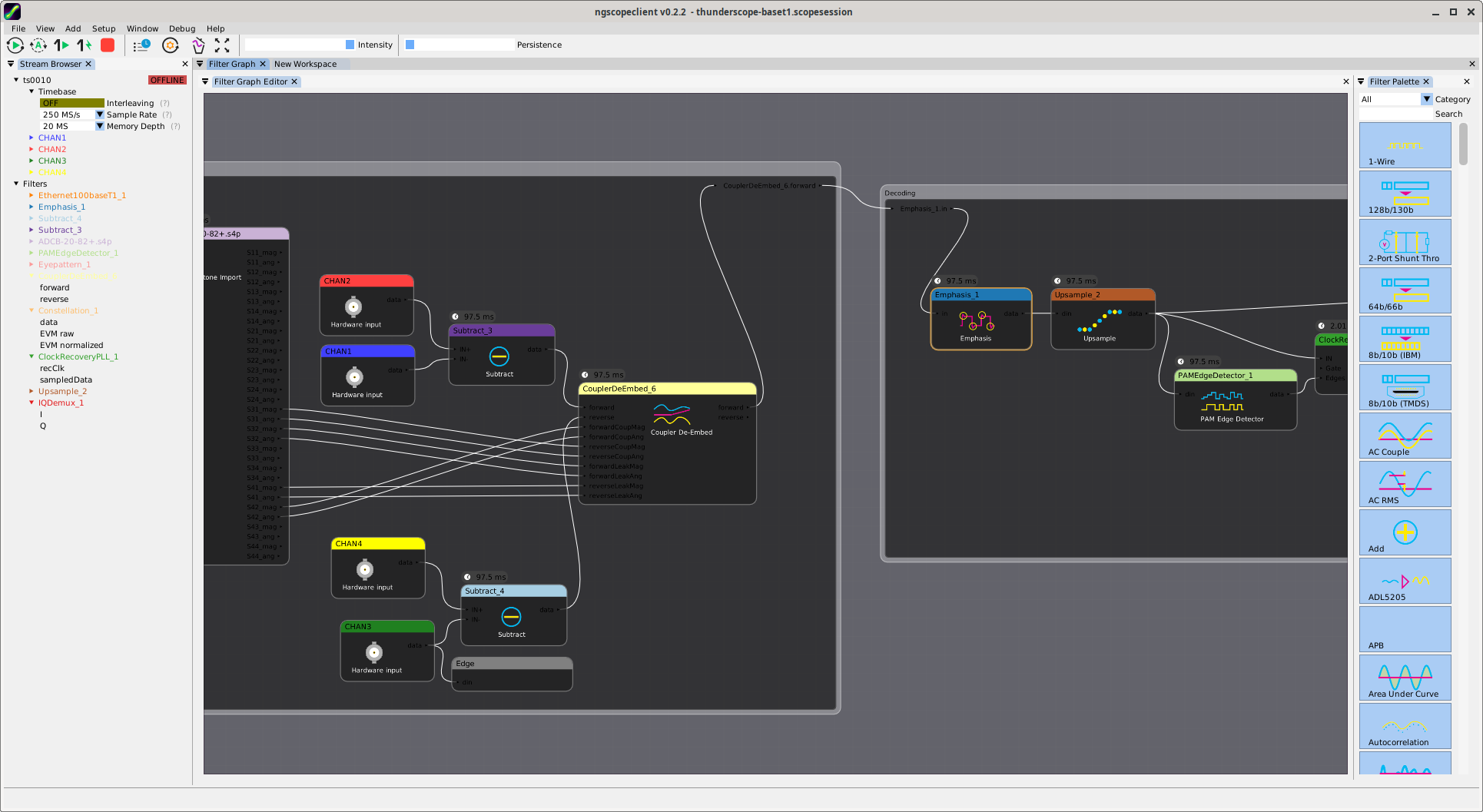
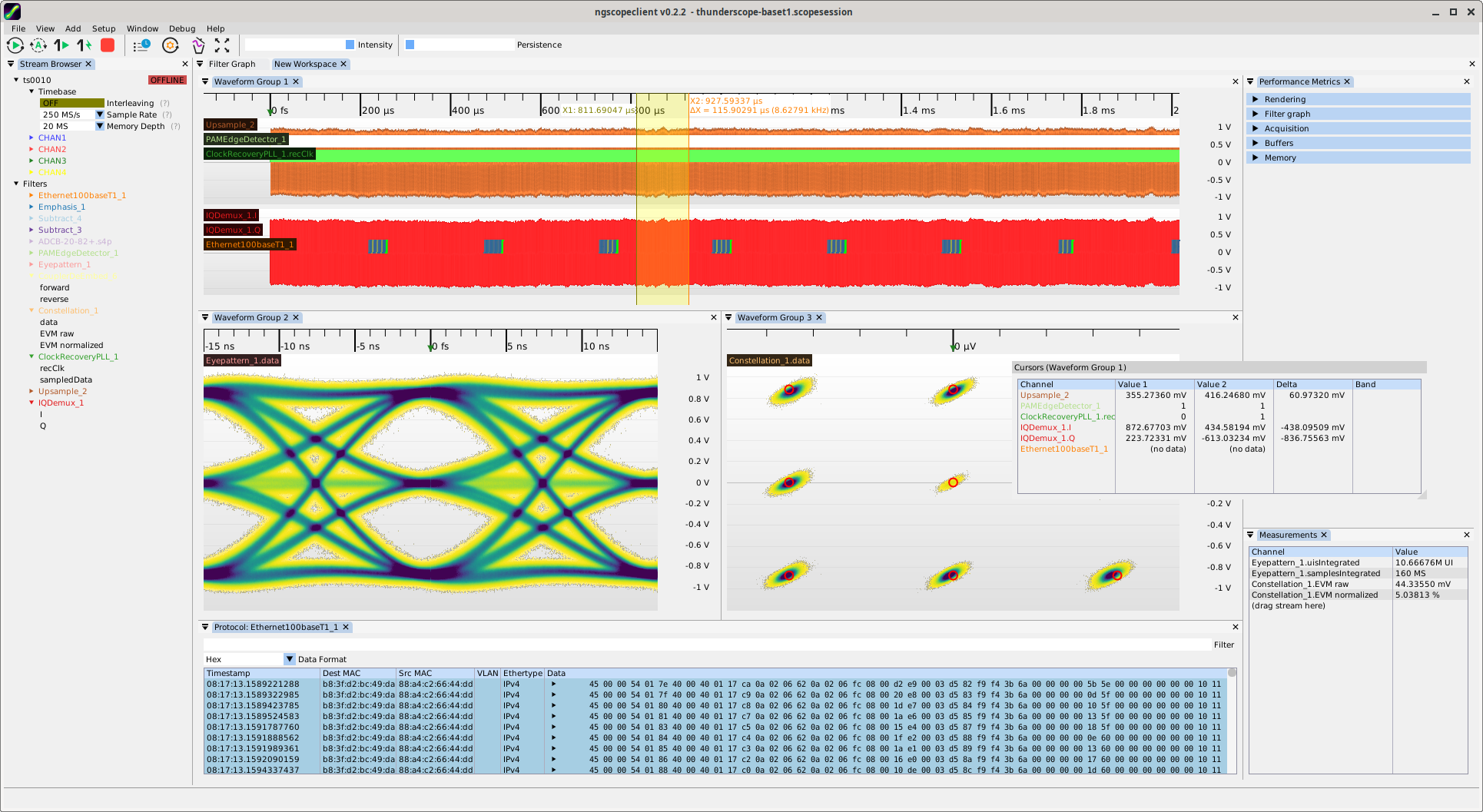
More progress toward a usable light mode theme in ngscopeclient.
Not pushed yet, but color preferences are now scoped to the GUI theme setting so when you change the theme, different sets of preferences are applied.
I'm gradually going through the code finding spots that need to be themed differently and picking sane light-mode default colors, which will take a bit longer.
One thing I'm not yet sure about is how to handle channel colors; the default values for instr…
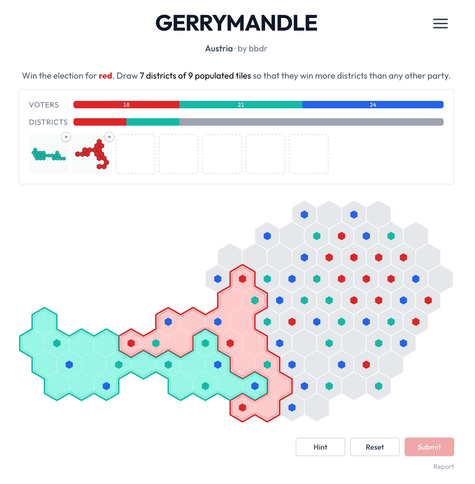
For my latest article for Inquirer.net, I decided to talk about something light and fun and it is the daily puzzle game #Gerrymandle. Your aim in the game is to create electoral districts so that your political party wins more districts than other parties.
Things that ended up not being fixed in the final release of #macOS 27 Golden Gate:
- can't drag & drop windows into the bar in mission control to fullscreen them, this still worked even in the first beta of macOS 27 and then was suddenly gone
- weird lack of contrast at the bottom of the new traffic lights in light mode (dark mode looks fine)
IT'S OFFICIAL! "KonoSuba: God's Blessing on This Wonderful World!" Season 4 is set to broadcast in 2027.
Official website https://konosuba.com/news/?mode=detail&id=20260726
Vigorous turbulence driven by quasar-mode feedback in a cluster core: #BlackHole "Blast" Reaches 300,000 Light Years: https://www.tohoku.ac.jp/en/press/black_hole_blast_reaches_300000_light_years.html
Setting up my new laptop for maximum trollage, using light mode, a terminal emulator with a script font; Doom Emacs with Evil mode; also mapping the tab key to two spaces, and the spacebar to tab.
Crosslisted article(s) found for astro-ph.GA. https://arxiv.org/list/astro-ph.GA/new
[1/2]:
- From Triadic Interactions to Kolmogorov Scaling: A Deterministic, Scale-Resolved Formulation of E...
Erik Bertram
https://arxiv.org/abs/2607.16381 https://mastoxiv.page/@arXiv_physicsfludyn_bot/116956890026314972
- Dynamical friction in stratified stellar envelopes
Damien Gagnier
https://arxiv.org/abs/2607.16422 https://mastoxiv.page/@arXiv_astrophSR_bot/116956909457047933
- Simultaneous radio, optical and X-ray monitoring of hard X-ray selected AGN: a variability study
L. Hern\'andez-Garc\'ia, F. Panessa, D. Williams-Baldwin, P. Ar\'evalo, A. M. Mu\~noz Arancibia
https://arxiv.org/abs/2607.16423 https://mastoxiv.page/@arXiv_astrophHE_bot/116956887664818723
- Origin of the Sloshing Spiral in the Abell 2107 Galaxy Cluster
Muhammed K{\i}yami Erdim
https://arxiv.org/abs/2607.16496 https://mastoxiv.page/@arXiv_astrophCO_bot/116956868365097623
- Determination of [Fe/H] in Fundamental mode Classical Cepheids from Gaia DR3 light curve Fourier ...
Roberto Molinaro, et al.
https://arxiv.org/abs/2607.16775 https://mastoxiv.page/@arXiv_astrophSR_bot/116956927940159880
- Escaped White Dwarf Candidates from Open Clusters
Huahui Yan, David R. Miller, Jingkun Zhao, Jincheng Guo, Chengyuan Li
https://arxiv.org/abs/2607.16815 https://mastoxiv.page/@arXiv_astrophSR_bot/116956930692481290
- Magnetic fields in Massive Star-Forming Regions (MagMaR). VIII. Magnetic field overrun by gravity...
M. Fern\'andez-L\'opez, et al.
https://arxiv.org/abs/2607.17160 https://mastoxiv.page/@arXiv_astrophSR_bot/116956996786764707
- Optically Thick Outflow Driven by Supercritical Accretion May Explain Little Red Dots
Jun-Rong Liu, Hua Feng, Luis C. Ho
https://arxiv.org/abs/2607.17448 https://mastoxiv.page/@arXiv_astrophHE_bot/116956954089426787
- Binary White Dwarfs as Gravitational Wave Sources for LISA
Sreeta Roy, Surajit Kalita, Tomasz Bulik, Dorota Gondek-Rosi\'nska
https://arxiv.org/abs/2607.17787 https://mastoxiv.page/@arXiv_astrophSR_bot/116957044926341801
- Intracluster light and dark matter halo shapes reflect common assembly, not mutual coupling: shap...
Martin, Hatch, Cui, Fernandez, Bah\'e, Fischer, Montes, Pearce, Sabiu, Yepes, Yoo
https://arxiv.org/abs/2607.17792 https://mastoxiv.page/@arXiv_astrophCO_bot/116956974931041178
toXiv_bot_toot
 @azonenberg@ioc.exchange