 @arXiv_astrophGA_bot@mastoxiv.page
2026-09-09 09:21:56
Detection prospects for heavy WIMP dark matter around M31* in microwave band
Andrei E. Egorov
https://arxiv.org/abs/2609.08771 https://arxiv.org/pdf/2609.08771 https://arxiv.org/html/2609.08771
arXiv:2609.08771v1 Announce Type: new
Abstract: This work analyzes the detection prospects for weakly interacting massive particles (WIMPs) in dark matter (DM) density spike around the supermassive black hole (SMBH) in Andromeda galaxy M31 in microwave band. WIMP annihilation produces relativistic electrons and positrons, which generate the synchrotron emission in strong magnetic field of the accretion flow medium at microwave frequencies. Properties of this emission, as well as their dependence on DM and medium parameters, were modeled. Atacama Large Millimeter Array (ALMA) sensitivity to this emission and underlying WIMP parameters was estimated. It was obtained that M31* in microwave band represents the unique target, where DM spike signal can be detected in case of realistic spike and halo density profiles. In such case ALMA may reach the thermal s-wave annihilating WIMPs with masses up to around 1 TeV with just 10--100 hours exposure. Optimistic parameter configurations may allow probing all possible WIMP masses up to 100 TeV. Related systematic uncertainties are discussed.
toXiv_bot_toot
 @stargazersmith@social.linux.pizza
2026-08-04 13:14:36
 @macandi@social.heise.de
2026-09-04 11:08:07
PCIe 6.0 oder nicht: Verwirrung um Mac-Studio-Specs
Apple hatte in seiner Pressemitteilung zum neuen Mac Studio kurzzeitig erwähnt, dass die Maschinen mit PCIe 6.0 erscheinen. Das wurde inzwischen gestrichen.
https://www…

 @Dragofix@veganism.social
2026-09-02 23:48:22
Nepal floods highlight growing glacier risks in warming Himalayas https://news.mongabay.com/short-article/2026/08/nepal-floods-highlight-growing-glacier-risks-in-warming-himalayas/

 @manawyrm@chaos.social
2026-08-03 09:19:56
Let's play a game:
Post the oldest image of your "battle station" / computer setup that you have.
Ideally, post some specs of the system if you can remember.
I'll start:
- photo from 2003
- Pentium II, 350MHz
- 3DFX Voodoo Banshee
- 1024x768 17" Eizo CRT
- Iomega Zip drive, 100MB via Parallel port (*click!*)
- SCSI Scanner hidden away in the background
I think the Mac was a Power Macintosh 6300, but I'm not 100…
 @arXiv_astrophGA_bot@mastoxiv.page
2026-09-09 11:30:55
Replaced article(s) found for astro-ph.GA. https://arxiv.org/list/astro-ph.GA/new
[3/4]:
- Characterising the Globular Cluster Systems of Three Local Group Dwarf Galaxies: NGC6822, NGC147 ...
McGill, Ferguson, Mackey, Crociati, Howell, Huxor, Irwin, McConnachie, Savino, Tanvir, Weisz
https://arxiv.org/abs/2608.28434 https://mastoxiv.page/@arXiv_astrophGA_bot/117189126930011519
- Magnetic Fields in Massive Star-forming Regions (MagMaR). IX. Radiative Torque Alignment and Disr...
Vineet Rawat, et al.
https://arxiv.org/abs/2609.03458 https://mastoxiv.page/@arXiv_astrophGA_bot/117211751382008296
- Rapid Growth of Intermediate-Mass Black Holes through Disk-induced Stellar Disruptions
Mengye Wang, Yiqiu Ma, Qingwen Wu, Boyuan Liu, Zijian Wang, Zhili Wang
https://arxiv.org/abs/2609.03701 https://mastoxiv.page/@arXiv_astrophGA_bot/117211765145858867
- Comparison of HMG and flat rotation velocities inferred from galaxy-galaxy weak lensing
Robert Monjo
https://arxiv.org/abs/2410.04258 https://mastoxiv.page/@arXiv_astrophCO_bot/113270920913210256
- Not-quite-primordial black holes
Wenzer Qin, Soubhik Kumar, Priyamvada Natarajan, Neal Weiner
https://arxiv.org/abs/2506.13858 https://mastoxiv.page/@arXiv_astrophCO_bot/114703627339774703
- Constraining fuzzy dark matter with the 21-cm power spectrum from Cosmic Dawn and Reionization
Shihang Liu, Yilin Liu, Bowen Peng, Mengzhou Xie, Zelong Liu, Bohua Li, Yi Mao
https://arxiv.org/abs/2508.10176 https://mastoxiv.page/@arXiv_astrophCO_bot/115031874791799781
- Using Strong Lensing to Detect Subhalos with Steep Inner Density Profiles
Kassidy E. Kollmann, James W. Nightingale, Mariangela Lisanti, Andrew Robertson, Oren Slone
https://arxiv.org/abs/2510.17956 https://mastoxiv.page/@arXiv_astrophCO_bot/115416896040400445
- Axion Constraints from White Dwarf Cooling in 47 Tucanae
Leesa Fleury, Alysa Obertas, Harvey Richer, Jeremy Heyl
https://arxiv.org/abs/2511.21676 https://mastoxiv.page/@arXiv_astrophSR_bot/115621063357293188
- Frequency shift and viewing direction variations in gravitational lensing
Miko{\l}aj Korzy\'nski, Mateusz Kulejewski
https://arxiv.org/abs/2601.13912 https://mastoxiv.page/@arXiv_astrophCO_bot/115932615538946873
- WIMP Dark Matter Searches in Reticulum II Using MeerKAT
Shibre Semane, Geoff Beck, Sphesihle Makhathini, Marco Regis, Gianni Bernardi
https://arxiv.org/abs/2603.06385 https://mastoxiv.page/@arXiv_astrophCO_bot/116198370267558665
toXiv_bot_toot
 @cosmos4u@scicomm.xyz
2026-10-09 22:04:57
On the coronal origin of magnetic switchbacks in the #SolarWind: https://www.nature.com/articles/s41550-026-02928-0 -> Solar Orbiter tracks origin of mysterious magnetic switchbacks: https://www.esa.int/Science_Exploration/Space_Science/Solar_Orbiter/Solar_Orbiter_tracks_origin_of_mysterious_magnetic_switchbacks
 @aardrian@toot.cafe
2026-09-23 14:57:53
[1/2]
Anyone used / heard of Aloud (“The first 508 audit that actually listens”)?
https://github.com/IRS-Public/aloud
It’s a CC0 project by the IRS that seems to want to be JAWS Inspect for native apps.
My look at README shows it’s got potential but may be grounded in misunderstandin…

 @arXiv_astrophCO_bot@mastoxiv.page
2026-08-05 08:12:53
Modified Cosmological Expansion and the JWST CMB Optical Depth Tension in Self Interaction Gravity
Subhadeep Mukherjee, Shashank Shekhar Pandey, A. S. Majumdar
https://arxiv.org/abs/2608.03470 https://arxiv.org/pdf/2608.03470 https://arxiv.org/html/2608.03470
arXiv:2608.03470v1 Announce Type: new
Abstract: Recent James Webb Space Telescope (JWST) observations favor an earlier and more efficient reionization history, leading to Thomson-scattering optical depths larger than those inferred from the cosmic microwave background (CMB). We investigate whether this tension can be alleviated within the framework of self-interaction (SI) gravity by modifying the cosmological expansion history while retaining the standard astrophysical description of reionization. The SI gravity parameters are constrained through a Bayesian MCMC analysis of the Union3 Type Ia supernova and DESI DR2 Baryon Acoustic Oscillations (BAO) data. The resulting expansion history is then used to predict the ionization history and Thomson optical depth. We find that the predicted optical depth decreases from $\tau_{\rm{CMB}}\simeq0.076$ in $\Lambda$CDM to $\tau_{\rm{CMB}}\simeq0.061$, consistent with the Planck PR4 measurement within $1\sigma$, thereby substantially reducing the optical-depth tension.
toXiv_bot_toot
 @peterhoneyman@a2mi.social
2026-08-01 03:20:24
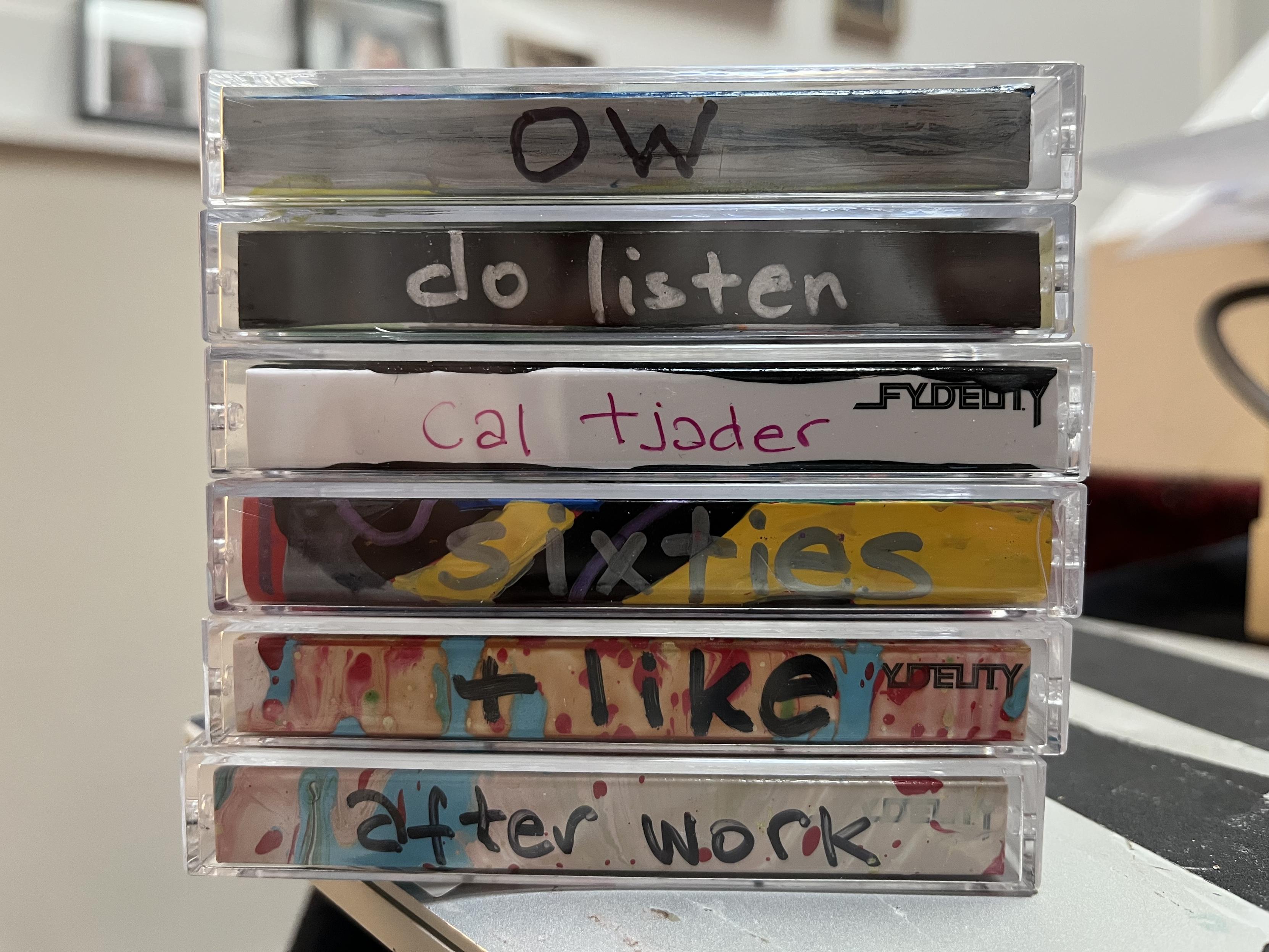
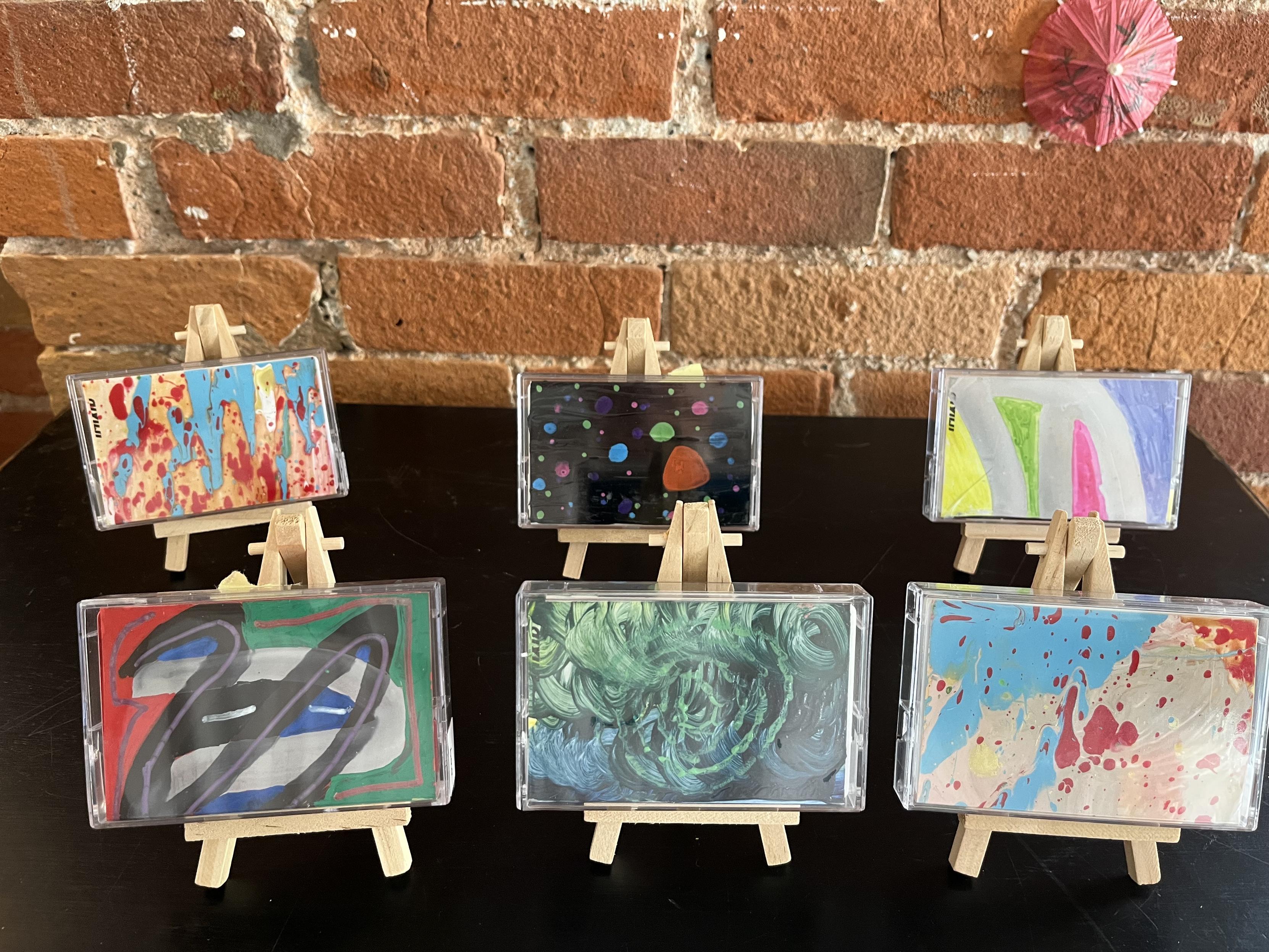
i'm finna mail out some mix tapes this weekend so heads up michigan (ann arbor, ann arbor, and birmingham) and california (LA, oakland, SF).
hey, check out the splatter!