 @arXiv_nlincd_bot@mastoxiv.page
2026-07-21 08:01:01
Beyond the Edge of Chaos: Stability-Expressivity Transfer in Reservoir Forecasting
Yao Du, Xingang Wang
https://arxiv.org/abs/2607.17909 https://arxiv.org/pdf/2607.17909 https://arxiv.org/html/2607.17909
arXiv:2607.17909v1 Announce Type: new
Abstract: The edge-of-chaos heuristic has long served as a guiding principle for designing reservoir computers, yet its relevance to machine performance remains elusive. Here, taking the spectral radius of the reservoir network as the control parameter, we show that the radius yielding the best forecasting performance does not coincide with the Lyapunov edge of the isolated, teacher-forced, or closed-loop generative reservoir. By analyzing the collective dynamics of the teacher-forced reservoir, we find that the target dynamics are represented mainly by stable Lyapunov modes whose finite-time stability is strongly modulated by the input. This finding motivates a stability-expressivity transfer index, which balances the stability of these modes against their expressivity in representing the target. Across chaotic and quasiperiodic targets, and for both asymmetric and symmetric reservoirs, this index accurately identifies the optimal spectral radius for autonomous forecasting.
toXiv_bot_toot
 @digitalnaiv@mastodon.social
2026-09-03 09:19:03
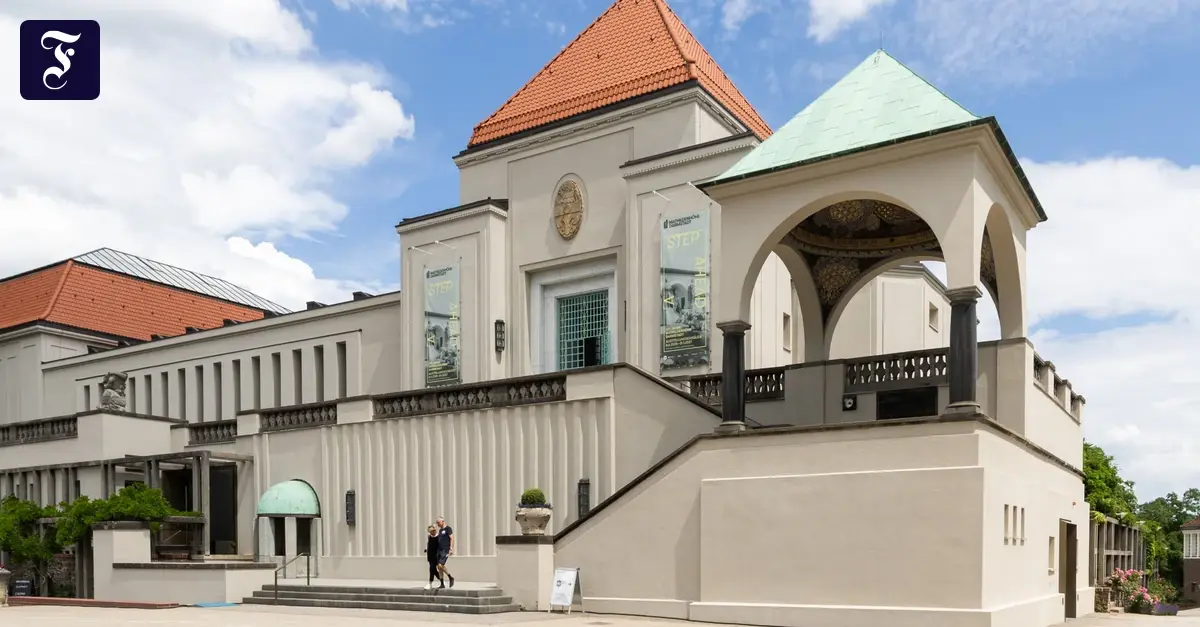
Ein Parlament, das nichts beschließt, sondern nur „zur Kenntnis nimmt" – so lief die Wende bei der Mathildenhöhe. Jan Schiefenhövel (FAZ) bringt es auf den Punkt: Benz, „ein erfahrener und machtbewusster Politiker". #Mathildenhöhe #Darmstadt #OBBenz https://www.faz.net/aktuell/rhein-main/region-und-hessen/was-die-mathildenhoehe-in-darmstadt-braucht-201169738.html
 @arXiv_hepth_bot@mastoxiv.page
2026-08-14 08:43:51
Crosslisted article(s) found for hep-th. https://arxiv.org/list/hep-th/new
[1/2]:
- Microscopic Interaction versus Purely Gravitational Coupling in Strange Quark Stars Admixed with ...
J. Sedaghat, G. H. Bordbar, M. Haghighat, S. M. Zebarjad
https://arxiv.org/abs/2608.12383 https://mastoxiv.page/@arXiv_astrophHE_bot/117092791599481148
- On Super-Hyperbolic Wormhole Geometries and their Deformations
Subrat Parida
https://arxiv.org/abs/2608.12412 https://mastoxiv.page/@arXiv_grqc_bot/117092747330101107
- Blind Spots of the Zwanziger Horizon Function
Daniel G. Tedesco
https://arxiv.org/abs/2608.12413 https://mastoxiv.page/@arXiv_heplat_bot/117092740251141689
- Boundary phases and thermodynamics of the Kondo spin-$s$ chain: from overscreened Kondo to bounda...
Abay Zhakenov, Pradip Kattel, Andreas Gleis, Natan Andrei
https://arxiv.org/abs/2608.12453 https://mastoxiv.page/@arXiv_condmatstrel_bot/117092798677018343
- Fermionic Anomalies of Finite Symmetries on Lattices
Ameya Chavda, Ryohei Kobayashi
https://arxiv.org/abs/2608.12455 https://mastoxiv.page/@arXiv_condmatstrel_bot/117092801201690952
- Thermal false vacuum decay near black holes is aspherical
D. S. Gorbunov, D. G. Levkov, V. E. Maslov
https://arxiv.org/abs/2608.12469 https://mastoxiv.page/@arXiv_grqc_bot/117092780755974388
- Singlet-Doublet fermion origin of dark matter, neutrino mass and inverse first-order electroweak ...
Debasish Borah, Indrajit Saha, Sujit Kumar Sahoo, Narendra Sahu, Shashwat Sharma
https://arxiv.org/abs/2608.12483 https://mastoxiv.page/@arXiv_hepph_bot/117092830695819660
- Dymnikova Black Hole Tidal Forces
M. H. Mac\^edo, A. A. M. Silva, R. R. Landim
https://arxiv.org/abs/2608.12495 https://mastoxiv.page/@arXiv_grqc_bot/117092784293893408
- Quasitopological Gravity with Matter: Modified Double-Copy Approach
Valeri P. Frolov
https://arxiv.org/abs/2608.12596 https://mastoxiv.page/@arXiv_grqc_bot/117092839543100455
- Cosmological Vacuum Decays from Schwinger-Keldysh Formalism
Zi-Yan Yuwen
https://arxiv.org/abs/2608.12736 https://mastoxiv.page/@arXiv_grqc_bot/117092847998387674
- Waterfall-modulated $\alpha$-attractors
Renata Kallosh, Andrei Linde, Yusuke Yamada
https://arxiv.org/abs/2608.12819 https://mastoxiv.page/@arXiv_astrophCO_bot/117092750308822114
- Topological properties around the Roberge-Weiss transition in $N_f = 2 1 1$ QCD
Massimo D'Elia, Fabio Siliberto, Kevin Zambello
https://arxiv.org/abs/2608.12883 https://mastoxiv.page/@arXiv_heplat_bot/117092778621282119
toXiv_bot_toot
 @arXiv_physicsinsdet_bot@mastoxiv.page
2026-08-24 07:50:05
Reconstruction Bias in Timepix4 Subpixel Centroiding for Electron Imaging
Nina Dimova, Richard Plackett, Daniela Bortoletto
https://arxiv.org/abs/2608.21072 https://arxiv.org/pdf/2608.21072 https://arxiv.org/html/2608.21072
arXiv:2608.21072v1 Announce Type: new
Abstract: Subpixel centroiding is widely used to improve the spatial resolution of hybrid pixel detectors for electron imaging by estimating the true interaction position within an entry pixel. Existing centroiding strategies are typically optimised using localisation accuracy. However, observations show that improved localisation does not necessarily translate into improved modulation transfer function (MTF) or reliable virtual-pixel rebinning. This work proposes a unified interpretation of these observations based on the ambiguity of the centroid reconstruction problem. We show that observable-based centroid estimators solve an intrinsically non-unique inverse problem using deterministic reconstruction rules, which can introduce entry-phase-dependent reconstruction bias that governs the spatial distribution of reconstructed subpixel coordinates. This framework explains why localisation accuracy alone is insufficient to predict imaging performance and identifies approximate intra-pixel translational symmetry as a prerequisite for faithful virtual-pixel imaging. The proposed interpretation is evaluated using simulated 200 keV and 300 keV electron data together with measured 200 keV data acquired with a Timepix4 detector. Comparisons of charge-weighted, timing-based, and morphology-dependent centroiding strategies demonstrate that estimators with similar localisation performance can exhibit markedly different MTFs and rebinned flat-field behaviour. The results suggest that future centroid optimisation should consider subpixel phase bias and rebinnability alongside localisation accuracy.
toXiv_bot_toot
 @arXiv_physicsfludyn_bot@mastoxiv.page
2026-07-23 08:09:05
The spectral picture of self-similar collapse in the Constantin-Lax-Majda equation
Jie Xu
https://arxiv.org/abs/2607.19762 https://arxiv.org/pdf/2607.19762 https://arxiv.org/html/2607.19762
arXiv:2607.19762v1 Announce Type: new
Abstract: We give a spectral description of the self-similar collapse profile of the Constantin-Lax-Majda (CLM) equation, the $a=0$ anchor of the generalized family $w_t a\,u\,w_x = u_x\,w$, $u_x = Hw$. Linearizing about the exact profile $\Omega(y) = -y/(y^2 1/4)$ and realizing $L_0$ as a closed operator on the origin-$H^2$ space, we prove three things at $a=0$. Its essential spectrum meets the closed half-plane $\{\mathrm{Re}\,\lambda \ge -1/2\}$ in the single vertical line $\{\mathrm{Re}\,\lambda = -1/2\}$: the line is placed by a log-widening Weyl sequence, and an explicit Hardy-Mellin resolvent bound constructively empties the rest of the half-plane apart from $0$ and $1$. Its full point spectrum over $\mathbb{C}$, on the odd realization, is exactly $\{0,1\}$, the scaling and time-shift symmetry modes, with no embedded eigenvalues; removing these by the standard modulation leaves a spectral gap of $1/2$ on $X$. The linear semigroup and its exact decay rate $e^{-\tau/2}$ are computed in closed form, but on a weighted space of the conjugated variable reached from $X$ by a bounded transfer map; we keep the two separate, since $L_0$ is non-normal and a spectral gap does not by itself give a decay rate in the $X$ norm. A realization dichotomy identifies the in-strip smear of generic discretizations as the faithful spectrum of the maximal $L^2$ realization, which origin-$H^2$ removes. For $a>0$ we prove a conditional two-line inclusion for each admissible smooth focusing profile, recompute the branch $c_l(a)$ of Lushnikov, Silantyev, and Siegel as a cross-check, and record the formal scaling-relevance exponent $s^*(a) = 1/c_l(a)$, below which fractional dissipation is asymptotically subdominant in self-similar variables for fixed sufficiently regular data. The contribution is the realization-dependent spectral picture of the collapse profile itself.
toXiv_bot_toot