 @cdarwin@c.im
2026-07-25 18:25:15
Age verification (or age-gating) laws generally require online services to check, estimate, or verify all users’ ages
—often through invasive tools like ID checks, biometric scans, or other dubious “age estimation” methods
—before granting them access to certain online content or services.
Governments in the U.S. and around the world are increasingly adopting these restrictive measures in the name of protecting children online.
But in practice, these systems create dan…

 @Techmeme@techhub.social
2026-08-18 23:15:50
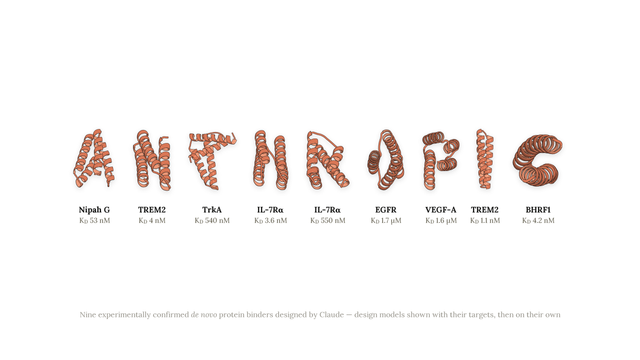
Anthropic details two experiments showing how Claude can accelerate protein design and analytical chemistry, and says it plans an access program for scientists (Anthropic)
https://www.anthropic.com/research/Claude-accelerates-protein-design
 @arXiv_mathDG_bot@mastoxiv.page
2026-08-07 07:48:45
Linearisation, splitting property and homotopy algebras
Seokbong Seol, Kai Wang
https://arxiv.org/abs/2608.05875 https://arxiv.org/pdf/2608.05875 https://arxiv.org/html/2608.05875
arXiv:2608.05875v1 Announce Type: new
Abstract: In this paper, we study the formal linearisation problem for vector fields in the framework of graded coalgebras. We prove that a formal vector field is linearisable if and only if it satisfies a splitting property, by providing an explicit recursive construction of the isomorphism that linearises it. This criterion yields a streamlined proof of Basto-Gon\c{c}alves' theorem on admissible resonant vector fields. We also establish a corresponding splitting criterion for morphisms of formal manifolds, proving that a morphism is linearisable if and only if it satisfies this property. Furthermore, we obtain an elementary and explicit proof of Bandiera's characterisation of linearisable (equivalently, homotopy abelian) $L_\infty[1]$ algebras. Finally, we extend this framework to $A_\infty[1]$ algebras, showing that their linearisability is similarly characterised by an analogous splitting property.
toXiv_bot_toot
 @arXiv_csCR_bot@mastoxiv.page
2026-07-24 07:51:53
Buzz to Boom: Detecting Message Progression Vulnerabilities in Electron Applications via Segmented Directed Fuzzing
Jianjia Yu, Zhengyu Liu, Ziyang Li, Yu Sun, Yinzhi Cao
https://arxiv.org/abs/2607.20698 https://arxiv.org/pdf/2607.20698 https://arxiv.org/html/2607.20698
arXiv:2607.20698v1 Announce Type: new
Abstract: Electron is a popular framework for building cross-platform desktop applications using web technologies. Such applications consist of multiple processes with different privilege levels that communicate via message passing. When inter-process messages carry attacker-controlled inputs, they can propagate across processes and reach privileged APIs, e.g., command execution. Such a message propagation behavior is characterized as Message Progression Vulnerabilities (MPVs). The exploitation of MPVs is challenging because it often requires multiple steps, e.g., first arbitrary code execution in one process via message passing, and then command injection in another process using another message crafted in the first process. To our knowledge, existing works on Electron security only study unsafe configurations and malicious Document Object Model (DOM) content, i.e., they cannot detect or exploit these vulnerabilities that need to be triggered by complex cross-process exploits via message passing. We present Proton, a segmented directed fuzzing framework for detecting MPVs. Our key insight is to decompose end-to-end fuzzing into per-process segments along message-passing boundaries, where the goals of fuzzing each segment are either: (i) reaching a sink in the current process or (ii) propagating the payload to the next process, to enable the exploration of another process. In the second case, the messages seed the corpus of the next segment. Finally, Proton synthesizes crash inputs from each process to validate end-to-end exploits. We evaluate Proton against 589 real-world Electron applications, resulting in 23 zero-day MPVs. Among them, 22 lead to OS command execution, including projects with over 50k GitHub stars. We responsibly disclosed all findings. To date, we have received 13 acknowledgments, 11 fixes, and 11 CVEs, including a bug bounty from Vercel.
toXiv_bot_toot