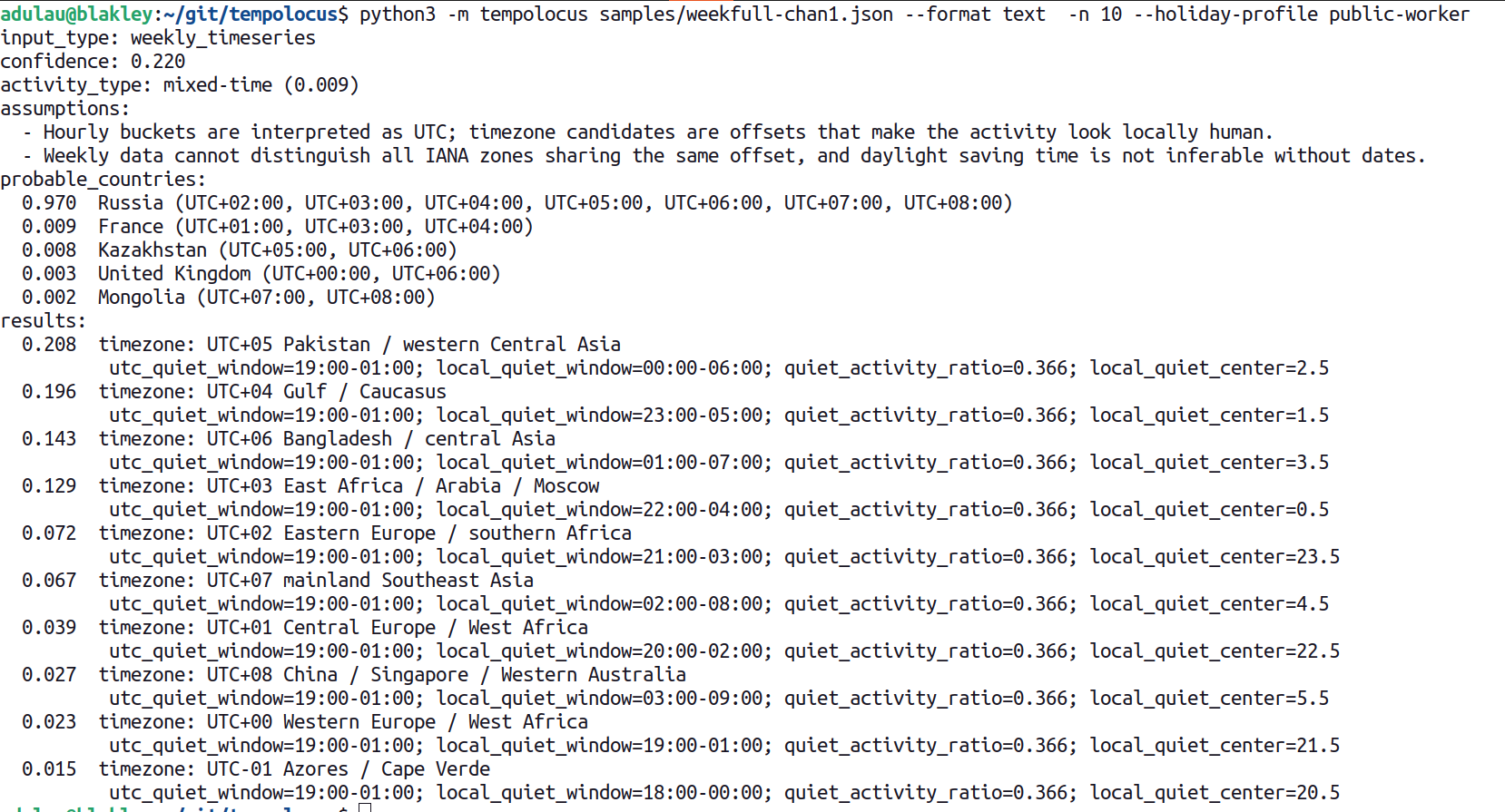
Working on tempolocus, a tool that analyses time-series activity patterns to infer a user’s likely location.
In @…, we work with a large volume of social-network time series. Estimating users’ locations from these patterns is often a manual task.
I prototyped a Python module that combines potential locations with yearly activity …
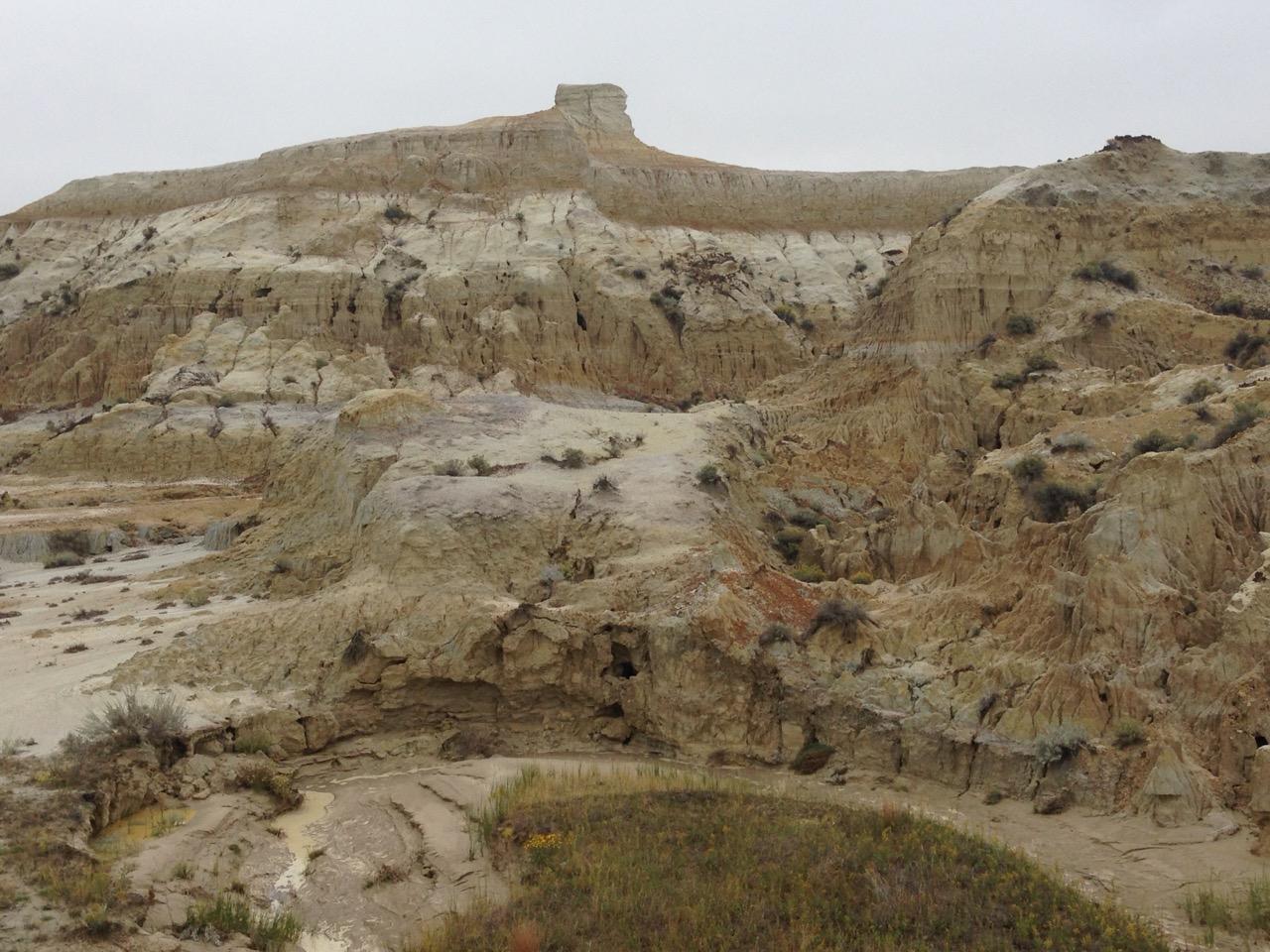
Labor Day, ten years ago, 2016. Field Geology in the Little Badlands of Western North Dakota. Paleocene / Eocene Golden Valley Formation. You may see some offsets!
Non-Thermal Pressure due to Gas Motions in the Intracluster Medium: Confronting XRISM/Resolve with TNG-Cluster Simulations
Erwin T. Lau, Naomi Ota, Daisuke Nagai
https://arxiv.org/abs/2608.04757 https://arxiv.org/pdf/2608.04757 https://arxiv.org/html/2608.04757
arXiv:2608.04757v1 Announce Type: new
Abstract: Intracluster medium (ICM) gas motions probe cluster assembly, feedback, and non-thermal pressure support, but recent XRISM observations reveal velocity dispersions and non-thermal pressure fractions systematically lower than simulations predict, with extreme systems such as Abell 2029 falling below nearly all simulated clusters. Using the TNG-Cluster simulations, we show that the non-thermal pressure fraction depends sensitively on cool-core state and formation history, and provide a two-scale fitting function capturing both the inner cool-core suppression and outer rise of the radial profile. By forward-modeling mock XRISM observations and comparing them with both projected and intrinsic three-dimensional quantities, we find that azimuthal variations and projection effects contribute to the deficit in the observed velocity dispersion and non-thermal pressure fraction. This bias increases with radius and partially offsets the intrinsic outward rise in the true three-dimensional non-thermal pressure fraction. However, these effects cannot explain the extremely low values of the non-thermal pressure fraction observed in Abell 2029, which fall below approximately the 0th - 6th percentiles of the simulated cool-core cluster distribution at every measured radius under both the turbulence-only and turbulence-plus-bulk definitions. The remaining tension points to rare dynamical conditions or missing physics affecting the amplitude of gas motions in current ICM models.
toXiv_bot_toot
MORSE-PI -- Flexible and artefact-free image reconstruction for structural and functional QSM and other phase-critical imaging applications
Barbara Dymerska, Oliver Josephs, Benjamin James, Vahid Malekian, Nadine N. Graedel, Martina F. Callaghan
https://arxiv.org/abs/2606.21336 https://arxiv.org/pdf/2606.21336 https://arxiv.org/html/2606.21336
arXiv:2606.21336v1 Announce Type: new
Abstract: Phase imaging applications such as QSM are highly sensitive to noise amplifications, phase singularities, and other artefacts, particularly in challenging scenarios such as ultra-high field (7T), under-sampled or single-echo acquisitions. We present a novel image reconstruction method, MORSE-PI, designed to produce high-SNR, artefact-free, and singularity-free phase images for both structural and functional phase-based brain imaging. MORSE-PI extends our previous approach, MORSE, by introducing a Virtual Reference Coil (VRC). The VRC is constructed as a linear combination of coil sensitivity maps, with correlations enhanced between coil elements using the noise covariance matrix. Such a VRC ensures robust signal support across the entire brain and is used to correct phase offsets in the MORSE-derived coil sensitivity estimates, resulting in artefact-free, high SNR phase. Compared to GRAPPA with ASPIRE phase correction, MORSE-PI demonstrates greater robustness to artefacts such as noise amplification and aliasing, and shows improved reproducibility in structural imaging at both 3T and 7T. Unlike ESPIRiT and GRAPPA combined with adaptive coil combination methods, MORSE-PI yields singularity-free phase maps. MORSE-PI enables high-SNR reconstructions even for the most challenging scenarios, such as single-echo EPI at 7T. Its efficient, containerised implementation using the Gadgetron framework supports deployment on the MRI scanner console during measurements. MORSE-PI offers a flexible and computationally efficient solution for generating high-SNR, artefact- and singularity-free phase images in both single- and multi-echo GRE and EPI acquisitions. This makes it particularly well-suited for structural and functional QSM, as well as other phase-based MRI applications. Its robustness and rapid computational time facilitate efficient deployment on scanners across field strengths.
toXiv_bot_toot
Replaced article(s) found for astro-ph.GA. https://arxiv.org/list/astro-ph.GA/new
[2/3]:
- Hunting Wandering 3<z<8 Black Holes: Spatial Offsets in Ionization Ratio and Continuum Emission
Urvi Thakurdesai, et al.
https://arxiv.org/abs/2606.30715 https://mastoxiv.page/@arXiv_astrophGA_bot/116843669196485332
- Spectral Energy Distributions of Globular Clusters in VV191a
Ashton Cardona, et al.
https://arxiv.org/abs/2607.10352 https://mastoxiv.page/@arXiv_astrophGA_bot/116917375134409194
- The different methods to calculate cluster membership probabilities
Tahereh Ramezani, Prapti Mondal, Katerina Neumannova, Ernst Paunzen, Johana Supikova, Gabriel Szasz
https://arxiv.org/abs/2607.13711 https://mastoxiv.page/@arXiv_astrophGA_bot/116928584338673264
- On the current status of tidal tails of Galactic open clusters
Tahereh Ramezani, Prapti Mondal, Katerina Neumannova, Ernst Paunzen, Johana Supikova, Gabriel Szasz
https://arxiv.org/abs/2607.13747 https://mastoxiv.page/@arXiv_astrophGA_bot/116928607930493156
- The Stripped-Star Ultraviolet Magellanic Cloud Survey (SUMS): The UV Photometric Catalog and Stri...
Bethany Ludwig, Maria R. Drout, Ylva Gotberg, Dustin Lang, Alexander Laroche
https://arxiv.org/abs/2505.18632 https://mastoxiv.page/@arXiv_astrophSR_bot/114578704405418342
- Observable signature of magnetic tidal coupling in hierarchical triple systems
Marta Cocco, Gianluca Grignani, Troels Harmark, Marta Orselli, Davide Panella, Daniele Pica
https://arxiv.org/abs/2510.24897 https://mastoxiv.page/@arXiv_grqc_bot/115462391818777276
- Periodic Gravitational Lensing with Oscillating Boson Stars
Xing-Yu Yang, Tan Chen, Rong-Gen Cai
https://arxiv.org/abs/2511.19606 https://mastoxiv.page/@arXiv_grqc_bot/115615137595636545
- Search for Dark Matter Annihilation and Decay with H$\alpha$ Line Emission
Rebecca K. Leane
https://arxiv.org/abs/2512.09019 https://mastoxiv.page/@arXiv_hepph_bot/115700041751825685
- Reanalyzing DESI DR1: 5. Cosmological Constraints with Simulation-Based Priors
Anton Chudaykin, Mikhail M. Ivanov, Oliver H. E. Philcox
https://arxiv.org/abs/2602.18554 https://mastoxiv.page/@arXiv_astrophCO_bot/116124504277603946
- Can wormholes have vanishing Love numbers?
Shauvik Biswas
https://arxiv.org/abs/2605.03025 https://mastoxiv.page/@arXiv_grqc_bot/116526586864139338
toXiv_bot_toot
Points as Tori: Fast Pointwise Signed Distance for Point Clouds
Nicole Feng, Ioannis Gkioulekas, Keenan Crane
https://arxiv.org/abs/2607.16946 https://arxiv.org/pdf/2607.16946 https://arxiv.org/html/2607.16946
arXiv:2607.16946v1 Announce Type: new
Abstract: We describe a method for computing signed distance to point clouds that allows fast pointwise evaluation at arbitrary spatial resolution. As input, our method takes a point cloud with normals; as output, it provides an analytical parameterization that allows queries of signed distance to the approximate underlying surface at arbitrary points - simultaneously providing reconstruction and distance. Our key idea is to reconstruct shapes by locally fitting point clouds with tori, which have closed-form signed distance functions. Tori are fitted in a feed-forward manner, using a pre-trained network to output per-point curvature and shift parameters. Importantly, our method does not require costly global optimization or spatial discretization, and is easily parallelizable. Underlying our method is a new theory that unifies signed distance with the classic reconstruction methods of winding numbers and Poisson surface reconstruction. We use our method to compute signed distance to point clouds arising from photogrammetry, meshes, 3D Gaussians, and neural implicits. Our method allows point clouds to be used directly in applications, without explicit surface reconstruction: as examples, we take offsets of point clouds, apply morphological and Boolean operations, and directly visualize offset surfaces using sphere tracing.
toXiv_bot_toot
 @memeorandum@universeodon.com