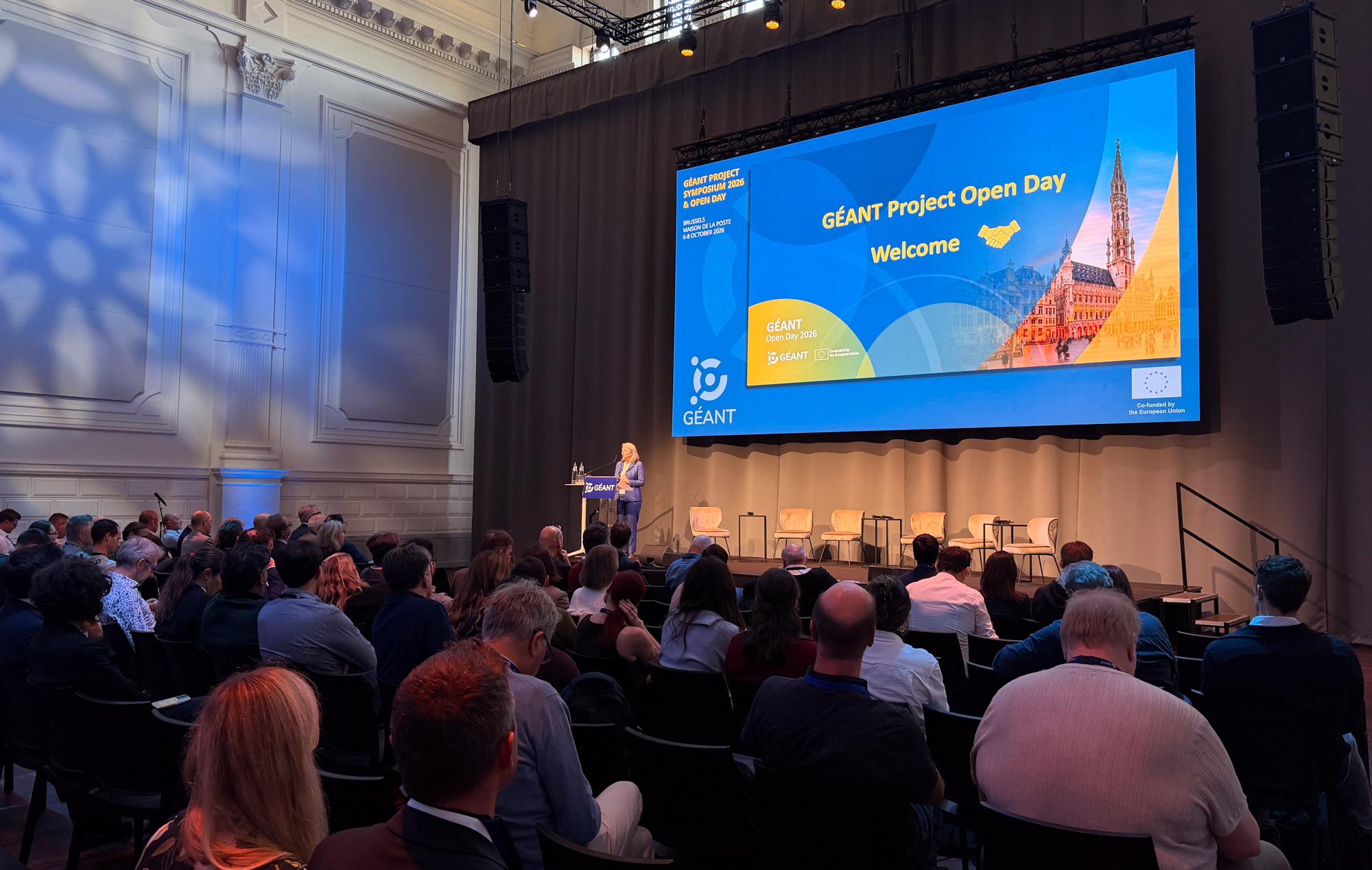
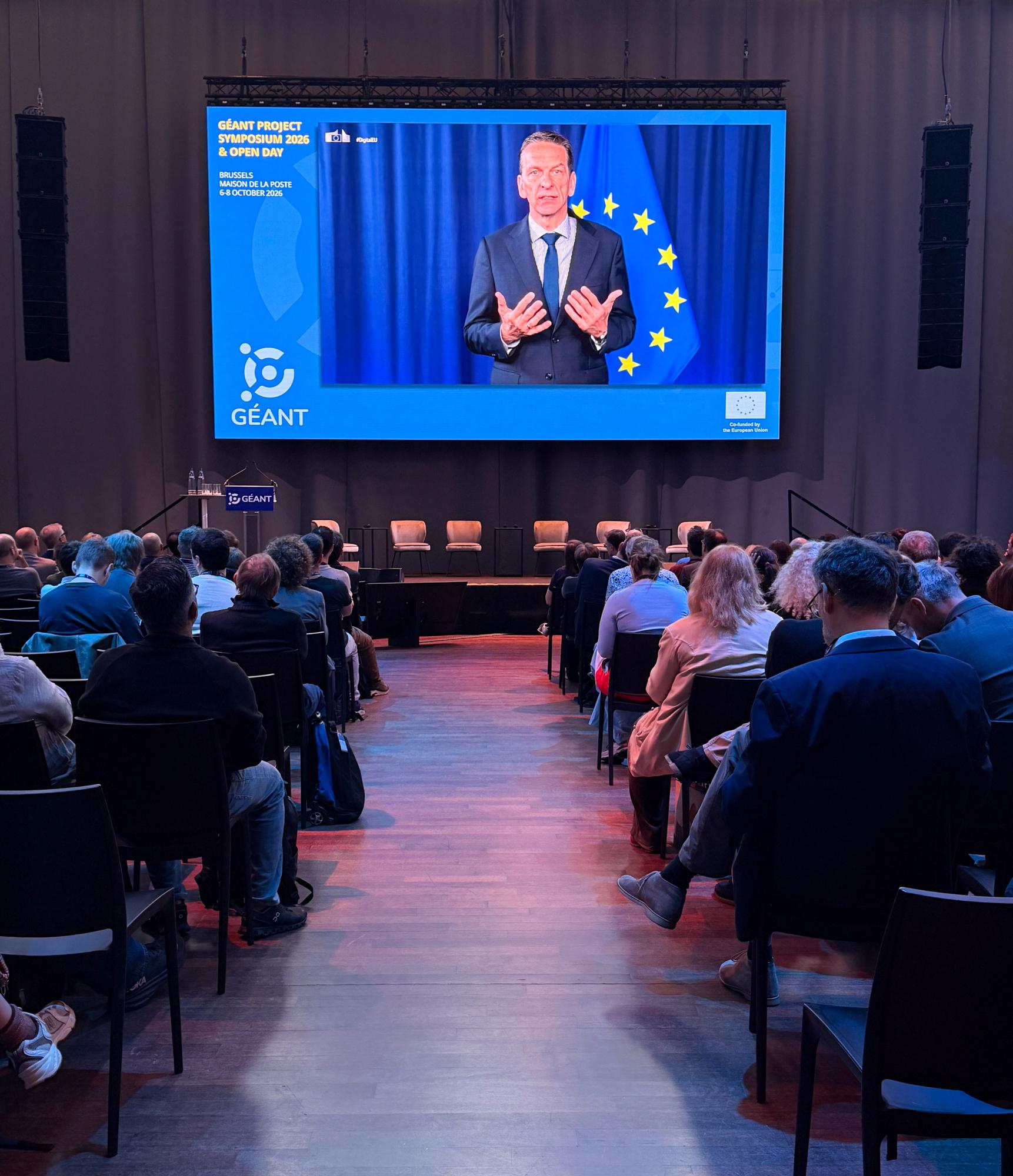
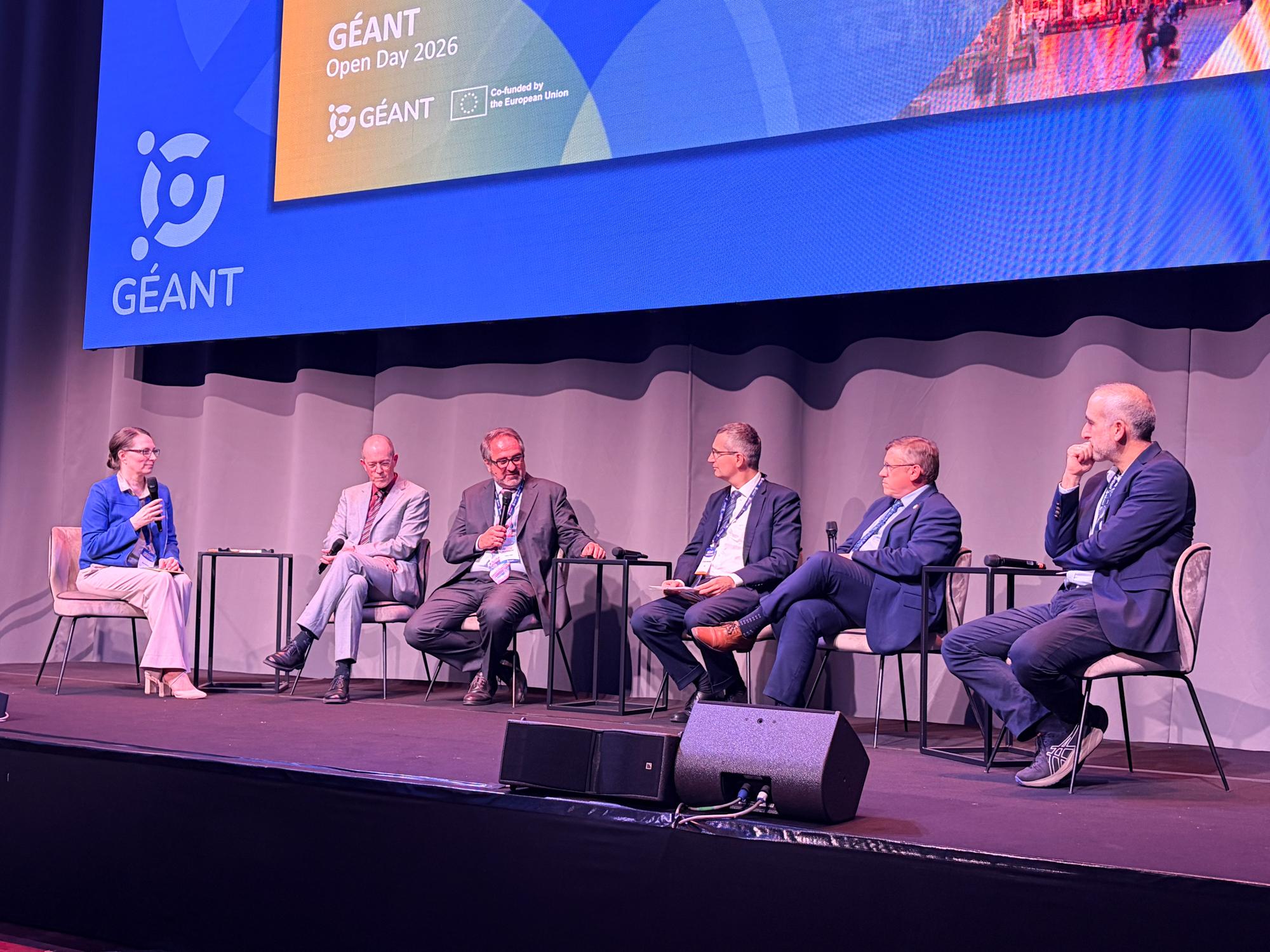
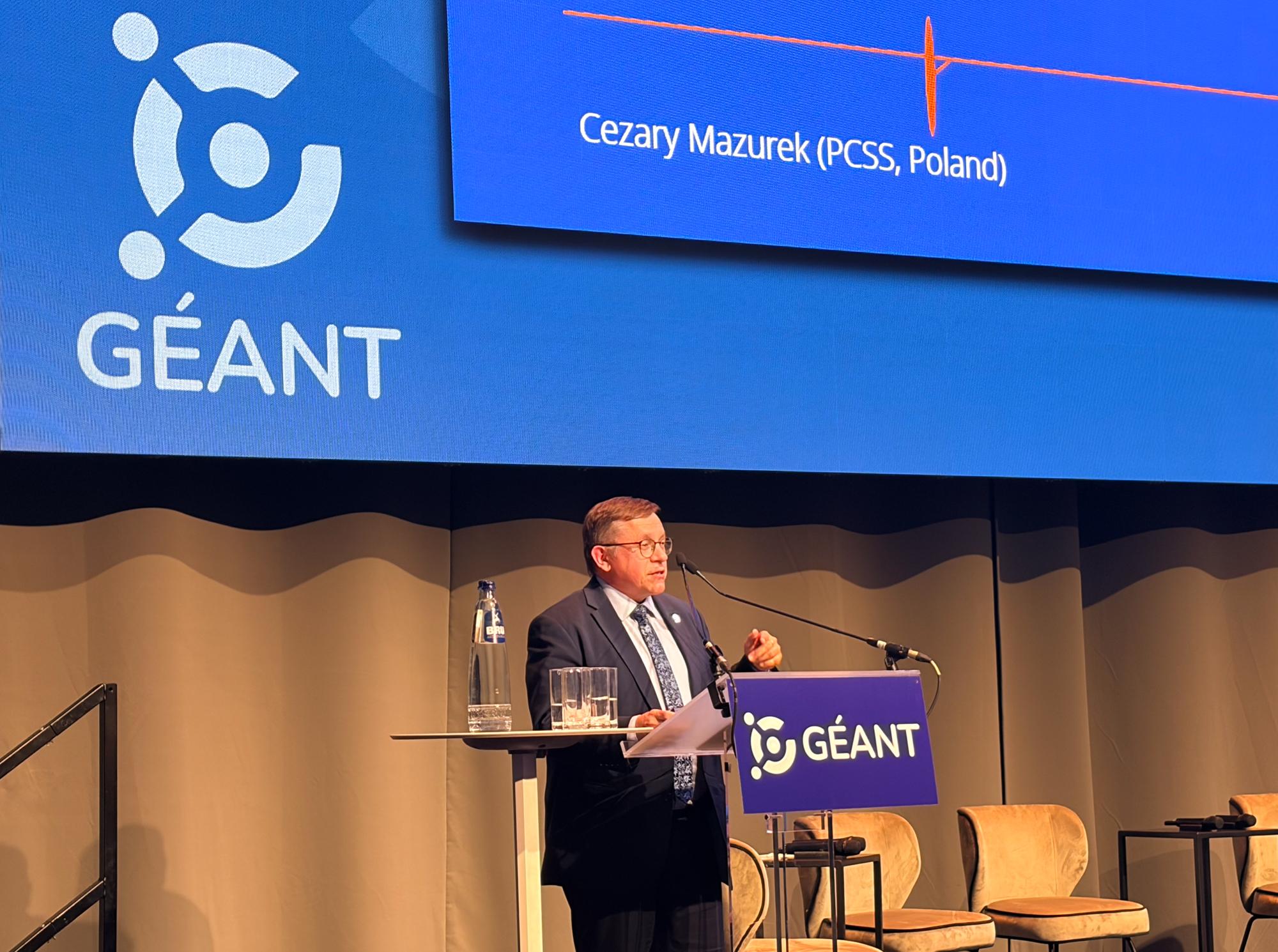
✨ GÉANT Project Open Day 2026 ✨
Our first ever first-ever GÉANT Project Open Day to celebrate 25 years of collaboration between the European Commission, the GÉANT Association, and our community of NREN members.
Last week in Brussels, we welcomed the EU institutions, research infrastructures, university associations and regional bodies to explore how our trusted digital foundation supports science at scale, global collaboration and national and regional networks.
🔗
Open PhD positions: The IMPRS for Solar System Science at the University of Göttingen and at TU Braunschweig is offering PhD projects in Star-Planet Interactions and in Planet Formation https://www.mps.mpg.de/phd/open-projects
Star-Planet Interactions with E. Ilin:
Manchester Climate Scientists call on the new PM not to drill for oil
Kevin Anderson and colleagues at the University Tyndall Centre have written an open letter to Andy Burnham calling on him not to agree drilling in the Rosebank and Jackdaw marine oil fields. They point out his leadership in commissioning work from them that led to setting of Greater Manchester’s ambitious, Paris-compliant carbon budget. They say that allowing more oil extraction would betray that…
Manchester Climate Scientists call on the new PM not to drill for oil
Kevin Anderson and colleagues at the University Tyndall Centre have written an open letter to Andy Burnham calling on him not to agree drilling in the Rosebank and Jackdaw marine oil fields. They point out his leadership in commissioning work from them that led to setting of Greater Manchester’s ambitious, Paris-compliant carbon budget. They say that allowing more oil extraction would betray that…
Open PhD positions at our partner university TU Braunschweig: The Institute for Theoretical Physics is offering PhD projects in space and astrophysics, working with Y. Narita: https://www.
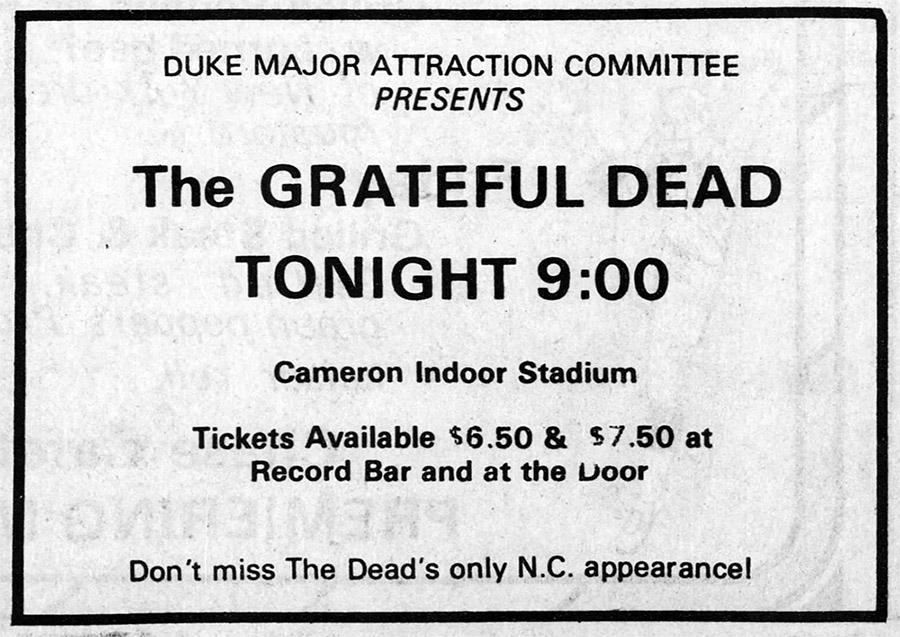
50 years ago tonight, the grateful dead open their fall tour at duke university, pulling out a few songs they haven’t played since before the road break. grotty mono PA tape with mushy lesh-poor/weir-rich mix. night of the ford/carter debate!
soundboard: https://archive.org/details/gd1976-09-
🚨Job Alert !🚨 Geochemistry
⚒️🧪
Jobs at the University of Freiburg (DE) with deadlines:
- #PhD in S Cycling in Wetlands & its Coupling to Fe & C (20 Sep/open until filled)
- #postdoc in Environ. Geochem. (23 Sep/open until filled)
- Lab Manager in the Environ. Geochem Lab (25 S…
School of Mathematics and Statistics, Guilin University of Technology, Guilin 541004, ChinaScott spaces of complete Boolean algebras need not be co-sober
Wei Ji, Xiaoquan Xu
https://arxiv.org/abs/2608.08484 https://arxiv.org/pdf/2608.08484 https://arxiv.org/html/2608.08484
arXiv:2608.08484v1 Announce Type: new
Abstract: In this paper, we first prove that for a complete Boolean algebra $L$, the complement graph of $L$ is a \emph{KC}-space (as a subspace) and each non-singleton compact irreducible subspace of that graph generates a non-principal $k$-irreducible compact saturated set in the Scott space of the square algebra $L\times L$. We then show that every compact sequential \emph{US}-space embeds into the complement graph of a suitable complete Boolean algebra. The embedding is built from a finite tail-constraint poset and its regular-open completion. Applying the construction to van Douwen's compact Fr\'echet anti-Hausdorff \emph{US}-space gives a complete Boolean algebra $B$ whose Scott space $\Sigma~\!\!B$ is not co-sober, thereby answering negatively a question on Scott spaces of complete Boolean algebras. The same Scott space $\Sigma~\!\!B$ is non-sober and, as a Scott space of a complete lattice, is well-filtered.
toXiv_bot_toot
In 2001 there were no iphones, email was the predominant form of all online communications, people were arguing about the utility of TCP MD5 auth on BGP sessions, and there was no such thing as passive DNS.
I was a volunteer helping with the "shownet" at Networld Interop in Atlanta on September 11. This would be the last N I I would attend.
Volunteers from umich brought up a live TV news stream via IP multicast from their university into a TV by the NOC where many of the teams and vendors could watch events unfold. I believe we saw the second plane hit on that TV that morning.
Surely a bit of exaggeration of our importance, but some couldn't help but wonder about the potential loss to the Internet community if there was some sort of attack in Atlanta that day.
The first rumor/conspiracy I heard was when someone told me a number of people of a certain religious persuasion did not show up for work at CNN that day, as if they all were in on it.
I remember the same night, many bars and restaurants were open. I remember seeing some (not many) people I knew partying almost like nothing happened and I will forever feel guilt just for being there.
My friends from umich and I ended up driving back home due to days-long closure/restrictions of the airspace. For weeks after ever I'd get triggered when I heard a plane in the sky, an eventually increasingly occurrence when you live and work around the Loop in Chicago.
Infosec was already becoming increasingly important, but that day was perhaps a real milestone when it began to eventually eclipse networking in importance, organizational decision making, and commercial product focus.
🇺🇦 #NowPlaying on BBCRadio3's #SofiJeanninSingingTogether
Benjamin Britten, Britten Sinfonia, Sawston Village College Choir, Cambridge University Musical Society & Stephen Cleobury:
🎵 Nicolas and the Pickled Boys
https://open.spotify.com/track/7HfgFsoUydTHvGDXVL1wmM
Examining the stellar-merger origin of the blue main sequence in the open cluster NGC\,3532 with N-body simulations
Khushboo K. Rao (Institute of Astronomy, National Central University, 300 Zhongda Road, Zhongli 32001 Taoyuan, Taiwan), Sambaran Banerjee (Helmholtz-Instituts f\"ur Strahlen- und Kernphysik)
https://arxiv.org/abs/2607.18681 https://arxiv.org/pdf/2607.18681 https://arxiv.org/html/2607.18681
arXiv:2607.18681v1 Announce Type: new
Abstract: Extended main-sequence turnoffs, extended main sequences, and split main sequences observed in the colour-magnitude diagrams of young and intermediate-age star clusters are now widely interpreted as the consequence of a distribution of stellar rotation rates among their intermediate-mass (1.5-1.8~M$_\odot$) members. However, the origin of the slowly rotating population that occupies the blue main sequence (bMS) remains uncertain, and stellar mergers have been proposed as one possible pathway. We investigate whether stellar mergers can account for the observed bMS population in the 330-Myr Galactic open cluster NGC 3532. We perform fourteen direct NBODY7 simulations spanning different initial cluster masses, radii, binary fractions, and binary orbital distributions. The simulations are selected to reproduce the present-day properties of NGC 3532 within the observational uncertainties, allowing us to estimate the expected number of merger products among its intermediate-mass main-sequence (MS) members. The cluster hosts $\approx 37\%$ bMS members among its intermediate-mass MS population, which are predominantly slow rotators. Despite this large bMS population, our simulations produce only a handful of MS-MS merger products, due to the cluster's low density and substantial mass loss during its evolution. Stellar mergers are unlikely to be the dominant formation channel for the observed slowly rotating bMS population in NGC 3532 and other disperse open clusters. Our results instead favour angular-momentum loss mechanisms operating before or shortly after the zero-age main sequence, such as pre-main-sequence star-disk interactions or tidal synchronization in low-mass ratio binaries.
toXiv_bot_toot
 @geant@mstdn.social