 @arXiv_physicsfludyn_bot@mastoxiv.page
2026-02-27 08:32:10
From synthetic turbulence to true solutions: A deep diffusion model for discovering periodic orbits in the Navier-Stokes equations
Jeremy P Parker, Tobias M Schneider
https://arxiv.org/abs/2602.23181 https://arxiv.org/pdf/2602.23181 https://arxiv.org/html/2602.23181
arXiv:2602.23181v1 Announce Type: new
Abstract: Generative artificial intelligence has shown remarkable success in synthesizing data that mimic complex real-world systems, but its potential role in the discovery of mathematically meaningful structures in physical models remains underexplored. In this work, we demonstrate how a generative diffusion model can be used to uncover previously unknown solutions of a nonlinear partial differential equation: the two-dimensional Navier-Stokes equations in a turbulent regime. Trained on data from a direct numerical simulation of turbulence, the model learns to generate time series that resemble physically plausible trajectories. By carefully modifying the temporal structure of the model and enforcing the symmetries of the governing equations, we produce synthetic trajectories that are periodic in time, despite the fact that the training data did not contain periodic trajectories. These synthetic trajectories are then refined into true solutions using an iterative solver, yielding 111 new periodic orbits (POs) with very short periods. Our results reveal a previously unobserved richness in the PO structure of this system and suggest a broader role for generative AI: not as replacements for simulation and existing solvers, but as a complementary tool for navigating the complex solution spaces of nonlinear dynamical systems.
toXiv_bot_toot
@arXiv_physicsfludyn_bot@mastoxiv.page2026-02-27 08:32:10
From synthetic turbulence to true solutions: A deep diffusion model for discovering periodic orbits in the Navier-Stokes equations
Jeremy P Parker, Tobias M Schneider
https://arxiv.org/abs/2602.23181
 @david@boles.xyz
2026-04-19 14:36:17
Below the Mesh
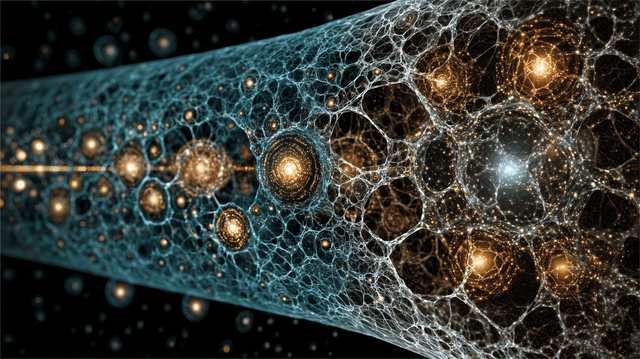
The light year is a bookkeeping unit that has been promoted, by repetition and by the poverty of better language, into a cosmic speed limit. Both halves of that sentence are wrong in slightly different ways. A light year measures the distance a photon covers in one orbit of Earth around the Sun, and it measures that distance against the stage on which photons and Earths and Suns appear.