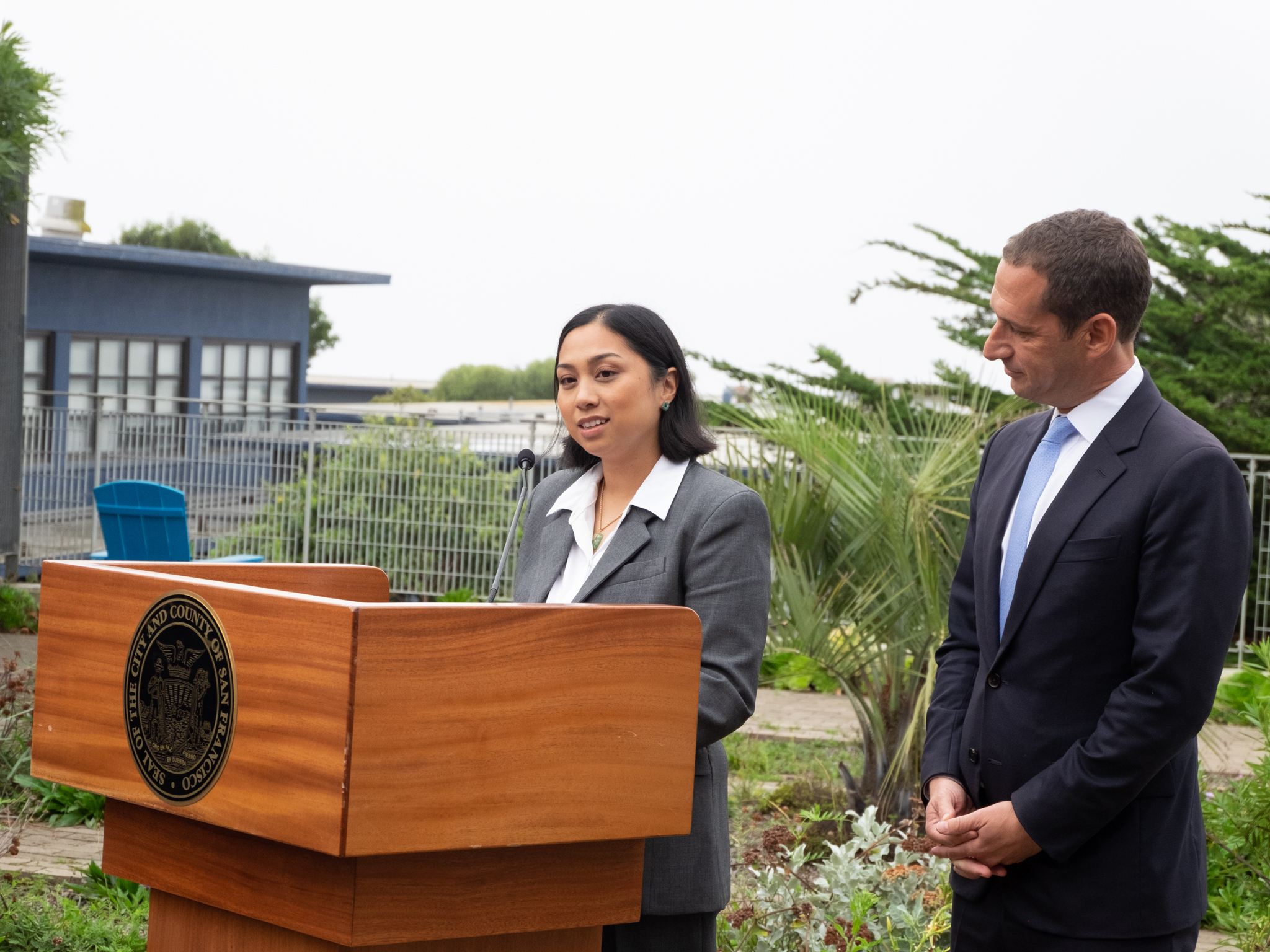
 @cdarwin@c.im
2026-02-15 16:13:03
A huge impact 4.3 billion years ago partially melted the Moon's mantle & made it lopsided
https://skywriter.blue/@coreyspowell.bsky.social/3meoshhxwic2u
@cdarwin@c.imA huge impact 4.3 billion years ago partially melted the Moon's mantle & made it lopsided
https://skywriter.blue/@coreyspowell.bsky.social/3meoshhxwic2u
 @arXiv_mathCO_bot@mastoxiv.page
On 3-Connected Planar Graphs with Unique Orientable Circuit Double Covers
Meike Wei{\ss}, Reymond Akpanya, Alice C. Niemeyer
https://arxiv.org/abs/2601.10171 https://
 @lysander07@sigmoid.social
The CfP for the 3rd International Workshop of Semantic Digital Humanities is out!
submission deadline for papers & panels: March 3, 2026
webpage: #semanticweb

 @grahamperrin@bsd.cafe
@… for clarity: I don't see pkgbase as strange, or dangerous.
It's sometimes misunderstood. Sometimes the big picture is not seen.
The 15.0 errata page, for example. The recent statement about major upgrades from 14.3 is wrong:
"systems installed with pkgbase(7) must backup and reinstall"
– that's unneces…
 @schoedland@digitalcourage.social
There's a tool named #WinSlop that gets rid of any and all unpleasantries #microslop seems to shovel upon us. Alas, there is a notice on the github page of the project that the domain winslop.com is not owned or operated by the creator of WinSlop.
 @NFL@darktundra.xyz
Bears QB Caleb Williams 'excited for the moment' ahead of Saturday's Week 16 rematch vs. Packers https://www.nfl.com/news/bears-qb-caleb-williams-excited-for-the-moment-ahead-of-saturday-s-week-16-rematch-vs-packers…
 @arXiv_physicsgeoph_bot@mastoxiv.page
[2025-12-17 Wed (UTC), 3 new articles found for physics.geo-ph Geophysics]
toXiv_bot_toot
@arXiv_mathCO_bot@mastoxiv.pageCylinder type and $p$-divisible sets in $\mathbb{F}_p^3$
Gergely Kiss, \'Ad\'am Mark\'o, Zolt\'an L\'or\'ant Nagy, G\'abor Somlai
https://arxiv.org/abs/2601.09910
 @michabbb@social.vivaldi.net
@…
Good question! The numbers are from a production server with NVMe storage.
Breakdown:
- 19k files (15 GB): ~8-9 sec
- 13k files (53 GB): ~13-14 sec
- Total: 32k files (68 GB): ~21 sec
That's ~3.2 GB/s throughput - achievable with:
1. NVMe SSDs (3-7 GB/s sequential read)
2. Linux page cache on subseque…
 @@arXiv_physicsatomph_bot@mastoxiv.page@mastoxiv.page
Replaced article(s) found for physics.atom-ph. https://arxiv.org/list/physics.atom-ph/new
[1/1]:
- Imaging atomic scattering potential in centroidal diffraction of elastic electrons
R. Aiswarya, Jobin Jose, Nenad Simonovi\'c, Bratislav P. Marinkovi\'c, Himadri S. Chakraborty
https://arxiv.org/abs/2507.04466 https://mastoxiv.page/@arXiv_physicsatomph_bot/114816830706448493
- Nonadiabatic corrections to electric quadrupole transition rates in H$_2$
Krzysztof Pachucki, Micha{\l} Si{\l}kowski
https://arxiv.org/abs/2511.02716 https://mastoxiv.page/@arXiv_physicsatomph_bot/115496115851400980
- Demonstration of magic dressing of $^3$He
Raymond Tat
https://arxiv.org/abs/2512.02443 https://mastoxiv.page/@arXiv_physicsatomph_bot/115654579955357210
- First observation and measurement of the ${}^{198}\text{Hg}$ bosonic transition in an optical lat...
Zyskind, Laupr\^etre, Shang, Pointard, Le Targat, Lodewyck, Bize
https://arxiv.org/abs/2512.04920 https://mastoxiv.page/@arXiv_physicsatomph_bot/115666084295921110
- Two-Mode Bosonic State Tomography with Single-Shot Joint-Parity Measurement of a Trapped Ion
Honggi Jeon, Jiyong Kang, Wonhyeong Choi, Kyunghye Kim, Jaehun You, Taehyun Kim
https://arxiv.org/abs/2506.12628 https://mastoxiv.page/@arXiv_quantph_bot/114698759566941964
- Phase-locked amplification enhanced by spin squeezing
Yan Zhang, Jing Zhang, Hou Ian
https://arxiv.org/abs/2507.02278 https://mastoxiv.page/@arXiv_quantph_bot/114794342738854491
- Temperature-Dependent Evolution of Coherence, Entropy, and Photon Statistics in Photoluminescence
Tomer Bar Lev, Carmel Rotschild
https://arxiv.org/abs/2508.01953 https://mastoxiv.page/@arXiv_physicsoptics_bot/114975598886927233
- Application of Quantum Annealing to Computation of Molecular Properties
Pradyot Pritam Sahoo, V. S. Prasannaa, B. P. Das
https://arxiv.org/abs/2508.12779 https://mastoxiv.page/@arXiv_quantph_bot/115055154966701578
toXiv_bot_toot
 @arXiv_csCV_bot@mastoxiv.page
Replaced article(s) found for cs.CV. https://arxiv.org/list/cs.CV/new
[3/5]:
- Unsupervised Learning for Industrial Defect Detection: A Case Study on Shearographic Data
Jessica Plassmann, Nicolas Schuler, Georg von Freymann, Michael Schuth
 @rmdes@mstdn.social
This weekend I worked on my custom /blogroll page
it has 3 input types :
1. you construct the collection by adding blogs manually
2. you import an OPML with your collection
3. you connect your /microsub existing collection to feed the blogroll on the frontend.
https://rmendes.net/notes/2026/02/08/3
 @arXiv_csLG_bot@mastoxiv.page
Crosslisted article(s) found for cs.LG. https://arxiv.org/list/cs.LG/new
[1/3]:
- Optimizing Text Search: A Novel Pattern Matching Algorithm Based on Ukkonen's Approach
Xinyu Guan, Shaohua Zhang
https://arxiv.org/abs/2512.16927 https://mastoxiv.page/@arXiv_csDS_bot/115762062326187898
- SpIDER: Spatially Informed Dense Embedding Retrieval for Software Issue Localization
Shravan Chaudhari, Rahul Thomas Jacob, Mononito Goswami, Jiajun Cao, Shihab Rashid, Christian Bock
https://arxiv.org/abs/2512.16956 https://mastoxiv.page/@arXiv_csSE_bot/115762248476963893
- MemoryGraft: Persistent Compromise of LLM Agents via Poisoned Experience Retrieval
Saksham Sahai Srivastava, Haoyu He
https://arxiv.org/abs/2512.16962 https://mastoxiv.page/@arXiv_csCR_bot/115762140339109012
- Colormap-Enhanced Vision Transformers for MRI-Based Multiclass (4-Class) Alzheimer's Disease Clas...
Faisal Ahmed
https://arxiv.org/abs/2512.16964 https://mastoxiv.page/@arXiv_eessIV_bot/115762196702065869
- Probing Scientific General Intelligence of LLMs with Scientist-Aligned Workflows
Wanghan Xu, et al.
https://arxiv.org/abs/2512.16969 https://mastoxiv.page/@arXiv_csAI_bot/115762050529328276
- PAACE: A Plan-Aware Automated Agent Context Engineering Framework
Kamer Ali Yuksel
https://arxiv.org/abs/2512.16970 https://mastoxiv.page/@arXiv_csAI_bot/115762054461584205
- A Women's Health Benchmark for Large Language Models
Elisabeth Gruber, et al.
https://arxiv.org/abs/2512.17028 https://mastoxiv.page/@arXiv_csCL_bot/115762049873946945
- Perturb Your Data: Paraphrase-Guided Training Data Watermarking
Pranav Shetty, Mirazul Haque, Petr Babkin, Zhiqiang Ma, Xiaomo Liu, Manuela Veloso
https://arxiv.org/abs/2512.17075 https://mastoxiv.page/@arXiv_csCL_bot/115762077400293945
- Disentangled representations via score-based variational autoencoders
Benjamin S. H. Lyo, Eero P. Simoncelli, Cristina Savin
https://arxiv.org/abs/2512.17127 https://mastoxiv.page/@arXiv_statML_bot/115762251753966702
- Biosecurity-Aware AI: Agentic Risk Auditing of Soft Prompt Attacks on ESM-Based Variant Predictors
Huixin Zhan
https://arxiv.org/abs/2512.17146 https://mastoxiv.page/@arXiv_csCR_bot/115762318582013305
- Application of machine learning to predict food processing level using Open Food Facts
Arora, Chauhan, Rana, Aditya, Bhagat, Kumar, Kumar, Semar, Singh, Bagler
https://arxiv.org/abs/2512.17169 https://mastoxiv.page/@arXiv_qbioBM_bot/115762302873829397
- Systemic Risk Radar: A Multi-Layer Graph Framework for Early Market Crash Warning
Sandeep Neela
https://arxiv.org/abs/2512.17185 https://mastoxiv.page/@arXiv_qfinRM_bot/115762275982224870
- Do Foundational Audio Encoders Understand Music Structure?
Keisuke Toyama, Zhi Zhong, Akira Takahashi, Shusuke Takahashi, Yuki Mitsufuji
https://arxiv.org/abs/2512.17209 https://mastoxiv.page/@arXiv_csSD_bot/115762341541572505
- CheXPO-v2: Preference Optimization for Chest X-ray VLMs with Knowledge Graph Consistency
Xiao Liang, Yuxuan An, Di Wang, Jiawei Hu, Zhicheng Jiao, Bin Jing, Quan Wang
https://arxiv.org/abs/2512.17213 https://mastoxiv.page/@arXiv_csCV_bot/115762574180736975
- Machine Learning Assisted Parameter Tuning on Wavelet Transform Amorphous Radial Distribution Fun...
Deriyan Senjaya, Stephen Ekaputra Limantoro
https://arxiv.org/abs/2512.17245 https://mastoxiv.page/@arXiv_condmatmtrlsci_bot/115762447037143855
- AlignDP: Hybrid Differential Privacy with Rarity-Aware Protection for LLMs
Madhava Gaikwad
https://arxiv.org/abs/2512.17251 https://mastoxiv.page/@arXiv_csCR_bot/115762396593872943
- Practical Framework for Privacy-Preserving and Byzantine-robust Federated Learning
Baolei Zhang, Minghong Fang, Zhuqing Liu, Biao Yi, Peizhao Zhou, Yuan Wang, Tong Li, Zheli Liu
https://arxiv.org/abs/2512.17254 https://mastoxiv.page/@arXiv_csCR_bot/115762402470985707
- Verifiability-First Agents: Provable Observability and Lightweight Audit Agents for Controlling A...
Abhivansh Gupta
https://arxiv.org/abs/2512.17259 https://mastoxiv.page/@arXiv_csMA_bot/115762225538364939
- Warmer for Less: A Cost-Efficient Strategy for Cold-Start Recommendations at Pinterest
Saeed Ebrahimi, Weijie Jiang, Jaewon Yang, Olafur Gudmundsson, Yucheng Tu, Huizhong Duan
https://arxiv.org/abs/2512.17277 https://mastoxiv.page/@arXiv_csIR_bot/115762214396869930
- LibriVAD: A Scalable Open Dataset with Deep Learning Benchmarks for Voice Activity Detection
Ioannis Stylianou, Achintya kr. Sarkar, Nauman Dawalatabad, James Glass, Zheng-Hua Tan
https://arxiv.org/abs/2512.17281 https://mastoxiv.page/@arXiv_csSD_bot/115762361858560703
- Penalized Fair Regression for Multiple Groups in Chronic Kidney Disease
Carter H. Nakamoto, Lucia Lushi Chen, Agata Foryciarz, Sherri Rose
https://arxiv.org/abs/2512.17340 https://mastoxiv.page/@arXiv_statME_bot/115762446402738033
toXiv_bot_toot
 @arXiv_csDS_bot@mastoxiv.page
Space Complexity Dichotomies for Subgraph Finding Problems in the Streaming Model
Yu-Sheng Shih, Meng-Tsung Tsai, Yen-Chu Tsai, Ying-Sian Wu
https://arxiv.org/abs/2602.08002 https://arxiv.org/pdf/2602.08002 https://arxiv.org/html/2602.08002
arXiv:2602.08002v1 Announce Type: new
Abstract: We study the space complexity of four variants of the standard subgraph finding problem in the streaming model. Specifically, given an $n$-vertex input graph and a fixed-size pattern graph, we consider two settings: undirected simple graphs, denoted by $G$ and $H$, and oriented graphs, denoted by $\vec{G}$ and $\vec{H}$. Depending on the setting, the task is to decide whether $G$ contains $H$ as a subgraph or as an induced subgraph, or whether $\vec{G}$ contains $\vec{H}$ as a subgraph or as an induced subgraph. Let Sub$(H)$, IndSub$(H)$, Sub$(\vec{H})$, and IndSub$(\vec{H})$ denote these four variants, respectively.
An oriented graph is well-oriented if it admits a bipartition in which every arc is oriented from one part to the other, and a vertex is non-well-oriented if both its in-degree and out-degree are non-zero. For each variant, we obtain a complete dichotomy theorem, briefly summarized as follows.
(1) Sub$(H)$ can be solved by an $\tilde{O}(1)$-pass $n^{2-\Omega(1)}$-space algorithm if and only if $H$ is bipartite.
(2) IndSub$(H)$ can be solved by an $\tilde{O}(1)$-pass $n^{2-\Omega(1)}$-space algorithm if and only if $H \in \{P_3, P_4, co\mbox{-}P_3\}$.
(3) Sub$(\vec{H})$ can be solved by a single-pass $n^{2-\Omega(1)}$-space algorithm if and only if every connected component of $\vec H$ is either a well-oriented bipartite graph or a tree containing at most one non-well-oriented vertex.
(4) IndSub$(\vec{H})$ can be solved by an $\tilde{O}(1)$-pass $n^{2-\Omega(1)}$-space algorithm if and only if the underlying undirected simple graph $H$ is a $co\mbox{-}P_3$.
toXiv_bot_toot
@arXiv_mathCO_bot@mastoxiv.pageThe 3-symmetric Pseudolinear Crossing Number of $K_{33}$
V\'ictor H. G\'omez Mart\'inez, C\'esar Hern\'andez-V\'elez, Jes\'us Lea\~nos
https://arxiv.org/abs/2601.09689
 @aardrian@toot.cafe
Nic Chan tells a familiar story and hits on one of three lessons I’ve learned in this scenario:
1. No discounts (project fees are different);
2. Very clear and tight scope with full-price out-of-scope rates;
3. Some clients are just a poor fit.
https://indieweb.social/@NicMakesStuff
@@arXiv_physicsatomph_bot@mastoxiv.page@mastoxiv.pageReplaced article(s) found for physics.atom-ph. https://arxiv.org/list/physics.atom-ph/new
[1/1]:
- Perturbation-assisted Observation of the Lowest Vibrational Level of the $\mathrm{b}^{3}\Pi_{0}$ ...
Yang, Nie, Yu, Liu, Avalos, He, Klos, Kotochigova, Dieckmann
https://arxiv.org/abs/2510.17166 https://mastoxiv.page/@arXiv_physicsatomph_bot/115411364513995859
- Direct Measurement of the $5s5p\,{}^1P_1 \to 5s4d\,{}^1D_2$ Decay Rate in Strontium
Naohiro Okamoto, Takatoshi Aoki, Yoshio Torii
https://arxiv.org/abs/2510.22184 https://mastoxiv.page/@arXiv_physicsatomph_bot/115450966319591523
- Turbulence and far-from-equilibrium equation of state of Bogoliubov waves in Bose-Einstein Conden...
Ying Zhu, Giorgio Krstulovic, Sergey Nazarenko
https://arxiv.org/abs/2408.15163 https://mastoxiv.page/@arXiv_condmatquantgas_bot/113038670682163852
- Observation of quantum free fall and the consistency with the equivalence principle
Or Dobkowski, et al.
https://arxiv.org/abs/2502.14535 https://mastoxiv.page/@arXiv_quantph_bot/114040790353608831
- Microwave-field quantum metrology with inherent robustness against detection losses enabled by Ry...
Kurzyna, Niewelt, Mazelanik, Wasilewski, Demkowicz-Dobrza\'nski, Parniak
https://arxiv.org/abs/2505.01506 https://mastoxiv.page/@arXiv_quantph_bot/114459737137154531
toXiv_bot_toot
 @arXiv_csGT_bot@mastoxiv.page
The Communication Complexity of Combinatorial Auctions with Additional Succinct Bidders
Frederick V. Qiu, S. Matthew Weinberg, Qianfan Zhang
https://arxiv.org/abs/2512.06585 https://arxiv.org/pdf/2512.06585 https://arxiv.org/html/2512.06585
arXiv:2512.06585v1 Announce Type: new
Abstract: We study the communication complexity of welfare maximization in combinatorial auctions with bidders from either a standard valuation class (which require exponential communication to explicitly state, such as subadditive or XOS), or arbitrary succinct valuations (which can be fully described in polynomial communication, such as single-minded). Although succinct valuations can be efficiently communicated, we show that additional succinct bidders have a nontrivial impact on communication complexity of classical combinatorial auctions. Specifically, let $n$ be the number of subadditive/XOS bidders. We show that for SA $\cup$ SC (the union of subadditive and succinct valuations): (1) There is a polynomial communication $3$-approximation algorithm; (2) As $n \to \infty$, there is a matching $3$-hardness of approximation, which (a) is larger than the optimal approximation ratio of $2$ for SA, and (b) holds even for SA $\cup$ SM (the union of subadditive and single-minded valuations); and (3) For all $n \geq 3$, there is a constant separation between the optimal approximation ratios for SA $\cup$ SM and SA (and therefore between SA $\cup$ SC and SA as well). Similarly, we show that for XOS $\cup$ SC: (1) There is a polynomial communication $2$-approximation algorithm; (2) As $n \to \infty$, there is a matching $2$-hardness of approximation, which (a) is larger than the optimal approximation ratio of $e/(e-1)$ for XOS, and (b) holds even for XOS $\cup$ SM; and (3) For all $n \geq 2$, there is a constant separation between the optimal approximation ratios for XOS $\cup$ SM and XOS (and therefore between XOS $\cup$ SC and XOS as well).
toXiv_bot_toot
 @arXiv_qbioNC_bot@mastoxiv.page
[2025-12-12 Fri (UTC), 3 new articles found for q-bio.NC Neurons and Cognition]
toXiv_bot_toot
 @arXiv_condmatmeshall_bot@mastoxiv.page
Chiral states induced by symmetry-breaking in $\alpha-T_3$ lattices: Magnetic field effect
J. P. G. Nascimento, J. M. Pereira Jr., R. N. Costa Filho, F. M. Peeters, M. M. Freire, W. P. Lima, D. R. da Costa
https://arxiv.org/abs/2602.10288
 @arXiv_hepph_bot@mastoxiv.page
Assessing the Impact of Fitting Methodology at aN$^3$LO with FPPDF: an Open Source Tool for Extracting Parton Distribution Functions in the Hessian Approach
J. M. Cruz-Martinez, T. Giani, L. A. Harland-Lang
https://arxiv.org/abs/2602.07118
 @arXiv_csOS_bot@mastoxiv.page
AgentCgroup: Understanding and Controlling OS Resources of AI Agents
Yusheng Zheng, Jiakun Fan, Quanzhi Fu, Yiwei Yang, Wei Zhang, Andi Quinn
https://arxiv.org/abs/2602.09345 https://arxiv.org/pdf/2602.09345 https://arxiv.org/html/2602.09345
arXiv:2602.09345v1 Announce Type: new
Abstract: AI agents are increasingly deployed in multi-tenant cloud environments, where they execute diverse tool calls within sandboxed containers, each call with distinct resource demands and rapid fluctuations. We present a systematic characterization of OS-level resource dynamics in sandboxed AI coding agents, analyzing 144 software engineering tasks from the SWE-rebench benchmark across two LLM models. Our measurements reveal that (1) OS-level execution (tool calls, container and agent initialization) accounts for 56-74% of end-to-end task latency; (2) memory, not CPU, is the concurrency bottleneck; (3) memory spikes are tool-call-driven with a up to 15.4x peak-to-average ratio; and (4) resource demands are highly unpredictable across tasks, runs, and models. Comparing these characteristics against serverless, microservice, and batch workloads, we identify three mismatches in existing resource controls: a granularity mismatch (container-level policies vs. tool-call-level dynamics), a responsiveness mismatch (user-space reaction vs. sub-second unpredictable bursts), and an adaptability mismatch (history-based prediction vs. non-deterministic stateful execution). We propose AgentCgroup , an eBPF-based resource controller that addresses these mismatches through hierarchical cgroup structures aligned with tool-call boundaries, in-kernel enforcement via sched_ext and memcg_bpf_ops, and runtime-adaptive policies driven by in-kernel monitoring. Preliminary evaluation demonstrates improved multi-tenant isolation and reduced resource waste.
toXiv_bot_toot
@arXiv_csLG_bot@mastoxiv.pageCrosslisted article(s) found for cs.LG. https://arxiv.org/list/cs.LG/new
[2/3]:
- Sharp Structure-Agnostic Lower Bounds for General Functional Estimation
Jikai Jin, Vasilis Syrgkanis
https://arxiv.org/abs/2512.17341 https://mastoxiv.page/@arXiv_statML_bot/115762312049963700
- Timely Information Updating for Mobile Devices Without and With ML Advice
Yu-Pin Hsu, Yi-Hsuan Tseng
https://arxiv.org/abs/2512.17381 https://mastoxiv.page/@arXiv_csNI_bot/115762180316858485
- SWE-Bench : A Framework for the Scalable Generation of Software Engineering Benchmarks from Open...
Wang, Ramalho, Celestino, Pham, Liu, Sinha, Portillo, Osunwa, Maduekwe
https://arxiv.org/abs/2512.17419 https://mastoxiv.page/@arXiv_csSE_bot/115762487015279852
- Perfect reconstruction of sparse signals using nonconvexity control and one-step RSB message passing
Xiaosi Gu, Ayaka Sakata, Tomoyuki Obuchi
https://arxiv.org/abs/2512.17426 https://mastoxiv.page/@arXiv_statML_bot/115762346108219997
- MULTIAQUA: A multimodal maritime dataset and robust training strategies for multimodal semantic s...
Jon Muhovi\v{c}, Janez Per\v{s}
https://arxiv.org/abs/2512.17450 https://mastoxiv.page/@arXiv_csCV_bot/115762717053353674
- When Data Quality Issues Collide: A Large-Scale Empirical Study of Co-Occurring Data Quality Issu...
Emmanuel Charleson Dapaah, Jens Grabowski
https://arxiv.org/abs/2512.17460 https://mastoxiv.page/@arXiv_csSE_bot/115762500123147574
- Behavioural Effects of Agentic Messaging: A Case Study on a Financial Service Application
Olivier Jeunen, Schaun Wheeler
https://arxiv.org/abs/2512.17462 https://mastoxiv.page/@arXiv_csIR_bot/115762430673347625
- Linear Attention for Joint Power Optimization and User-Centric Clustering in Cell-Free Networks
Irched Chafaa, Giacomo Bacci, Luca Sanguinetti
https://arxiv.org/abs/2512.17466 https://mastoxiv.page/@arXiv_eessSY_bot/115762336277179643
- Translating the Rashomon Effect to Sequential Decision-Making Tasks
Dennis Gross, J{\o}rn Eirik Betten, Helge Spieker
https://arxiv.org/abs/2512.17470 https://mastoxiv.page/@arXiv_csAI_bot/115762556506696539
- Alternating Direction Method of Multipliers for Nonlinear Matrix Decompositions
Atharva Awari, Nicolas Gillis, Arnaud Vandaele
https://arxiv.org/abs/2512.17473 https://mastoxiv.page/@arXiv_eessSP_bot/115762580078964235
- TwinSegNet: A Digital Twin-Enabled Federated Learning Framework for Brain Tumor Analysis
Almustapha A. Wakili, Adamu Hussaini, Abubakar A. Musa, Woosub Jung, Wei Yu
https://arxiv.org/abs/2512.17488 https://mastoxiv.page/@arXiv_csCV_bot/115762726884307901
- Resource-efficient medical image classification for edge devices
Mahsa Lavaei, Zahra Abadi, Salar Beigzad, Alireza Maleki
https://arxiv.org/abs/2512.17515 https://mastoxiv.page/@arXiv_eessIV_bot/115762459510336799
- PathBench-MIL: A Comprehensive AutoML and Benchmarking Framework for Multiple Instance Learning i...
Brussee, Valkema, Weijer, Doeleman, Schrader, Kers
https://arxiv.org/abs/2512.17517 https://mastoxiv.page/@arXiv_csCV_bot/115762741957639051
- HydroGym: A Reinforcement Learning Platform for Fluid Dynamics
Christian Lagemann, et al.
https://arxiv.org/abs/2512.17534 https://mastoxiv.page/@arXiv_physicsfludyn_bot/115762391350754768
- When De-noising Hurts: A Systematic Study of Speech Enhancement Effects on Modern Medical ASR Sys...
Chondhekar, Murukuri, Vasani, Goyal, Badami, Rana, SN, Pandia, Katiyar, Jagadeesh, Gulati
https://arxiv.org/abs/2512.17562 https://mastoxiv.page/@arXiv_csSD_bot/115762423443170715
- Enabling Disaggregated Multi-Stage MLLM Inference via GPU-Internal Scheduling and Resource Sharing
Lingxiao Zhao, Haoran Zhou, Yuezhi Che, Dazhao Cheng
https://arxiv.org/abs/2512.17574 https://mastoxiv.page/@arXiv_csDC_bot/115762425409322293
- SkinGenBench: Generative Model and Preprocessing Effects for Synthetic Dermoscopic Augmentation i...
N. A. Adarsh Pritam, Jeba Shiney O, Sanyam Jain
https://arxiv.org/abs/2512.17585 https://mastoxiv.page/@arXiv_eessIV_bot/115762479150695610
- MAD-OOD: A Deep Learning Cluster-Driven Framework for an Out-of-Distribution Malware Detection an...
Tosin Ige, Christopher Kiekintveld, Aritran Piplai, Asif Rahman, Olukunle Kolade, Sasidhar Kunapuli
https://arxiv.org/abs/2512.17594 https://mastoxiv.page/@arXiv_csCR_bot/115762509298207765
- Confidence-Credibility Aware Weighted Ensembles of Small LLMs Outperform Large LLMs in Emotion De...
Menna Elgabry, Ali Hamdi
https://arxiv.org/abs/2512.17630 https://mastoxiv.page/@arXiv_csCL_bot/115762575512981257
- Generative Multi-Objective Bayesian Optimization with Scalable Batch Evaluations for Sample-Effic...
Madhav R. Muthyala, Farshud Sorourifar, Tianhong Tan, You Peng, Joel A. Paulson
https://arxiv.org/abs/2512.17659 https://mastoxiv.page/@arXiv_statML_bot/115762554519447500
toXiv_bot_toot
 @arXiv_condmatsuprcon_bot@mastoxiv.page
YRu$_3$B$_2$ - a kagome lattice superconductor
Micha{\l} J. Winiarski, Dominik Walczak, Szymon Kr\'olak, Duygu Yazici, Robert J. Cava, Tomasz Klimczuk
https://arxiv.org/abs/2512.08514
 @arXiv_mathAC_bot@mastoxiv.page
Replaced article(s) found for math.AC. https://arxiv.org/list/math.AC/new
[1/1]:
- A topological approach to key polynomials
Enric Nart, Josnei Novacoski, Giulio Peruginelli
https://arxiv.org/abs/2404.08357 https://mastoxiv.page/@arXiv_mathAC_bot/112273919597079364
- Local cohomology with support in Schubert varieties
Michael Perlman
https://arxiv.org/abs/2405.02142 https://mastoxiv.page/@arXiv_mathAG_bot/112392829352971463
- Retrieving biparameter persistence modules from monoparameter ones: a characterization of hook-de...
Isabella Mastroianni, Marco Guerra, Ulderico Fugacci, Emanuela De Negri
https://arxiv.org/abs/2506.14678 https://mastoxiv.page/@test_3/114703138072612318
toXiv_bot_toot
@rmdes@mstdn.socialThis is really funny futuristic HN frontpage post reach HN frontpage and delivers gold satire 😅 https://news.ycombinator.com/item?id=46205632
 @arXiv_physicsinsdet_bot@mastoxiv.page
[2026-02-09 Mon (UTC), 3 new articles found for physics.ins-det Instrumentation and Detectors]
toXiv_bot_toot
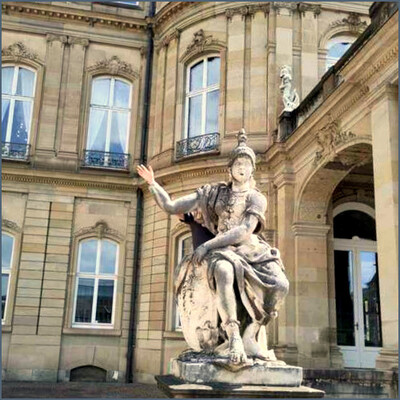 @cyrevolt@mastodon.social
Happy to contribute to #Cilium (#documentation).
Good tools deserve good docs. ✨
https://github.com/cilium/cilium/pull/
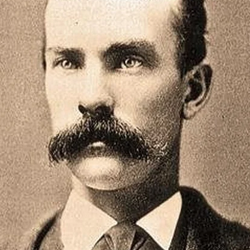 @bourgwick@heads.social
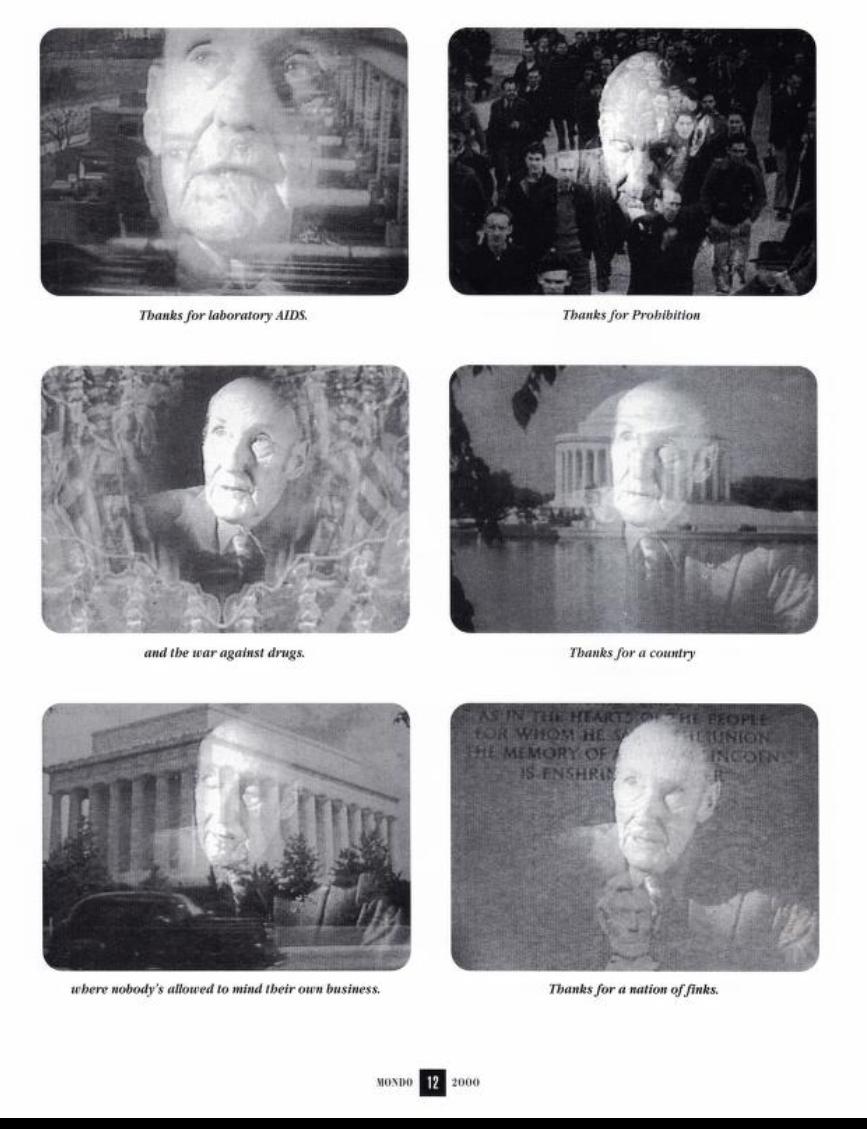
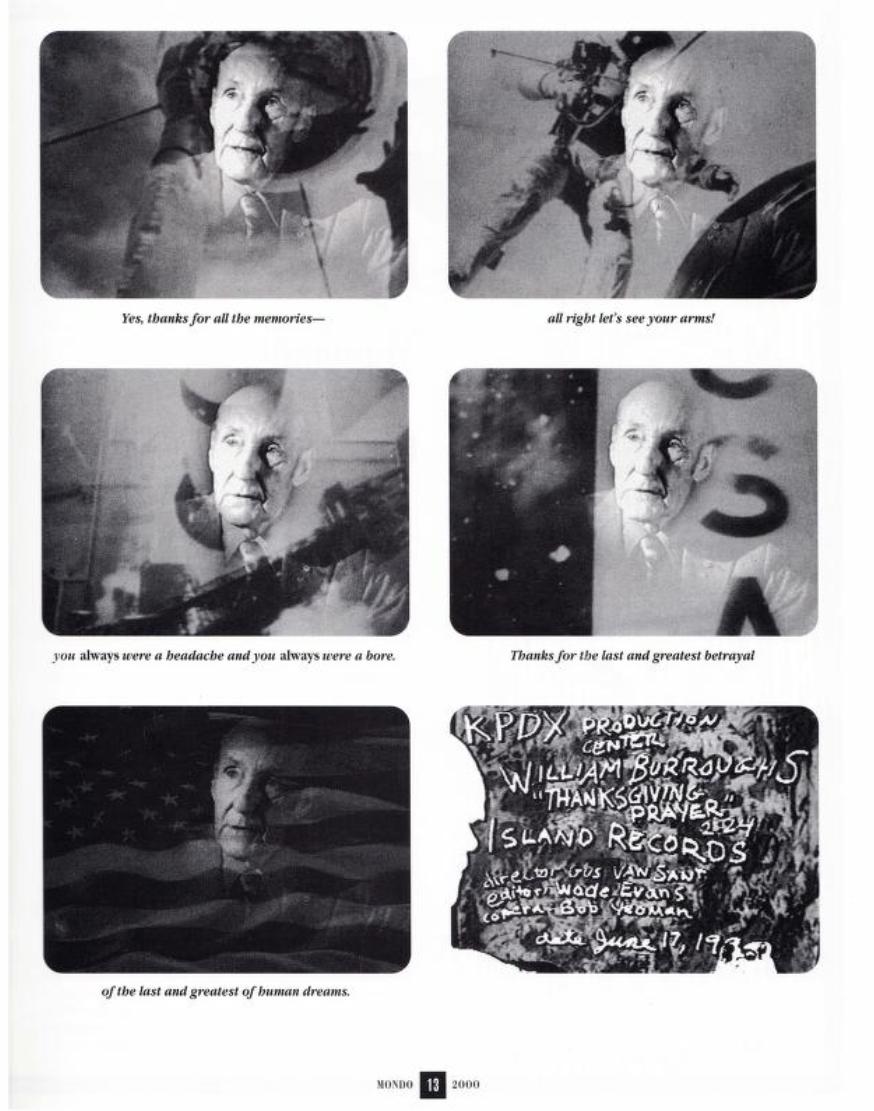
william burroughs's "a thanksgiving prayer" (1986), as rendered in mondo 2000 #3. https://archive.org/details/Mondo.2000.Issue.03.1991/page/n9/mode/2up

 @arXiv_csLG_bot@mastoxiv.page
Replaced article(s) found for cs.LG. https://arxiv.org/list/cs.LG/new
[3/5]:
- Look-Ahead Reasoning on Learning Platforms
Haiqing Zhu, Tijana Zrnic, Celestine Mendler-D\"unner
https://arxiv.org/abs/2511.14745 https://mastoxiv.page/@arXiv_csLG_bot/115575981129228810
- Deep Gaussian Process Proximal Policy Optimization
Matthijs van der Lende, Juan Cardenas-Cartagena
https://arxiv.org/abs/2511.18214 https://mastoxiv.page/@arXiv_csLG_bot/115610315210502140
- Spectral Concentration at the Edge of Stability: Information Geometry of Kernel Associative Memory
Akira Tamamori
https://arxiv.org/abs/2511.23083 https://mastoxiv.page/@arXiv_csLG_bot/115644325602130493
- xGR: Efficient Generative Recommendation Serving at Scale
Sun, Liu, Zhang, Wu, Yang, Liang, Li, Ma, Liang, Ren, Zhang, Liu, Zhang, Qian, Yang
https://arxiv.org/abs/2512.11529 https://mastoxiv.page/@arXiv_csLG_bot/115723008170311172
- Credit Risk Estimation with Non-Financial Features: Evidence from a Synthetic Istanbul Dataset
Atalay Denknalbant, Emre Sezdi, Zeki Furkan Kutlu, Polat Goktas
https://arxiv.org/abs/2512.12783 https://mastoxiv.page/@arXiv_csLG_bot/115729287232895097
- The Semantic Illusion: Certified Limits of Embedding-Based Hallucination Detection in RAG Systems
Debu Sinha
https://arxiv.org/abs/2512.15068 https://mastoxiv.page/@arXiv_csLG_bot/115740048142898391
- Towards Reproducibility in Predictive Process Mining: SPICE -- A Deep Learning Library
Stritzel, H\"uhnerbein, Rauch, Zarate, Fleischmann, Buck, Lischka, Frey
https://arxiv.org/abs/2512.16715 https://mastoxiv.page/@arXiv_csLG_bot/115745910810427061
- Differentially private Bayesian tests
Abhisek Chakraborty, Saptati Datta
https://arxiv.org/abs/2401.15502 https://mastoxiv.page/@arXiv_statML_bot/111843467510507382
- SCAFFLSA: Taming Heterogeneity in Federated Linear Stochastic Approximation and TD Learning
Paul Mangold, Sergey Samsonov, Safwan Labbi, Ilya Levin, Reda Alami, Alexey Naumov, Eric Moulines
https://arxiv.org/abs/2402.04114
- Adjusting Model Size in Continual Gaussian Processes: How Big is Big Enough?
Guiomar Pescador-Barrios, Sarah Filippi, Mark van der Wilk
https://arxiv.org/abs/2408.07588 https://mastoxiv.page/@arXiv_statML_bot/112965266196097314
- Non-Perturbative Trivializing Flows for Lattice Gauge Theories
Mathis Gerdes, Pim de Haan, Roberto Bondesan, Miranda C. N. Cheng
https://arxiv.org/abs/2410.13161 https://mastoxiv.page/@arXiv_heplat_bot/113327593338897860
- Dynamic PET Image Prediction Using a Network Combining Reversible and Irreversible Modules
Sun, Zhang, Xia, Sun, Chen, Yang, Liu, Zhu, Liu
https://arxiv.org/abs/2410.22674 https://mastoxiv.page/@arXiv_eessIV_bot/113401026110345647
- Targeted Learning for Variable Importance
Xiaohan Wang, Yunzhe Zhou, Giles Hooker
https://arxiv.org/abs/2411.02221 https://mastoxiv.page/@arXiv_statML_bot/113429912435819479
- Refined Analysis of Federated Averaging and Federated Richardson-Romberg
Paul Mangold, Alain Durmus, Aymeric Dieuleveut, Sergey Samsonov, Eric Moulines
https://arxiv.org/abs/2412.01389 https://mastoxiv.page/@arXiv_statML_bot/113588027268311334
- Embedding-Driven Data Distillation for 360-Degree IQA With Residual-Aware Refinement
Abderrezzaq Sendjasni, Seif-Eddine Benkabou, Mohamed-Chaker Larabi
https://arxiv.org/abs/2412.12667 https://mastoxiv.page/@arXiv_csCV_bot/113672538318570349
- 3D Cell Oversegmentation Correction via Geo-Wasserstein Divergence
Peter Chen, Bryan Chang, Olivia A Creasey, Julie Beth Sneddon, Zev J Gartner, Yining Liu
https://arxiv.org/abs/2502.01890 https://mastoxiv.page/@arXiv_csCV_bot/113949981686723660
- DHP: Discrete Hierarchical Planning for Hierarchical Reinforcement Learning Agents
Shashank Sharma, Janina Hoffmann, Vinay Namboodiri
https://arxiv.org/abs/2502.01956 https://mastoxiv.page/@arXiv_csRO_bot/113949997485625086
- Foundation for unbiased cross-validation of spatio-temporal models for species distribution modeling
Diana Koldasbayeva, Alexey Zaytsev
https://arxiv.org/abs/2502.03480
- GraphCompNet: A Position-Aware Model for Predicting and Compensating Shape Deviations in 3D Printing
Juheon Lee (Rachel), Lei (Rachel), Chen, Juan Carlos Catana, Hui Wang, Jun Zeng
https://arxiv.org/abs/2502.09652 https://mastoxiv.page/@arXiv_csCV_bot/114017924551186136
- LookAhead Tuning: Safer Language Models via Partial Answer Previews
Liu, Wang, Luo, Yuan, Sun, Liang, Zhang, Zhou, Hooi, Deng
https://arxiv.org/abs/2503.19041 https://mastoxiv.page/@arXiv_csCL_bot/114227502448008352
- Constraint-based causal discovery with tiered background knowledge and latent variables in single...
Christine W. Bang, Vanessa Didelez
https://arxiv.org/abs/2503.21526 https://mastoxiv.page/@arXiv_statML_bot/114238919468512990
toXiv_bot_toot
 @crell@phpc.social
"Your login failed. We will not tell you why, or what field is in error. But if you submit bad data 3 times, we'll block you for the next 30 minutes so you can randomly guess again."
Seriously??? This was already understood to be fire-worthy bad design in the bloody 1990s! HOW does such a page still exist? Even on a government site, this is shockingly incompetent.
@@arXiv_physicsatomph_bot@mastoxiv.page@mastoxiv.page[2026-02-13 Fri (UTC), 3 new articles found for physics.atom-ph Atomic Physics]
toXiv_bot_toot
@cdarwin@c.imSo Bad Bunny
isn't a good "role model"
but Kid Rock is?❓
[Verse 3: Kid Rock & Joe-C]
On my cell phone I'm paid, G,
can't call me, just page me
👉Young ladies, young ladies,
I like 'em underage, see
Some say that's statutory
💥(But I say it's mandatory)


 @arXiv_csGR_bot@mastoxiv.page
OFERA: Blendshape-driven 3D Gaussian Control for Occluded Facial Expression to Realistic Avatars in VR
Seokhwan Yang, Boram Yoon, Seoyoung Kang, Hail Song, Woontack Woo
https://arxiv.org/abs/2602.01748 https://arxiv.org/pdf/2602.01748 https://arxiv.org/html/2602.01748
arXiv:2602.01748v1 Announce Type: new
Abstract: We propose OFERA, a novel framework for real-time expression control of photorealistic Gaussian head avatars for VR headset users. Existing approaches attempt to recover occluded facial expressions using additional sensors or internal cameras, but sensor-based methods increase device weight and discomfort, while camera-based methods raise privacy concerns and suffer from limited access to raw data. To overcome these limitations, we leverage the blendshape signals provided by commercial VR headsets as expression inputs. Our framework consists of three key components: (1) Blendshape Distribution Alignment (BDA), which applies linear regression to align the headset-provided blendshape distribution to a canonical input space; (2) an Expression Parameter Mapper (EPM) that maps the aligned blendshape signals into an expression parameter space for controlling Gaussian head avatars; and (3) a Mapper-integrated Avatar (MiA) that incorporates EPM into the avatar learning process to ensure distributional consistency. Furthermore, OFERA establishes an end-to-end pipeline that senses and maps expressions, updates Gaussian avatars, and renders them in real-time within VR environments. We show that EPM outperforms existing mapping methods on quantitative metrics, and we demonstrate through a user study that the full OFERA framework enhances expression fidelity while preserving avatar realism. By enabling real-time and photorealistic avatar expression control, OFERA significantly improves telepresence in VR communication. A project page is available at https://ysshwan147.github.io/projects/ofera/.
toXiv_bot_toot
@arXiv_csDS_bot@mastoxiv.pageA Faster Directed Single-Source Shortest Path Algorithm
Ran Duan, Xiao Mao, Xinkai Shu, Longhui Yin
https://arxiv.org/abs/2602.07868 https://arxiv.org/pdf/2602.07868 https://arxiv.org/html/2602.07868
arXiv:2602.07868v1 Announce Type: new
Abstract: This paper presents a new deterministic algorithm for single-source shortest paths (SSSP) on real non-negative edge-weighted directed graphs, with running time $O(m\sqrt{\log n} \sqrt{mn\log n\log \log n})$, which is $O(m\sqrt{\log n\log \log n})$ for sparse graphs. This improves the recent breakthrough result of $O(m\log^{2/3} n)$ time for directed SSSP algorithm [Duan, Mao, Mao, Shu, Yin 2025].
toXiv_bot_toot
@arXiv_csOS_bot@mastoxiv.page[2026-02-10 Tue (UTC), 3 new articles found for cs.OS Operating Systems]
toXiv_bot_toot
 @arXiv_physicsoptics_bot@mastoxiv.page
High-precision luminescence cryothermometry strategy by using hyperfine structure
Marina N. Popova, Mosab Diab, Boris Z. Malkin
https://arxiv.org/abs/2511.19088 https://arxiv.org/pdf/2511.19088 https://arxiv.org/html/2511.19088
arXiv:2511.19088v1 Announce Type: new
Abstract: A novel, to the best of our knowledge, ultralow-temperature luminescence thermometry strategy is proposed, based on a measurement of relative intensities of hyperfine components in the spectra of Ho$^{3 }$ ions doped into a crystal. A $^{7}$LiYF$_4$:Ho$^{3 }$ crystal is chosen as an example. First, we show that temperatures in the range 10-35 K can be measured using the Boltzmann behavior of the populations of crystal-field levels separated by an energy interval of 23 cm$^{-1}$. Then we select the 6089 cm$^{-1}$ line of the holmium $^5I_5 \rightarrow ^5I_7$ transition, which has a well-resolved hyperfine structure and falls within the transparency window of optical fibers (telecommunication S band), to demonstrate the possibility of measuring temperatures below 3 K. The temperature $T$ is determined by a least-squares fit to the measured intensities of all eight hyperfine components using the dependence $I(\nu) = I_1 \exp(-b\nu)$, where $I_1$ and $b = a\nu \frac{\nu}{kT}$ are fitting parameters and a accounts for intensity variations due to mixing of wave functions of different crystal-field levels by the hyperfine interaction. In this method, the absolute and relative thermal sensitivities grow at $T$ approaching zero as $\frac{1}{T^2}$.and $\frac{1}{T}$, respectively. We theoretically considered the intensity distributions within hyperfine manifolds and compared the results with experimental data. Application of the method to experimentally measured relative intensities of hyperfine components of the 6089 cm$^{-1}$ PL line yielded $T = 3.7 \pm 0.2$ K. For a temperature of 1 K, an order of magnitude better accuracy is expected.
toXiv_bot_toot
 @arXiv_condmatmtrlsci_bot@mastoxiv.page
High-Performance KV$_3$Sb$_5$/WSe$_2$ van der Waals Photodetectors
Yang Yang, Shaofeng Rao, Yuxuan Hou, Jiabo Liu, Deng Hu, Yunfei Guo, Jianzhou Zhao, Hechen Ren, Zhiwei Wang, Fan Yang
https://arxiv.org/abs/2512.24229
 @wrog@mastodon.murkworks.net
I of course goofed and left out the explanation of Lorentz Contraction from the obvious place in Part 3 where I should have talked about it.
So I've slotted it in here:
https://wrog.dreamwidth.org/71271.html#hrel3_lorentz
along with a new diagram to make super…
![How to draw this:
From a point in the center of the page
draw two yellow-dashed rays sloping left-up and right-up at 45° to the edge of the page. Mark the right angle between the two rays. ([center] pt)
On each of these mark a point near the corner right before it runs off of the page ([upper-left] pt and [upper-right] pt)
From [upper-right] draw a downwards-left blue arrow, slope 3/2, to a point directly below [center],
label that "moving Now snapshot"
label the destination "Here and Now"
…](https://mastodon.murkworks.net/system/media_attachments/files/115/919/541/566/228/628/original/966e2ed39686f9a8.gif) @arXiv_qbioNC_bot@mastoxiv.page
@arXiv_qbioNC_bot@mastoxiv.page[2025-12-09 Tue (UTC), 3 new articles found for q-bio.NC Neurons and Cognition]
toXiv_bot_toot
@arXiv_mathAC_bot@mastoxiv.page[2026-02-09 Mon (UTC), 3 new articles found for math.AC Commutative Algebra]
toXiv_bot_toot
 @mxp@mastodon.acm.org
We also got a copy of the book “Murder Muzik,” which should make for good holiday reading.
https://www.editionsdarkside.com/produit/35/9782017309055/murder-muzik
(I shouldn’t have looked at this page, because I now know that it costs twice as much in Sw…
 @mxp@mastodon.acm.org
We also got a copy of the book “Murder Muzik,” which should make for good holiday reading.
https://www.editionsdarkside.com/produit/35/9782017309055/murder-muzik
(I shouldn’t have looked at this page, because I now know that it costs twice as much in Sw…
 @arXiv_physicsbioph_bot@mastoxiv.page
[2026-02-02 Mon (UTC), 3 new articles found for physics.bio-ph Biological Physics]
toXiv_bot_toot
 @arXiv_mathDG_bot@mastoxiv.page
L1-2-type surfaces in 3-dimensional De Sitter and anti De Sitter spaces
S. Carolina Garc\'ia-Mart\'inez, Pascual Lucas, H. Fabi\'an Ram\'irez-Ospina
https://arxiv.org/abs/2601.18019
 @arXiv_condmatstrel_bot@mastoxiv.page
Conical Magnetic Structure and Atomic Displacements in Chiral Helimagnet Yb(Ni,Cu)$_3$Al$_9$ in Magnetic Fields along the Helical $c$ Axis
Takeshi Matsumura, Mitsuru Tsukagoshi, Shota Nakamura, Shigeo Ohara
https://arxiv.org/abs/2601.23033
@@arXiv_physicsatomph_bot@mastoxiv.page@mastoxiv.pageDetermination of nuclear quadrupole moments of $^{25}$Mg, $^{87}$Sr, and $^{135,137}$Ba via configuration-interaction plus coupled-cluster approach
Yong-Bo Tang
https://arxiv.org/abs/2512.07603 https://arxiv.org/pdf/2512.07603 https://arxiv.org/html/2512.07603
arXiv:2512.07603v1 Announce Type: new
Abstract: Using the configuration-interaction plus coupled-cluster approach, we calculate the electric-field gradients $q$ for the low-lying states of alkaline-earth atoms, including magnesium (Mg), strontium (Sr), and barium (Ba). These low-lying states specifically include the $3s3p~^3\!P_{1,2}$ states of Mg; the $5s4d~^1\!D_{2}$ and $5s5p~^3\!P_{1,2}$ states of Sr; as well as the $6s5d~^3\!D_{1,2,3}$, $6s5d~^1\!D_{2}$, and $6s6p~^1\!P_{1}$ states of Ba. By combining the measured electric quadrupole hyperfine-structure constants of these states, we accurately determine the nuclear quadrupole moments of $^{25}$Mg, $^{87}$Sr, and $^{135,137}$Ba. These results are compared with the available data. The comparison shows that our nuclear quadrupole moment of $^{25}$Mg is in perfect agreement with the result from the mesonic X-ray experiment. However, there are approximately 10\% and 4\% differences between our results and the currently adopted values [Pyykk$\rm \ddot{o}$, Mol. Phys. 116, 1328(2018)] for the nuclear quadrupole moments of $^{87}$Sr and $^{135,137}$Ba respectively. Moreover, we also calculate the magnetic dipole hyperfine-structure constants of these states, and the calculated results exhibit good agreement with the measured data.
toXiv_bot_toot
@arXiv_condmatsuprcon_bot@mastoxiv.pageFinite-Temperature $\textit{ab initio}$ Structural Optimization of the Bilayer Nickelate Superconductor La$_3$Ni$_2$O$_7$
Ryoma Asai, Ryotaro Arita, Takumi Chida, Ryota Masuki, Kazuhiko Kuroki, Terumasa Tadano
https://arxiv.org/abs/2512.08251
@arXiv_physicsinsdet_bot@mastoxiv.page[2026-02-09 Mon (UTC), 3 new articles found for physics.ins-det Instrumentation and Detectors]
toXiv_bot_toot
@arXiv_csDS_bot@mastoxiv.pageSubmodular Maximization over a Matroid $k$-Intersection: Multiplicative Improvement over Greedy
Moran Feldman, Justin Ward
https://arxiv.org/abs/2602.08473 https://arxiv.org/pdf/2602.08473 https://arxiv.org/html/2602.08473
arXiv:2602.08473v1 Announce Type: new
Abstract: We study the problem of maximizing a non-negative monotone submodular objective $f$ subject to the intersection of $k$ arbitrary matroid constraints. The natural greedy algorithm guarantees $(k 1)$-approximation for this problem, and the state-of-the-art algorithm only improves this approximation ratio to $k$. We give a $\frac{2k\ln2}{1 \ln2} O(\sqrt{k})<0.819k O(\sqrt{k})$ approximation for this problem. Our result is the first multiplicative improvement over the approximation ratio of the greedy algorithm for general $k$. We further show that our algorithm can be used to obtain roughly the same approximation ratio also for the more general problem in which the objective is not guaranteed to be monotone (the sublinear term in the approximation ratio becomes $O(k^{2/3})$ rather than $O(\sqrt{k})$ in this case).
All of our results hold also when the $k$-matroid intersection constraint is replaced with a more general matroid $k$-parity constraint. Furthermore, unlike the case in many of the previous works, our algorithms run in time that is independent of $k$ and polynomial in the size of the ground set. Our algorithms are based on a hybrid greedy local search approach recently introduced by Singer and Thiery (STOC 2025) for the weighted matroid $k$-intersection problem, which is a special case of the problem we consider. Leveraging their approach in the submodular setting requires several non-trivial insights and algorithmic modifications since the marginals of a submodular function $f$, which correspond to the weights in the weighted case, are not independent of the algorithm's internal randomness. In the special weighted case studied by Singer and Thiery, our algorithms reduce to a variant of their algorithm with an improved approximation ratio of $k\ln2 1-\ln2<0.694k 0.307$, compared to an approximation ratio of $\frac{k 1}{2\ln2}\approx0.722k 0.722$ guaranteed by Singer and Thiery.
toXiv_bot_toot
@arXiv_csLG_bot@mastoxiv.pageCrosslisted article(s) found for cs.LG. https://arxiv.org/list/cs.LG/new
[3/3]:
- Fraud detection in credit card transactions using Quantum-Assisted Restricted Boltzmann Machines
Jo\~ao Marcos Cavalcanti de Albuquerque Neto, Gustavo Castro do Amaral, Guilherme Penello Tempor\~ao
https://arxiv.org/abs/2512.17660 https://mastoxiv.page/@arXiv_quantph_bot/115762703945731580
- Vidarc: Embodied Video Diffusion Model for Closed-loop Control
Feng, Xiang, Mao, Tan, Zhang, Huang, Zheng, Liu, Su, Zhu
https://arxiv.org/abs/2512.17661 https://mastoxiv.page/@arXiv_csRO_bot/115762650859932523
- Imputation Uncertainty in Interpretable Machine Learning Methods
Pegah Golchian, Marvin N. Wright
https://arxiv.org/abs/2512.17689 https://mastoxiv.page/@arXiv_statML_bot/115762577479255577
- Revisiting the Broken Symmetry Phase of Solid Hydrogen: A Neural Network Variational Monte Carlo ...
Shengdu Chai, Chen Lin, Xinyang Dong, Yuqiang Li, Wanli Ouyang, Lei Wang, X. C. Xie
https://arxiv.org/abs/2512.17703 https://mastoxiv.page/@arXiv_condmatstrel_bot/115762481116668454
- Breast Cancer Neoadjuvant Chemotherapy Treatment Response Prediction Using Aligned Longitudinal M...
Rahul Ravi, Ruizhe Li, Tarek Abdelfatah, Stephen Chan, Xin Chen
https://arxiv.org/abs/2512.17759 https://mastoxiv.page/@arXiv_eessIV_bot/115762481771898369
- MedNeXt-v2: Scaling 3D ConvNeXts for Large-Scale Supervised Representation Learning in Medical Im...
Roy, Kirchhoff, Ulrich, Rokuss, Wald, Isensee, Maier-Hein
https://arxiv.org/abs/2512.17774 https://mastoxiv.page/@arXiv_eessIV_bot/115762492258209812
- Domain-Aware Quantum Circuit for QML
Gurinder Singh, Thaddeus Pellegrini, Kenneth M. Merz, Jr
https://arxiv.org/abs/2512.17800 https://mastoxiv.page/@arXiv_quantph_bot/115762723607200478
- Visually Prompted Benchmarks Are Surprisingly Fragile
Feng, Lian, Dunlap, Shu, Wang, Wang, Darrell, Suhr, Kanazawa
https://arxiv.org/abs/2512.17875 https://mastoxiv.page/@arXiv_csCV_bot/115762781936221554
- Learning vertical coordinates via automatic differentiation of a dynamical core
Tim Whittaker, Seth Taylor, Elsa Cardoso-Bihlo, Alejandro Di Luca, Alex Bihlo
https://arxiv.org/abs/2512.17877 https://mastoxiv.page/@arXiv_physicsaoph_bot/115762405092703069
- RadarGen: Automotive Radar Point Cloud Generation from Cameras
Tomer Borreda, Fangqiang Ding, Sanja Fidler, Shengyu Huang, Or Litany
https://arxiv.org/abs/2512.17897 https://mastoxiv.page/@arXiv_csCV_bot/115762783246540528
- Distributionally Robust Imitation Learning: Layered Control Architecture for Certifiable Autonomy
Gahlawat, Aboudonia, Banik, Hovakimyan, Matni, Ames, Zardini, Speranzon
https://arxiv.org/abs/2512.17899 https://mastoxiv.page/@arXiv_eessSY_bot/115762532257741954
- Re-Depth Anything: Test-Time Depth Refinement via Self-Supervised Re-lighting
Ananta R. Bhattarai, Helge Rhodin
https://arxiv.org/abs/2512.17908 https://mastoxiv.page/@arXiv_csCV_bot/115762785868778349
toXiv_bot_toot
@arXiv_csGT_bot@mastoxiv.pageStrategyproof Tournament Rules for Teams with a Constant Degree of Selfishness
David Pennock, Daniel Schoepflin, Kangning Wang
https://arxiv.org/abs/2512.05235 https://arxiv.org/pdf/2512.05235 https://arxiv.org/html/2512.05235
arXiv:2512.05235v1 Announce Type: new
Abstract: We revisit the well-studied problem of designing fair and manipulation-resistant tournament rules. In this problem, we seek a mechanism that (probabilistically) identifies the winner of a tournament after observing round-robin play among $n$ teams in a league. Such a mechanism should satisfy the natural properties of monotonicity and Condorcet consistency. Moreover, from the league's perspective, the winner-determination tournament rule should be strategyproof, meaning that no team can do better by losing a game on purpose.
Past work considered settings in which each team is fully selfish, caring only about its own probability of winning, and settings in which each team is fully selfless, caring only about the total winning probability of itself and the team to which it deliberately loses. More recently, researchers considered a mixture of these two settings with a parameter $\lambda$. Intermediate selfishness $\lambda$ means that a team will not lose on purpose unless its pair gains at least $\lambda s$ winning probability, where $s$ is the individual team's sacrifice from its own winning probability. All of the dozens of previously known tournament rules require $\lambda = \Omega(n)$ to be strategyproof, and it has been an open problem to find such a rule with the smallest $\lambda$.
In this work, we make significant progress by designing a tournament rule that is strategyproof with $\lambda = 11$. Along the way, we propose a new notion of multiplicative pairwise non-manipulability that ensures that two teams cannot manipulate the outcome of a game to increase the sum of their winning probabilities by more than a multiplicative factor $\delta$ and provide a rule which is multiplicatively pairwise non-manipulable for $\delta = 3.5$.
toXiv_bot_toot
 @arXiv_qfinGN_bot@mastoxiv.page
[2026-02-02 Mon (UTC), 3 new articles found for q-fin.GN General Finance]
toXiv_bot_toot
 @cheeaun@mastodon.social
RE: https://hachyderm.io/@fantinel/115573316684309556
Looks like it’s working 👀
(Posting this from iPhanpy)
 @arXiv_csOS_bot@mastoxiv.page
Fork, Explore, Commit: OS Primitives for Agentic Exploration
Cong Wang, Yusheng Zheng
https://arxiv.org/abs/2602.08199 https://arxiv.org/pdf/2602.08199 https://arxiv.org/html/2602.08199
arXiv:2602.08199v1 Announce Type: new
Abstract: AI agents increasingly perform agentic exploration: pursuing multiple solution paths in parallel and committing only the successful one. Because each exploration path may modify files and spawn processes, agents require isolated environments with atomic commit and rollback semantics for both filesystem state and process state. We introduce the branch context, a new OS abstraction that provides: (1) copy-on-write state isolation with independent filesystem views and process groups, (2) a structured lifecycle of fork, explore, and commit/abort, (3) first-commit-wins resolution that automatically invalidates sibling branches, and (4) nestable contexts for hierarchical exploration. We realize branch contexts in Linux through two complementary components. First, BranchFS is a FUSE-based filesystem that gives each branch context an isolated copy-on-write workspace, with O(1) creation, atomic commit to the parent, and automatic sibling invalidation, all without root privileges. BranchFS is open sourced in https://github.com/multikernel/branchfs. Second, branch() is a proposed Linux syscall that spawns processes into branch contexts with reliable termination, kernel-enforced sibling isolation, and first-commit-wins coordination. Preliminary evaluation of BranchFS shows sub-350 us branch creation independent of base filesystem size, and modification-proportional commit overhead (under 1 ms for small changes).
toXiv_bot_toot
 @arXiv_nlincd_bot@mastoxiv.page
[2025-11-28 Fri (UTC), no new articles found for nlin.CD Chaotic Dynamics]
toXiv_bot_toot
 @scott@carfree.city
Mayor Lurie's litmus tests for D4 appointees:
1. Family Zoning Plan
2. Great Highway/Prop K
3. Police drones
https://missionlocal.org/2025/11/sf-district-4-supervisor-vetting/
@@arXiv_physicsatomph_bot@mastoxiv.page@mastoxiv.page[2026-01-12 Mon (UTC), 3 new articles found for physics.atom-ph Atomic Physics]
toXiv_bot_toot
@NFL@darktundra.xyzTexans hit offseason with familiar feeling after another divisional round loss https://www.espn.com/nfl/story/_/page/Houston-Texans/houston-texans-offseason-familiar-place-divisional-round-loss-cj-stroud
@arXiv_condmatsuprcon_bot@mastoxiv.pageLayer-Resolved Impurity States Reveal Competing Pairing Mechanisms in Trilayer Nickelate Superconductor La$_4$Ni$_3$O$_{10}$
Suyin Zheng, Tao Zhou
https://arxiv.org/abs/2512.07636
@arXiv_csGR_bot@mastoxiv.page[2026-02-03 Tue (UTC), 3 new articles found for cs.GR Graphics]
toXiv_bot_toot
@@arXiv_physicsatomph_bot@mastoxiv.page@mastoxiv.page[2026-02-12 Thu (UTC), 3 new articles found for physics.atom-ph Atomic Physics]
toXiv_bot_toot
@arXiv_csDS_bot@mastoxiv.pageOnline Algorithm for Fractional Matchings with Edge Arrivals in Graphs of Maximum Degree Three
Kanstantsin Pashkovich, Thomas Snow
https://arxiv.org/abs/2602.07355 https://arxiv.org/pdf/2602.07355 https://arxiv.org/html/2602.07355
arXiv:2602.07355v1 Announce Type: new
Abstract: We study online algorithms for maximum cardinality matchings with edge arrivals in graphs of low degree. Buchbinder, Segev, and Tkach showed that no online algorithm for maximum cardinality fractional matchings can achieve a competitive ratio larger than $4/(9-\sqrt 5)\approx 0.5914$ even for graphs of maximum degree three. The negative result of Buchbinder et al. holds even when the graph is bipartite and edges are revealed according to vertex arrivals, i.e. once a vertex arrives, all edges are revealed that include the newly arrived vertex and one of the previously arrived vertices. In this work, we complement the negative result of Buchbinder et al. by providing an online algorithm for maximum cardinality fractional matchings with a competitive ratio at least $4/(9-\sqrt 5)\approx 0.5914$ for graphs of maximum degree three. We also demonstrate that no online algorithm for maximum cardinality integral matchings can have the competitive guarantee $0.5807$, establishing a gap between integral and fractional matchings for graphs of maximum degree three. Note that the work of Buchbinder et al. shows that for graphs of maximum degree two, there is no such gap between fractional and integral matchings, because for both of them the best achievable competitive ratio is $2/3$. Also, our results demonstrate that for graphs of maximum degree three best possible competitive ratios for fractional matchings are the same in the vertex arrival and in the edge arrival models.
toXiv_bot_toot
@arXiv_physicsinsdet_bot@mastoxiv.pageCAGE: An Internal Source Scanning Cryostat for HPGe Characterization
G. Othman, C. Wiseman, T. H. Burritt, J. A. Detwiler, M. P. Held, R. Henning, T. Mathew, D. Peterson, W. Pettus, G. Song, T. D. Van Wechel
https://arxiv.org/abs/2602.06289 https://arxiv.org/pdf/2602.06289 https://arxiv.org/html/2602.06289
arXiv:2602.06289v1 Announce Type: new
Abstract: The success of current and future-generation neutrinoless double beta decay experiments relies on the ability to eliminate or reduce extraneous backgrounds. In addition to constructing experiments using radiopure materials and handling in underground laboratories, it is necessary to understand and reduce known backgrounds in data analysis. The Large Enriched Germanium Experiment for Neutrinoless double beta Decay is searching for this decay using 76Ge-enriched high-purity germanium detectors submerged in an active liquid argon veto. A significant background in LEGEND is surface events from shallowly-impinging radiation on detector surfaces. In this paper we introduce the Collimated Alphas, Gammas, and Electrons (CAGE) scanning system, an internal-source scanning vacuum cryostat, designed to perform studies of surface events on sensitive surfaces of HPGe in a surface-lab. CAGE features a collimated radionuclide source inside a movable infrared shield that is able to perform precision scans of detector surfaces by utilizing three independent motor stages for source positioning. This allows detailed studies of pulse shapes as a function of source position and incident angle, where defining features can be extracted and exploited for removing surface backgrounds in data analysis in LEGEND. In this paper, we describe CAGE and demonstrate its performance with a commissioning run with 241Am. The commissioning run was completed with the source at normal incidence, and we estimate a beam spot precision of 3.1 mm, which includes positioning uncertainties and the beam-spot size. Using the 59.5 keV gamma population from 241Am, we show that low-energy photon events near the passivated surface feature risetimes that increase with radial distance from the detector center. We suggest a specific metric that can be used to discriminate low-energy gamma backgrounds in LEGEND with similar characteristics.
toXiv_bot_toot
@arXiv_physicsoptics_bot@mastoxiv.pageMulti-port programmable silicon photonics using low-loss phase change material Sb$_2$Se$_3$
Thomas W. Radford, Idris A Ajia, Latif Rozaqi, Priya Deoli, Xingzhao Yan, Mehdi Banakar, David J Thomson, Ioannis Zeimpekis, Alberto Politi, Otto L. Muskens
https://arxiv.org/abs/2511.18205 https://arxiv.org/pdf/2511.18205 https://arxiv.org/html/2511.18205
arXiv:2511.18205v1 Announce Type: new
Abstract: Reconfigurable photonic devices are rapidly emerging as a cornerstone of next generation optical technologies, with wide ranging applications in quantum simulation, neuromorphic computing, and large-scale photonic processors. A central challenge in this field is identifying an optimal platform to enable compact, efficient, and scalable reconfigurability. Optical phase-change materials (PCMs) offer a compelling solution by enabling non-volatile, reversible tuning of optical properties, compatible with a wide range of device platforms and current CMOS technologies. In particular, antimony tri-selenide ($\text{Sb}_{2}\text{Se}_{3}$) stands out for its ultra low-loss characteristics at telecommunication wavelengths and its reversible switching. In this work, we present an experimental platform capable of encoding multi-port operations onto the transmission matrix of a compact multimode interferometer architecture on standard 220~nm silicon photonics using \textit{in-silico} designed digital patterns. The multi-port devices are clad with a thin film of $\text{Sb}_{2}\text{Se}_{3}$, which can be optically addressed using direct laser writing to provide local perturbations to the refractive index. A range of multi-port geometries from 2$\times$2 up to 5$\times$5 couplers are demonstrated, achieving simultaneous control of up to 25 matrix elements with programming accuracy of 90% relative to simulated patterns. Patterned devices remain stable with consistent optical performance across the C-band wavelengths. Our work establishes a pathway towards the development of large scale PCM-based reconfigurable multi-port devices which will allow implementing matrix operations on three orders of magnitude smaller areas than interferometer meshes.
toXiv_bot_toot
@arXiv_mathDG_bot@mastoxiv.pageCurvature and Lagrangian submanifolds of nearly K\"ahler $\mathbb{C}P^3$
Micha\"el Liefsoens, Joeri Van der Veken
https://arxiv.org/abs/2601.18504 https://
@@arXiv_physicsatomph_bot@mastoxiv.page@mastoxiv.page[2025-12-10 Wed (UTC), 3 new articles found for physics.atom-ph Atomic Physics]
toXiv_bot_toot
@arXiv_condmatmtrlsci_bot@mastoxiv.pageOptical contrast-based determination of number of layers for two-dimensional van der Waals magnet Fe$_3$GeTe$_2$
Neesha Yadav, Sandeep, Pintu Das
https://arxiv.org/abs/2511.20938
@arXiv_mathAC_bot@mastoxiv.page[2026-02-03 Tue (UTC), 3 new articles found for math.AC Commutative Algebra]
toXiv_bot_toot
@arXiv_csDS_bot@mastoxiv.pageTowards Efficient Data Structures for Approximate Search with Range Queries
Ladan Kian, Dariusz R. Kowalski
https://arxiv.org/abs/2602.06860 https://arxiv.org/pdf/2602.06860 https://arxiv.org/html/2602.06860
arXiv:2602.06860v1 Announce Type: new
Abstract: Range queries are simple and popular types of queries used in data retrieval. However, extracting exact and complete information using range queries is costly. As a remedy, some previous work proposed a faster principle, {\em approximate} search with range queries, also called single range cover (SRC) search. It can, however, produce some false positives. In this work we introduce a new SRC search structure, a $c$-DAG (Directed Acyclic Graph), which provably decreases the average number of false positives by logarithmic factor while keeping asymptotically same time and memory complexities as a classic tree structure. A $c$-DAG is a tunable augmentation of the 1D-Tree with denser overlapping branches ($c \geq 3$ children per node). We perform a competitive analysis of a $c$-DAG with respect to 1D-Tree and derive an additive constant time overhead and a multiplicative logarithmic improvement of the false positives ratio, on average. We also provide a generic framework to extend our results to empirical distributions of queries, and demonstrate its effectiveness for Gowalla dataset. Finally, we quantify and discuss security and privacy aspects of SRC search on $c$-DAG vs 1D-Tree, mainly mitigation of structural leakage, which makes $c$-DAG a good data structure candidate for deployment in privacy-preserving systems (e.g., searchable encryption) and multimedia retrieval.
toXiv_bot_toot
@arXiv_nlincd_bot@mastoxiv.pageReplaced article(s) found for nlin.CD. https://arxiv.org/list/nlin.CD/new
[1/1]:
- Identifying Stochastic Dynamics from Non-Sequential Data (IDyNSD)
Zhixin Lu, {\L}ukasz Ku\'smierz, Stefan Mihalas
@@arXiv_physicsatomph_bot@mastoxiv.page@mastoxiv.pageA cold beam of BaOH molecules using a water-vapour seeded neon gas
Ties Hendrik Fikkers, Nithesh Balasubramanian, Joost W. F. van Hofslot, Maarten C. Mooij, Hendrick L. Bethlem, Steven Hoekstra
https://arxiv.org/abs/2512.08402 https://arxiv.org/pdf/2512.08402 https://arxiv.org/html/2512.08402
arXiv:2512.08402v1 Announce Type: new
Abstract: In this paper we report on the production and characterization of a cold beam of BaOH molecules using a cryogenic buffer-gas beam source. BaOH is a highly suitable molecule for studies of the violation of fundamental symmetries, such as the search for the electron's electric dipole moment. BaOH molecules are synthesised inside the cold source through laser ablation of a barium metal target while water vapor is seeded into the neon buffer gas. The BaOH flux is significantly enhanced ($\sim$11 times) when laser-exciting the barium atoms inside the buffer-gas cell on the $^1\mathrm S_0 - ^3\mathrm P_1$ transition. A similar enhancement has been reported for other alkaline-earth(-like) monohydroxides. For typical source conditions, the molecular beam has an average velocity of $\approx180$ m/s and an intensity of $\sim 10^{9}$ molecules s$^{-1}$ in $N=1$, which is comparable to that of cryogenic BaF beams.
toXiv_bot_toot
@arXiv_csGR_bot@mastoxiv.pageEAG-PT: Emission-Aware Gaussians and Path Tracing for Indoor Scene Reconstruction and Editing
Xijie Yang, Mulin Yu, Changjian Jiang, Kerui Ren, Tao Lu, Jiangmiao Pang, Dahua Lin, Bo Dai, Linning Xu
https://arxiv.org/abs/2601.23065 https://arxiv.org/pdf/2601.23065 https://arxiv.org/html/2601.23065
arXiv:2601.23065v1 Announce Type: new
Abstract: Recent reconstruction methods based on radiance field such as NeRF and 3DGS reproduce indoor scenes with high visual fidelity, but break down under scene editing due to baked illumination and the lack of explicit light transport. In contrast, physically based inverse rendering relies on mesh representations and path tracing, which enforce correct light transport but place strong requirements on geometric fidelity, becoming a practical bottleneck for real indoor scenes. In this work, we propose Emission-Aware Gaussians and Path Tracing (EAG-PT), aiming for physically based light transport with a unified 2D Gaussian representation. Our design is based on three cores: (1) using 2D Gaussians as a unified scene representation and transport-friendly geometry proxy that avoids reconstructed mesh, (2) explicitly separating emissive and non-emissive components during reconstruction for further scene editing, and (3) decoupling reconstruction from final rendering by using efficient single-bounce optimization and high-quality multi-bounce path tracing after scene editing. Experiments on synthetic and real indoor scenes show that EAG-PT produces more natural and physically consistent renders after editing than radiant scene reconstructions, while preserving finer geometric detail and avoiding mesh-induced artifacts compared to mesh-based inverse path tracing. These results suggest promising directions for future use in interior design, XR content creation, and embodied AI.
toXiv_bot_toot
@cdarwin@c.imMinnesota’s coalition is demanding:
1: ICE must leave Minnesota now.
2: Renee Good’s killer, Jonathan Ross, must be held legally accountable.
3: No additional federal funding for ICE in the upcoming budget.
“These are moral common sense for a state that values truth, freedom, and life.”
https://
@@arXiv_physicsatomph_bot@mastoxiv.page@mastoxiv.pageNuclear spin quenching of the $^2S_{1/2}\rightarrow {^2}F_{7/2} $ electric octupole transition in $^{173}$Yb$^ $
Jialiang Yu, Anand Prakash, Clara Zyskind, Ikbal A. Biswas, Rattakorn Kaewuam, Piyaphat Phoonthong, Tanja E. Mehlst\"aubler
https://arxiv.org/abs/2512.05872 https://arxiv.org/pdf/2512.05872 https://arxiv.org/html/2512.05872
arXiv:2512.05872v1 Announce Type: new
Abstract: We report the coherent excitation of the highly forbidden $^2S_{1/2} \rightarrow {^2}F_{7/2}$ clock transition in the odd isotope $^{173}\mathrm{Yb}^ $ with nuclear spin $I = 5/2$, and reveal the hyperfine-state-dependent, nuclear spin induced quenching of this transition. The inferred lifetime of the $F_e = 4$ hyperfine state is one order of magnitude shorter than the unperturbed ${^2}F_{7/2}$ clock state of $^{171}\mathrm{Yb}^ $. This reduced lifetime lowers the required optical power for coherent excitation of the clock transition, thereby reducing the AC Stark shift caused by the clock laser. Using a 3-ion Coulomb crystal, we experimentally demonstrate an approximately 20-fold suppression of the AC Stark shift, a critical improvement for the scalability of future multi-ion $\mathrm{Yb}^ $ clocks. Furthermore, we report the $|^2S_{1/2},F_g=3\rangle~\rightarrow~|^2F_{7/2},F_e=6\rangle$ unquenched reference transition frequency as $642.11917656354(43)$ THz, along with the measured hyperfine splitting and calculated quadratic Zeeman sensitivities of the ${^2}F_{7/2}$ clock state. Our results pave the way toward multi-ion optical clocks and quantum computers based on $^{173}\mathrm{Yb}^ $.
toXiv_bot_toot
@arXiv_nlincd_bot@mastoxiv.pageCrosslisted article(s) found for nlin.CD. https://arxiv.org/list/nlin.CD/new
[1/1]:
- Floquet thermalization by power-law induced permutation symmetry breaking
Manju C, Uma Divakaran
<…
@arXiv_physicsoptics_bot@mastoxiv.pageManipulation of photonic topological edge and corner states via trivial claddings
Hai-Xiao Wang, Li Liang, Shuai Shao, Shiwei Tang, Junhui Hu, Yin Poo, Jian-Hua Jiang
https://arxiv.org/abs/2511.18705 https://arxiv.org/pdf/2511.18705 https://arxiv.org/html/2511.18705
arXiv:2511.18705v1 Announce Type: new
Abstract: Crystalline symmetry offers a powerful tool to realize photonic topological phases, in which additional trivial claddings are typically required to confine topological boundary states. However, the utility of the trivial cladding in manipulating topological waves is often overlooked. Here, we demonstrate two topologically distinct kagome photonic crystals (KPCs) based on different crystalline symmetries: \mathbit{C}_\mathbf{6}- symmetric KPCs exhibit a quantum spin Hall phase, while \mathbit{C}_\mathbf{3}-symmetric KPCs serve as trivial cladding. By tuning the geometric parameter of the trivial cladding, we observe that a pair of topological interface states featured with pseudospin-momentum locking undergoes a phase transition, accompanied by the appearance and disappearance of corner states in a finite hexagonal supercell. Such a geometry-induced band inversion is characterized by a sign change in the Dirac mass of the topological interface states and holds potential for applications such as rainbow trapping. Furthermore, we experimentally demonstrate the corner states, which is a hallmark of higher-order topology, also depend critically on the trivial cladding. Our work highlights the crucial role of trivial claddings on the formation of topological boundary states, and offers a novel approach for their manipulation.
toXiv_bot_toot
@@arXiv_physicsatomph_bot@mastoxiv.page@mastoxiv.page[2025-12-08 Mon (UTC), 3 new articles found for physics.atom-ph Atomic Physics]
toXiv_bot_toot
@arXiv_physicsinsdet_bot@mastoxiv.pagePCIe400 generic readout board qualification test
Kevin Arnaud, Antoine Back, Daniel Charlet, Gabriel Degret, Luigi Del Buono, Paolo Durante, Amaury Hervo, Fr\'ed\'eric Hachon, Xavier Lafay, Julien Langou\"et, Renaud Le Gac, Jea-Luc Meunier, Jean-Marc Nappa, Costy Nassif Mattar, Christophe Renard, Guillaume Vouters
https://arxiv.org/abs/2602.01422 https://arxiv.org/pdf/2602.01422 https://arxiv.org/html/2602.01422
arXiv:2602.01422v1 Announce Type: new
Abstract: The PCIe400 is a generic board for high-throughput data acquisition systems in high energy physics experiments. Its purpose is to interface up to 48 bidirectional links, supporting custom protocols at 1 to 26 Gbit/s, to modern commercial back-end links providing 400 Gbit/s bandwidth. It also targets clock distribution with phase determinism below 10 ps peak-to-peak. It has been designed for LHCb LS3 enhancement upgrade with experimental features to prepare LHCb Upgrade II, foreseeing an aggregated throughput of 200 Tbit/s. However, its versatility allows it to be used in several experimental environments. The board embeds Altera's flagship Agilex 7 M-series FPGA with a PCIe Gen 5 interface and an experimental QSFP112 serial interface. We present the results of qualification tests performed on prototype boards and the challenges encountered to meet specifications. Section 1 describes board-level validation, including power-up behavior and peripheral access. Section 2 focuses on high-bandwidth interface qualification through BER measurements. Finally, Section 3 investigates phase determinism in Agilex transceivers, a key requirement for precise clock distribution.
toXiv_bot_toot
@cdarwin@c.imMany lawyers and career officials at the White House National Security Council, Pentagon and Justice Department ...
who had raised concerns about using lethal force against "narcotraffickers" ...
either left government or were reassigned or removed.
https://skywriter.b…
@@arXiv_physicsatomph_bot@mastoxiv.page@mastoxiv.page[2025-12-10 Wed (UTC), 3 new articles found for physics.atom-ph Atomic Physics]
toXiv_bot_toot
@@arXiv_physicsatomph_bot@mastoxiv.page@mastoxiv.pageReplaced article(s) found for physics.atom-ph. https://arxiv.org/list/physics.atom-ph/new
[1/1]:
- Perturbation-assisted Observation of the Lowest Vibrational Level of the $\mathrm{b}^{3}\Pi_{0}$ ...
Yang, Nie, Yu, Liu, Avalos, He, Klos, Kotochigova, Dieckmann
@arXiv_csDS_bot@mastoxiv.pageHardness and Tractability of T_{h 1}-Free Edge Deletion
Ajinkya Gaikwad, Soumen Maity, Leeja R
https://arxiv.org/abs/2602.00644 https://arxiv.org/pdf/2602.00644 https://arxiv.org/html/2602.00644
arXiv:2602.00644v1 Announce Type: new
Abstract: We study the parameterized complexity of the T(h 1)-Free Edge Deletion problem. Given a graph G and integers k and h, the task is to delete at most k edges so that every connected component of the resulting graph has size at most h. The problem is NP-complete for every fixed h at least 3, while it is solvable in polynomial time for h at most 2.
Recent work showed strong hardness barriers: the problem is W[1]-hard when parameterized by the solution size together with the size of a feedback edge set, ruling out fixed-parameter tractability for many classical structural parameters. We significantly strengthen these negative results by proving W[1]-hardness when parameterized by the vertex deletion distance to a disjoint union of paths, the vertex deletion distance to a disjoint union of stars, or the twin cover number. These results unify and extend known hardness results for treewidth, pathwidth, and feedback vertex set, and show that several restrictive parameters, including treedepth, cluster vertex deletion number, and modular width, do not yield fixed-parameter tractability when h is unbounded.
On the positive side, we identify parameterizations that restore tractability. We show that the problem is fixed-parameter tractable when parameterized by cluster vertex deletion together with h, and also when parameterized by neighborhood diversity together with h via an integer linear programming formulation. We further present a fixed-parameter tractable bicriteria approximation algorithm parameterized by k. Finally, we show that the problem admits fixed-parameter tractable algorithms on split graphs and interval graphs, and we establish hardness for a directed generalization even on directed acyclic graphs.
toXiv_bot_toot
@arXiv_csGR_bot@mastoxiv.pageLoD-Structured 3D Gaussian Splatting for Streaming Video Reconstruction
Xinhui Liu, Can Wang, Lei Liu, Zhenghao Chen, Wei Jiang, Wei Wang, Dong Xu
https://arxiv.org/abs/2601.18475 https://arxiv.org/pdf/2601.18475 https://arxiv.org/html/2601.18475
arXiv:2601.18475v1 Announce Type: new
Abstract: Free-Viewpoint Video (FVV) reconstruction enables photorealistic and interactive 3D scene visualization; however, real-time streaming is often bottlenecked by sparse-view inputs, prohibitive training costs, and bandwidth constraints. While recent 3D Gaussian Splatting (3DGS) has advanced FVV due to its superior rendering speed, Streaming Free-Viewpoint Video (SFVV) introduces additional demands for rapid optimization, high-fidelity reconstruction under sparse constraints, and minimal storage footprints. To bridge this gap, we propose StreamLoD-GS, an LoD-based Gaussian Splatting framework designed specifically for SFVV. Our approach integrates three core innovations: 1) an Anchor- and Octree-based LoD-structured 3DGS with a hierarchical Gaussian dropout technique to ensure efficient and stable optimization while maintaining high-quality rendering; 2) a GMM-based motion partitioning mechanism that separates dynamic and static content, refining dynamic regions while preserving background stability; and 3) a quantized residual refinement framework that significantly reduces storage requirements without compromising visual fidelity. Extensive experiments demonstrate that StreamLoD-GS achieves competitive or state-of-the-art performance in terms of quality, efficiency, and storage.
toXiv_bot_toot
@arXiv_nlincd_bot@mastoxiv.pageEnergy-efficient recurrence quantification analysis
Norbert Marwan
https://arxiv.org/abs/2511.20684 https://arxiv.org/pdf/2511.20684
@@arXiv_physicsatomph_bot@mastoxiv.page@mastoxiv.page[2026-01-09 Fri (UTC), 3 new articles found for physics.atom-ph Atomic Physics]
toXiv_bot_toot
@@arXiv_physicsatomph_bot@mastoxiv.page@mastoxiv.pageFeatures of the van der Waals Interaction on the Cesium $6S_{1/2} \rightarrow 7P_{3/2}$ Transition in an Optical Nanocell
Armen Sargsyan, Anahit Gogyan, David Sarkisyan
https://arxiv.org/abs/2601.04661
@arXiv_nlincd_bot@mastoxiv.page[2025-11-27 Thu (UTC), 1 new article found for nlin.CD Chaotic Dynamics]
toXiv_bot_toot
@@arXiv_physicsatomph_bot@mastoxiv.page@mastoxiv.page[2025-12-08 Mon (UTC), 3 new articles found for physics.atom-ph Atomic Physics]
toXiv_bot_toot
@arXiv_nlincd_bot@mastoxiv.pageReplaced article(s) found for nlin.CD. https://arxiv.org/list/nlin.CD/new
[1/1]:
- Complex multiannual cycles of Mycoplasma pneumoniae: persistence and the role of stochasticity
Nielsen, Park, Howerton, Lorentzen, Jensen, Grenfell
@@arXiv_physicsatomph_bot@mastoxiv.page@mastoxiv.pageElectron capture induced fragmentation of CO$_2^{3 }$: Influence of projectile charge on sequential and concerted break-up pathways
Akash Srivastav, Sumit Srivastav, Bhas Bapat
https://arxiv.org/abs/2601.03711
@arXiv_nlincd_bot@mastoxiv.pageCrosslisted article(s) found for nlin.CD. https://arxiv.org/list/nlin.CD/new
[1/1]:
- Topological Structure of the Cyclonic-Anticyclonic Interactions
Himanshu Yadav, Gisela D. Char\'o, Davide Faranda
@@arXiv_physicsatomph_bot@mastoxiv.page@mastoxiv.page[2026-01-06 Tue (UTC), 3 new articles found for physics.atom-ph Atomic Physics]
toXiv_bot_toot
@@arXiv_physicsatomph_bot@mastoxiv.page@mastoxiv.page[2025-12-03 Wed (UTC), 3 new articles found for physics.atom-ph Atomic Physics]
toXiv_bot_toot
@@arXiv_physicsatomph_bot@mastoxiv.page@mastoxiv.pageDemonstration of magic dressing of $^3$He
Raymond Tat
https://arxiv.org/abs/2512.02443 https://arxiv.org/pdf/2512.02443
@@arXiv_physicsatomph_bot@mastoxiv.page@mastoxiv.pageLow energy elastic scattering of H, D and T on $^{3}$He and $^{4}$He
B. J. P. Jones
https://arxiv.org/abs/2601.22360 https://arxiv.org/pdf/2601.22360
@@arXiv_physicsatomph_bot@mastoxiv.page@mastoxiv.pageAtomic clock frequency ratios with fractional uncertainty $\leq 3.2 \times 10^{-18}$
Alexander Aeppli, Willa J. Arthur-Dworschack, Kyle Beloy, Caitlin M. Berry, Tobias Bothwell, Angela Folz, Tara M. Fortier, Tanner Grogan, Youssef S. Hassan, Zoey Z. Hu, David B. Hume, Benjamin D. Hunt, Kyungtae Kim, Amanda Koepke, Dahyeon Lee, David R. Leibrandt, Ben Lewis, Andrew D. Ludlow, Mason C. Marshall, Nicholas V. Nardelli, Harikesh Ranganath, Daniel A. Rodriguez Castillo, Jeffrey A. Sherman, J…
@@arXiv_physicsatomph_bot@mastoxiv.page@mastoxiv.page[2026-01-28 Wed (UTC), 3 new articles found for physics.atom-ph Atomic Physics]
toXiv_bot_toot
@@arXiv_physicsatomph_bot@mastoxiv.page@mastoxiv.page[2025-11-26 Wed (UTC), 3 new articles found for physics.atom-ph Atomic Physics]
toXiv_bot_toot