 @arXiv_statME_bot@mastoxiv.page
2025-10-14 10:17:08
On function-on-function linear quantile regression
Muge Mutis, Ufuk Beyaztas, Filiz Karaman, Han Lin Shang
https://arxiv.org/abs/2510.10792 https://arxiv.o…
@arXiv_statME_bot@mastoxiv.pageOn function-on-function linear quantile regression
Muge Mutis, Ufuk Beyaztas, Filiz Karaman, Han Lin Shang
https://arxiv.org/abs/2510.10792 https://arxiv.o…
 @arXiv_mathOC_bot@mastoxiv.page
Convergence analysis of inexact MBA method for constrained upper-$\mathcal{C}^2$ optimization problems
Ruyu Liu, Shaohua Pan
https://arxiv.org/abs/2511.09940 https://arxiv.org/pdf/2511.09940 https://arxiv.org/html/2511.09940
arXiv:2511.09940v1 Announce Type: new
Abstract: This paper concerns a class of constrained optimization problems in which, the objective and constraint functions are both upper-$\mathcal{C}^2$. For such nonconvex and nonsmooth optimization problems, we develop an inexact moving balls approximation (MBA) method by a workable inexactness criterion for the solving of subproblems. By leveraging a global error bound for the strongly convex program associated with parametric optimization problems, we establish the full convergence of the iterate sequence under the partial bounded multiplier property (BMP) and the Kurdyka-{\L}ojasiewicz (KL) property of the constructed potential function, and achieve the local convergence rate of the iterate and objective value sequences if the potential function satisfies the KL property of exponent $q\in[1/2,1)$. A verifiable condition is also provided to check whether the potential function satisfies the KL property of exponent $q\in[1/2,1)$ at the given critical point. To the best of our knowledge, this is the first implementable inexact MBA method with a full convergence certificate for the constrained nonconvex and nonsmooth optimization problem.
toXiv_bot_toot
 @arXiv_mathAP_bot@mastoxiv.page
$L^2$ normal velocity implies strong solution for graphical Brakke flows
Kotaro Motegi
https://arxiv.org/abs/2510.11377 https://arxiv.org/pdf/2510.11377
 @arXiv_mathFA_bot@mastoxiv.page
Characterizing Maximal Monotone Operators with Unique Representation
Sotiris Armeniakos, Aris Daniilidis
https://arxiv.org/abs/2510.09368 https://arxiv.org…
@arXiv_mathOC_bot@mastoxiv.pageLearning Mean-Field Games through Mean-Field Actor-Critic Flow
Mo Zhou, Haosheng Zhou, Ruimeng Hu
https://arxiv.org/abs/2510.12180 https://arxiv.org/pdf/25…
 @arXiv_csLG_bot@mastoxiv.page
Monte Carlo-Type Neural Operator for Differential Equations
Salah Eddine Choutri, Prajwal Chauhan, Othmane Mazhar, Saif Eddin Jabari
https://arxiv.org/abs/2510.05620 https://
 @arXiv_mathph_bot@mastoxiv.page
An Approach to Anti-Wick Ordering of Bosonic Fields
John E. Gough, Hideyasu Yamasita
https://arxiv.org/abs/2510.06425 https://arxiv.org/pdf/2510.06425
@arXiv_mathAP_bot@mastoxiv.pagePartial regularity for parabolic systems of double phase type
Jihoon Ok, Giovanni Scilla, Bianca Stroffolini
https://arxiv.org/abs/2510.03849 https://arxiv…
 @arXiv_mathOA_bot@mastoxiv.page
Spectral results for free random variables
Brian C. Hall, Ching-Wei Ho
https://arxiv.org/abs/2510.03382 https://arxiv.org/pdf/2510.03382
 @arXiv_mathCV_bot@mastoxiv.page
A Function-Sharing Criterion for Normal Functions
Gopal Datt, Ritesh Pal, Ashish Kumar Trivedi
https://arxiv.org/abs/2509.16740 https://arxiv.org/pdf/2509.…
 @arXiv_hepth_bot@mastoxiv.page
Path Integral Derivations Of K-Theoretic Donaldson Invariants
Heeyeon Kim, Jan Manschot, Gregory W. Moore, Runkai Tao, Xinyu Zhang
https://arxiv.org/abs/2509.23042 https://
 @arXiv_mathPR_bot@mastoxiv.page
Spatial fluctuation for stochastic heat equation with H\"older coefficients
Carl Mueller, Fei Pu
https://arxiv.org/abs/2510.00807 https://arxiv.org/pd…
 @arXiv_mathGM_bot@mastoxiv.page
The properties of general Fourier partial sums of functions $f \in C_L$
Giorgi Tutberidze, Vakhtang Tsagareishvili, Giorgi Cagareishvili
https://arxiv.org/abs/2509.19311 https:/…
 @arXiv_eessSY_bot@mastoxiv.page
Recurrent Control Barrier Functions: A Path Towards Nonparametric Safety Verification
Jixian Liu, Enrique Mallada
https://arxiv.org/abs/2510.02127 https://…
 @mgorny@social.treehouse.systems
I've probably mentioned that I'm working on switching #Gentoo from our half-broken eselect-ldso logic to #FlexiBLAS. This also involves a transition period where both setups would be supported.
A good thing is that the switch is ABI-compatible with the previous state (or at least it's supposed to be — we're working with upstream on fixing function coverage). Since libblas.so, liblapack.so and the rest are replaced by symlinks, programs that link to them will simply start using FlexiBLAS. So far, so good.
Unfortunately, switching the other way doesn't work as well. Stuff newly built against our libblas.so & co. symlinks naturally reads FlexiBLAS's SONAME from them, and links to libflexiblas directly. So should you decide to switch back, some packages will stay linked to FlexiBLAS and will need to rebuilt.
In order to avoid this, I would have to replace the symlinks with wrapper libraries, having libblas.so.3 and so on SONAMEs, and linking to libflexiblas. Unfortunately, a dummy wrapper isn't going to work — the linker will complain about using indirect symbols from libflexiblas.so. So I would probably have to "reexport" their symbols somehow, and ideally split into appropriate libraries, so that `-Wl,--as-needed` wouldn't drop some of them. But how to do that?
Well, let's look at the existing logic for eselect-ldso — clearly both BLIS and OpenBLAS create some wrappers. So I've spent some time investigating upstream Makefiles, and literally couldn't find the respective targets. I mean, these are quite complex Makefiles, but I'm grepping hard and can't find even a partial match.
As it turns out, these Makefile targets are added by Gentoo-specific patches. And these patches are just horrible. In case of OpenBLAS, they create the wrapper libraries by linking all the relevant .o files from OpenBLAS build, plus the shared OpenBLAS library. So the OpenBLAS symbols relevant to each interface end up duplicated in libblas.so, liblapack.so, etc., and apparently the symbols needed by them are taken from libopenblas.so. The individual interface libraries aren't even linked to one another, so they expose their own duplicate symbols, but use the implementation from OpenBLAS instead.
BLIS is even worse — the patch is simply creating libblas.so and libcblas.so, using all BLIS objects directly, plus symbol visibility to hide symbols irrelevant to the library. So yes, libblis.so, libblas.so and libcblas.so are roughly three separate copies of the same library, differing only in symbol visibility. And of course libcblas.so doesn't use libblas.so.
Truly #GSoC quality.
 @thomastraynor@social.linux.pizza
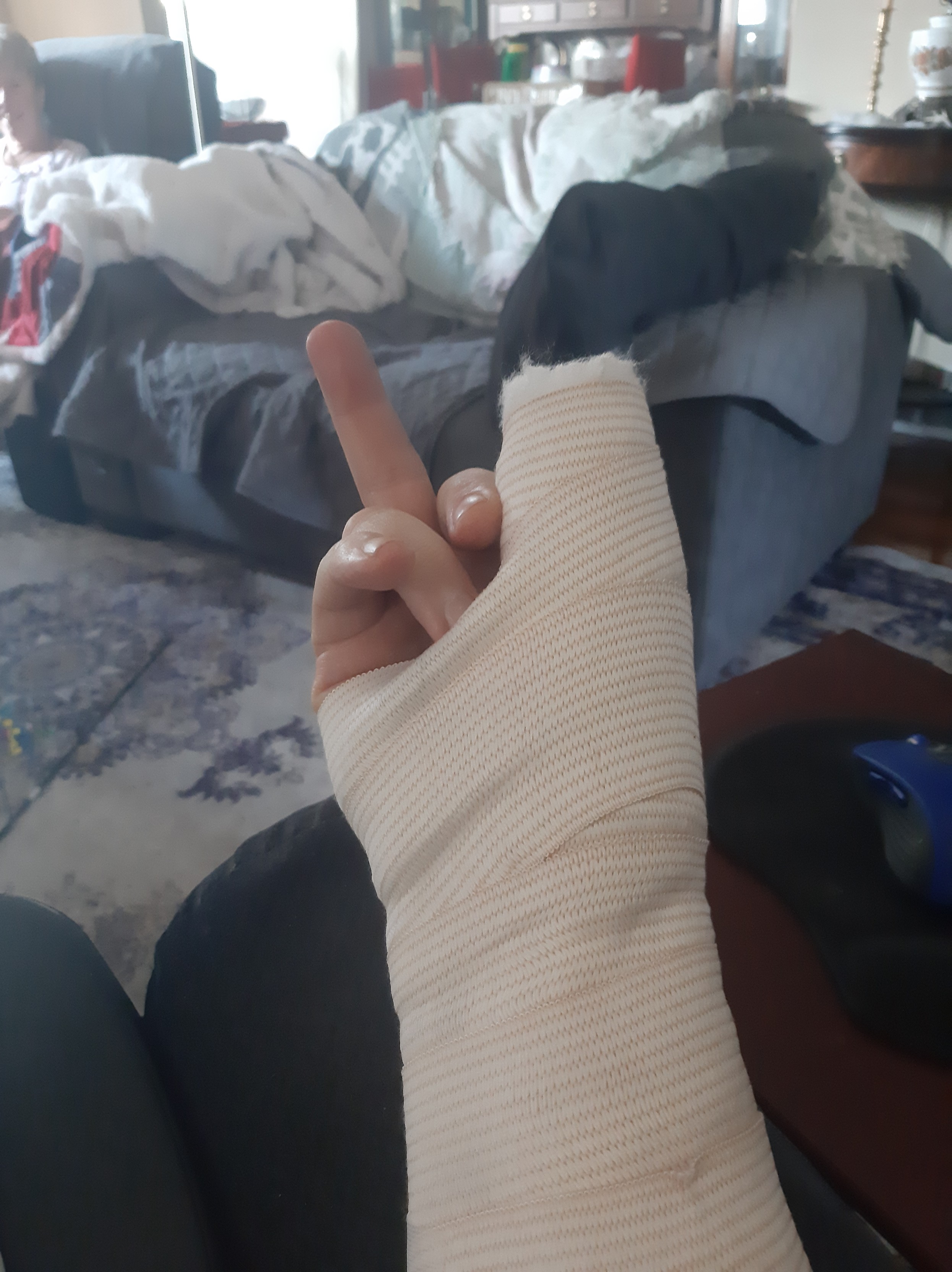
An older photo of me when I crushed my thumb expressing my opinion of having the cast. It also fits my opinion of the TACO and the maggots who lavish unthinking devotion to him.
I remember being told the doctor that I was extremely lucky not needing surgery and will get most if not all function back. It was crushed by a 35 lb ladder when I was collapsing it, and my thumb slipped when triggering the release. The wife will not allow me to use it unless there is an adult supervising me.…
 @arXiv_mathNA_bot@mastoxiv.page
Nonlocal modeling of spatial fractional diffusion with truncated interaction domains and truncated kernel function singularity
Shiping Zhou, Yanzhi Zhang, Max Gunzburger
https://arxiv.org/abs/2509.16315
@arXiv_mathCV_bot@mastoxiv.pagePartial sharing and cross sharing of entire function with its derivative
Sujoy Majumder, Nabadwip Sarkar, Debabrata Pramanik
https://arxiv.org/abs/2509.20273 https://
 @arXiv_condmatstrel_bot@mastoxiv.page
Universal Scaling Functions of the Gr{\"u}neisen Ratio near Quantum Critical Points
Xuan Zhou, Enze Lv, Wei Li, Yang Qi
https://arxiv.org/abs/2509.17362 https://
@arXiv_mathAP_bot@mastoxiv.pageRobin Problems of Elliptic Equations on Rough Domains: H\"older Regularity, Green's Functions, and Harmonic Measures
Jiayi Wang, Dachun Yang, Sibei Yang
https://arxiv.org/abs/2509.23073
 @arXiv_csCE_bot@mastoxiv.page
Optimal Experimental Design of a Moving Sensor for Linear Bayesian Inverse Problems
Nicole Aretz, Thomas Lynn, Karen Willcox, Sven Leyffer
https://arxiv.org/abs/2509.15961 https…
@arXiv_mathPR_bot@mastoxiv.pageLyapunov exponents and growth indices for fractional stochastic heat equations with space-time L\'evy white noise
Yuichi Shiozawa, Jian Wang
https://arxiv.org/abs/2509.23534
@arXiv_mathNA_bot@mastoxiv.pageDiffuse Domain Methods with Dirichlet Boundary Conditions
Luke Benfield, Andreas Dedner
https://arxiv.org/abs/2509.25115 https://arxiv.org/pdf/2509.25115…
@arXiv_csLG_bot@mastoxiv.pageFedSSG: Expectation-Gated and History-Aware Drift Alignment for Federated Learning
Zhanting Zhou, Jinshan Lai, Fengchun Zhang, Zeqin Wu, Fengli Zhang
https://arxiv.org/abs/2509.13895
 @arXiv_mathST_bot@mastoxiv.page
Non-parametric estimation of non-linear diffusion coefficient in parabolic SPDEs
Martin Andersson, Benny Avelin, Valentin Garino, Pauliina Ilmonen, Lauri Viitasaari
https://arxiv.org/abs/2509.12921
@arXiv_mathCV_bot@mastoxiv.pageThe pluricomplex Poisson kernel for convex finite type domains
Leandro Arosio, Filippo Bracci, Matteo Fiacchi
https://arxiv.org/abs/2509.26230 https://arxi…
@arXiv_mathFA_bot@mastoxiv.pageAbsolutely Summing Toeplitz operators on Fock spaces
Zhangjian Hu, Ermin Wang
https://arxiv.org/abs/2509.19967 https://arxiv.org/pdf/2509.19967
@arXiv_hepth_bot@mastoxiv.pageIntegrable Sigma Models and Universal Root $T\bar{T}$ Deformation via Courant-Hilbert Approach
H. Babaei-Aghbolagh, Bin Chen, Song He
https://arxiv.org/abs/2509.17075 https://…
 @arXiv_statCO_bot@mastoxiv.page
Knots and variance ordering of sequential Monte Carlo algorithms
Joshua J Bon, Anthony Lee
https://arxiv.org/abs/2510.01901 https://arxiv.org/pdf/2510.0190…
@arXiv_mathAP_bot@mastoxiv.pageStochastic diffusive energy balance climate model with a multiplicative noise modeling the Solar variability
Gregorio D\'iaz, Jes\'us Ildefonso D\'iaz
https://arxiv.org/abs/2509.23153
@arXiv_hepth_bot@mastoxiv.pagePhysics-informed neural network solves minimal surfaces in curved spacetime
Koji Hashimoto, Koichi Kyo, Masaki Murata, Gakuto Ogiwara, Norihiro Tanahashi
https://arxiv.org/abs/2509.10866
@arXiv_mathOC_bot@mastoxiv.pageA Converse Control Lyapunov Theorem for Joint Safety and Stability
Thanin Quartz, Maxwell Fitzsimmons, Jun Liu
https://arxiv.org/abs/2509.12182 https://arx…
@arXiv_mathAP_bot@mastoxiv.pageRemarks on the reinforcement of the spectrum of an elliptic problem with Robin boundary condition
Emanuele Cristoforoni, Federico Villone
https://arxiv.org/abs/2509.22305 https:…