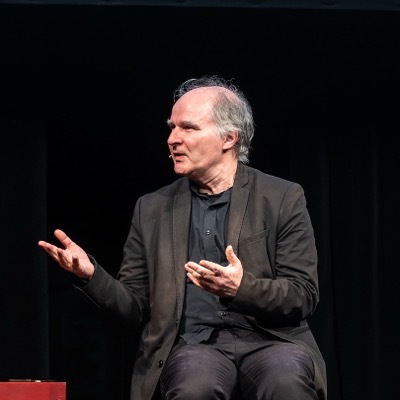
Sen. Bernie Sanders said at a “No Kings” protest on Saturday that mega-billionaires have “hijacked” the economy,
slamming some of the wealthiest people in the nation.
“This is about a handful of the wealthiest people on earth who,
in their insatiable greed,
have hijacked our economy and our political system in order to enrich themselves at the expense of working families throughout this country,”
Sanders said in a clip highlighted by Mediaite.
“I am talkin…
Hivemind:
I am looking for suitable reading on data for a second-year undergraduate module called "Liberal Arts and the Public Sphere". Any recommendations for monographs or essays on critical data literacy or the importance of data to the political economy are gratefully received. The students do not necessarily have advanced numeracy or statistical skills, so the reading must be fairly accessible.
#HE
The only question is what kind of hot water.
Amazon has their finger on the pulse of a lot of the economy: both retail and B2B, both corporate and consumer behavior. Honestly, with the government shut down and US gov job stats now under political control, Amazon’s probably got more, fresher, and better data about what’s going on with the US economy than just about anyone else on Earth.
What is Amazon seeing that they don’t want to say to their investors (yet)?
RE: https://fediscience.org/@suomenantropologi/115614886106180185
Vale Keith Hart. That keynote from 2010 (link below) was (and still is) a compelling argument for reconnecting value theory to practical political economy by weaving together Marx's commodity fetishism, the concept of plural economy inspired by Mauss, and the digital revolution's radical cheapening of information.
Albany Georgia isn’t the only place where the poorest among us are also the sickest.
The United States is blessed with one of the most scientifically and technologically advanced health care systems in the world,
a sprawling industry so vast and lucrative that it is now one of the largest drivers of the economy,
accounting for more jobs and revenue than manufacturing.
But for all the money flowing in and out,
Americans have more chronic illnesses and shorte…
The Theory of Strategic Evolution: Games with Endogenous Players and Strategic Replicators
Kevin Vallier
https://arxiv.org/abs/2512.07901 https://arxiv.org/pdf/2512.07901 https://arxiv.org/html/2512.07901
arXiv:2512.07901v1 Announce Type: new
Abstract: This paper develops the Theory of Strategic Evolution, a general model for systems in which the population of players, strategies, and institutional rules evolve together. The theory extends replicator dynamics to settings with endogenous players, multi level selection, innovation, constitutional change, and meta governance. The central mathematical object is a Poiesis stack: a hierarchy of strategic layers linked by cross level gain matrices. Under small gain conditions, the system admits a global Lyapunov function and satisfies selection, tracking, and stochastic stability results at every finite depth. We prove that the class is closed under block extension, innovation events, heterogeneous utilities, continuous strategy spaces, and constitutional evolution. The closure theorem shows that no new dynamics arise at higher levels and that unrestricted self modification cannot preserve Lyapunov structure. The theory unifies results from evolutionary game theory, institutional design, innovation dynamics, and constitutional political economy, providing a general mathematical model of long run strategic adaptation.
toXiv_bot_toot
Between December 2023 and July 2025, 18,000 businesses have closed and 253,800 registered jobs have been lost, according to the Centre for Argentine Political Economy (CEPA). Alongside the exchange rate freeze, which made Argentina the most expensive country in South America, Milei’s government – unlike Donald Trump’s – has reduced or scrapped tariffs, leaving heavily taxed local industries at a disadvantage against Chinese imports.
https://www.theguardian.com/news/ng-interactive/2025/oct/26/do-populists-always-crash-the-economy?CMP=Share_iOSApp_Other
We distinguish "personal unfairness",
-- the view that one’s own economic situation is unfair,
from "social unfairness",
-- the view that the economic situation of others in society is unfair.
Uncertainties associated with the transition to a globalized knowledge economy heighten people’s feelings of personal unfairness
Feelings of personal unfairness increase support for the "populist right"
and feelings about social unfairn…
Trump shares Milei’s love of chaos and showbiz but his approach does not fit straightforwardly into his Argentinian ally’s laissez-faire playbook. While Trump has cut taxes for the wealthy and slashed regulation in some sectors, his administration has also taken stakes in strategic firms and used trade policy as a political weapon – a muscular interventionism more familiar in Beijing than Washington.
https://www.theguardian.com/news/ng-interactive/2025/oct/26/do-populists-always-crash-the-economy?CMP=Share_iOSApp_Other
 @cdarwin@c.im