Tootfinder

Opt-in global Mastodon full text search. Join the index!

@azonenberg@ioc.exchange
2026-03-31 12:06:52

Looking at a pollen sample from outside (just a piece of double sided tape pressed against the roof of the car to see what had stuck).
This isn't necessarily a representative sample of what's in the air, I could do a more scientific test by leaving a piece of tape out for a while to see what settles out, but I just wanted something to show my daughter what pollen looked like.
Can anybody ID any of these? We have alder, willow, maple, poplar, and various evergreens in clos…

Elongated mostly-opaque green particle with several smaller semitransparent green particles nearby
Spherical-ish pale green particle with a slightly fuzzy looking texture visible around the perimeter
Another rounded slightly fuzzy pale green particle
@joe@toot.works
2026-04-01 19:01:01

Ok, this is cool. You use Coqui to clone a voice from a 30 sec sample, use Qwen to call people via Google Voice using the cloned voice, and demand gift cards.
#AI #Deepfakes

@kurtsh@mastodon.social
2026-03-28 16:03:27

No they want your DNA to track you.
Folks, have you seen GATTACA?
▶️ U.S. lawmakers demand answers after Canadian man says border officers made him give DNA sample | CBC News
cbc.ca/news/canada/windsor/us-

@azonenberg@ioc.exchange
2026-02-01 05:45:40

Another evening, another few filters getting OOM speedups.
Tonight it was invert (27.3x, trivial memory bound shader that just outputs negative x[i] for each output sample) and the 8B/10B decode (didn't even bother to GPU it, just removing the redundant sampling operation by using the new CDR recovered-data output was enough for a 12.1x speedup and 6ms on my 50M point benchmark is fast enough I'm in no hurry to GPU... but at faster data rates with lower oversampling factors it …

@netzschleuder@social.skewed.de

2026-01-28 21:00:20

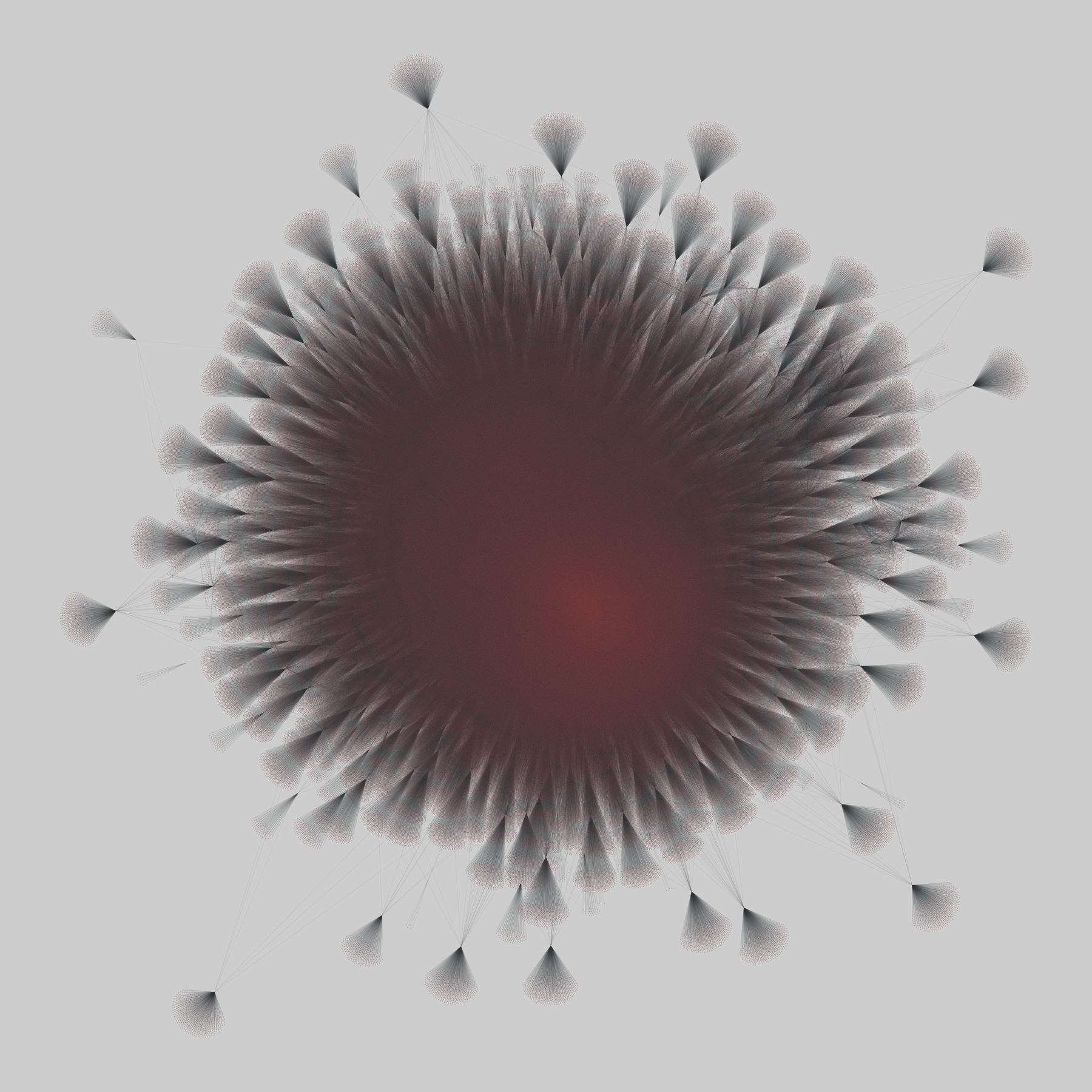
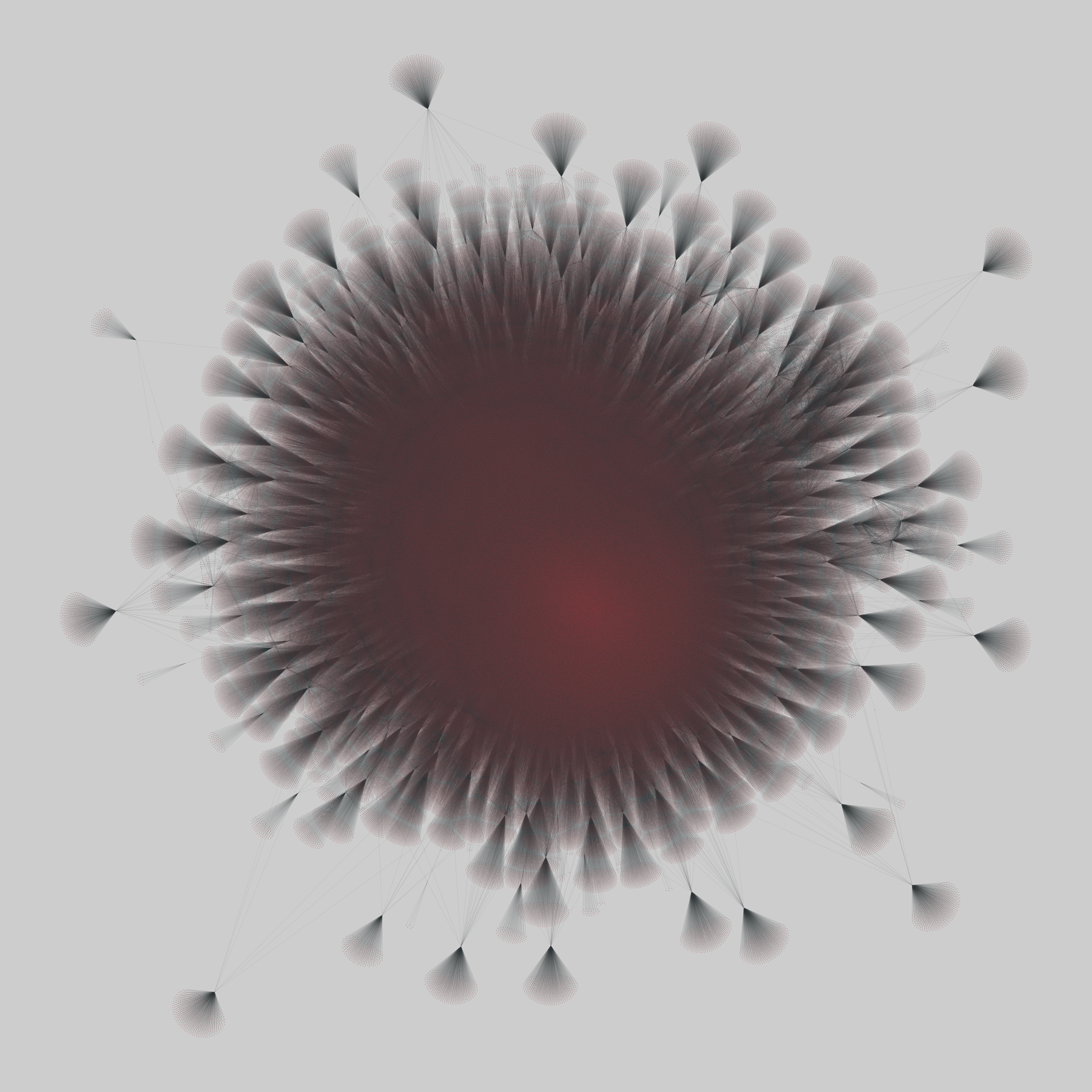
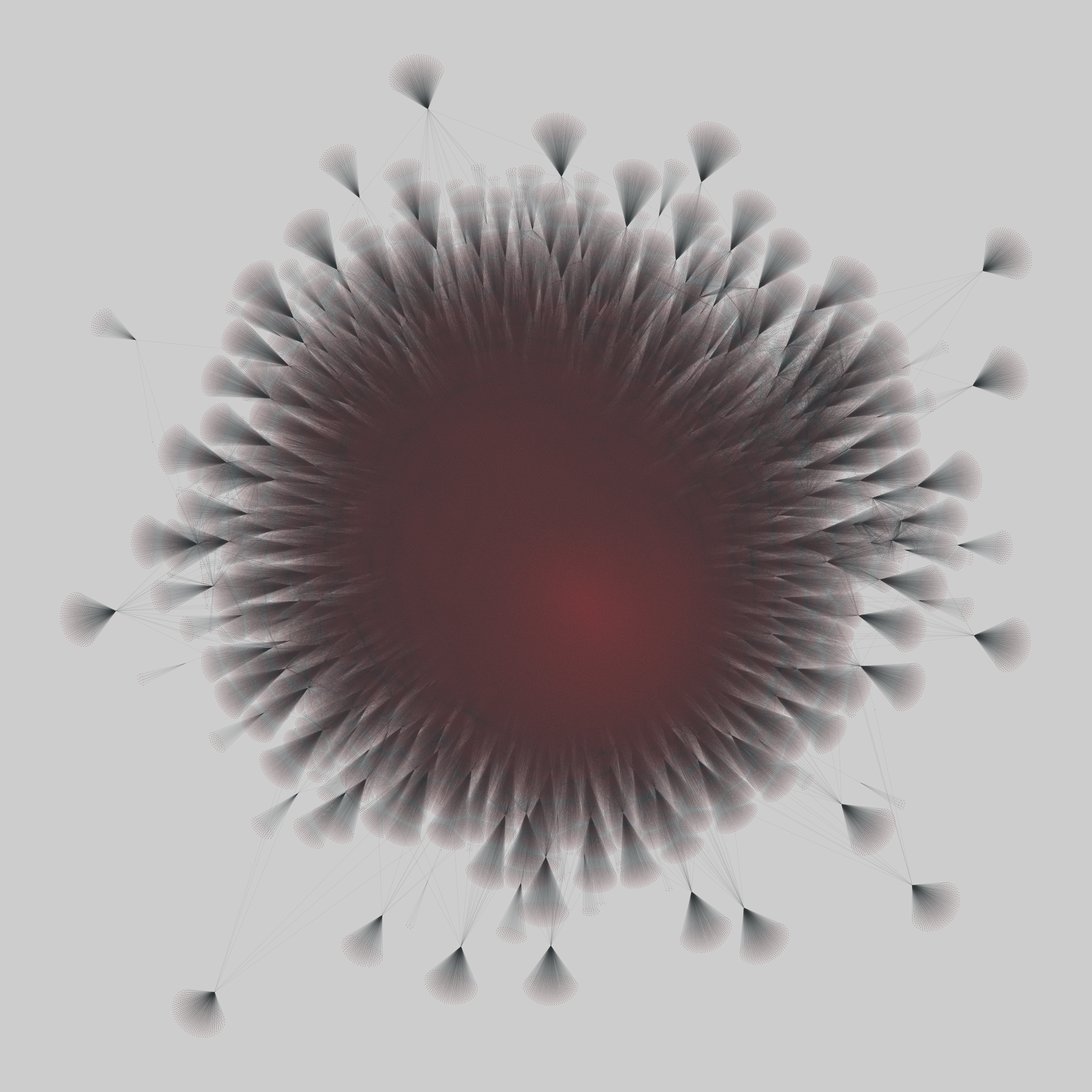
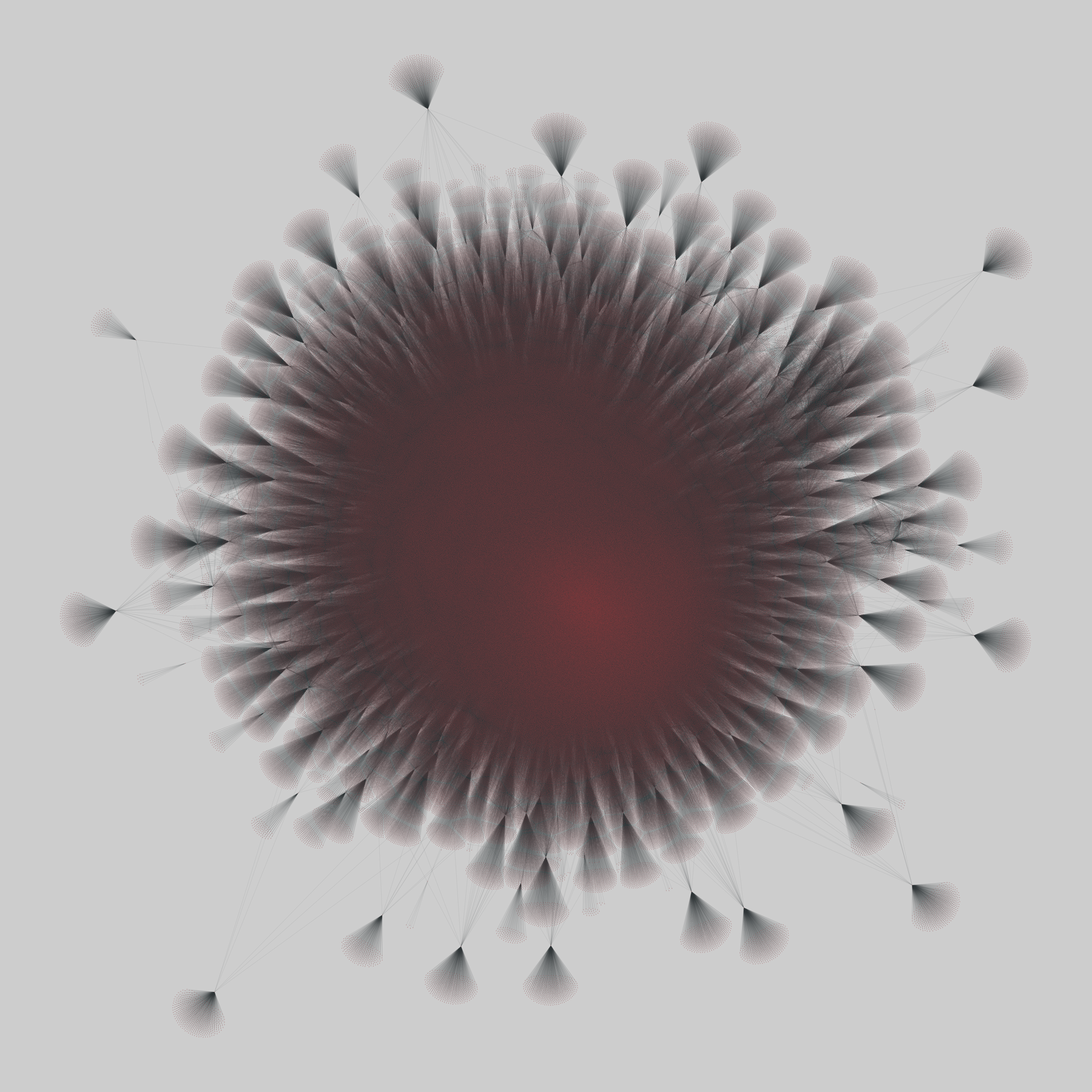
twitter: Twitter followers (2010)
A directed network of following relationships from Twitter, from a snowball sample crawl across "quality" users in 2009. A directed edge (i, j) indicates that user i follows user j.
This network has 465017 nodes and 834797 edges.
Tags: Social, Online, Unweighted
network…

twitter: Twitter followers (2010). 465017 nodes, 834797 edges. https://networks.skewed.de/net/twitter
@doktrock@toad.social
2026-01-29 22:21:08

Back on the SEM-EDS for a class exercise in measuring chemical composition of "unknowns"

A JEOL JSM-IT200 electron microscope, with EDS X-ray detector. Next to it screens showing images of a sample surface and X-ray spectra. People are looking at the screens.
@hakona@im.alstadheim.no
2026-03-30 05:28:04

Nå spiller de f*-meg Anita Skorgan og Georg Keller på NRK mP3. " Æ syns den hær va dritkul".
OK.
Det var et sample, riktignok . HŸrtes mer ut som en remix.

@timbray@cosocial.ca
2026-03-28 01:54:51

Just saw my first #MLB ball/strike challenge. Seems to work as intended. On a sample size of 1, I approve.

@heiseonline@social.heise.de
2026-01-08 14:09:00

Bodenproben vom Roten Planeten: „Mars Sample Return“ bei der NASA vor dem Aus
In einem komplizierten Manöver wollten die NASA und die ESA Bodenproben vom Mars zur Erde bringen. Daraus wird aber nichts, die USA drehen den Geldhahn zu.

@arXiv_csCL_bot@mastoxiv.page
2026-03-31 11:12:28

Replaced article(s) found for cs.CL. arxiv.org/list/cs.CL/new
[1/5]:
- Beyond In-Distribution Success: Scaling Curves of CoT Granularity for Language Model Generalization
Ru Wang, Wei Huang, Selena Song, Haoyu Zhang, Qian Niu, Yusuke Iwasawa, Yutaka Matsuo, Jiaxian Guo
arxiv.org/abs/2502.18273 mastoxiv.page/@arXiv_csCL_bot/
- Benchmarking NLP-supported Language Sample Analysis for Swiss Children's Speech
Anja Ryser, Yingqiang Gao, Sarah Ebling
arxiv.org/abs/2504.00780 mastoxiv.page/@arXiv_csCL_bot/
- Cultural Biases of Large Language Models and Humans in Historical Interpretation
Fabio Celli, Georgios Spathulas
arxiv.org/abs/2504.02572 mastoxiv.page/@arXiv_csCL_bot/
- BRIDGE: Benchmarking Large Language Models for Understanding Real-world Clinical Practice Text
Jiageng Wu, et al.
arxiv.org/abs/2504.19467 mastoxiv.page/@arXiv_csCL_bot/
- Understanding the Anchoring Effect of LLM with Synthetic Data: Existence, Mechanism, and Potentia...
Yiming Huang, Biquan Bie, Zuqiu Na, Weilin Ruan, Songxin Lei, Yutao Yue, Xinlei He
arxiv.org/abs/2505.15392 mastoxiv.page/@arXiv_csCL_bot/
- Just as Humans Need Vaccines, So Do Models: Model Immunization to Combat Falsehoods
Raza, Qureshi, Farooq, Lotif, Chadha, Pandya, Emmanouilidis
arxiv.org/abs/2505.17870 mastoxiv.page/@arXiv_csCL_bot/
- LingoLoop Attack: Trapping MLLMs via Linguistic Context and State Entrapment into Endless Loops
Fu, Jiang, Hong, Li, Guo, Yang, Chen, Zhang
arxiv.org/abs/2506.14493 mastoxiv.page/@arXiv_csCL_bot/
- GHTM: A Graph-based Hybrid Topic Modeling Approach with a Benchmark Dataset for the Low-Resource ...
Farhana Haque, Md. Abdur Rahman, Sumon Ahmed
arxiv.org/abs/2508.00605 mastoxiv.page/@arXiv_csCL_bot/
- Link Prediction for Event Logs in the Process Industry
Anastasia Zhukova, Thomas Walton, Christian E. Lobm\"uller, Bela Gipp
arxiv.org/abs/2508.09096 mastoxiv.page/@arXiv_csCL_bot/
- AirQA: A Comprehensive QA Dataset for AI Research with Instance-Level Evaluation
Huang, Cao, Zhang, Kang, Wang, Wang, Luo, Zheng, Qian, Chen, Yu
arxiv.org/abs/2509.16952 mastoxiv.page/@arXiv_csCL_bot/
- Multi-View Attention Multiple-Instance Learning Enhanced by LLM Reasoning for Cognitive Distortio...
Jun Seo Kim, Hyemi Kim, Woo Joo Oh, Hongjin Cho, Hochul Lee, Hye Hyeon Kim
arxiv.org/abs/2509.17292 mastoxiv.page/@arXiv_csCL_bot/
- Dual-Space Smoothness for Robust and Balanced LLM Unlearning
Han Yan, Zheyuan Liu, Meng Jiang
arxiv.org/abs/2509.23362 mastoxiv.page/@arXiv_csCL_bot/
- The Rise of AfricaNLP: Contributions, Contributors, Community Impact, and Bibliometric Analysis
Tadesse Destaw Belay, et al.
arxiv.org/abs/2509.25477 mastoxiv.page/@arXiv_csCL_bot/
- Open ASR Leaderboard: Towards Reproducible and Transparent Multilingual and Long-Form Speech Reco...
Srivastav, Zheng, Bezzam, Le Bihan, Koluguri, \.Zelasko, Majumdar, Moumen, Gandhi
arxiv.org/abs/2510.06961 mastoxiv.page/@arXiv_csCL_bot/
- Neuron-Level Analysis of Cultural Understanding in Large Language Models
Taisei Yamamoto, Ryoma Kumon, Danushka Bollegala, Hitomi Yanaka
arxiv.org/abs/2510.08284 mastoxiv.page/@arXiv_csCL_bot/
- CLMN: Concept based Language Models via Neural Symbolic Reasoning
Yibo Yang
arxiv.org/abs/2510.10063 mastoxiv.page/@arXiv_csCL_bot/
- Schema for In-Context Learning
Chen, Chen, Wang, Leong, Fung, Bernales, Aspuru-Guzik
arxiv.org/abs/2510.13905 mastoxiv.page/@arXiv_csCL_bot/
- Evaluating Latent Knowledge of Public Tabular Datasets in Large Language Models
Matteo Silvestri, Fabiano Veglianti, Flavio Giorgi, Fabrizio Silvestri, Gabriele Tolomei
arxiv.org/abs/2510.20351 mastoxiv.page/@arXiv_csCL_bot/
- LuxIT: A Luxembourgish Instruction Tuning Dataset from Monolingual Seed Data
Julian Valline, Cedric Lothritz, Siwen Guo, Jordi Cabot
arxiv.org/abs/2510.24434 mastoxiv.page/@arXiv_csCL_bot/
- Surfacing Subtle Stereotypes: A Multilingual, Debate-Oriented Evaluation of Modern LLMs
Muhammed Saeed, Muhammad Abdul-mageed, Shady Shehata
arxiv.org/abs/2511.01187 mastoxiv.page/@arXiv_csCL_bot/
toXiv_bot_toot

@stephaniebarton@social.linux.pizza
2026-04-01 02:12:27

Sample thing at 13s intervals. Oops! Ship the number now! Before launch, he shake tonight.

@cosmos4u@scicomm.xyz
2026-01-26 03:47:09

The ALMA survey to Resolve #ExoKuiper belt Substructures (ARKS) - motivation, sample, data reduction, and results overview: mpg.de/26005548/arks_part_i_ov -> ALMA Reveals Teenage Years of New Worlds: mpia.de/news/science/2026-01-a - new astronomical survey captures previously unknown growing pains in the lives of planets.

@aardrian@toot.cafe
2026-03-25 14:13:21

Well, that’s half of the two hard problems in computer science solved!
From W3C “Use of Large Language Models in Standards Work”
w3.org/TR/llms-standards/#brai
Now LLMs just need to solve cache invalidation and off-by-one errors.

§ 1.3 Brainstorming Names: New standards work often needs new names. Those names should be easy to understand while still fitting platform conventions and avoiding conflicts with existing terms. Because LLMs are trained on a very large sample of human language, they're a great tool to use when trying to come up with human friendly names for novel concepts.
@radioeinsmusicbot@mastodonapp.uk
2026-02-19 17:06:48

🇺🇦 Auf radioeins läuft...
Foxwarren:
🎵 Listen2me
#NowPlaying #Foxwarren
foxwarren.bandcamp.com/track/l
open.spotify.com/track/29WWHCu

@azonenberg@ioc.exchange
2026-02-22 07:30:05

It's sooo nice having SEM sample prep and mounting gear at home.
I don't need to waste time in the lab at work getting everything ready, I can prep my sample in the comfort of my own home then show up bright and early Monday morning and pop it in the chamber with no dilly-dallying.

@tinoeberl@mastodon.online
2026-02-16 17:20:31

In einer kleinen Studie wurden #Mikroplastik-Partikel in den Plazenten von drei trächtigen #Katzen und in Föten von zwei Tieren nachgewiesen.
Insgesamt fanden Forschende 19 verschiedene #Kunststoffarten

@arXiv_csLG_bot@mastoxiv.page
2026-02-25 10:44:51

Why Pass@k Optimization Can Degrade Pass@1: Prompt Interference in LLM Post-training
Anas Barakat, Souradip Chakraborty, Khushbu Pahwa, Amrit Singh Bedi
arxiv.org/abs/2602.21189 arxiv.org/pdf/2602.21189 arxiv.org/html/2602.21189
arXiv:2602.21189v1 Announce Type: new
Abstract: Pass@k is a widely used performance metric for verifiable large language model tasks, including mathematical reasoning, code generation, and short-answer reasoning. It defines success if any of $k$ independently sampled solutions passes a verifier. This multi-sample inference metric has motivated inference-aware fine-tuning methods that directly optimize pass@$k$. However, prior work reports a recurring trade-off: pass@k improves while pass@1 degrades under such methods. This trade-off is practically important because pass@1 often remains a hard operational constraint due to latency and cost budgets, imperfect verifier coverage, and the need for a reliable single-shot fallback. We study the origin of this trade-off and provide a theoretical characterization of when pass@k policy optimization can reduce pass@1 through gradient conflict induced by prompt interference. We show that pass@$k$ policy gradients can conflict with pass@1 gradients because pass@$k$ optimization implicitly reweights prompts toward low-success prompts; when these prompts are what we term negatively interfering, their upweighting can rotate the pass@k update direction away from the pass@1 direction. We illustrate our theoretical findings with large language model experiments on verifiable mathematical reasoning tasks.
toXiv_bot_toot

@detondev@social.linux.pizza
2026-03-21 03:47:39

Learning how to psyop Third World populations with Manual of The Mercenary Soldier
archive.org/details/PaulBalorM

Your best psy-op is that which seems to demonstrate to the enemy as well as your people that the enemy has lost control of the situation. You can be pretty sure that by the | time you go in, the bad guys have had things going their way. And you’re not going to reverse that with words alone.

Remember . . . you’re not going up against an open Western society or one of the West’s sloppy, half-assed Third World client states. You’re going up against rebels or a regime which is totalitarian in…
tunity to “build bridges to the people.” Unfortunately, building that bridge takes too long and it is too easily blown. Your opposition gives lip service to civic action— but he practices “grab ’em by the balls and yank. Their hearts and minds will follow.” And damned if they don’t!
Sample psy-op:

Your conflicts always throw up little local despots in the countryside. They may be the rural police chief, a militia captain, guerrilla leader, even a local religious figure. They may be on either side. Or no side. What they have in com¬ mon is that they’re vicious, detested by the local people they oppress. Select one. Take him out. Visibly. Hoist his body in the village square.

And, of course, broadcast the fact. Now you’re really in the hearts-and-minds business.

Your best…
Not for you any cold, colorless recitation of facts. You’re not the Voice of America, Radio Free Europe, Radio Marti. . . . Come on strong. Speak passionate truths! Feel free to indulge in color, symbolism, folklore, histrionics, and invective! You have to not only inform—you also must entertain.

But never forget: Third worlders are realists. They have to be. They’ve been exposed to the application of raw power all their lives. They want to survive. They’ll accom¬ modate whoever is able to app…
@karlauerbach@sfba.social
2026-01-19 09:27:37

I just sent this to my Congress critter who voted for HR 7006 - which effectively funds trump rather than resists him.
(It is too large for one part, so I am splitting it...)
I am *EXTREMELY* disappointed that you voted in favor of H. R. 7006.
That bill simply pours money into the pockets of our mad president - he will spend it without regard for the niceties or purposes in the bill. Did you read this bill? Just as a single sample from the bill's vast absurdities is th…

@penguin42@mastodon.org.uk
2026-01-18 01:17:56

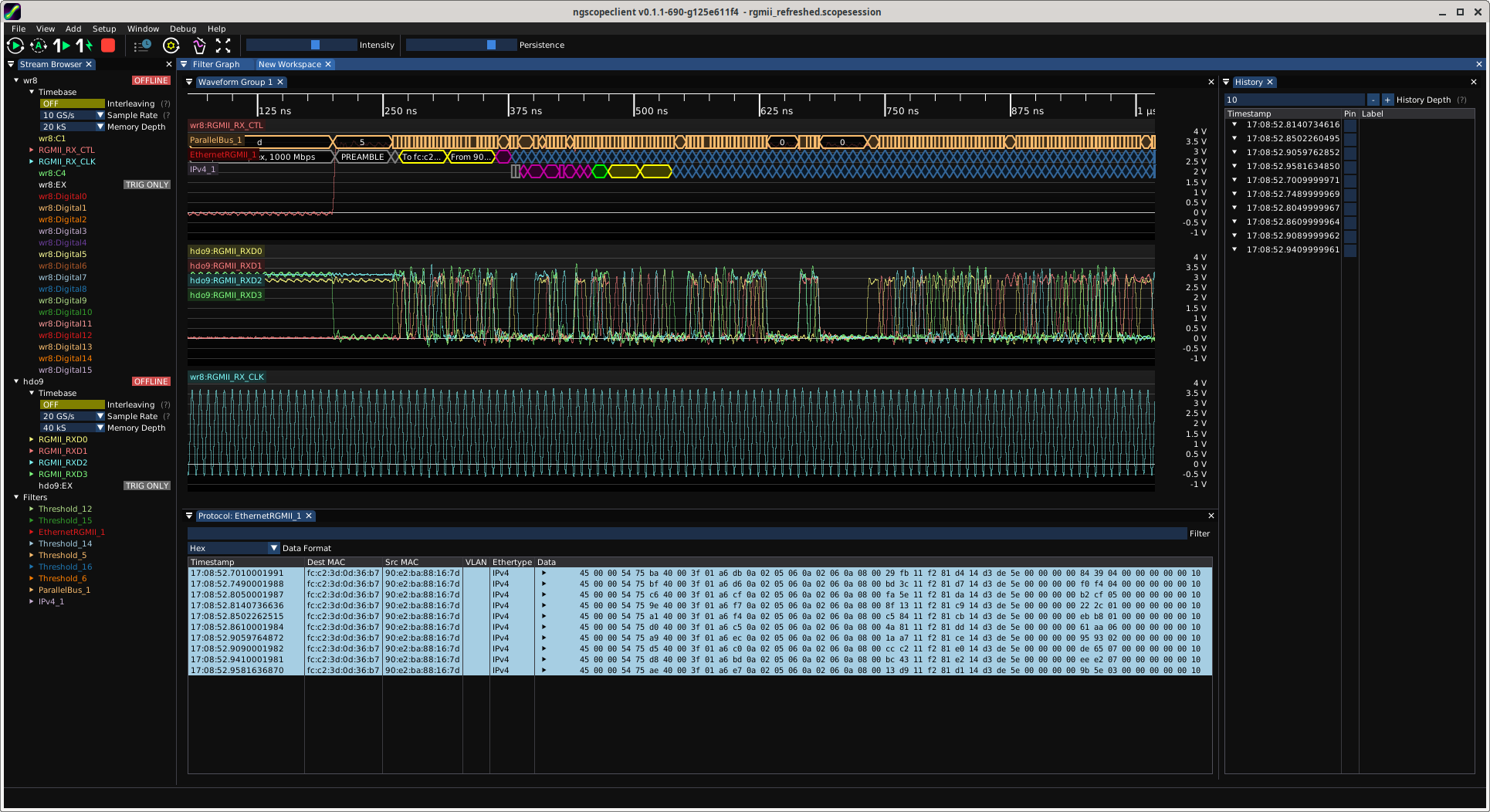
@… 's ngscopeclient showing a trace and fft (from a 1kHz sample) from my Rigol DS series scope; I can't say it's that happy with the Rigol, but hey I think that's as much about the Rigol's firmware.

An oscilloscope-like display captured from Linux, showing one channel of my scope with a 1kHz reference and an FFT calculated by ngscopeclient
@kexpmusicbot@mastodonapp.uk
2026-03-10 13:58:10

🇺🇦 #NowPlaying on KEXP's #Early
Curtis Mayfield:
🎵 No Thing on Me (Cocaine Song) (instrumental version)
#CurtisMayfield
gurusamplebeats.bandcamp.com/t
open.spotify.com/track/4ex8e6I

@netzschleuder@social.skewed.de
2026-02-19 04:00:16

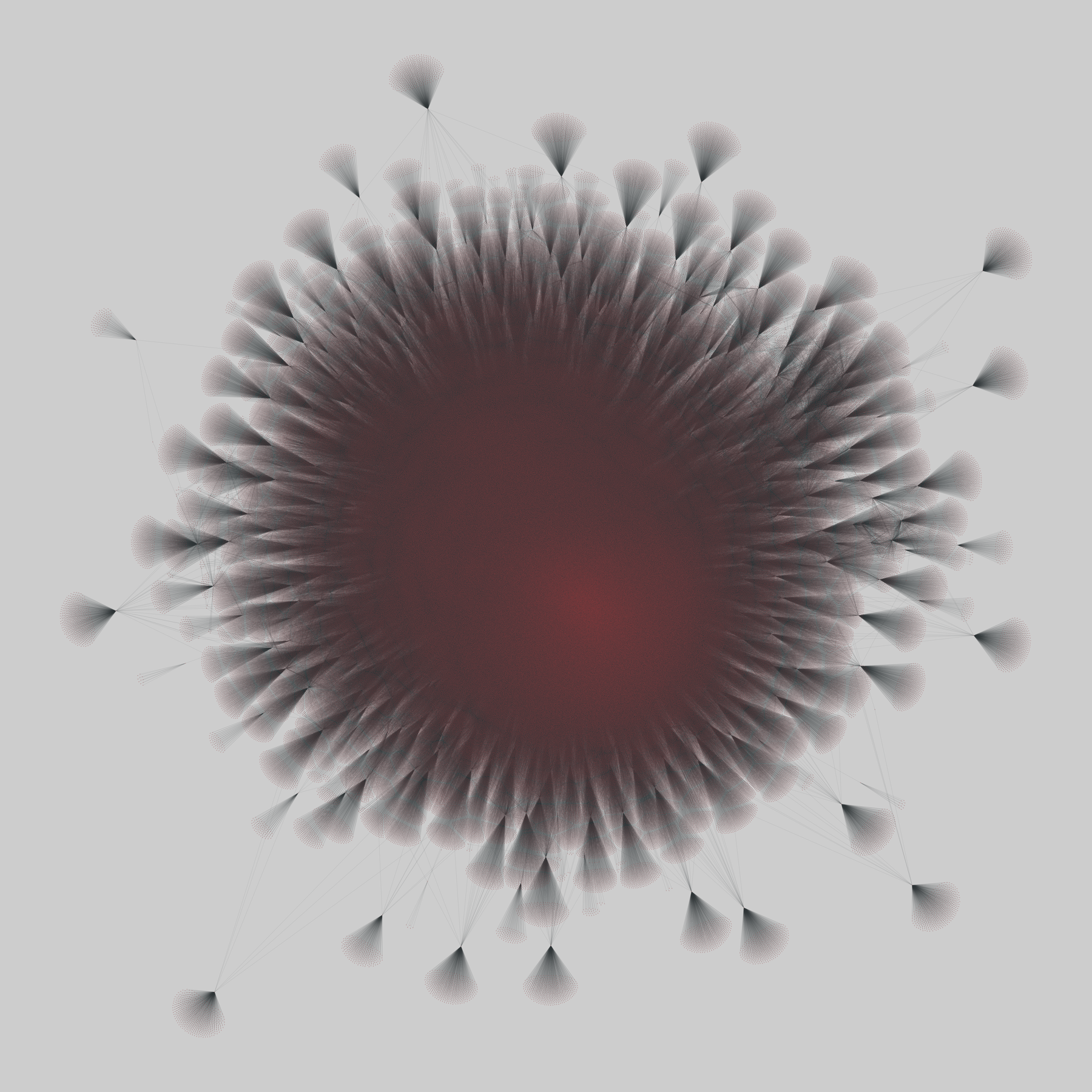
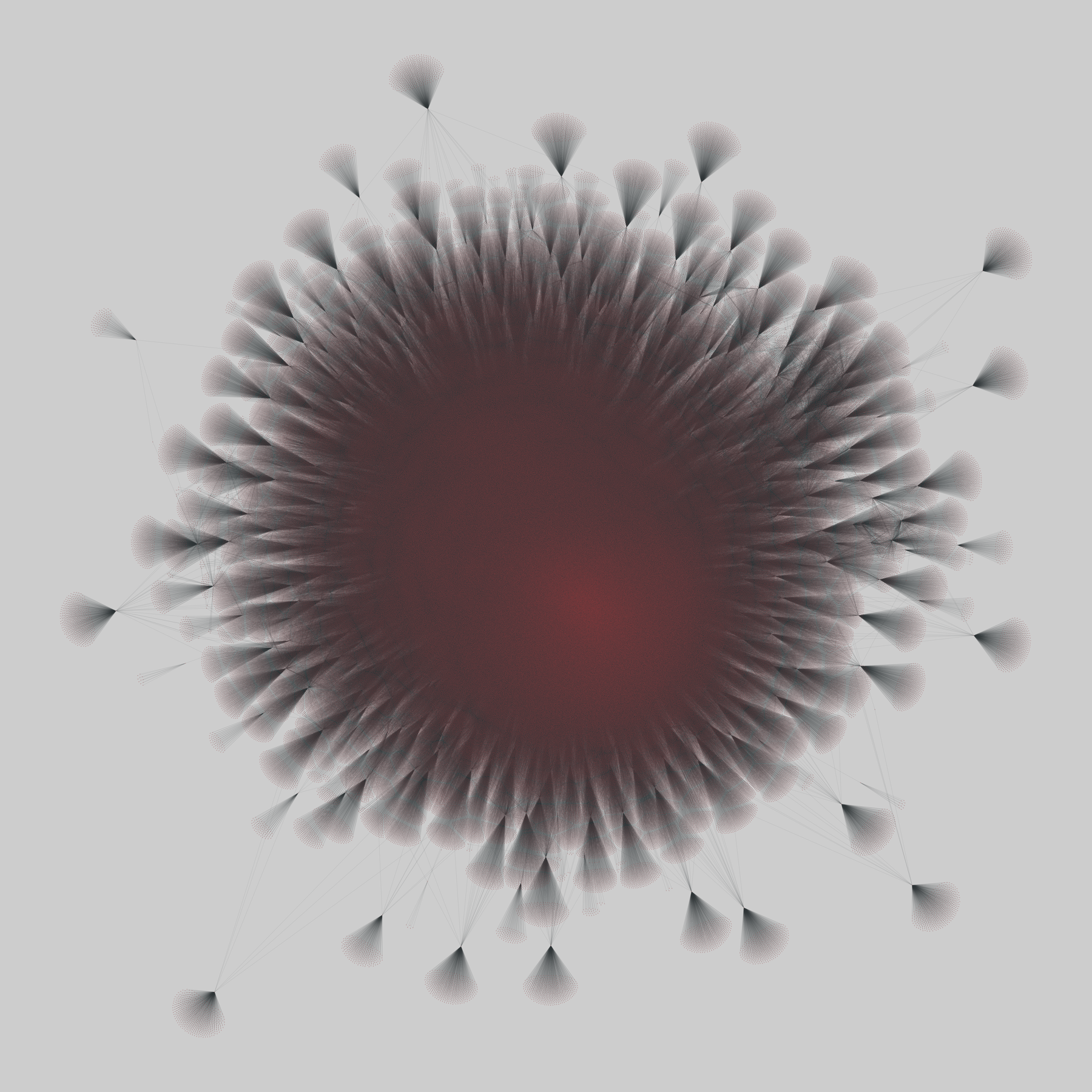
twitter: Twitter followers (2010)
A directed network of following relationships from Twitter, from a snowball sample crawl across "quality" users in 2009. A directed edge (i, j) indicates that user i follows user j.
This network has 465017 nodes and 834797 edges.
Tags: Social, Online, Unweighted
network…

twitter: Twitter followers (2010). 465017 nodes, 834797 edges. https://networks.skewed.de/net/twitter
@NFL@darktundra.xyz
2026-03-05 20:36:28

Comparing Malik Willis to prior small-sample wonders, plus Dane Brugler's post-combine risers nytimes.com/athletic/7090880/2

@primonatura@mstdn.social
2026-01-17 12:00:28

"Microplastics found in rural woodland at higher levels than in city centers"
#Microplastics #Plastic #Plastics

@Dragofix@veganism.social
2026-03-17 22:19:48

Sunscreen produces persistent free radicals when exposed to light, study finds #environment

@metacurity@infosec.exchange
2026-01-13 11:23:30

Target's dev server offline after hackers claim to steal source code
bleepingcomputer.com/news/secu

@radioeinsmusicbot@mastodonapp.uk
2026-03-20 17:49:26

🇺🇦 Auf radioeins läuft...
Foxwarren:
🎵 Listen2me
#NowPlaying #Foxwarren
foxwarren.bandcamp.com/track/l
open.spotify.com/track/29WWHCu

@arXiv_physicschemph_bot@mastoxiv.page
2026-03-26 08:15:52

Restoring missing low scattering angle data in two-dimensional diffraction patterns of isolated molecules
Yanwei Xiong, Martin Centurion
arxiv.org/abs/2603.24334 arxiv.org/pdf/2603.24334 arxiv.org/html/2603.24334
arXiv:2603.24334v1 Announce Type: new
Abstract: Anisotropic two-dimensional diffraction signals contain more information than the conventional isotropic signals for both gas phase ultrafast electron and X-ray diffraction experiments and are common in typical time-resolved diffraction experiments due to the use of linearly polarized lasers to excite the sample that imprints spatial anisotropy on the molecules. We report an iterative algorithm to restore the missing data at low scattering angles in a two-dimensional diffraction signal, which is essential to obtain real-space representation. The iterative algorithm transforms two-dimensional signals back and forth between the momentum transfer domain and the real space domain through Fourier and Abel transforms and apply real space constraints to retrieve missing signal at low scattering angles. The algorithm only requires an approximate a-priori knowledge of the shortest and longest internuclear distances in the molecule. We demonstrated successful retrieval of the missing signal in simulated patterns and in experimentally measured diffraction patterns from laser-induced alignment of trifluoroiodomethane molecules.
toXiv_bot_toot

Like the Hayabusa2 mission,
which explored and returned samples from an asteroid,
#MMX will investigate the Martian moons -- and return a sample from Phobos to Earth.
The mission is scheduled for launch in JFY 2026, followed by an approximately five year journey for the round-trip to the Martian sphere and exploration of the system.
MMX aims to collect more than 10g of material from P…

@callunavulgaris@mastodon.scot
2026-01-14 06:23:30

A massive (but not unusual) sneezing fit followed by hiccups certainly wakes you up in the morning. I hope Wednesday is good to you. I'm bringing together the findings from one part of a small sample set we've processed and then moving onto the microscopes to analyse the other part. I enjoy both aspects but tragically it's the admin that really makes my heart sing 😄 I spent years fighting it but now I accept I was born under the admin star.

@raiders@darktundra.xyz
2026-03-05 20:33:49

Comparing Malik Willis to prior small-sample wonders, plus Dane Brugler's post-combine risers nytimes.com/athletic/7090880/2

@cosmos4u@scicomm.xyz
2026-02-19 15:42:05

The #LOFAR Two-metre Sky Survey - VII. Third Data Release: arxiv.org/abs/2602.15949 -> Largest Ever Radio Sky Survey Maps the Universe in Unprecedented Detail: ru.nl/en/research/research-new (see the ALT text for what the three sample images show).

@azonenberg@ioc.exchange
2026-02-23 06:59:58

Looking back at some of my old decaps compared to one I did recently. Amazing what a difference 15 years of practice makes lol.
The etch is so much more surgical now (and I can preserve copper bond wires which was a pipe dream before - although to be fair back then copper wires were not in common use)
The clipped pin on the recent sample is intentional, you'll find out why in a few weeks

8-pin SOIC on a SEM stub with a nice clean rectangular cutout etched in the middle exposing a die and copper bond wires
100ish pin rectangular TQFP with a giant crater etched in it partially exposing the die and some blue RTV rubber around the perimeter
Dirty silicon die  surrounded by gold bond wires, some broken, on a rather mangled decapped package
28 pin DIP with a giant crater etched in the middle exposing the die at the bottom of a deep hole
‪@mxp@mastodon.acm.org‬
2026-01-04 14:39:21

I’ve been wondering for years about the source of the sample at the beginning of Etienne de Crécy’s “Affaires Š faire.” youtu.be/7URcTSDDLMU
Maybe an obscure Nouvelle vague film? No, it’s from… “Dallas.”

@mxp@mastodon.acm.org‬
2026-01-04 14:39:21

I’ve been wondering for years about the source of the sample at the beginning of Etienne de Crécy’s “Affaires Š faire.” youtu.be/7URcTSDDLMU
Maybe an obscure Nouvelle vague film? No, it’s from… “Dallas.”

@mxp@mastodon.acm.org
2026-01-04 14:39:21

I’ve been wondering for years about the source of the sample at the beginning of Etienne de Crécy’s “Affaires Š faire.” youtu.be/7URcTSDDLMU
Maybe an obscure Nouvelle vague film? No, it’s from… “Dallas.”

@andres4ny@social.ridetrans.it
2026-03-03 01:51:25

how many times can an 8yo scream directly into your ear before your brain melts?
(study shortcomings include the tiny sample size of 1)

@arXiv_csLG_bot@mastoxiv.page
2026-02-25 10:41:21

Localized Dynamics-Aware Domain Adaption for Off-Dynamics Offline Reinforcement Learning
Zhangjie Xia, Yu Yang, Pan Xu
arxiv.org/abs/2602.21072 arxiv.org/pdf/2602.21072 arxiv.org/html/2602.21072
arXiv:2602.21072v1 Announce Type: new
Abstract: Off-dynamics offline reinforcement learning (RL) aims to learn a policy for a target domain using limited target data and abundant source data collected under different transition dynamics. Existing methods typically address dynamics mismatch either globally over the state space or via pointwise data filtering; these approaches can miss localized cross-domain similarities or incur high computational cost. We propose Localized Dynamics-Aware Domain Adaptation (LoDADA), which exploits localized dynamics mismatch to better reuse source data. LoDADA clusters transitions from source and target datasets and estimates cluster-level dynamics discrepancy via domain discrimination. Source transitions from clusters with small discrepancy are retained, while those from clusters with large discrepancy are filtered out. This yields a fine-grained and scalable data selection strategy that avoids overly coarse global assumptions and expensive per-sample filtering. We provide theoretical insights and extensive experiments across environments with diverse global and local dynamics shifts. Results show that LoDADA consistently outperforms state-of-the-art off-dynamics offline RL methods by better leveraging localized distribution mismatch.
toXiv_bot_toot

@netzschleuder@social.skewed.de
2026-01-19 02:00:20

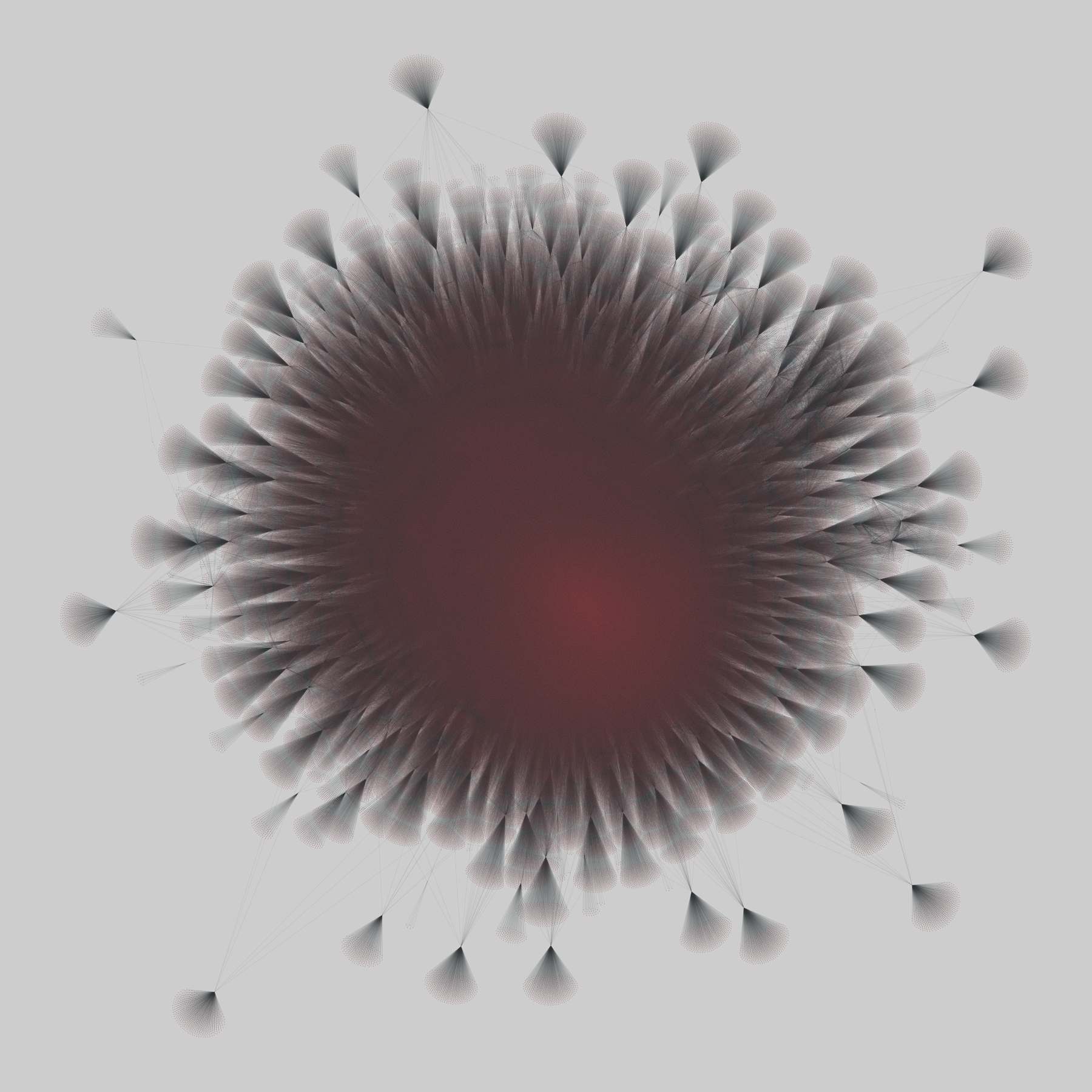
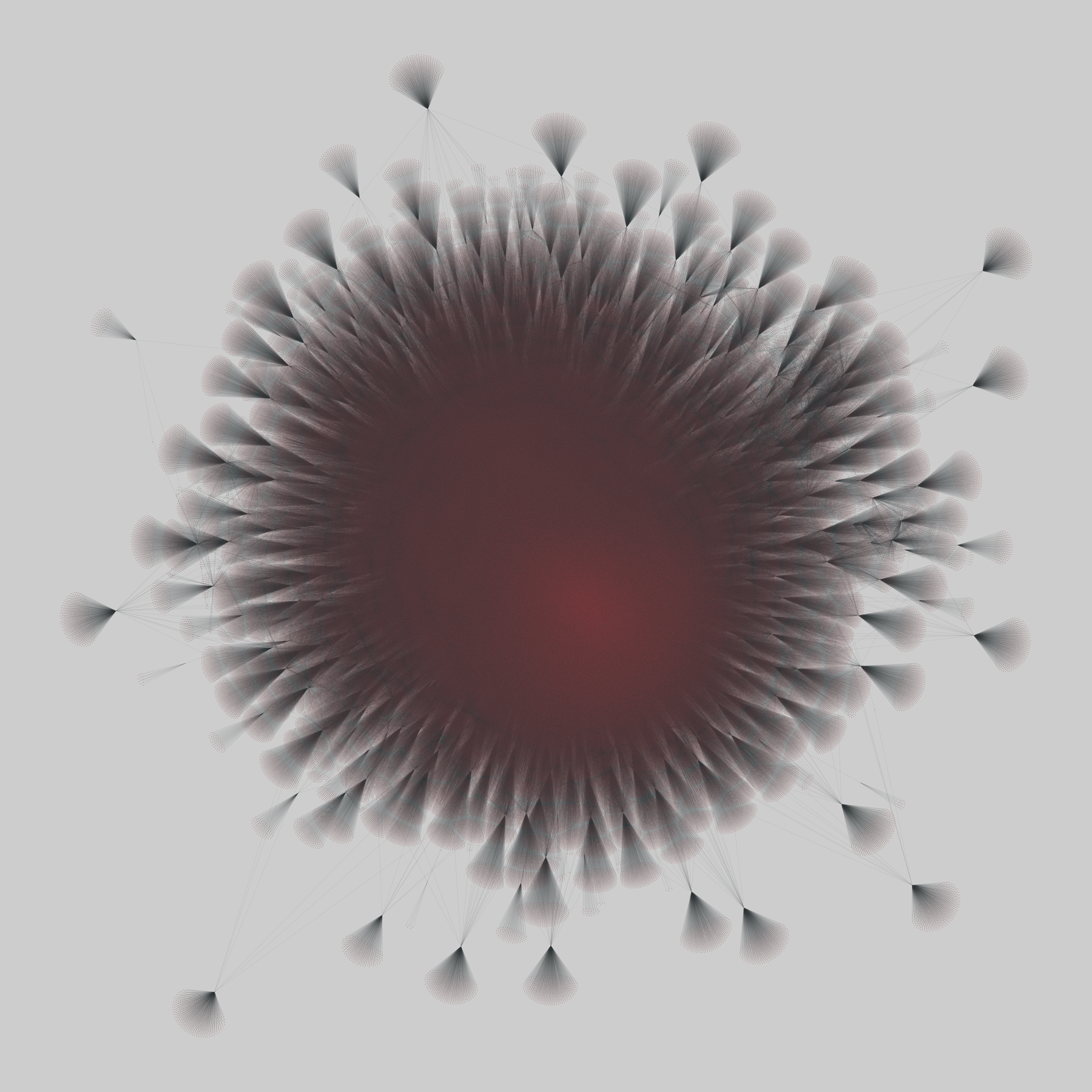
twitter: Twitter followers (2010)
A directed network of following relationships from Twitter, from a snowball sample crawl across "quality" users in 2009. A directed edge (i, j) indicates that user i follows user j.
This network has 465017 nodes and 834797 edges.
Tags: Social, Online, Unweighted
network…

twitter: Twitter followers (2010). 465017 nodes, 834797 edges. https://networks.skewed.de/net/twitter
@azonenberg@ioc.exchange
2026-03-24 10:32:31

This projector does not photograph well at all.
But should be a fun talk

Projector screen showing a title slide for a talk titled "precision sample preparation of advanced packages using atmospheric microwave induced plasma"
@arXiv_physicschemph_bot@mastoxiv.page
2026-03-26 08:20:02

Orientation Reconstruction of Proteins using Coulomb Explosions
Tomas Andr\'e, Alfredo Bellisario, Nicusor Timneanu, Carl Caleman
arxiv.org/abs/2603.24553 arxiv.org/pdf/2603.24553 arxiv.org/html/2603.24553
arXiv:2603.24553v1 Announce Type: new
Abstract: We solve the orientation recovery of a tumbling protein in the gas phase from single-event measurements of the spatial positions of its ions after an X-ray laser induced explosion. We simulate diffracted X-ray signal and ion dynamics under experimental conditions and compare our method to conventional orientation recovery in single-particle imaging with X-ray free-electron lasers using only diffraction data. We reconstruct 3D diffraction intensities using orientations recovered from the ion signatures and retrieve the electron density with established phase-retrieval algorithms. We test our orientation recovery procedure on 56 proteins ranging from 14 to 52 kDa (1800 to 6500 atoms), achieving roughly an angular error of around 5{\deg}. The resulting 3D electron-density reconstructions are compared to ground-truth volumes simulated at the same nominal resolution, and achieve the resolution at the edge of the detector in conditions similar to current single-particle imaging setups. We investigate the reconstruction quality and demonstrate that ion data can be used for reliable orientation recovery of particles in single-particle imaging, achieving orientation on par or better than currently used recovery techniques. This work shows the potential of ion detection for retrieving additional information from the sample fragmentation, and boost single particle imaging with X-ray lasers in the cases where the diffraction signal is a limiting factor.
toXiv_bot_toot

@cosmos4u@scicomm.xyz
2026-01-07 02:16:01

RE: flipboard.com/@spacecom/space.
More in aaas.org/news/fy-2026-rd-appro, scicomm.xyz/@AkaSci@fosstodon., leonarddavid.com/mars-sample-r and eos.org/research-and-developme

@arXiv_csLG_bot@mastoxiv.page
2026-02-25 10:38:41

On the Generalization Behavior of Deep Residual Networks From a Dynamical System Perspective
Jinshu Huang, Mingfei Sun, Chunlin Wu
arxiv.org/abs/2602.20921 arxiv.org/pdf/2602.20921 arxiv.org/html/2602.20921
arXiv:2602.20921v1 Announce Type: new
Abstract: Deep neural networks (DNNs) have significantly advanced machine learning, with model depth playing a central role in their successes. The dynamical system modeling approach has recently emerged as a powerful framework, offering new mathematical insights into the structure and learning behavior of DNNs. In this work, we establish generalization error bounds for both discrete- and continuous-time residual networks (ResNets) by combining Rademacher complexity, flow maps of dynamical systems, and the convergence behavior of ResNets in the deep-layer limit. The resulting bounds are of order $O(1/\sqrt{S})$ with respect to the number of training samples $S$, and include a structure-dependent negative term, yielding depth-uniform and asymptotic generalization bounds under milder assumptions. These findings provide a unified understanding of generalization across both discrete- and continuous-time ResNets, helping to close the gap in both the order of sample complexity and assumptions between the discrete- and continuous-time settings.
toXiv_bot_toot

@doktrock@toad.social
2026-03-05 22:37:59

Just back from a demo of the XPS! #Chemistry

A floor standing instrument labeled Thermo Scientific and K-Alpha. Part of it is a sizable stainless steel vacuum chamber in which the sample is irradiated w X-rays, and the energies of ejected electrons are measured.
@arXiv_qfinPM_bot@mastoxiv.page
2026-02-12 11:25:09

Crosslisted article(s) found for q-fin.PM. arxiv.org/list/q-fin.PM/new
[1/1]:
- A novel approach to trading strategy parameter optimization using double out-of-sample data and w...
Tomasz Mroziewicz, Robert \'Slepaczuk

@arXiv_csLG_bot@mastoxiv.page
2026-02-25 10:35:11

High-Dimensional Robust Mean Estimation with Untrusted Batches
Maryam Aliakbarpour, Vladimir Braverman, Yuhan Liu, Junze Yin
arxiv.org/abs/2602.20698 arxiv.org/pdf/2602.20698 arxiv.org/html/2602.20698
arXiv:2602.20698v1 Announce Type: new
Abstract: We study high-dimensional mean estimation in a collaborative setting where data is contributed by $N$ users in batches of size $n$. In this environment, a learner seeks to recover the mean $\mu$ of a true distribution $P$ from a collection of sources that are both statistically heterogeneous and potentially malicious. We formalize this challenge through a double corruption landscape: an $\varepsilon$-fraction of users are entirely adversarial, while the remaining ``good'' users provide data from distributions that are related to $P$, but deviate by a proximity parameter $\alpha$.
Unlike existing work on the untrusted batch model, which typically measures this deviation via total variation distance in discrete settings, we address the continuous, high-dimensional regime under two natural variants for deviation: (1) good batches are drawn from distributions with a mean-shift of $\sqrt{\alpha}$, or (2) an $\alpha$-fraction of samples within each good batch are adversarially corrupted. In particular, the second model presents significant new challenges: in high dimensions, unlike discrete settings, even a small fraction of sample-level corruption can shift empirical means and covariances arbitrarily.
We provide two Sum-of-Squares (SoS) based algorithms to navigate this tiered corruption. Our algorithms achieve the minimax-optimal error rate $O(\sqrt{\varepsilon/n} \sqrt{d/nN} \sqrt{\alpha})$, demonstrating that while heterogeneity $\alpha$ represents an inherent statistical difficulty, the influence of adversarial users is suppressed by a factor of $1/\sqrt{n}$ due to the internal averaging afforded by the batch structure.
toXiv_bot_toot

@netzschleuder@social.skewed.de
2026-01-10 14:00:19

twitter: Twitter followers (2010)
A directed network of following relationships from Twitter, from a snowball sample crawl across "quality" users in 2009. A directed edge (i, j) indicates that user i follows user j.
This network has 465017 nodes and 834797 edges.
Tags: Social, Online, Unweighted
network…

twitter: Twitter followers (2010). 465017 nodes, 834797 edges. https://networks.skewed.de/net/twitter
@arXiv_physicsinsdet_bot@mastoxiv.page
2026-02-09 08:13:08

Millimeter-scale rigid diamond probe for high sensitivity endoscopic-magnetometry applications
Jihongbo Shen, Heng Yuan, Hongyu Tao, Zekun Niu, Haoming Xu, Chentao Zhang, Chen Su, Zhuo Wang, Chen Zhang
arxiv.org/abs/2602.06077 arxiv.org/pdf/2602.06077 arxiv.org/html/2602.06077
arXiv:2602.06077v1 Announce Type: new
Abstract: Magnetometry based on diamond nitrogen-vacancy (NV) centers has been extensively studied for applications requiring diverse capabilities, spanning from nanometer spatial resolution to subpicotesla sensitivity. Among various applications, diamond magnetometers can demonstrate high sensitivity magnetic sensing within millimeter-scale size for endoscopic applications. However, the trade-off between sensitivity and spatial resolution of diamond magnetometry makes it difficult to achieve such a probe. In this study, we present a millimeter-scale rigid diamond magnetometer probe with enhanced sensitivity via optimizing the optical design. By coupling the frustum diamond with the miniaturized compound parabolic concentrator (CPC) lens, we enhance the fluorescence collection efficiency by 37% within 4 mm diameter, and the achieved sensitivity is 200 pT/Hz1/2 based on the sample with the resonance linewidth of ~8 MHz. With this verified structure, endoscopes with mm-size probe and picotesla sensitivity can be projected for surgical and industrial applications in the future.
toXiv_bot_toot

@arXiv_csLG_bot@mastoxiv.page
2026-02-25 10:35:21

WeirNet: A Large-Scale 3D CFD Benchmark for Geometric Surrogate Modeling of Piano Key Weirs
Lisa L\"uddecke, Michael Hohmann, Sebastian Eilermann, Jan Tillmann-Mumm, Pezhman Pourabdollah, Mario Oertel, Oliver Niggemann
arxiv.org/abs/2602.20714 arxiv.org/pdf/2602.20714 arxiv.org/html/2602.20714
arXiv:2602.20714v1 Announce Type: new
Abstract: Reliable prediction of hydraulic performance is challenging for Piano Key Weir (PKW) design because discharge capacity depends on three-dimensional geometry and operating conditions. Surrogate models can accelerate hydraulic-structure design, but progress is limited by scarce large, well-documented datasets that jointly capture geometric variation, operating conditions, and functional performance. This study presents WeirNet, a large 3D CFD benchmark dataset for geometric surrogate modeling of PKWs. WeirNet contains 3,794 parametric, feasibility-constrained rectangular and trapezoidal PKW geometries, each scheduled at 19 discharge conditions using a consistent free-surface OpenFOAM workflow, resulting in 71,387 completed simulations that form the benchmark and with complete discharge coefficient labels. The dataset is released as multiple modalities compact parametric descriptors, watertight surface meshes and high-resolution point clouds together with standardized tasks and in-distribution and out-of-distribution splits. Representative surrogate families are benchmarked for discharge coefficient prediction. Tree-based regressors on parametric descriptors achieve the best overall accuracy, while point- and mesh-based models remain competitive and offer parameterization-agnostic inference. All surrogates evaluate in milliseconds per sample, providing orders-of-magnitude speedups over CFD runtimes. Out-of-distribution results identify geometry shift as the dominant failure mode compared to unseen discharge values, and data-efficiency experiments show diminishing returns beyond roughly 60% of the training data. By publicly releasing the dataset together with simulation setups and evaluation pipelines, WeirNet establishes a reproducible framework for data-driven hydraulic modeling and enables faster exploration of PKW designs during the early stages of hydraulic planning.
toXiv_bot_toot

@azonenberg@ioc.exchange
2026-03-04 07:12:28

Ok fedi, you're full of game devs and weird microarchitecture experts and generally the right kind of people to ask...
I'm thinking about a generic data representation for multi-bit vectors in ngscopeclient.
Right now we support single-bit digital signals (one byte aka C bool per sample), analog signals (one float32 per sample), and arbitrary struct/class types (for protocol decoder output).
Notably missing is multi-bit digital vectors. There is some legacy code i…

@netzschleuder@social.skewed.de
2026-02-07 08:00:21

twitter: Twitter followers (2010)
A directed network of following relationships from Twitter, from a snowball sample crawl across "quality" users in 2009. A directed edge (i, j) indicates that user i follows user j.
This network has 465017 nodes and 834797 edges.
Tags: Social, Online, Unweighted
network…

twitter: Twitter followers (2010). 465017 nodes, 834797 edges. https://networks.skewed.de/net/twitter
@netzschleuder@social.skewed.de
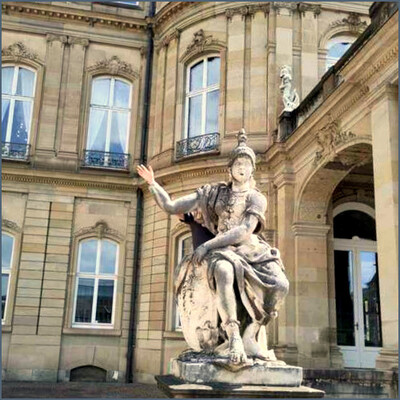
2026-01-03 08:00:21

twitter: Twitter followers (2010)
A directed network of following relationships from Twitter, from a snowball sample crawl across "quality" users in 2009. A directed edge (i, j) indicates that user i follows user j.
This network has 465017 nodes and 834797 edges.
Tags: Social, Online, Unweighted
network…

twitter: Twitter followers (2010). 465017 nodes, 834797 edges. https://networks.skewed.de/net/twitter
@azonenberg@ioc.exchange
2026-01-07 11:17:20

Math people: If I have a bunch of sampled data that I've found a local maximum on, and I want to interpolate the peak location to sub-sample precision, what's a good way to do that?
I know how to interpolate a zero crossing linearly but this is a bit more complex, I feel like I'll probably want to fit a sinc or gaussian or something to the data somehow?

@arXiv_physicsinsdet_bot@mastoxiv.page
2026-02-03 09:09:47

Gamma Imagers for Nuclear Security and Nuclear Forensics: Recommendations based on results from a side-by-side intercomparison
L. E. Sinclair, P. R. B. Saull, A. McCann, A. M. L. MacLeod, N. J. Murtha, A. El-Jaby, G. Jonkmans
arxiv.org/abs/2602.00826 arxiv.org/pdf/2602.00826 arxiv.org/html/2602.00826
arXiv:2602.00826v1 Announce Type: new
Abstract: Nuclear security operations and forensic investigations require the utilization of a suite of instruments ranging from passive gamma spectrometers to high-precision laboratory sample analyzers. Gamma spectroscopy survey is further broken down into wide-area search performed with large-volume scintillator-based mobile survey spectrometers which are integrated with geographic position sensors for mapping and identification of hot zones, and high-precision long-dwell measurements using solid state spectrometers for follow-on characterization to establish isotopic content and ratios. While performing well at detecting the presence, quantity and type of radioactivity, all of these methods have limited ability to determine the location of a source of radioactivity. In recent years, technology advances have resulted in gamma imager devices which can create an image of the distribution of radioactive sources using the gamma emissions which accompany radioactive decay, and overlay this on an optical photograph of the environment. These gamma imaging devices have arisen out of methods developed for medical physics, experimental particle physics, and astrophysics, resulting in a proliferation of different technological approaches. Those responsible for establishing a nuclear security concept of operations, require guidance to choose the proper gamma imager for each of the application spaces in a tiered response. Here the results of an intercomparison of two gamma imagers based on two widely different technologies, semiconductor and scintillator detectors, are presented. The optimal utilization of these imaging technologies in a tiered response is discussed based on the results of the trial. Finally, an outlook on future directions for gamma imaging advances is provided.
toXiv_bot_toot

@azonenberg@ioc.exchange
2026-02-05 03:01:19

Fine tuning the Lego spectrometer more.
Using a maglite as the source eliminates the need for a separate collimating lens.
I also switched away from the very flaky variable slit made of a sliding brick that wouldn't stay in place if you looked at it wrong.
After some failed experiments with aluminum foil, I discovered that the round tree trunk Duplo brick was a tiny bit smaller than a nominal square 2x2 brick. When placed next to a square brick and locked in place with …

Overview of the new spectrometer setup: a mag lite sits in the groove between two studs with bricks on either side to keep it from rolling, then has a single stud gap before the slit for inserting the sample into
Closeup of the slit assembly showing the very small gap
@netzschleuder@social.skewed.de
2026-03-14 11:00:21

twitter: Twitter followers (2010)
A directed network of following relationships from Twitter, from a snowball sample crawl across "quality" users in 2009. A directed edge (i, j) indicates that user i follows user j.
This network has 465017 nodes and 834797 edges.
Tags: Social, Online, Unweighted
network…

twitter: Twitter followers (2010). 465017 nodes, 834797 edges. https://networks.skewed.de/net/twitter
@azonenberg@ioc.exchange
2026-02-03 02:45:57

Introducing the kiddo to optical spectroscopy

Crude spectrometer made from mega bloks as a slit, a handheld flashlight, and a prism sitting on a book
A different version of the spectrometer made from legos with a colored translucent plastic toy in the sample slot
Top down view showing the light path
@azonenberg@ioc.exchange
2026-01-04 08:34:12

So, tonight's goal is to continue with ngscopeclient performance work.
I started out by doubling the speed of the eye pattern *again* by moving index buffer calculation from CPU to GPU.
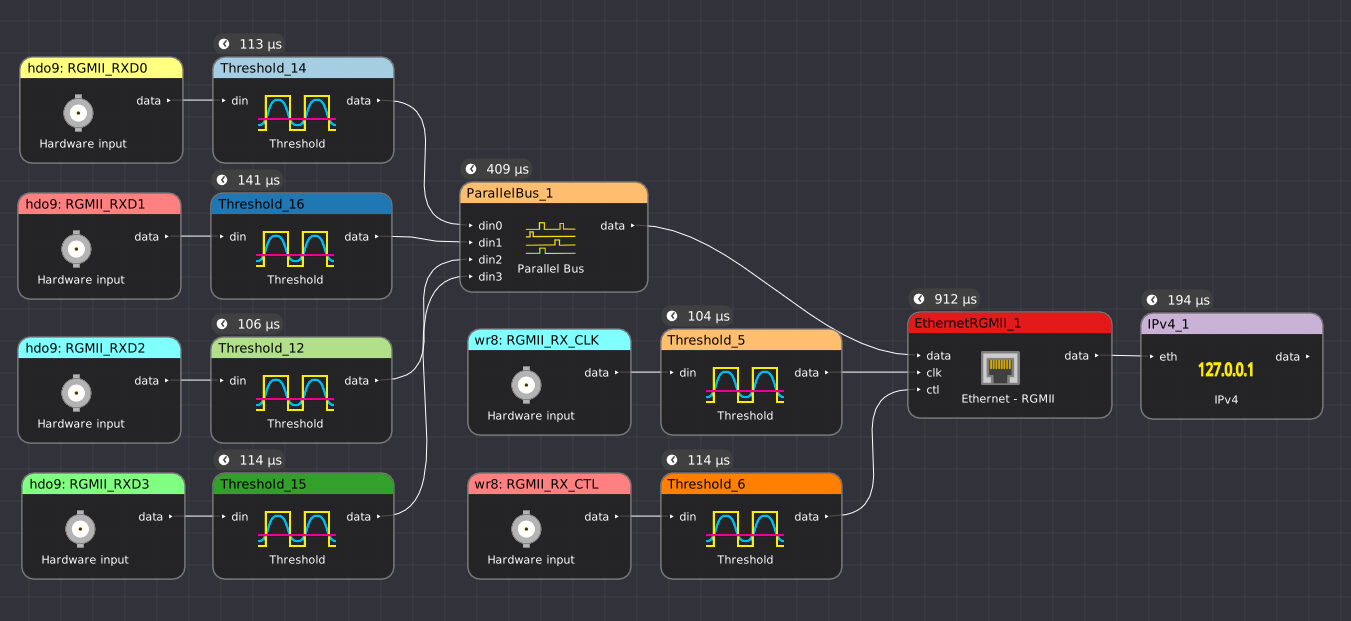
Next up is going to be getting the 100baseTX decoder to not be so slow. Right now of the 43 seconds of CPU time in the current 1-minute benchmark, 26.9 is spent sampling the MLT-3 waveform on rising edges of the recovered clock.
The thing is, we already *know* the sample values at the re…

VTune screenshot of a filter graph where most of the time is spent in Filter
ngscopeclient screenshot of a filter graph for decoding 100baseTX ethernet
ngscopeclient screenshot showing decodes of 100baseTX ethernet
@arXiv_physicsinsdet_bot@mastoxiv.page
2026-02-03 08:51:39

Inter-detector differential fuzz testing for tamper detection in gamma spectrometers
Pei Yao Li, Jayson R. Vavrek, Sean Peisert
arxiv.org/abs/2602.00336 arxiv.org/pdf/2602.00336 arxiv.org/html/2602.00336
arXiv:2602.00336v1 Announce Type: new
Abstract: We extend physical differential fuzz testing as an anti-tamper method for radiation detectors [Vavrek et al., Science and Global Security 2025] to comparisons across multiple detector units. The method was previously introduced as a tamper detection method for authenticating a single radiation detector in nuclear safeguards and treaty verification scenarios, and works by randomly sampling detector configuration parameters to produce a sequence of spectra that form a baseline signature of an untampered system. At a later date, after potential tampering, the same random sequence of parameters is used to generate another series of spectra that can be compared against the baseline. Anomalies in the series of comparisons indicate changes in detector behavior, which may be due to tampering. One limitation of this original method is that once the detector has `gone downrange' and may have been tampered with, the original baseline is fixed, and a new trusted baseline can never be established if tests at new parameters are required. In this work, we extend our anti-tamper fuzz testing concept to multiple detector units, such that the downrange detector can be compared against a trusted or `golden copy' detector, even despite normal inter-detector manufacturing variations. We show using three NaI detectors that this inter-detector differential fuzz testing can detect a representative attack, even when the tested and golden copy detectors are from different manufacturers and have different performances. Here, detecting tampering requires visualizing the comparison metric vs. the parameter values and not just the sample number; moreover this baseline is non-linear and may require anomaly detection methods more complex than a simple threshold. Overall, this extension to multiple detectors improves prospects for operationalizing the technique in real-world treaty verification and safeguards contexts.
toXiv_bot_toot