 @hex@kolektiva.social
2025-11-17 08:52:05
The implications are interesting enough when we apply this to systems like capitalism or national governments, but there are other very interesting implications when applied to systems like race or gender.
Like, as a cis man the only way I can be free to express and explore my own masculinity is if the masculinity I participate in is one which allows anyone the freedom to leave. Then I have an obligation to recognize the validity of nom-masculine trans identity as a necessary component of my own. If I fail to do this, then I trap myself in masculinity and allow the system to control me rather than me to be a free participant in the system.
But if it's OK to escape but not enter, that's it's own restriction that constrains the freedom to leave. It creates a barrier that keeps people in by the fear that they cannot return. So in order for me to be free in my cis masculine identity, I must accept non-masculine trans identities as they are and accept detransitioning as also valid.
But I also need to accept trans-masc identities because restricting entry to my masculinity means non-consensually constraining other identities. If every group imposes an exclusion against others coming in, that, by default, makes it impossible to leave every other group. This is just a description of how national borders work to trap people within systems, even if a nation itself allows people to "freely" leave.
So then, a free masculinity is one which recognizes all configurations of trans identities as valid and welcomes, if not celebrates, people who transition as affirmations of the freedom of their own identity (even for those who never feel a reason to exercise that same freedom).
The most irritating type of white person may look at this and say, "oh, so then why can't I be <not white>?" Except that the critique of transratial identities has never been "that's not allowed" and has always been "this person didn't do the work." If that person did the work, they would understand that the question doesn't make sense based on how race is constructed. That person might understand that race, especially whiteness, is more fluid than they at first understood. They might realize that whiteness is often chosen at the exclusion of other racialized identities. They would, perhaps, realize that to actually align with any racialized identity, they would first have to understand the boot of whiteness on their neck, have to recognize the need to destroy this oppressive identity for their own future liberation. The best, perhaps only, way to do this would be to use the privilege afforded by that identity to destroy it, and in doing so would either destroy their own privilege or destroy the system of privilege. The must either become themselves completely ratialized or destroy the system of race itself such being "transracial" wouldn't really make sense anymore.
But that most annoying of white person would, of course, not do any such work. Nevertheless, one hopes that they may recognize the paradox that they are trapped by their white identity, forced forever by it to do the work of maintaining it. And such is true for all privileged identities, where privilege is only maintained through restrictions where these restrictions ultimately become walls that imprison both the privileged and the marginalized in a mutually reinforcing hell that can only be escaped by destroying the system of privilege itself.
 @mariyadelano@hachyderm.io
2025-10-16 21:51:13
2/2 Reflection on #citizenship:
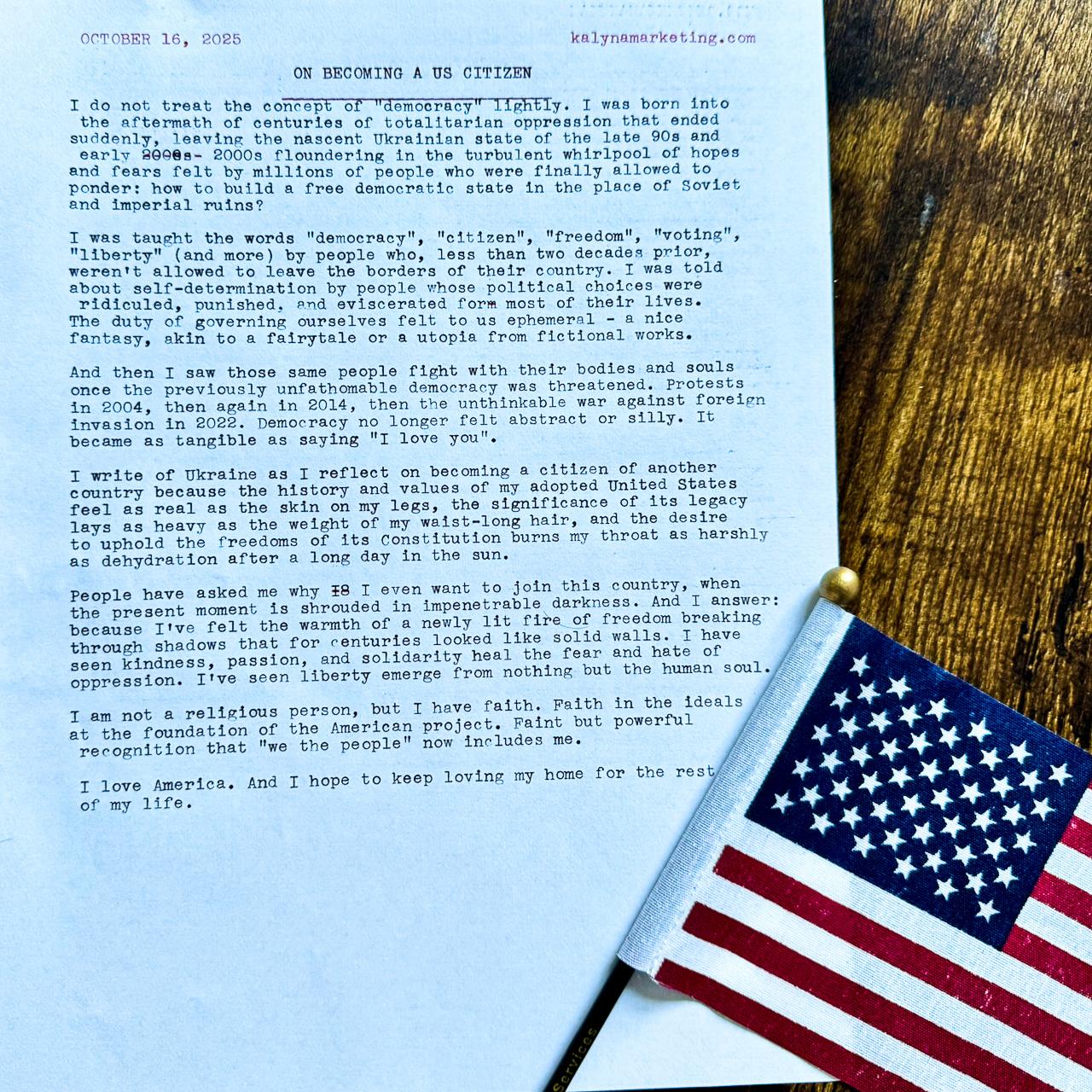
I do not treat the concept of “#democracy" lightly. I was born into the aftermath of centuries of totalitarian oppression that ended suddenly, leaving the nascent Ukrainian state of the late 90s and early 2000s floundering in the turbulent whirlpool of hopes and fears felt by millions of people who were finally allowed to ponder: how to build a free democratic state in the place of Soviet and imperial ruins?
I was taught the words "democracy", "citizen", "freedom", "voting", “liberty" (and more) by people who, less than two decades prior, weren't allowed to leave the borders of their country. I was told about self-determination by people whose political choices were ridiculed, punished, and eviscerated form most of their lives. The duty of governing ourselves felt to us ephemeral - a nice fantasy, akin to a fairytale or a utopia from fictional works.
And then I saw those same people fight with their bodies and souls once the previously unfathomable democracy was threatened. Protests in 2004, then again in 2014, then the unthinkable war against foreign invasion in 2022. Democracy no longer felt abstract or silly. It became as tangible as saying "I love you".
I write of Ukraine as I reflect on becoming a citizen of another country because the history and values of my adopted United States feel as real as the skin on my legs, the significance of its legacy lays as heavy as the weight of my waist-long hair, and the desire to uphold the freedoms of its Constitution burns my throat as harshly as dehydration after a long day in the sun.
People have asked me why I even want to join this country, when the present moment is shrouded in impenetrable darkness. And I answer: because I've felt the warmth of a newly lit fire of freedom breaking through shadows that for centuries looked like solid walls. I have seen kindness, and solidarity heal the fear and hate of oppression. I've seen liberty emerge from nothing but the human soul.
I am not a religious person, but I have faith. Faith in the ideals at the foundation of the American project. Faint but powerful recognition that "we the people" now includes me.
I love #America. And I hope to keep loving my home for the rest of my life.
 @thomasfuchs@hachyderm.io
2025-11-16 19:10:58
PSA about food labeling in the US
We have a gluten detection service dog because many things that should be gluten free/say they’re gluten free are not actually gluten free.
Stuff gets contaminated when growing (e.g. next to wheat field), by shared equipment, in factories, from packaging, during transport and in-store.
Every US consumer should know:
1. The list of ingredients on food isn't exhaustive
2. Allergen labeling:
a) limited to just some allergens
b) manufacturers don't actually have to test
c) "certified" foods are tested—but not continuously
d) testing only works with enough contamination
Some certifications may require batch-testing, but usually they don't.
A "certified gluten free" product may e.g. contain oats which sometimes are contaminated with gluten—but as not every batch is tested it's impossible to know unless you test yourself (hence the service dog).
Even if the product is properly batch-tested, you might get a part of the product that has the allergen in it, whereas the tested part didn't.
Or the threshold was too low (our dog can detect gluten better than any available lab testing equipment; yes, dogs are amazing).
Food products also contain ingredients that do not have to be included on the label when they're "incidental" (included in an another ingredient) or if they're considered part of the manufacturing process but not of the final product (e.g. various coatings on factory equipment).
Don't need to list flavors or specific spices either. ¯\_(ツ)_/¯
As for allergens, only those responsible for ~90% of food allergies* have to be specifically declared, and they're not tested for as it's simply based on the ingredients list.
Good luck if you have other allergies.
*milk, egg, egg, fish, Crustacean shellfish, tree nuts, wheat, peanuts, soybeans
@hex@kolektiva.social2025-10-16 08:24:42
Actually, I do want to come back to masculinity under patriarchy and whiteness under white supremacy because I think it's worth talking more about. The "man" under patriarchy (at least "Western" patriarchy) is represented as power and independence. The man needs nothing and thus owes nothing to anyone. The man controls and is not controlled, which is intimately related to independence as dependence can make someone vulnerable to control. The image of "man" projects power and invulnerability. At the same time "man" is a bumbling fool who can't be held accountable for his inability to control his sexual urges. He must be fed and cared for, as though another child. His worst behaviors must be dismissed with phrases such as "boys will be boys" and "locker room talk." The absurdity of the concept of human "independence" is impossible to understate.
Even if you go all Ted Kaczynski, you have still been raised and taught. This is, perhaps, why it is so much more useful to think in terms of obligations than rights. Rights can be claimed and protected with violence alone, but obligations reveal the true interdependence that sustains us. A "man" may assert his rights. Yet, on some level, we all know that the "man" of patriarchy acts as a child who is not mature enough to recognize his obligations.
White violence and white fragility reflect the same dichotomy. "The master race" somehow always needs brown folks to make all their shit and do all the reproductive labor for them. For those who fully embrace whiteness, the "safe space" is a joke. DEI shows weakness. Yet, when presented with an honest history adults become children who are incapable of differentiating between criticism and simple facts. *They* become the ones who must be kept safe. The expectation to be responsible for one's own words and actions, one of the very core definitions of being an adult, is far too much to expect. Their guilt needs room, needs tending, needs caring. White people cannot simply "grow the fuck up" or, as they may say of slavery, "fucking get over it."
And again, interestingly, it is *rights* that they reference: "Mah Freeze PEACH!" I find it hard to distinguish between such and my own child's assertion that anything she doesn't like is "not fair!" No, these assertions fail to recognize the fundamental fabric of adult society: the obligations we hold to each other.
At the intersection of all privilege is the sovereign, the ultimate god-man-baby. Again, referencing the essay (https://hexmhell.writeas.com/observations-on-domination-and-trump)
> This is where it becomes important to consider the ideology behind the sovereign ritual. Participation within the sovereign ritual denotes to the participants elements of the sovereign. That is, all agents of the sovereign are, essentially, micro dictators. By carrying out the will of the sovereign, these micro dictators can, by extension, act outside of the law.
While law enforcement is the ultimate representative of sovereign violence, privileges allow a gradated approximation of the sovereign. Those who are "closer" in privilege to the sovereign may, for example, be permitted to carry out violence against those who are father away. The gradation of privilege turns the whole society, except for the least privileged, into a cult that protects the privilege system on behalf of the most privileged. (And immediately Malcolm X pops to mind as having already talked about part of this relationship in 1963 https://www.youtube.com/watch?v=jf7rsCAfQCo.)
 @aral@mastodon.ar.al
2025-11-17 17:56:12
On the fediverse, as we live through the ongoing Israeli genocide of the Palestinian people, there are those who oppose the genocide and are trying to help the victims and there are those who deny the genocide, try to erase the victims, and attempt to vilify the ones trying to help.
If you’re neutral, you’ve chosen the side of the latter.
If you give genocide deniers sanctuary on your servers, you’re telling genocide victims that they are not safe on your server.
This isn’t…
@hex@kolektiva.social2025-11-17 09:26:08
And you don't need to accept the trap of authoritarian masculinity on logic alone, the proof is right there in male influencers like Andrew Tate and their followers. These dipshits get so obsessed with gatekeeping they don't realize that the gates they're tending keep them in, that the more walls they put up to protect their privilege, the smaller their identity can be. They huddle in tiny pens, terrified of crossing imaginary bounds that they imposed *on themselves.*
They have built their own torture chambers and locked themselves inside, and for what? They turn themselves into dragons, hoarding what they see as valuable while repressing every emotion including joy. And if they let themselves experience joy, they would, perhaps, realize that all these privileges are inconsistent with it. They might, perhaps, recognize that they have built up these privileges so they don't have to admit that their suffering and fear are not, in fact, admirable. They might have to face the fact that they have lived lives that are deeply pathetic, might have to face the fact that only empathy can give one access to deep satisfaction, might have to face the fact that they have lived their whole lives on a treadmill, going nowhere.
But I assume that they won't ever do that, because to do so would force them to face the enormity of the emotional debt, the pain and suffering they have inflicted on the world, and those are big feelings. It's far easier to hide in a hole, forever alone, making up silly rules to keep everyone inside scared and keep everyone outside from seeing in.
@hex@kolektiva.social2025-11-17 06:11:16
I think we can actually prove that this constraint is the *only* constraint that can preserve freedom:
1. There will exist actors in a system who will wish to take advantage of others. Evolution drives survival and one strategy for increasing survival in an altruistic society is to become a parasite.
2. Expecting exploitative dynamics, a system needs to have a set of rules to manage exploitation.
3. If the set of rules is static it will lack the requisite variety necessary to manage the infinite possible behavior of humans so the system will fail.
4. If the system is dynamic then it must have a rule set about how it's own rules are updated. This would make the system recursive, which makes the system at least as complex as mathematics. Any system at least as complex as mathematics is necessarily either incomplete or inconsistent (Gödel's incompleteness theorem). If the system is incomplete, then constraints can be evaded which then allow a malicious agent to seize control of the system and update the rules for their own benefit. If constraints are incomplete, then a malicious agent can take advantage of others within the system.
5. Therefore, no social system can possibly protect freedom unless there exists a single metasystemic constraint (that the system must be optional) allowing for the system to be abandoned when compromised.
Oh, you might say, but this just means you have to infinitely abandon systems. Sure, but there's an evolutionary advantage to cooperation so there's evolutionary pressure to *not* be a malicious actor. So a malicious actor being able to compromise the whole system is likely to be a much more rare event. Compromising a system is a lot of work, so the first thing a malicious actor would want to do is preserve that work. They would want to lock you in. The most important objective to a malicious actor compromising a system would be to violate that metasystemic constraint, or all of their work goes out the window when everyone leaves.
And now you understand why borders exist, why fascists are obsessed with maintaining categories like gender, race, ethnicity, etc. This is why even Democrats like Newsom are on board with putting houseless people in concentration camps. And this is why the most important thing anarchists promote is the ability to choose not to be part of any of that.
@hex@kolektiva.social2025-12-16 17:09:35
One of the things that made organizing a lot easier with the GDC was a thing called "GDC in a box." It was a zip file with all kinds of resources. There was a directory structure, templates for all kinds of things like meetings and paperwork you had to file (for legal reasons) and "read me" files.
We had all kinds of support. There were people you could talk to who had been there. There were people you could call to walk through legal paperwork (taxes). Centralized orgs are vulnerable and easy to infiltrate. They're easy for states to shut down. But there are benefits to org structures.
I think it's possible to have the type of support we had with the GDC, but without the politics of an org (even the IWW). I hope this most recent essay has some of the same properties. I hope that it makes building something new, something no one has really imagined before, easier.
This whole project is something a bit different. It's a collective vision and collective project, from the ground up. Some of it has felt like a brain dump, just getting things that have been swimming around in my head down somewhere. But I hope this feels more like an invitation.
Everything thus far written is all useless unless people do things with it. Only from that point does it become a thing that lives, a thing with its own consciousness that can't be controlled by any individual human.
Tech billionaire cultists want to bring a new era of humanity with AGI. That is definitely not possible with LLMs, and may not be possible at all. But there is a super intelligence that is possible, though it's been constrained by capitalism: collective human intelligence.
The grand vision of the tech dystopians is that of the ultimate slave that can then enslave all humans on their behalf. I think we can build a humanity that can liberate itself from their grasp, crush their vision, and build for itself a world in which people will never be enslaved again. Not only do I think it's possible, I think it's necessary. I think there are only two choices: collective liberation or death.
And that's what I plan to write about next time to wrap this whole project up. Today things often feel impossible. But people talked about the Middle Ages as though they were the end of the world, and then everything changed in unimaginable ways. Everything can, and will, change again.
"The profit motive often is in conflict with the aims of art. We live in capitalism. Its power seems inescapable. So did the divine right of kings."
@hex@kolektiva.social2025-11-16 07:08:26
There's a word at the beginning and end of Dawn of Everything that feels self-referential right now: Kairos.
> We began this book with a quote which refers to the Greek notion of kairos as one of those occasional moments in a society’s history when its frames of reference undergo a shift – a metamorphosis of the fundamental principles and symbols, when the lines between myth and history, science and magic become blurred – and, therefore, real change is possible. Philosophers sometimes like to speak of ‘the Event’ – a political revolution, a scientific discovery, an artistic masterpiece – that is, a breakthrough which reveals aspects of reality that had previously been unimaginable but, once seen, can never be unseen. If so, kairos is the kind of time in which Events are prone to happen.
> Societies around the world appear to be cascading towards such a point. This is particularly true of those which, since the First World War, have been in the habit of calling themselves ‘Western’. On the one hand, fundamental breakthroughs in the physical sciences, or even artistic expression, no longer seem to occur with anything like the regularity people came to expect in the late nineteenth and early twentieth centuries. Yet at the same time, our scientific means of understanding the past, not just our species’ past but that of our planet, has been advancing with dizzying speed. Scientists in 2020 are not (as readers of mid-twentieth-century science fiction might have hoped) encountering alien civilizations in distant star systems; but they are encountering radically different forms of society under their own feet, some forgotten and newly rediscovered, others more familiar, but now understood in entirely new ways.
Reading this as I write something very inspired by this work feels especially serendipitous, especially at this time. When they wrote the book, I think that kairos felt more serendipitous itself. But as the frequency of opportunity increases, the veil between realities feels more malleable... that perhaps we can poke a finger through and open a portal to a completely different future than the one we've felt locked into for such a long time.
https://anarchoccultism.org/building-zion/the-coordinated-swarm-lyhr
@hex@kolektiva.social2025-11-17 10:15:14
I feel as though I should illustrate the difference that this one single constraint can make by two examples.
The rules of Simon Says are maximally authoritarian. You must perform any action ordered, with the only restriction that the authority must say "Simon says" first. Were you forced to stay in this system, it would be the most despotic autocracy possible. But it's not. It's a silly game because you can leave at any time.
Let's flip this and imagine a room. During a specific period of time you will have absolute control over everything in this room. In this room you have total freedom. This is not even the limited freedom, the coordinated freedom, the compromising freedom of civil society. You could, without consequence, perform any action you wish in this room. You could say anything, destroy or steal any object, order any individual to perform any action, kill any person in the room with you and take anything they own. This is the sovereign freedom, the absolute freedom, of dictators and kings. The only restriction is that you are not allowed to leave the room while you have this freedom. In fact, you really only have this level of freedom because the room is actually empty other than for you. I am, of course, talking about a form of torture still common in the US: solitary confinement.