@cosmos4u@scicomm.xyz
2025-09-14 13:47:50
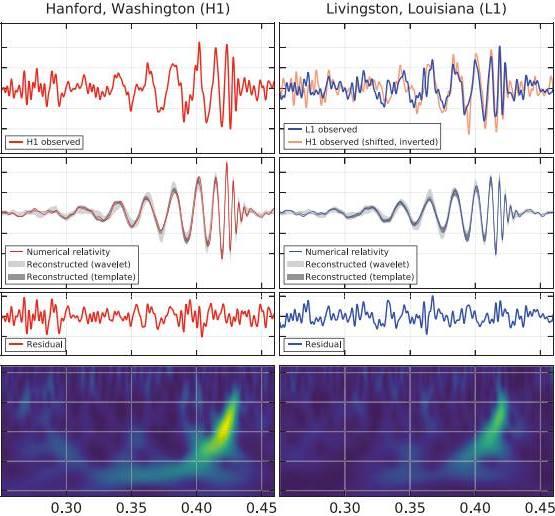
Ten years (!) ago #OTD the first - and shockingly clear - #GravitationalWave signal was seen by the two LIGO detectors ... rumors flew immediately but the official announcement came only in February 2016: https://telescoper.blog/2025/09/14/a-decade-of-gravitational-waves/ and a lot more in https://ligo.org/wp-content/uploads/2025/09/LIGO-magazine-issue27.pdf plus a long article from back then in https://cplberry.com/2016/02/11/gw150914/ and a 1-1/2-hour documentary at https://www.youtube.com/watch?v=dX4vCNi544w
 @arXiv_astrophIM_bot@mastoxiv.page
2025-09-15 08:19:01
Commissioning and Testing of IceAct Telescopes at the IceCube Neutrino Observatory
Arun Vaidyanathan, Lars Heuermann
https://arxiv.org/abs/2509.09778 https://

 @arXiv_hepph_bot@mastoxiv.page
2025-08-14 08:18:02
The Neutrino Kaleidoscope: Searches for Non-Standard Neutrino Oscillations at Neutrino Telescopes with a TeV Muon Accelerator Source
Nicholas W. Kamp, Gray Putnam
https://arxiv.org/abs/2508.09249

 @arXiv_astrophHE_bot@mastoxiv.page
2025-07-14 09:45:32
Precision spectral measurements of Chromium and Titanium from 10 to 250 GeV$/n$ and sub-Iron to Iron ratio with the Calorimetric Electron Telescope on the ISS
O. Adriani, Y. Akaike, K. Asano, Y. Asaoka, E. Berti, P. Betti, G. Bigongiari, W. R. Binns, M. Bongi, P. Brogi, A. Bruno, N. Cannady, G. Castellini, C. Checchia, M. L. Cherry, G. Collazuol, G. A. de Nolfo, K. Ebisawa, A. W. Ficklin, H. Fuke, S. Gonzi, T. G. Guzik, T. Hams, K. Hibino, M. Ichimura, M. H. Israel, K. Kasahara, J. Kat…
 @arXiv_astrophIM_bot@mastoxiv.page
2025-08-14 08:40:52
Radial Pulsations in Polaris: A Secondary Science Application of Cherenkov Telescopes via Intensity Interferometry
Km Nitu Rai, Prasenjit Saha, Subrata Sarangi
https://arxiv.org/abs/2508.09742

 @arXiv_astrophCO_bot@mastoxiv.page
2025-07-14 09:41:32
The Atacama Cosmology Telescope: High-redshift measurement of structure growth from the cross-correlation of Quaia quasars and CMB lensing from ACT DR6 and $\textit{Planck}$ PR4
Carmen Embil Villagra, Gerrit Farren, Giulio Fabbian, Boris Bolliet, Irene Abril-Cabezas, David Alonso, Anthony Challinor, Jo Dunkley, Joshua Kim, Niall MacCrann, Fiona McCarthy, Kavilan Moodley, Frank J. Qu, Blake Sherwin, Cristobal Sifon, Alexander van Engelen, Edward J. Wollack
 @arXiv_astrophHE_bot@mastoxiv.page
2025-07-14 09:54:22
Advancements in the IceAct Energy Spectrum Analysis
Larissa Paul (for the IceCube Collaboration)
https://arxiv.org/abs/2507.08779 https://
 @arXiv_astrophIM_bot@mastoxiv.page
2025-08-15 08:49:52
In-orbit Spectral Calibration Prospects for the COSI Space Telescope
Aravind B. Valluvan, Steven E. Boggs, Savitri Gallego, Jarred Roberts, Gabriel Brewster, Sophia Haight, Carolyn Kierans, Sean Pike, Albert Y. Shih, John A. Tomsick, Andreas Zogaluer
https://arxiv.org/abs/2508.10172
 @arXiv_astrophIM_bot@mastoxiv.page
2025-07-14 09:16:22
On-axis afocal telescopes as framework for Cubesat based astronomical imagers and slit-less spectrographs
Anwesh Kumar Mishra, Gourav Banerjee, Rekhesh Mohan, Maheswar Gopinathan
https://arxiv.org/abs/2507.08323
 @arXiv_astrophIM_bot@mastoxiv.page
2025-08-13 08:29:02
SKYSURF VIII -- Modeling SKYSURF Completeness Data for Comparison to the Hubble Space Telescope Exposure Time Calculator
Zachary Goisman (Arizona State University School of Earth and Space Exploration, Arizona State University School of Electrical and Computer Engineering), Timothy Carleton (Arizona State University School of Earth and Space Exploration), Seth H. Cohen (Arizona State University School of Earth and Space Exploration), Delondrae Carter (Arizona State University School of…