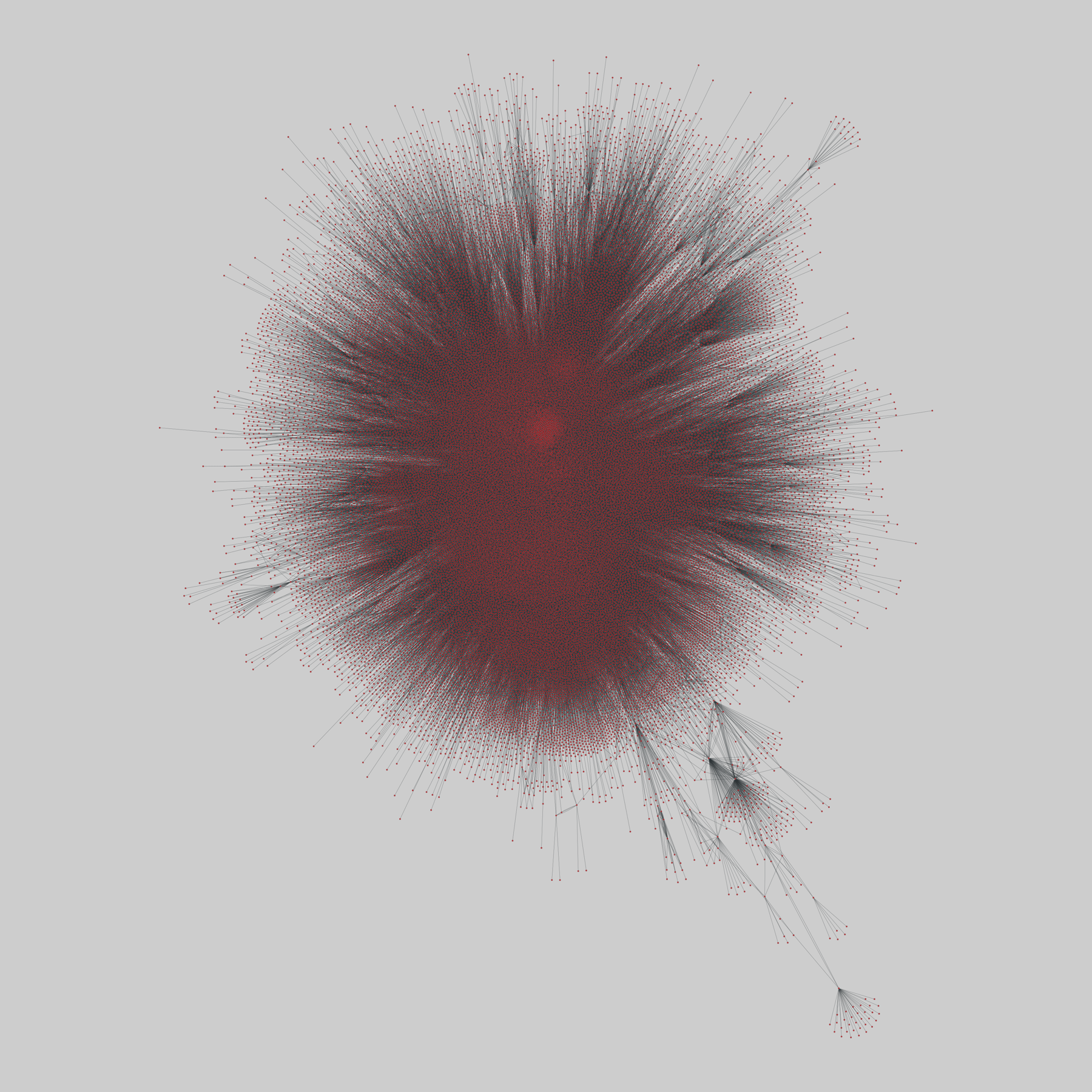
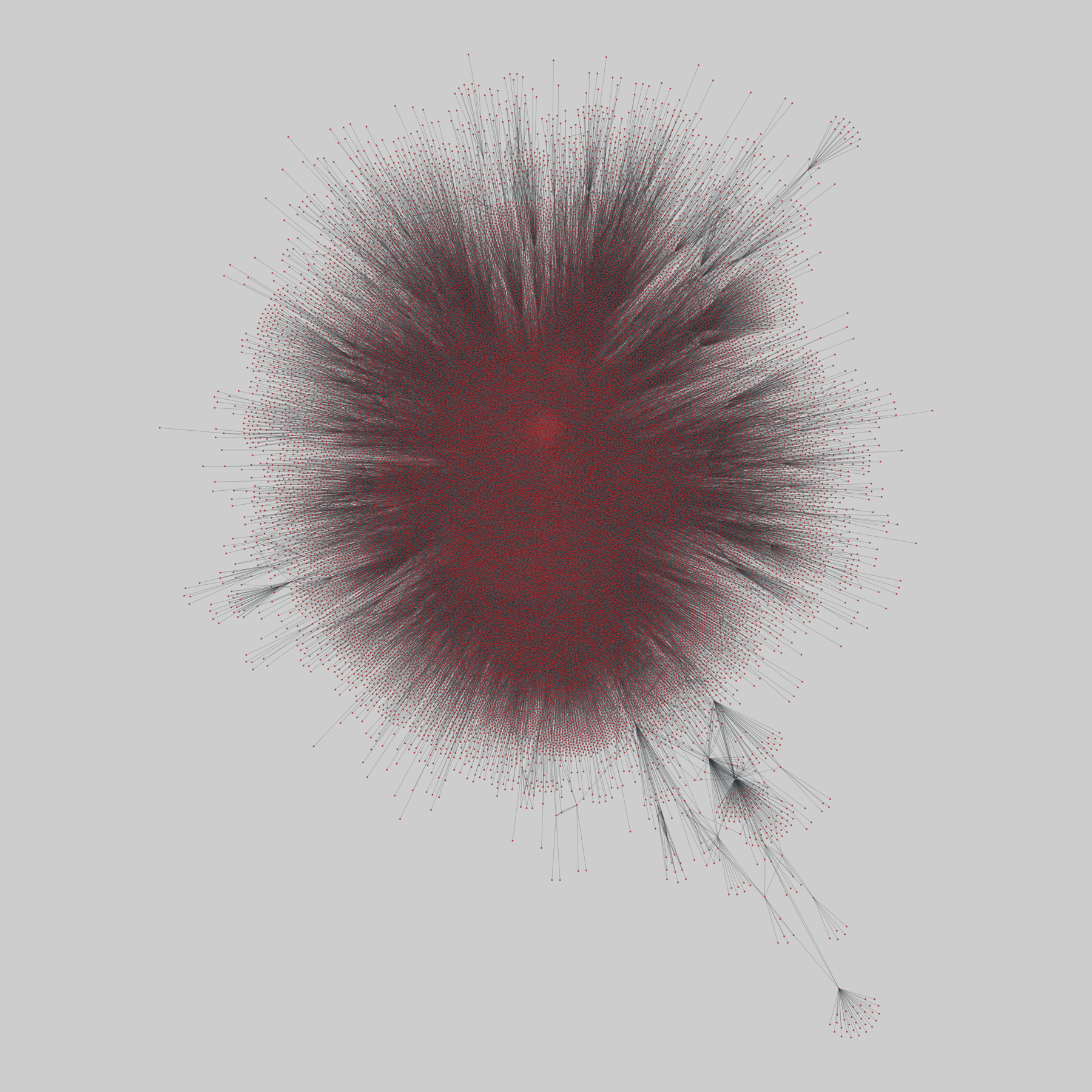
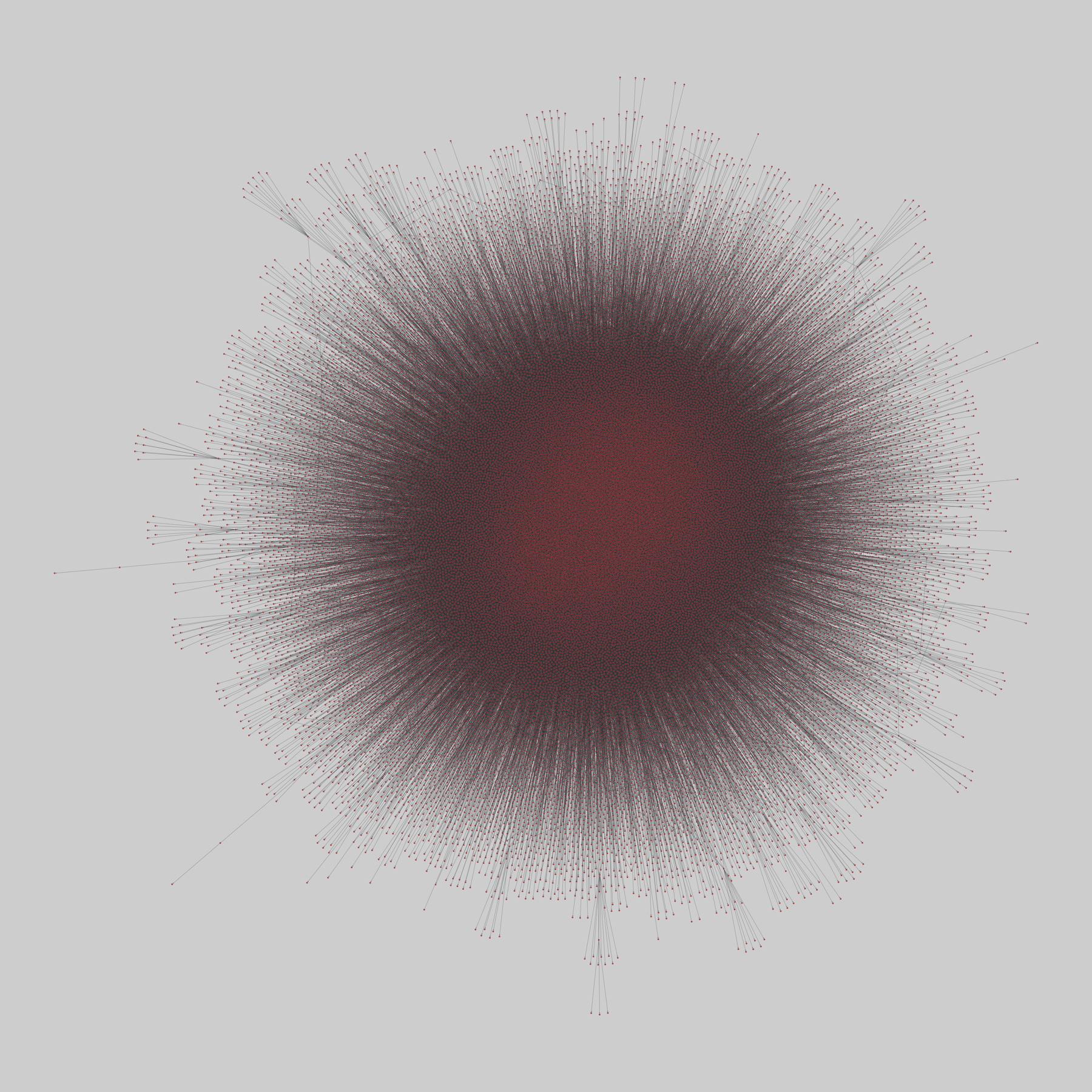
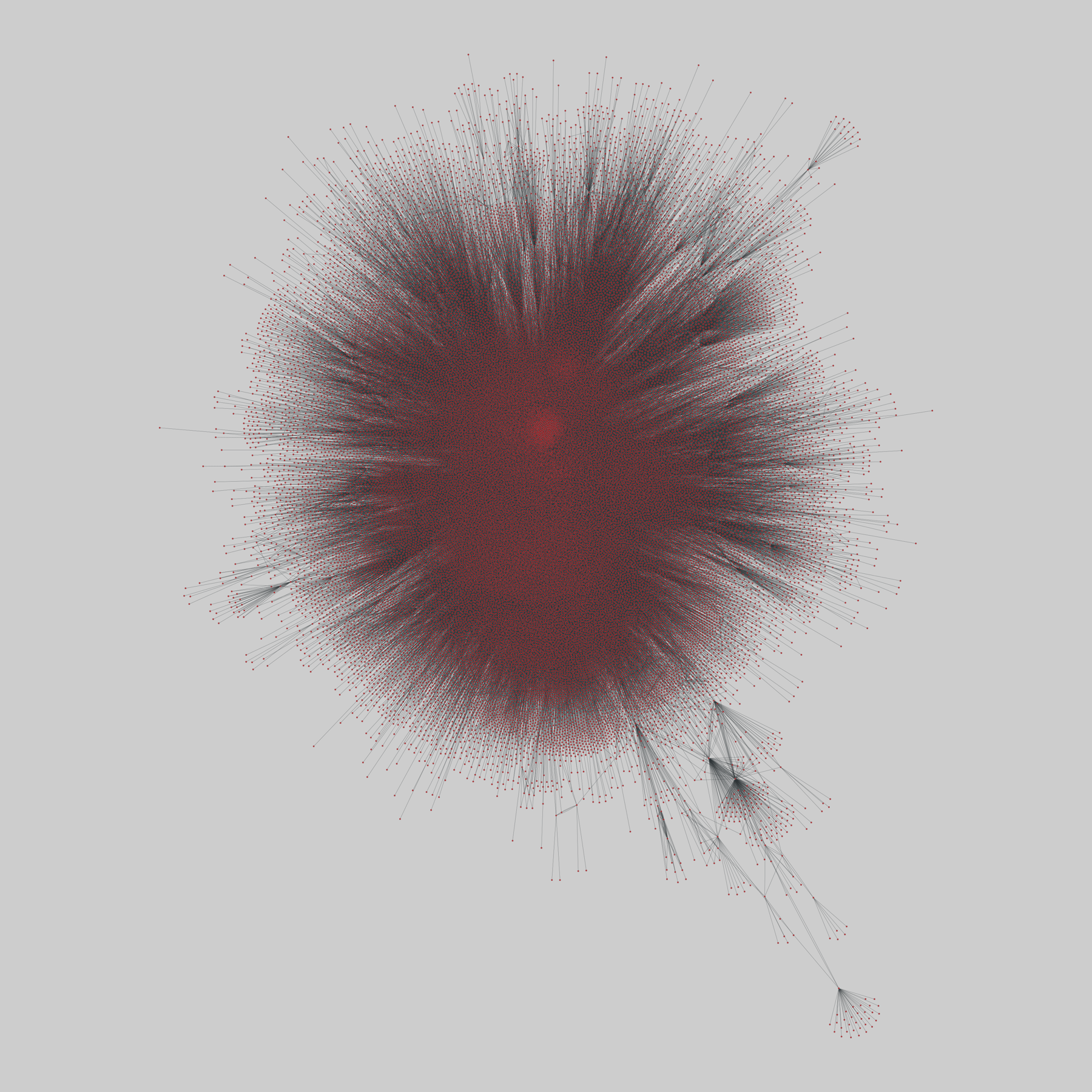
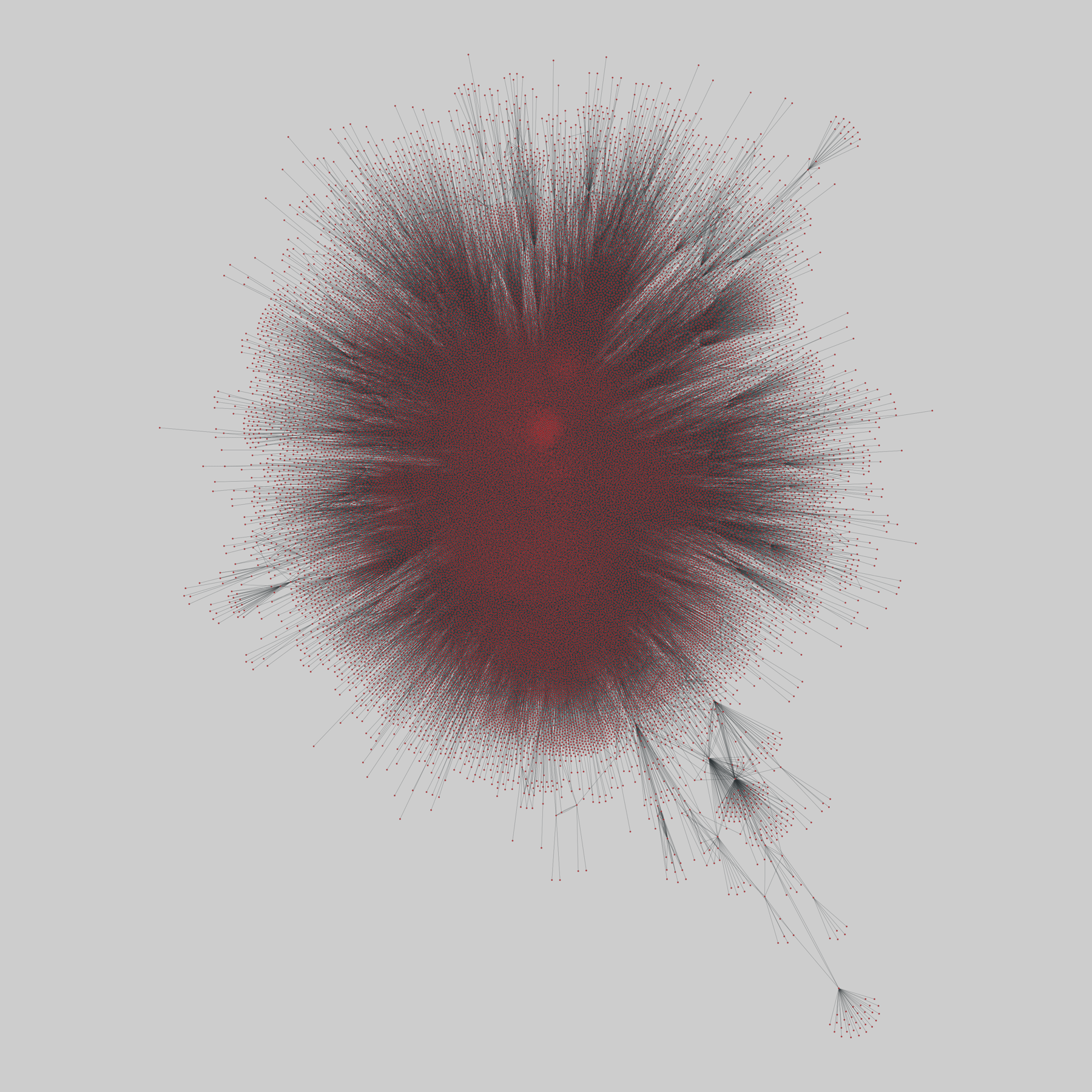
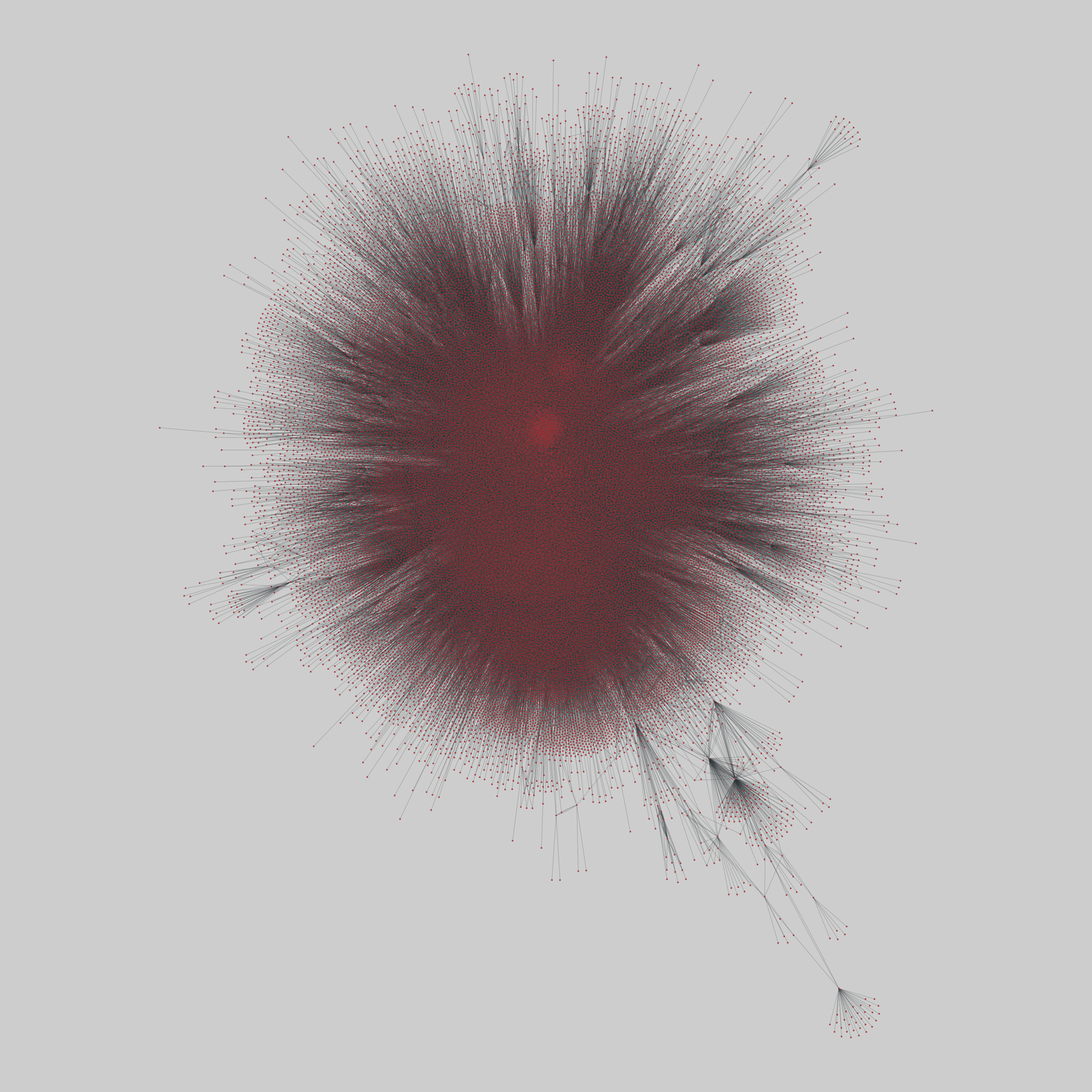
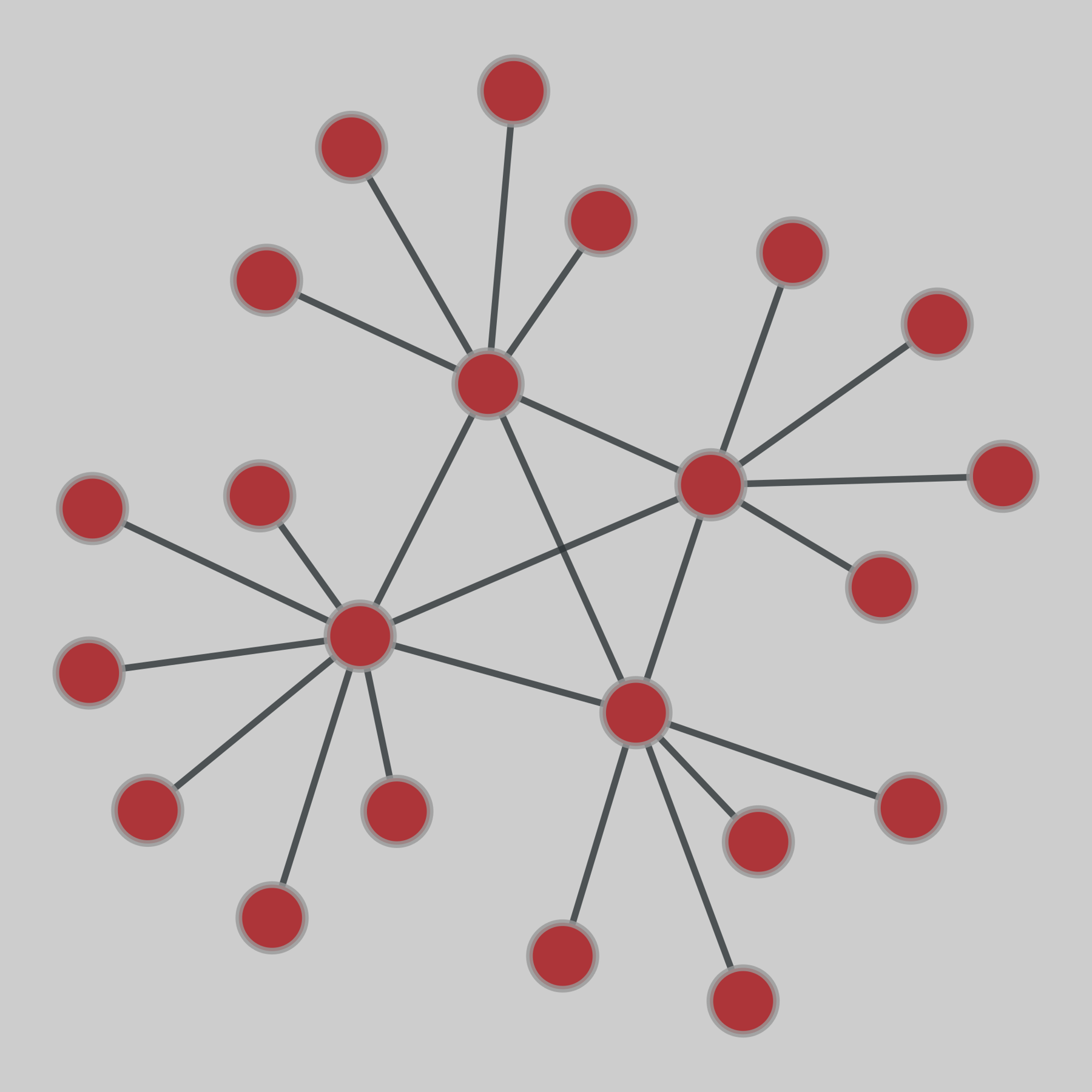
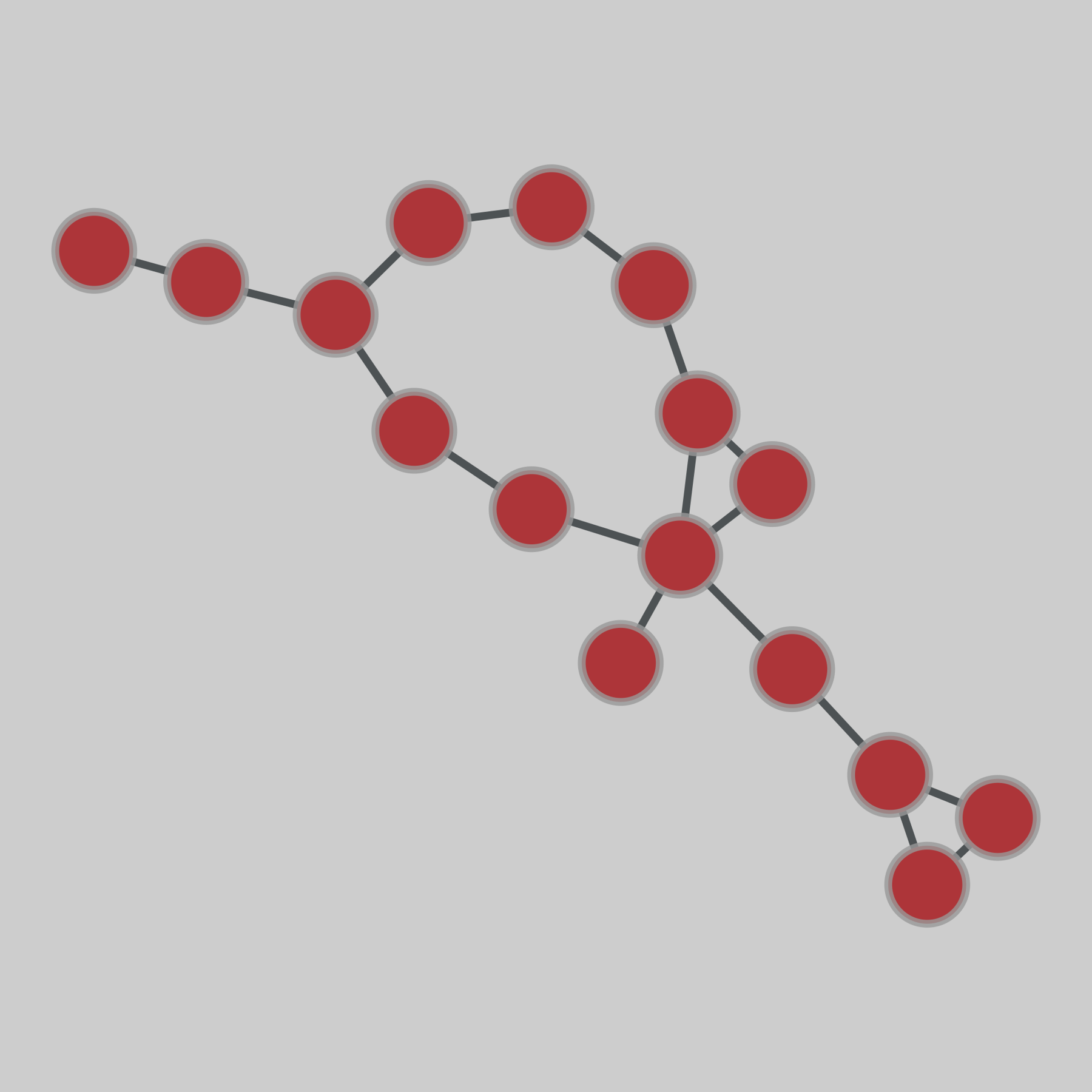
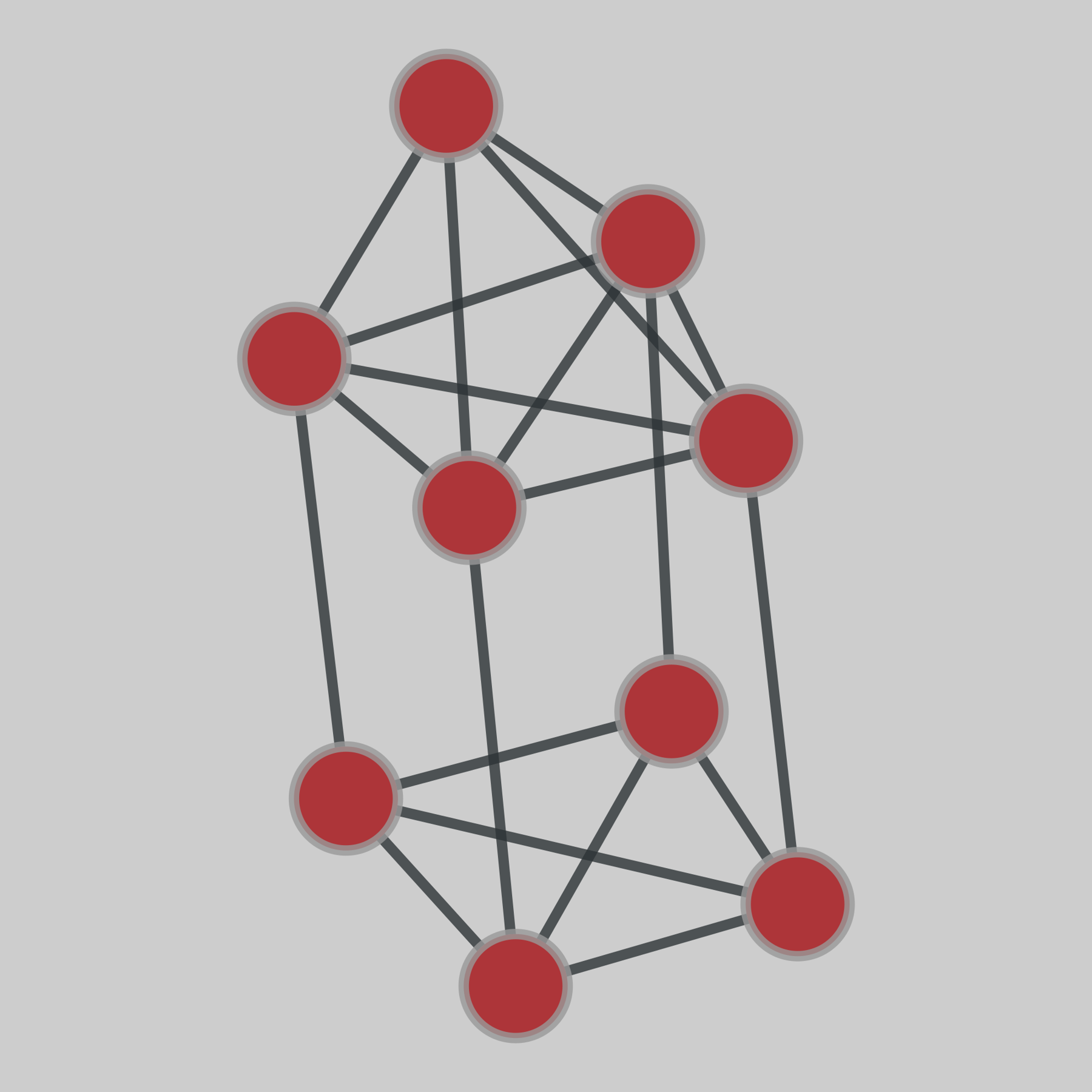
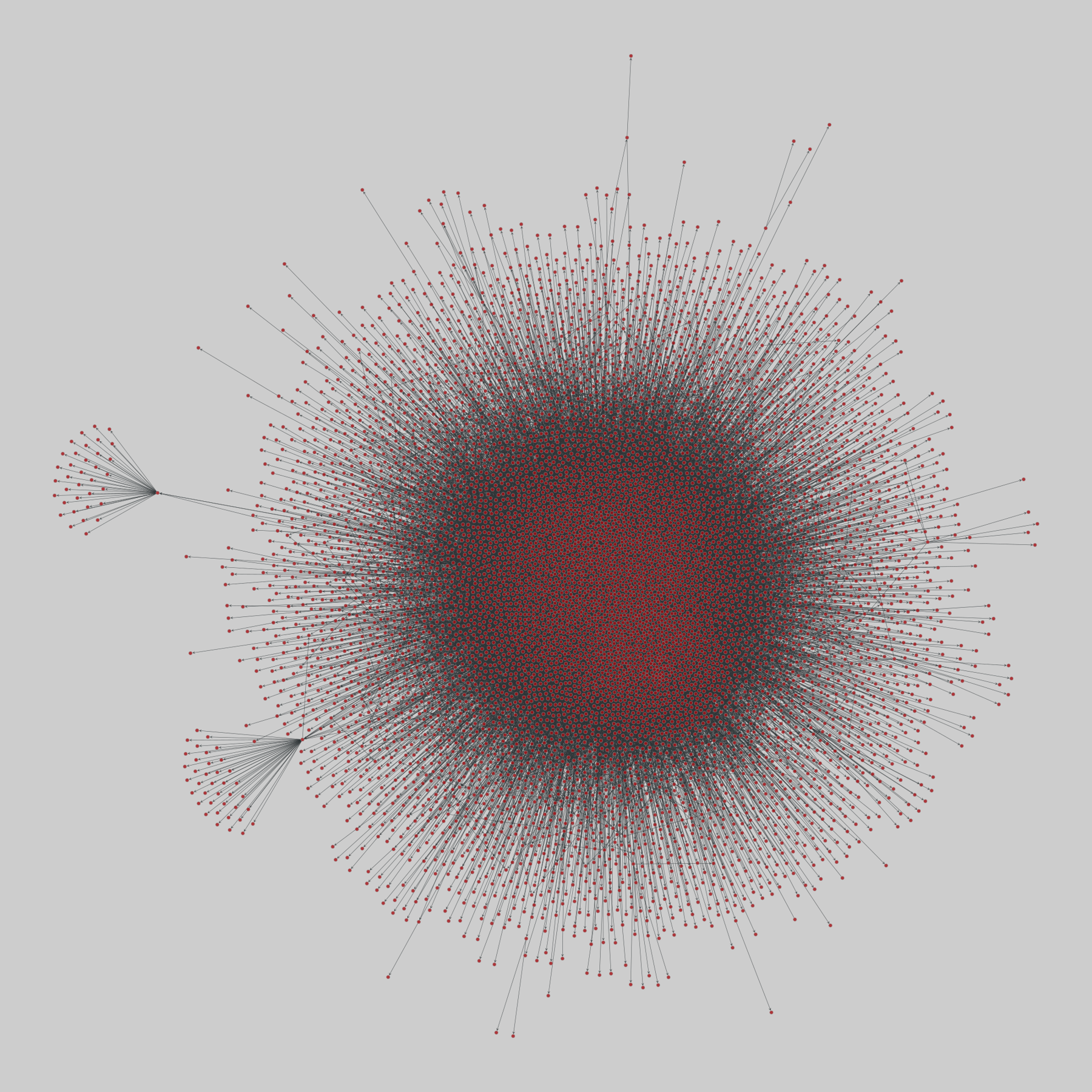
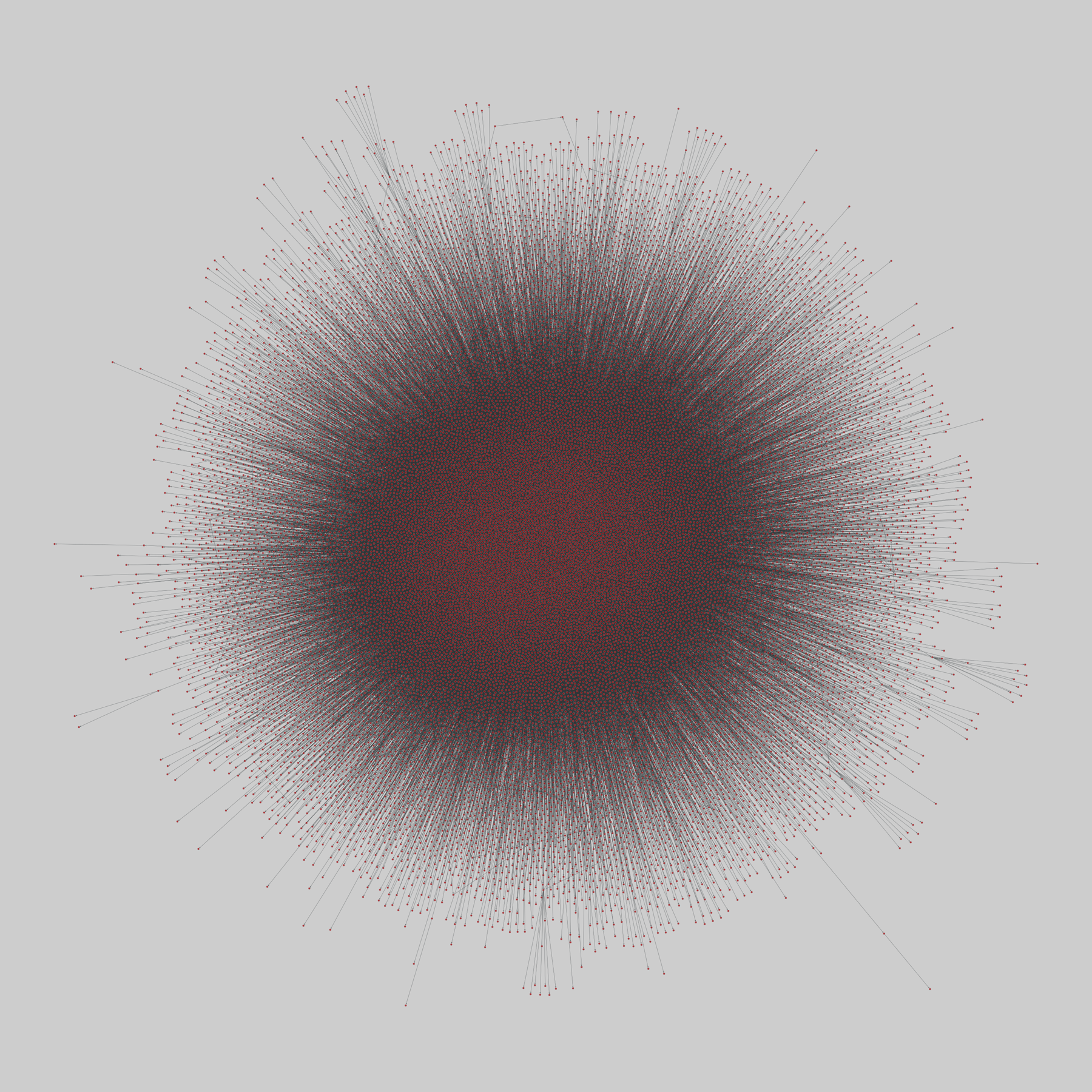
topology: Internet AS graph (2004)
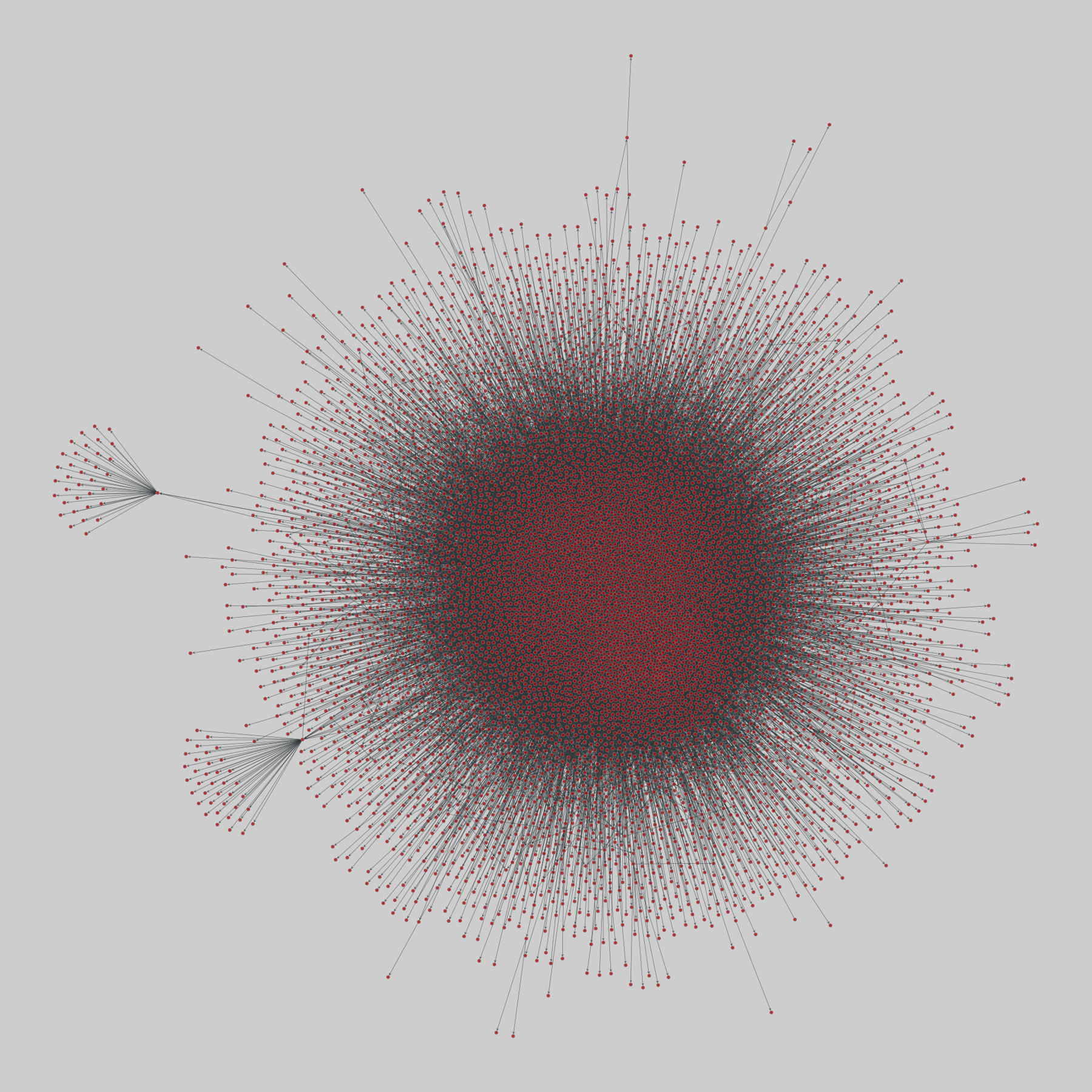
An integrated snapshot of the structure of the Internet at the level of Autonomous Systems (ASs), reconstructed from multiple sources, including the RouteViews and RIPE BGP trace collectors, route servers, looking glasses, and the Internet Routing Registry databases. This snapshot was created around October 2004.
This network has 34761 nodes and 171403 edges.
Tags: Technological, Communication, Unweighted, Multigraph, Timestamps
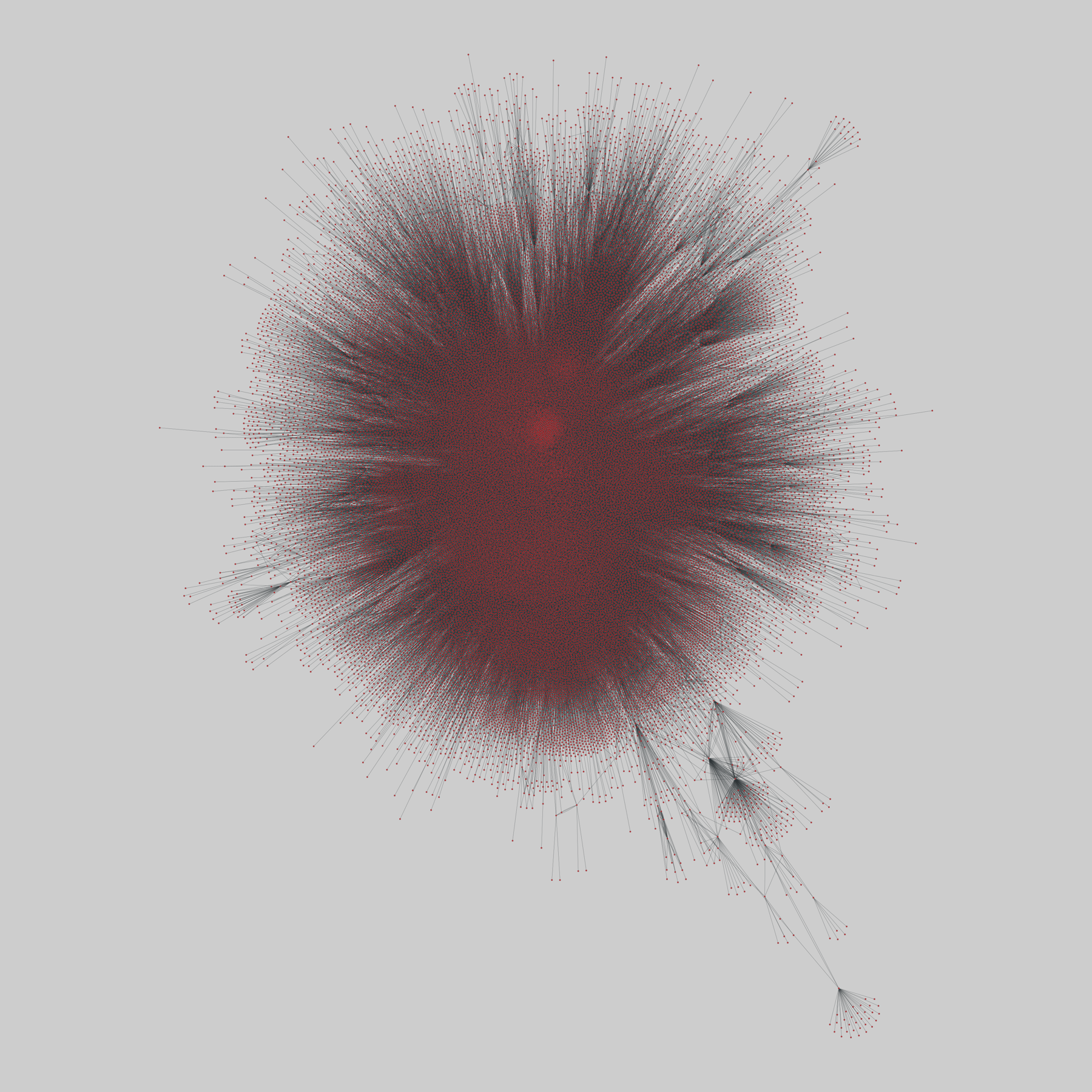
topology: Internet AS graph (2004)
An integrated snapshot of the structure of the Internet at the level of Autonomous Systems (ASs), reconstructed from multiple sources, including the RouteViews and RIPE BGP trace collectors, route servers, looking glasses, and the Internet Routing Registry databases. This snapshot was created around October 2004.
This network has 34761 nodes and 171403 edges.
Tags: Technological, Communication, Unweighted, Multigraph, Timestamps
gnutella: Gnutella p2p networks (2002)
A sequence of 9 snapshots of the Gnutella peer-to-peer file sharing network from 5-31 August 2002. Nodes are hosts in the Gnutella network topology and edges are connections between them.
This network has 26518 nodes and 65369 edges.
Tags: Technological, Peer-to-peer, Unweighted
https://
VoroUDF: Meshing Unsigned Distance Fields with Voronoi Optimization
Ningna Wang, Zilong Wang, Xiana Carrera, Xiaohu Guo, Silvia Sell\'an
https://arxiv.org/abs/2602.02907 https://arxiv.org/pdf/2602.02907 https://arxiv.org/html/2602.02907
arXiv:2602.02907v1 Announce Type: new
Abstract: We present VoroUDF, an algorithm for reconstructing high-quality triangle meshes from Unsigned Distance Fields (UDFs). Our algorithm supports non-manifold geometry, sharp features, and open boundaries, without relying on error-prone inside/outside estimation, restrictive look-up tables nor topologically noisy optimization. Our Voronoi-based formulation combines a L_1 tangent minimization with feature-aware repulsion to robustly recover complex surface topology. It achieves significantly improved topological consistency and geometric fidelity compared to existing methods, while producing lightweight meshes suitable for downstream real-time and interactive applications.
toXiv_bot_toot
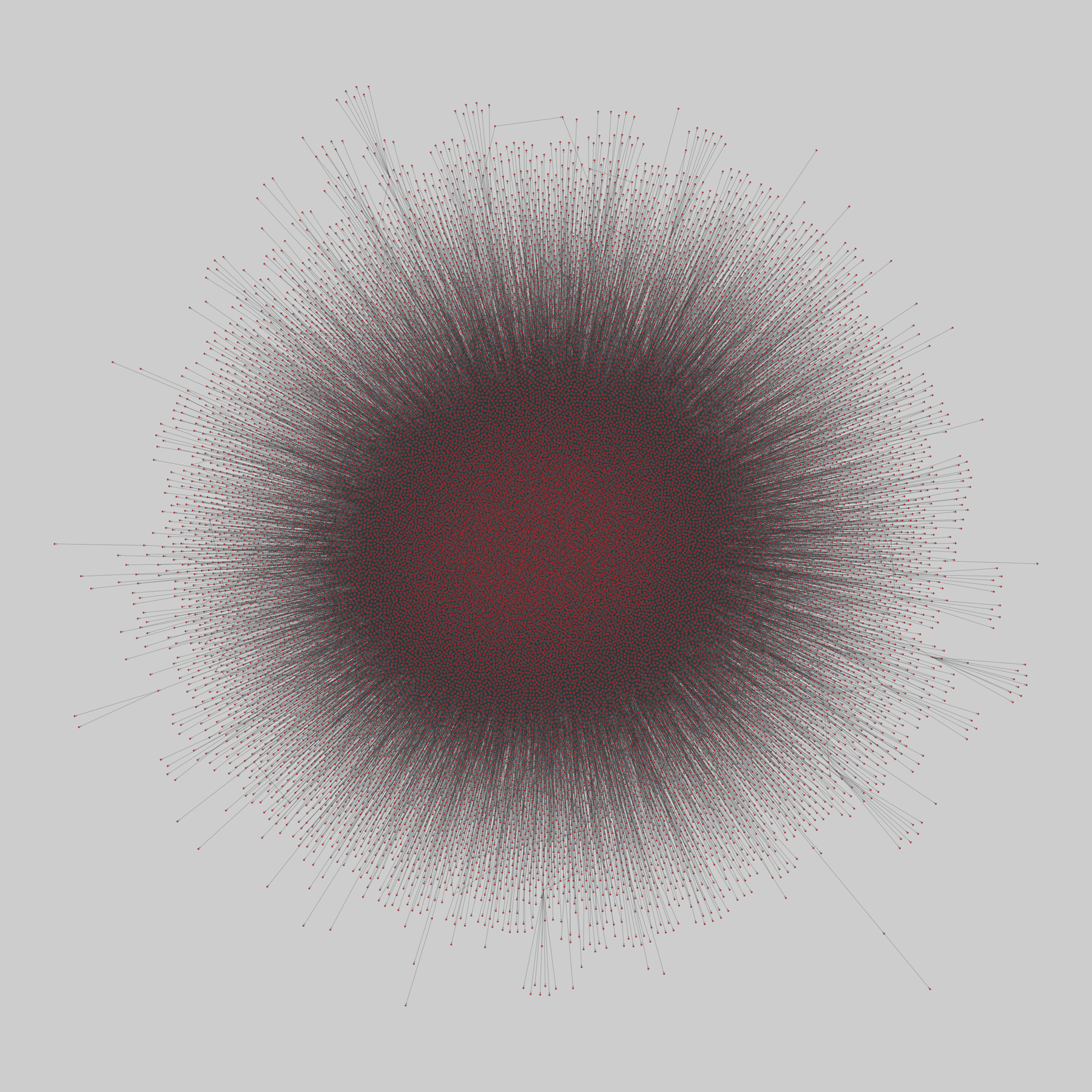
topology: Internet AS graph (2004)
An integrated snapshot of the structure of the Internet at the level of Autonomous Systems (ASs), reconstructed from multiple sources, including the RouteViews and RIPE BGP trace collectors, route servers, looking glasses, and the Internet Routing Registry databases. This snapshot was created around October 2004.
This network has 34761 nodes and 171403 edges.
Tags: Technological, Communication, Unweighted, Multigraph, Timestamps
SOM-VQ: Topology-Aware Tokenization for Interactive Generative Models
Alessandro Londei, Denise Lanzieri, Matteo Benati
https://arxiv.org/abs/2602.21133 https://arxiv.org/pdf/2602.21133 https://arxiv.org/html/2602.21133
arXiv:2602.21133v1 Announce Type: new
Abstract: Vector-quantized representations enable powerful discrete generative models but lack semantic structure in token space, limiting interpretable human control. We introduce SOM-VQ, a tokenization method that combines vector quantization with Self-Organizing Maps to learn discrete codebooks with explicit low-dimensional topology. Unlike standard VQ-VAE, SOM-VQ uses topology-aware updates that preserve neighborhood structure: nearby tokens on a learned grid correspond to semantically similar states, enabling direct geometric manipulation of the latent space. We demonstrate that SOM-VQ produces more learnable token sequences in the evaluated domains while providing an explicit navigable geometry in code space. Critically, the topological organization enables intuitive human-in-the-loop control: users can steer generation by manipulating distances in token space, achieving semantic alignment without frame-level constraints. We focus on human motion generation - a domain where kinematic structure, smooth temporal continuity, and interactive use cases (choreography, rehabilitation, HCI) make topology-aware control especially natural - demonstrating controlled divergence and convergence from reference sequences through simple grid-based sampling. SOM-VQ provides a general framework for interpretable discrete representations applicable to music, gesture, and other interactive generative domains.
toXiv_bot_toot
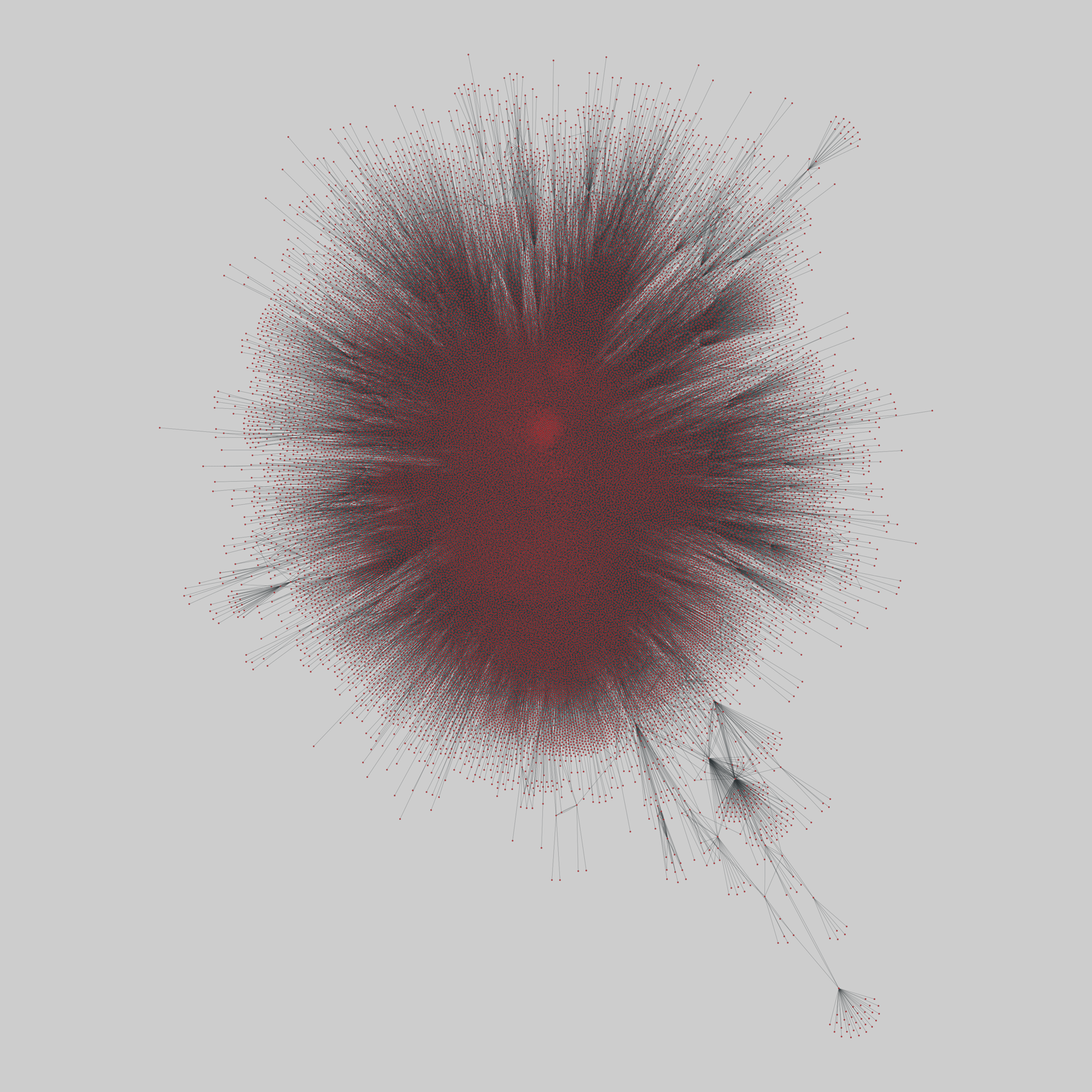
topology: Internet AS graph (2004)
An integrated snapshot of the structure of the Internet at the level of Autonomous Systems (ASs), reconstructed from multiple sources, including the RouteViews and RIPE BGP trace collectors, route servers, looking glasses, and the Internet Routing Registry databases. This snapshot was created around October 2004.
This network has 34761 nodes and 171403 edges.
Tags: Technological, Communication, Unweighted, Multigraph, Timestamps
gnutella: Gnutella p2p networks (2002)
A sequence of 9 snapshots of the Gnutella peer-to-peer file sharing network from 5-31 August 2002. Nodes are hosts in the Gnutella network topology and edges are connections between them.
This network has 36682 nodes and 88328 edges.
Tags: Technological, Peer-to-peer, Unweighted
https://
Probing Graph Neural Network Activation Patterns Through Graph Topology
Floriano Tori, Lorenzo Bini, Marco Sorbi, St\'ephane Marchand-Maillet, Vincent Ginis
https://arxiv.org/abs/2602.21092 https://arxiv.org/pdf/2602.21092 https://arxiv.org/html/2602.21092
arXiv:2602.21092v1 Announce Type: new
Abstract: Curvature notions on graphs provide a theoretical description of graph topology, highlighting bottlenecks and denser connected regions. Artifacts of the message passing paradigm in Graph Neural Networks, such as oversmoothing and oversquashing, have been attributed to these regions. However, it remains unclear how the topology of a graph interacts with the learned preferences of GNNs. Through Massive Activations, which correspond to extreme edge activation values in Graph Transformers, we probe this correspondence. Our findings on synthetic graphs and molecular benchmarks reveal that MAs do not preferentially concentrate on curvature extremes, despite their theoretical link to information flow. On the Long Range Graph Benchmark, we identify a systemic \textit{curvature shift}: global attention mechanisms exacerbate topological bottlenecks, drastically increasing the prevalence of negative curvature. Our work reframes curvature as a diagnostic probe for understanding when and why graph learning fails.
toXiv_bot_toot
[2026-02-27 Fri (UTC), no new articles found for math.GN General Topology]
toXiv_bot_toot
topology: Internet AS graph (2004)
An integrated snapshot of the structure of the Internet at the level of Autonomous Systems (ASs), reconstructed from multiple sources, including the RouteViews and RIPE BGP trace collectors, route servers, looking glasses, and the Internet Routing Registry databases. This snapshot was created around October 2004.
This network has 34761 nodes and 171403 edges.
Tags: Technological, Communication, Unweighted, Multigraph, Timestamps
@… look what you made me do
Replaced article(s) found for physics.flu-dyn. https://arxiv.org/list/physics.flu-dyn/new
[1/1]:
- Phase dynamics and their role determining energy flux in hydrodynamic shell models
Santiago J. Benavides, Miguel D. Bustamante
https://arxiv.org/abs/2507.03397 https://mastoxiv.page/@arXiv_physicsfludyn_bot/114817127598602181
- Sequential water wave reconstruction in VOF-based numerical wave tanks with the EnKF approach
Liwen Yan, Linyuan Che, Jing Li
https://arxiv.org/abs/2510.14356 https://mastoxiv.page/@arXiv_physicsfludyn_bot/115388597190883395
- cfdmfFTFoam: A front-tracking solver for multiphase flows on general unstructured grids in OpenFOAM
Ehsan Amani
https://arxiv.org/abs/2602.05627
- Causally coherent structures in turbulent dynamical systems
Daniele Massaro, Saleh Rezaeiravesh, Philipp Schlatter
https://arxiv.org/abs/2602.13899 https://mastoxiv.page/@arXiv_physicsfludyn_bot/116085105891668720
- On Topology of Perturbed Vortices
Taosif Ahsan, Samuel A. Cohen, Alan H. Glasser
https://arxiv.org/abs/2507.04596 https://mastoxiv.page/@arXiv_mathph_bot/114817045016896633
- Multi-Sink Solutions to the Self-Similar Euler Equations
Hyungjun Choi, Matei P. Coiculescu
https://arxiv.org/abs/2602.15152 https://mastoxiv.page/@arXiv_mathAP_bot/116090659297578893
toXiv_bot_toot
Crosslisted article(s) found for cs.DC. https://arxiv.org/list/cs.DC/new
[1/1]:
- Agent Identity URI Scheme: Topology-Independent Naming and Capability-Based Discovery for Multi-A...
Roland R. Rodriguez Jr
gnutella: Gnutella p2p networks (2002)
A sequence of 9 snapshots of the Gnutella peer-to-peer file sharing network from 5-31 August 2002. Nodes are hosts in the Gnutella network topology and edges are connections between them.
This network has 8114 nodes and 26013 edges.
Tags: Technological, Peer-to-peer, Unweighted
https://
[2026-02-26 Thu (UTC), no new articles found for math.GN General Topology]
toXiv_bot_toot
Mesh Splatting for End-to-end Multiview Surface Reconstruction
Ruiqi Zhang, Jiacheng Wu, Jie Chen
https://arxiv.org/abs/2601.21400 https://arxiv.org/pdf/2601.21400 https://arxiv.org/html/2601.21400
arXiv:2601.21400v1 Announce Type: new
Abstract: Surfaces are typically represented as meshes, which can be extracted from volumetric fields via meshing or optimized directly as surface parameterizations. Volumetric representations occupy 3D space and have a large effective receptive field along rays, enabling stable and efficient optimization via volumetric rendering; however, subsequent meshing often produces overly dense meshes and introduces accumulated errors. In contrast, pure surface methods avoid meshing but capture only boundary geometry with a single-layer receptive field, making it difficult to learn intricate geometric details and increasing reliance on priors (e.g., shading or normals). We bridge this gap by differentiably turning a surface representation into a volumetric one, enabling end-to-end surface reconstruction via volumetric rendering to model complex geometries. Specifically, we soften a mesh into multiple semi-transparent layers that remain differentiable with respect to the base mesh, endowing it with a controllable 3D receptive field. Combined with a splatting-based renderer and a topology-control strategy, our method can be optimized in about 20 minutes to achieve accurate surface reconstruction while substantially improving mesh quality.
toXiv_bot_toot
topology: Internet AS graph (2004)
An integrated snapshot of the structure of the Internet at the level of Autonomous Systems (ASs), reconstructed from multiple sources, including the RouteViews and RIPE BGP trace collectors, route servers, looking glasses, and the Internet Routing Registry databases. This snapshot was created around October 2004.
This network has 34761 nodes and 171403 edges.
Tags: Technological, Communication, Unweighted, Multigraph, Timestamps
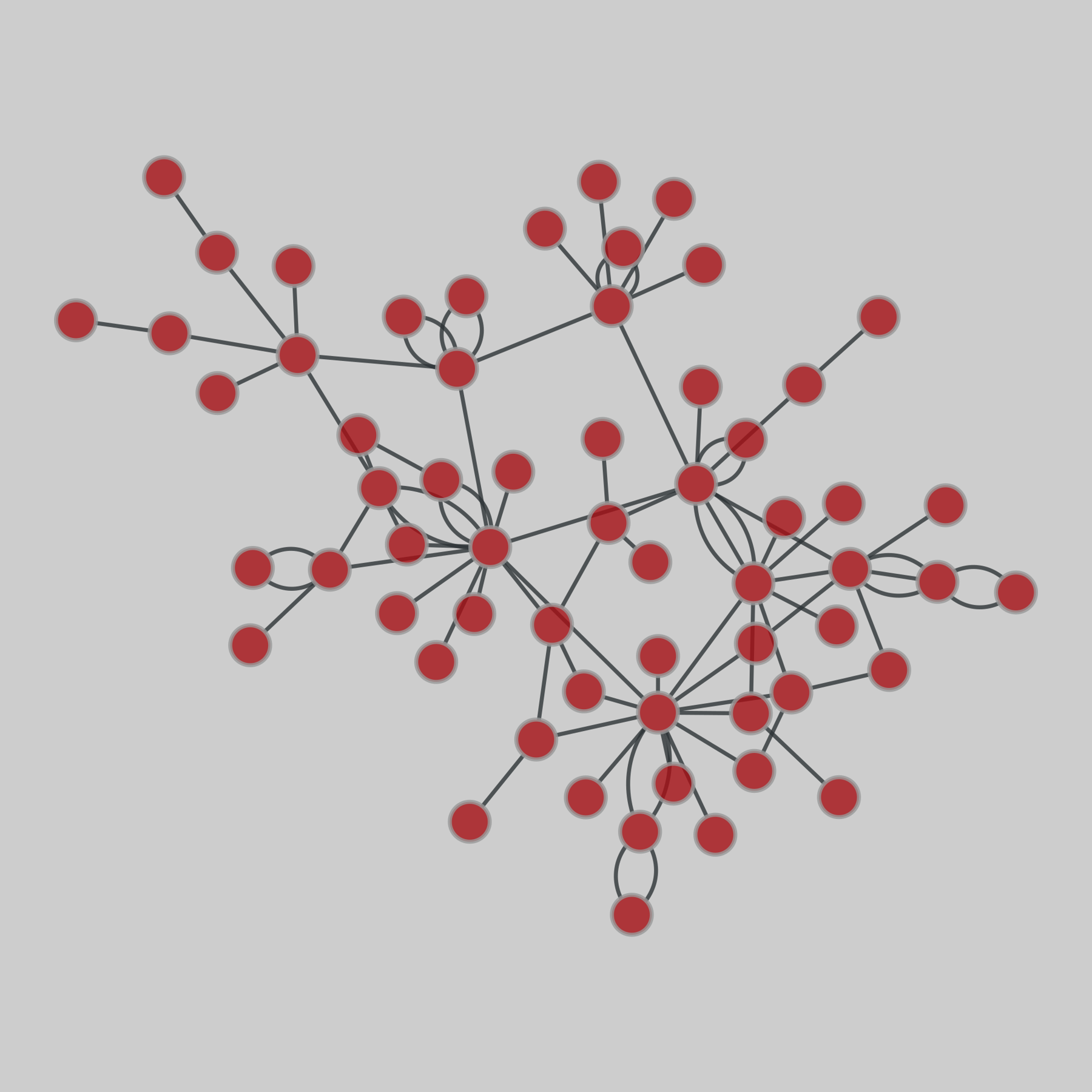
internet_top_pop: Internet topology (PoP level) (1969-2012)
Assorted snapshots of internet graph at the Point of Presence (PoP) level (which lies between the IP and AS levels), collected from around the world and at various times. The earliest snapshots are for ARPANET (1969-1972), with a few more from pre-2000. Most are from 2006 onward. Metadata include link type or speed, longitudes, and latitudes of nodes, URL, and date of record.
This network has 61 nodes and 89 edges.
[2026-02-25 Wed (UTC), no new articles found for math.GN General Topology]
toXiv_bot_toot
topology: Internet AS graph (2004)
An integrated snapshot of the structure of the Internet at the level of Autonomous Systems (ASs), reconstructed from multiple sources, including the RouteViews and RIPE BGP trace collectors, route servers, looking glasses, and the Internet Routing Registry databases. This snapshot was created around October 2004.
This network has 34761 nodes and 171403 edges.
Tags: Technological, Communication, Unweighted, Multigraph, Timestamps
topology: Internet AS graph (2004)
An integrated snapshot of the structure of the Internet at the level of Autonomous Systems (ASs), reconstructed from multiple sources, including the RouteViews and RIPE BGP trace collectors, route servers, looking glasses, and the Internet Routing Registry databases. This snapshot was created around October 2004.
This network has 34761 nodes and 171403 edges.
Tags: Technological, Communication, Unweighted, Multigraph, Timestamps
[2026-02-24 Tue (UTC), 2 new articles found for math.GN General Topology]
toXiv_bot_toot
internet_top_pop: Internet topology (PoP level) (1969-2012)
Assorted snapshots of internet graph at the Point of Presence (PoP) level (which lies between the IP and AS levels), collected from around the world and at various times. The earliest snapshots are for ARPANET (1969-1972), with a few more from pre-2000. Most are from 2006 onward. Metadata include link type or speed, longitudes, and latitudes of nodes, URL, and date of record.
This network has 22 nodes and 24 edges.
[2026-02-23 Mon (UTC), no new articles found for math.GN General Topology]
toXiv_bot_toot
internet_top_pop: Internet topology (PoP level) (1969-2012)
Assorted snapshots of internet graph at the Point of Presence (PoP) level (which lies between the IP and AS levels), collected from around the world and at various times. The earliest snapshots are for ARPANET (1969-1972), with a few more from pre-2000. Most are from 2006 onward. Metadata include link type or speed, longitudes, and latitudes of nodes, URL, and date of record.
This network has 16 nodes and 18 edges.
internet_top_pop: Internet topology (PoP level) (1969-2012)
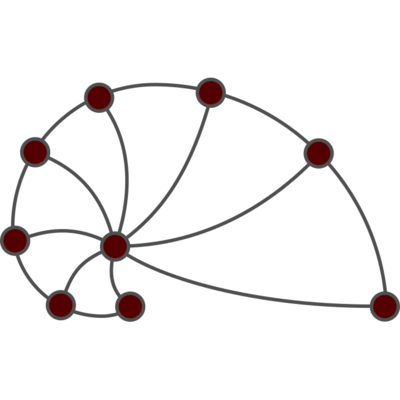
Assorted snapshots of internet graph at the Point of Presence (PoP) level (which lies between the IP and AS levels), collected from around the world and at various times. The earliest snapshots are for ARPANET (1969-1972), with a few more from pre-2000. Most are from 2006 onward. Metadata include link type or speed, longitudes, and latitudes of nodes, URL, and date of record.
This network has 9 nodes and 20 edges.
…
[2026-02-20 Fri (UTC), 1 new article found for math.GN General Topology]
toXiv_bot_toot
[2026-02-19 Thu (UTC), 1 new article found for math.GN General Topology]
toXiv_bot_toot
gnutella: Gnutella p2p networks (2002)
A sequence of 9 snapshots of the Gnutella peer-to-peer file sharing network from 5-31 August 2002. Nodes are hosts in the Gnutella network topology and edges are connections between them.
This network has 8114 nodes and 26013 edges.
Tags: Technological, Peer-to-peer, Unweighted
https://
Replaced article(s) found for math.GN. https://arxiv.org/list/math.GN/new
[1/1]:
- Complexity of deep computations via topology of function spaces
Eduardo Due\~nez, Jos\'e Iovino, Tonatiuh Matos-Wiederhold, Luciano Salvetti, Franklin D. Tall
gnutella: Gnutella p2p networks (2002)
A sequence of 9 snapshots of the Gnutella peer-to-peer file sharing network from 5-31 August 2002. Nodes are hosts in the Gnutella network topology and edges are connections between them.
This network has 26518 nodes and 65369 edges.
Tags: Technological, Peer-to-peer, Unweighted
https://
 @netzschleuder@social.skewed.de