 @arXiv_csLO_bot@mastoxiv.page
2025-10-15 08:46:22
Type Theory with Single Substitutions
Ambrus Kaposi (E\"otv\"os Lor\'and University), Szumi Xie (E\"otv\"os Lor\'and University)
https://arxiv.org/abs/2510.12303
@arXiv_csLO_bot@mastoxiv.pageType Theory with Single Substitutions
Ambrus Kaposi (E\"otv\"os Lor\'and University), Szumi Xie (E\"otv\"os Lor\'and University)
https://arxiv.org/abs/2510.12303
 @fanf@mendeddrum.org
from my link log —
Arend: a theorem prover based on Homotopy Type Theory.
https://arend-lang.github.io/
saved 2019-08-07 https://dotat.at/:/AR6J2.html
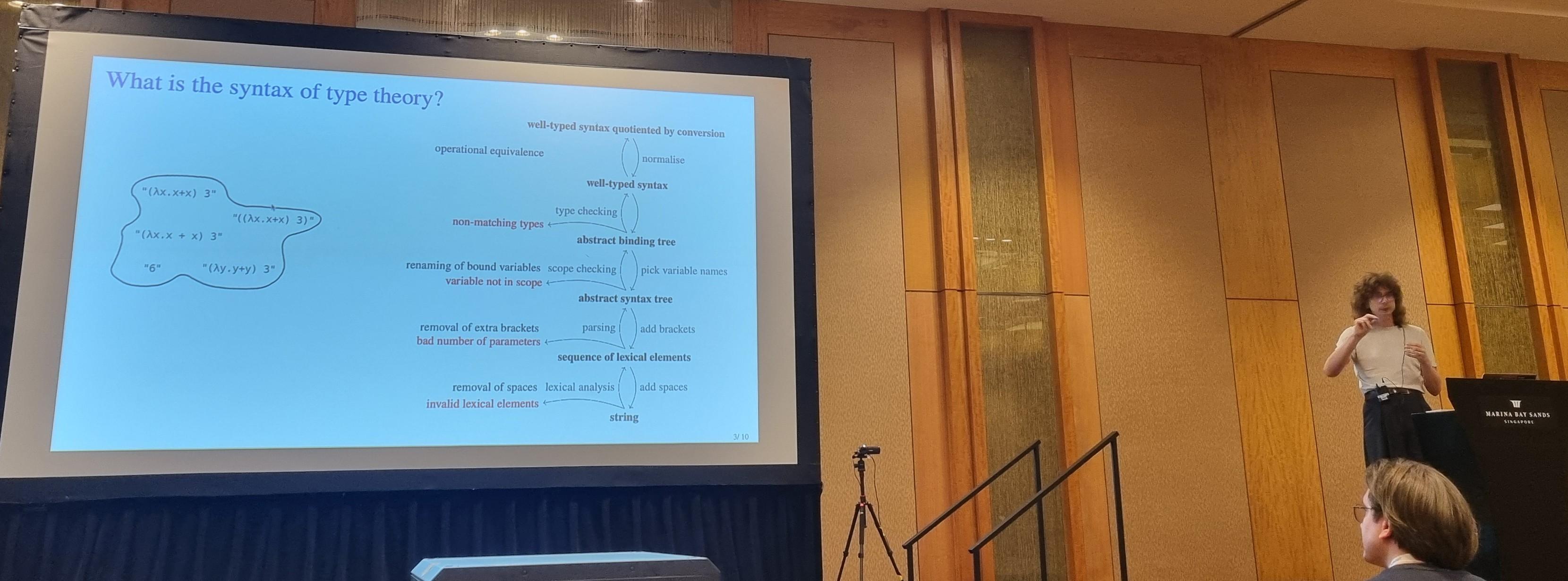
 @patrikja@functional.cafe
Fascinating talk on
Type Theory in Type Theory using a Strictified Syntax
Presented by Ambrus Kaposi, joint work with Loïc Pujet.
#icfpsplash25
 @arXiv_mathNT_bot@mastoxiv.page
On the growth of Tate-Shafarevich groups of $p$-supersingular abelian varieties of ${\rm GL}_2$-type over $\mathbb{Z}_p$-extensions of number fields
Erman Isik, Antonio Lei
https://arxiv.org/abs/2510.11511
 @arXiv_mathCA_bot@mastoxiv.page
Some capacitary strong type inequalities and related function spaces
Keng Hao Ooi, Nguyen Cong Phuc
https://arxiv.org/abs/2510.08982 https://arxiv.org/pdf/…
 @arXiv_mathFA_bot@mastoxiv.page
Fixed Point Theory For Singh-Chatterjea Type Contractive Mappings
Zouaoui Bekri, Nicola Fabiano
https://arxiv.org/abs/2510.11975 https://arxiv.org/pdf/2510…
 @arXiv_csAI_bot@mastoxiv.page
Humanoid Artificial Consciousness Designed with Large Language Model Based on Psychoanalysis and Personality Theory
Sang Hun Kim, Jongmin Lee, Dongkyu Park, So Young Lee, Yosep Chong
https://arxiv.org/abs/2510.09043
@arXiv_csLO_bot@mastoxiv.pageA Graded Modal Type Theory for Pulse Schedules
Robin Adams
https://arxiv.org/abs/2510.03130 https://arxiv.org/pdf/2510.03130…
 @arXiv_hepth_bot@mastoxiv.page
K-Points and Type IIB/Heterotic Duality with NS5-Branes
Jeroen Monnee, Timo Weigand, Max Wiesner
https://arxiv.org/abs/2510.02435 https://arxiv.org/pdf/251…
 @arXiv_statCO_bot@mastoxiv.page
Great expectations: Unifying Statistical Theory and Programming
Bradley Saul
https://arxiv.org/abs/2510.09853 https://arxiv.org/pdf/2510.09853
 @arXiv_mathAP_bot@mastoxiv.page
Two-temperature fluid models for a polyatomic gas based on kinetic theory for nearly resonant collisions
Kazuo Aoki, Niclas Bernhoff
https://arxiv.org/abs/2510.12464 https://
 @arXiv_mathCT_bot@mastoxiv.page
Replaced article(s) found for math.CT. https://arxiv.org/list/math.CT/new
[1/1]:
- Homotopy type theory as a language for diagrams of $\infty$-logoses
Taichi Uemura
 @arXiv_csGT_bot@mastoxiv.page
The Theory of Strategic Evolution: Games with Endogenous Players and Strategic Replicators
Kevin Vallier
https://arxiv.org/abs/2512.07901 https://arxiv.org/pdf/2512.07901 https://arxiv.org/html/2512.07901
arXiv:2512.07901v1 Announce Type: new
Abstract: This paper develops the Theory of Strategic Evolution, a general model for systems in which the population of players, strategies, and institutional rules evolve together. The theory extends replicator dynamics to settings with endogenous players, multi level selection, innovation, constitutional change, and meta governance. The central mathematical object is a Poiesis stack: a hierarchy of strategic layers linked by cross level gain matrices. Under small gain conditions, the system admits a global Lyapunov function and satisfies selection, tracking, and stochastic stability results at every finite depth. We prove that the class is closed under block extension, innovation events, heterogeneous utilities, continuous strategy spaces, and constitutional evolution. The closure theorem shows that no new dynamics arise at higher levels and that unrestricted self modification cannot preserve Lyapunov structure. The theory unifies results from evolutionary game theory, institutional design, innovation dynamics, and constitutional political economy, providing a general mathematical model of long run strategic adaptation.
toXiv_bot_toot
 @sperbsen@discuss.systems
Pedro Abreu aka #TypeTheoryForall had an epic conversation with me about all things programming languages, out now on the podcast.
https://www.typetheoryforall.com/…
 @arXiv_mathOC_bot@mastoxiv.page
Best Proximity Points for Geraghty-Type Non-Self Mappings with a Registration-Inspired Alignment Model
Fatemeh Fogh, Sara Behnamian
https://arxiv.org/abs/2510.02406 https://
 @arXiv_mathRA_bot@mastoxiv.page
Effective integration of Lie type algebras
Bruno Vallette
https://arxiv.org/abs/2510.10144 https://arxiv.org/pdf/2510.10144
 @arXiv_physicsfludyn_bot@mastoxiv.page
Radially weighted Backus- and Childress-type bounds for spherical dynamos
Ralf Kaiser, Andreas Tilgner
https://arxiv.org/abs/2510.05884 https://arxiv.org/p…
 @arXiv_mathRT_bot@mastoxiv.page
Crosslisted article(s) found for math.RT. https://arxiv.org/list/math.RT/new
[1/1]:
- Semisimple module categories with fusion rules of the compact full flag manifold type
Mao Hoshino
…
 @arXiv_mathAG_bot@mastoxiv.page
Finite generation of higher rank quasi-monomial valuations via the extended Rees algebra
Zhiyuan Chen
https://arxiv.org/abs/2510.10737 https://arxiv.org/pd…
 @arXiv_mathGN_bot@mastoxiv.page
Dimensionality reduction and width of deep neural networks based on topological degree theory
Xiao-Song Yang
https://arxiv.org/abs/2511.06821 https://arxiv.org/pdf/2511.06821 https://arxiv.org/html/2511.06821
arXiv:2511.06821v1 Announce Type: new
Abstract: In this paper we present a mathematical framework on linking of embeddings of compact topological spaces into Euclidean spaces and separability of linked embeddings under a specific class of dimension reduction maps. As applications of the established theory, we provide some fascinating insights into classification and approximation problems in deep learning theory in the setting of deep neural networks.
toXiv_bot_toot
 @arXiv_mathLO_bot@mastoxiv.page
Formalizing the zigzag construction of path spaces of pushouts
Vojt\v{e}ch \v{S}t\v{e}pan\v{c}\'ik
https://arxiv.org/abs/2510.08452 https://arxiv.org/p…
@arXiv_mathFA_bot@mastoxiv.pageOn Korovkin-type theorems including exponential test functions on infinite intervals through power series convergence
Dilek S\"oylemez, Mehmet \"Unver
https://arxiv.org/abs/2510.12568
@arXiv_mathCA_bot@mastoxiv.pageA Continuum Beck-type Theorem for Hyperplanes
Paige Bright, Alexander Ortiz, Dmitrii Zakharov
https://arxiv.org/abs/2510.10907 https://arxiv.org/pdf/2510.1…
 @arXiv_grqc_bot@mastoxiv.page
Noncommutative Regge-Wheeler potential: some nonperturbative results
Nikola Herceg, Tajron Juri\'c, A. Naveena Kumara, Andjelo Samsarov, Ivica Smoli\'c
https://arxiv.org/abs/2510.08125
 @arXiv_mathSP_bot@mastoxiv.page
Replaced article(s) found for math.SP. https://arxiv.org/list/math.SP/new
[1/1]:
- On the Hausdorff measure of sets of non-Lyapunov behaviour, and a Jarnik-type theorem for random ...
Sasha Sodin
 @arXiv_csIT_bot@mastoxiv.page
A doubly composite Chernoff-Stein lemma and its applications
Ludovico Lami
https://arxiv.org/abs/2510.06342 https://arxiv.org/pdf/2510.06342
 @arXiv_physicsgenph_bot@mastoxiv.page
Topological Structure of Infrared QCD
J. Gamboa
https://arxiv.org/abs/2511.07455 https://arxiv.org/pdf/2511.07455 https://arxiv.org/html/2511.07455
arXiv:2511.07455v1 Announce Type: new
Abstract: We investigate the infrared structure of QCD within the adiabatic approximation, where soft gluon configurations evolve slowly compared to the fermionic modes. In this formulation, the functional space of gauge connections replaces spacetime as the natural arena for the theory, and the long-distance behavior is encoded in quantized Berry phases associated with the infrared clouds. Our results suggest that the infrared sector of QCD exhibits features reminiscent of a \emph{topological phase}, similar to those encountered in condensed-matter systems, where topological protection replaces dynamical confinement at low energies. In this geometric framework, color-neutral composites such as quark--gluon and gluon--gluon clouds arise as topological bound states described by functional holonomies. Illustrative applications to hadronic excitations are discussed within this approach, including mesonic and baryonic examples. This perspective provides a unified picture of infrared dressing and topological quantization, establishing a natural bridge between non-Abelian gauge theory, adiabatic Berry phases, and the topology of the space of gauge configurations.
toXiv_bot_toot
 @arXiv_hepph_bot@mastoxiv.page
Hydrodynamic models of Reheating
Juan Pablo El\'ia, Lucas Cantarutti, Nahuel Mir\'on-Granese, Esteban Calzetta
https://arxiv.org/abs/2510.08685 https://
 @arXiv_mathCO_bot@mastoxiv.page
Majority relations for Condorcet domains of tiling type
Victor Reiner, Bridget Eileen Tenner
https://arxiv.org/abs/2509.19614 https://arxiv.org/pdf/2509.19…
 @arXiv_mathSG_bot@mastoxiv.page
Infinite-dimensional Lagrange-Dirac systems with boundary energy flow II: Field theories with bundle-valued forms
Fran\c{c}ois Gay-Balmaz, \'Alvaro Rodr\'iguez Abella, Hiroaki Yoshimura
https://arxiv.org/abs/2511.05687 https://arxiv.org/pdf/2511.05687 https://arxiv.org/html/2511.05687
arXiv:2511.05687v1 Announce Type: new
Abstract: Part I of this paper introduced the infinite dimensional Lagrange--Dirac theory for physical systems on the space of differential forms over a smooth manifold with boundary. This approach is particularly well-suited for systems involving energy exchange through the boundary, as it is built upon a restricted dual space -a vector subspace of the topological dual of the configuration space- that captures information about both the interior dynamics and boundary interactions. Consequently, the resulting dynamical equations naturally incorporate boundary energy flow. In this second part, the theory is extended to encompass vector-bundle-valued differential forms and non-Abelian gauge theories. To account for two commonly used forms of energy flux and boundary power densities, we introduce two distinct but equivalent formulations of the restricted dual. The results are derived from both geometric and variational viewpoints and are illustrated through applications to matter and gauge field theories. The interaction between gauge and matter fields is also addressed, along with the associated boundary conditions, applied to the case of the Yang-Mills-Higgs equations.
toXiv_bot_toot
 @arXiv_condmatmtrlsci_bot@mastoxiv.page
Ground state magnetic structure of Mn3Sn
Jeppe Jon Cederholm, Zhian Xu, Yanfeng Guo, Martin Ovesen, Thomas Olsen, Kristine M. L. Krighaar, Chrystalla Knekna, Jian Rui Soh, Youngro Lee, Navid Qureshi, Jose Alberto Rodriguez Velamazan, Eric Ressouche, Andrew T. Boothroyd, Henrik Jacobsen
https://arxiv.org/abs/2510.06808
 @ncf@types.pl
@… In your note on algebraic type theory you mention the "Lindenbaum-Tarski model generated by the raw syntax of pure MLTT without connectives". Just to be sure, this model is trivial, right? There are no types, so the only context is the terminal one.
@arXiv_mathAP_bot@mastoxiv.pageRegularity Theory for the Space Homogeneous Polyatomic Boltzmann Flow
Ricardo Alonso, Milana \v{C}oli\'c
https://arxiv.org/abs/2510.10523 https://arxiv…
@arXiv_hepth_bot@mastoxiv.pageModular theory and symmetry resolution in hyperfinite von Neumann algebras
Giuseppe Di Giulio, Moritz Dorband, Johanna Erdmenger, Henri Scheppach
https://arxiv.org/abs/2510.02441
 @arXiv_mathDS_bot@mastoxiv.page
Hausdorff dimension of the Wedding cake type surfaces
Bal\'azs B\'ar\'any, Manuj Verma
https://arxiv.org/abs/2510.04613 https://arxiv.org/pdf/2…
 @arXiv_qfinMF_bot@mastoxiv.page
Mean-Field Price Formation on Trees
Masaaki Fujii
https://arxiv.org/abs/2510.11261 https://arxiv.org/pdf/2510.11261…
 @arXiv_astrophCO_bot@mastoxiv.page
Constraining GREA, an alternative theory accounting for the present cosmic acceleration
R. Calderon, J. Garcia-Bellido, B. Vos-Gines, V. Gonzalez-Perez, A. Shafieloo, J. Aguilar, S. Ahlen, D. Bianchi, D. Brooks, T. Claybaugh, A. de la Macorra, J. E. Forero-Romero, E. Gazta\~naga, S. Gontcho A Gontcho, G. Gutierrez, K. Honscheid, C. Howlett, M. Ishak, R. Joyce, R. Kehoe, T. Kisner, A. Kremin, O. Lahav, A. Lambert, M. Landriau, M. Manera, R. Miquel, F. Prada, I. Perez-Rafols, E. Sanchez,…
 @arXiv_csFL_bot@mastoxiv.page
One-sided Hom shifts
Marie-Pierre B\'eal, Alexi Block Gorman
https://arxiv.org/abs/2509.24754 https://arxiv.org/pdf/2509.24754
@arXiv_mathRT_bot@mastoxiv.pageCrosslisted article(s) found for math.RT. https://arxiv.org/list/math.RT/new
[1/1]:
- Reconstruction of tensor categories of type $G_2$
Lilit Martirosyan, Hans Wenzl
@fanf@mendeddrum.orgfrom my link log —
Homotopy type theory for dummies.
http://www.chriswarbo.net/blog/2015-09-11-hott_for_dummies.html
saved 2025-11-03 …
@arXiv_mathAG_bot@mastoxiv.pageDuality theory of tautological systems
Paul G\"orlach, Christian Sevenheck
https://arxiv.org/abs/2510.01980 https://arxiv.org/pdf/2510.01980
 @arXiv_mathDG_bot@mastoxiv.page
Poincar\'e-Einstein 4-manifolds with conformally K\"ahler geometry
Mingyang Li, Hongyi Liu
https://arxiv.org/abs/2510.04928 https://arxiv.org/pdf/…
 @arXiv_csPL_bot@mastoxiv.page
Replaced article(s) found for cs.PL. https://arxiv.org/list/cs.PL/new
[1/1]:
- A Two-Level Linear Dependent Type Theory
Qiancheng Fu, Hongwei Xi
https://
 @arXiv_mathNA_bot@mastoxiv.page
Flexible fixed-point iteration and its applications for nonsymmetric algebraic Riccati equations
Zhen-Chen Guo, Xin Liang
https://arxiv.org/abs/2509.25942 https://
 @arXiv_mathph_bot@mastoxiv.page
Turing instability and 2-D pattern formation in reaction-diffusion systems derived from kinetic theory
Stefano Boccelli, Giorgio Martal\`o, Romina Travaglini
https://arxiv.org/abs/2509.20268
@arXiv_mathCT_bot@mastoxiv.pageCategory Theory for Supercomputing: The Tensor Product of Linear BSP Algorithms
Thomas Koopman, Rob H. Bisseling, Sven-Bodo Scholz
https://arxiv.org/abs/2510.00979 https://
 @arXiv_qbioNC_bot@mastoxiv.page
Complexity of Activity Patterns in a Bio-Inspired Hopfield-Type Network in Different Topologies
Marco Cafiso, Paolo Paradisi
https://arxiv.org/abs/2509.18758 https://
@arXiv_mathSG_bot@mastoxiv.pageNatural transformations between braiding functors in the Fukaya category
Yujin Tong
https://arxiv.org/abs/2511.10462 https://arxiv.org/pdf/2511.10462 https://arxiv.org/html/2511.10462
arXiv:2511.10462v1 Announce Type: new
Abstract: We study the space of $A_\infty$-natural transformations between braiding functors acting on the Fukaya category associated to the Coulomb branch $\mathcal{M}(\bullet,1)$ of the $\mathfrak{sl}_2$ quiver gauge theory. We compute all cohomologically distinct $A_\infty$-natural transformations $\mathrm{Nat}(\mathrm{id}, \mathrm{id})$ and $\mathrm{Nat}(\mathrm{id}, \beta_i^-)$, where $\beta_i^-$ denotes the negative braiding functor. Our computation is carried out in a diagrammatic framework compatible with the established embedding of the KLRW category into this Fukaya category. We then compute the Hochschild cohomology of the Fukaya category using an explicit projective resolution of the diagonal bimodule obtained via the Chouhy-Solotar reduction system, and use this to classify all cohomologically distinct natural transformations. These results determine the higher $A_\infty$-data encoded in the braiding functors and their natural transformations, and provide the first step toward a categorical formulation of braid cobordism actions on Fukaya categories.
toXiv_bot_toot
@arXiv_mathOC_bot@mastoxiv.pageGlobal Convergence of Four-Layer Matrix Factorization under Random Initialization
Minrui Luo, Weihang Xu, Xiang Gao, Maryam Fazel, Simon Shaolei Du
https://arxiv.org/abs/2511.09925 https://arxiv.org/pdf/2511.09925 https://arxiv.org/html/2511.09925
arXiv:2511.09925v1 Announce Type: new
Abstract: Gradient descent dynamics on the deep matrix factorization problem is extensively studied as a simplified theoretical model for deep neural networks. Although the convergence theory for two-layer matrix factorization is well-established, no global convergence guarantee for general deep matrix factorization under random initialization has been established to date. To address this gap, we provide a polynomial-time global convergence guarantee for randomly initialized gradient descent on four-layer matrix factorization, given certain conditions on the target matrix and a standard balanced regularization term. Our analysis employs new techniques to show saddle-avoidance properties of gradient decent dynamics, and extends previous theories to characterize the change in eigenvalues of layer weights.
toXiv_bot_toot
 @arXiv_csCY_bot@mastoxiv.page
The 2025 OpenAI Preparedness Framework does not guarantee any AI risk mitigation practices: a proof-of-concept for affordance analyses of AI safety policies
Sam Coggins, Alex Saeri, Katherine A. Daniell, Lorenn P. Ruster, Jessie Liu, Jenny L. Davis
https://arxiv.org/abs/2509.24394
@arXiv_mathFA_bot@mastoxiv.pageFunctional Donoho-Elad-Gribonval-Nielsen-Fuchs Sparsity Theorem
K. Mahesh Krishna
https://arxiv.org/abs/2510.09609 https://arxiv.org/pdf/2510.09609
@arXiv_condmatmtrlsci_bot@mastoxiv.pageThe magnon spectra of g-type altermagnet bulk CrSb
Murat Tas
https://arxiv.org/abs/2510.03759 https://arxiv.org/pdf/2510.03759
 @arXiv_mathCV_bot@mastoxiv.page
On Bergman projections and sharp decomposition theorems in tubular and related domains in $C^n$
R. F. Shamoyan
https://arxiv.org/abs/2509.22024 https://arx…
@arXiv_mathAP_bot@mastoxiv.pageRegularity theory for mixed local-nonlocal problem involving general stable operators
Pedro Fellype Pontes, Minbo Yang
https://arxiv.org/abs/2510.06569 https://
 @arXiv_nuclth_bot@mastoxiv.page
Isoenergetic description of induced fission pathways within energy-density functional theory
Alan A. Dzhioev, N. V. Antonenko
https://arxiv.org/abs/2509.22006 https://
 @arXiv_condmatstrel_bot@mastoxiv.page
Ab initio calculation of atomic solid hydrogen phases based on Gutzwiller many-body wave functions
Zhuo Ye, Jun Liu, Yong-Xin Yao, Feng Zhang, Kai-Ming Ho, Cai-Zhuang Wang
https://arxiv.org/abs/2510.02064
 @ncf@types.pl
Is the Wikipedia page on the calculus of constructions wrong? It seems to present a type theory with Prop : Type and where both are impredicative, while also claiming that this is consistent...
(ping @… since you seem to be on an editing roll)
@arXiv_mathRA_bot@mastoxiv.page$\chi$ -extending modular lattices
Jesus Adrian Celis-Gonz\'alez, Hugo Alberto Rinc\'on-Mej\'ia
https://arxiv.org/abs/2509.22903 https://arxiv.…
 @arXiv_mathST_bot@mastoxiv.page
Nonparametric hazard rate estimation with associated kernels and minimax bandwidth choice
Luce Breuil, Sarah Kaaka\"i
https://arxiv.org/abs/2509.24535 https://
@arXiv_mathOC_bot@mastoxiv.pageS-D-RSM: Stochastic Distributed Regularized Splitting Method for Large-Scale Convex Optimization Problems
Maoran Wang, Xingju Cai, Yongxin Chen
https://arxiv.org/abs/2511.10133 https://arxiv.org/pdf/2511.10133 https://arxiv.org/html/2511.10133
arXiv:2511.10133v1 Announce Type: new
Abstract: This paper investigates the problems large-scale distributed composite convex optimization, with motivations from a broad range of applications, including multi-agent systems, federated learning, smart grids, wireless sensor networks, compressed sensing, and so on. Stochastic gradient descent (SGD) and its variants are commonly employed to solve such problems. However, existing algorithms often rely on vanishing step sizes, strong convexity assumptions, or entail substantial computational overhead to ensure convergence or obtain favorable complexity. To bridge the gap between theory and practice, we integrate consensus optimization and operator splitting techniques (see Problem Reformulation) to develop a novel stochastic splitting algorithm, termed the \emph{stochastic distributed regularized splitting method} (S-D-RSM). In practice, S-D-RSM performs parallel updates of proximal mappings and gradient information for only a randomly selected subset of agents at each iteration. By introducing regularization terms, it effectively mitigates consensus discrepancies among distributed nodes. In contrast to conventional stochastic methods, our theoretical analysis establishes that S-D-RSM achieves global convergence without requiring diminishing step sizes or strong convexity assumptions. Furthermore, it achieves an iteration complexity of $\mathcal{O}(1/\epsilon)$ with respect to both the objective function value and the consensus error. Numerical experiments show that S-D-RSM achieves up to 2--3$\times$ speedup compared to state-of-the-art baselines, while maintaining comparable or better accuracy. These results not only validate the algorithm's theoretical guarantees but also demonstrate its effectiveness in practical tasks such as compressed sensing and empirical risk minimization.
toXiv_bot_toot
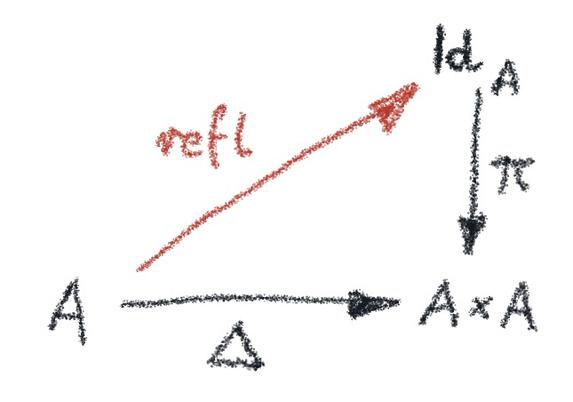
@fanf@mendeddrum.orgfrom my link log —
Identity types.
https://bartoszmilewski.com/2025/09/22/identity-types/
saved 2025-09-26 https://dotat.…
@arXiv_mathSP_bot@mastoxiv.pageOn the finiteness of logarithmic Hamiltonians for Volterra-type lattices in terms of the spectral measures of Jacobi operators
Andrey Osipov
https://arxiv.org/abs/2509.26250 htt…
@arXiv_csGT_bot@mastoxiv.pageOn Dynamic Programming Theory for Leader-Follower Stochastic Games
Jilles Steeve Dibangoye, Thibaut Le Marre, Ocan Sankur, Fran\c{c}ois Schwarzentruber
https://arxiv.org/abs/2512.05667 https://arxiv.org/pdf/2512.05667 https://arxiv.org/html/2512.05667
arXiv:2512.05667v1 Announce Type: new
Abstract: Leader-follower general-sum stochastic games (LF-GSSGs) model sequential decision-making under asymmetric commitment, where a leader commits to a policy and a follower best responds, yielding a strong Stackelberg equilibrium (SSE) with leader-favourable tie-breaking. This paper introduces a dynamic programming (DP) framework that applies Bellman recursion over credible sets-state abstractions formally representing all rational follower best responses under partial leader commitments-to compute SSEs. We first prove that any LF-GSSG admits a lossless reduction to a Markov decision process (MDP) over credible sets. We further establish that synthesising an optimal memoryless deterministic leader policy is NP-hard, motivating the development of {\epsilon}-optimal DP algorithms with provable guarantees on leader exploitability. Experiments on standard mixed-motive benchmarks-including security games, resource allocation, and adversarial planning-demonstrate empirical gains in leader value and runtime scalability over state-of-the-art methods.
toXiv_bot_toot
 @arXiv_mathKT_bot@mastoxiv.page
Crosslisted article(s) found for math.KT. https://arxiv.org/list/math.KT/new
[1/1]:
- On the representation type of a finite tensor category
Petter Andreas Bergh, Karin Erdmann, Julia Yael Plavnik, Sarah Witherspoon
@arXiv_mathAP_bot@mastoxiv.pageHigher H\"older regularity for degenerate elliptic PDEs with data in Morrey spaces
Giuseppe Di Fazio, Rafayel Teymurazyan, Jos\'e Miguel Urbano
https://arxiv.org/abs/2510.10359
@arXiv_mathRT_bot@mastoxiv.pageReplaced article(s) found for math.RT. https://arxiv.org/list/math.RT/new
[1/1]:
- Tilting representations of finite groups of Lie type
Arnaud Eteve
https://
@patrikja@functional.cafeAfter a few intense weeks — first at #icfpsplash25 in Singapore, then four days of interviewing candidates for tenure-track positions as part of the faculty appointment committee (Lärarförslagsnämnd) at the University of Gothenburg — I’m now in Budapest for (mostly) vacation.
Tomorrow (2025-10-27) I’ll give a talk at the local Type Theory Seminar (invited by Ambrus Kaposi). Looking f…

 @arXiv_hepph_bot@mastoxiv.page
Neural network approximation of Euclidean path integrals and its application for the $\phi^4$ theory in 1 1 dimensions
Gabor Balassa
https://arxiv.org/abs/2509.18785 https://
@arXiv_hepth_bot@mastoxiv.pageGhost-free, gauge invariant SVT generalizations of Horndeski theory
S. Mironov, A. Shtennikova, M. Valencia-Villegas
https://arxiv.org/abs/2509.16850 https://
@arXiv_mathAG_bot@mastoxiv.pageStability conditions on Calabi-Yau threefolds via Brill-Noether theory of curves
Soheyla Feyzbakhsh, Naoki Koseki, Zhiyu Liu, Nick Rekuski
https://arxiv.org/abs/2509.24990 https…
 @tomkalei@machteburch.social
… zwischen zwei Saunagängen ne Idee gehabt wie man Martin-Löf dependent type theory im @… erklärt und mir jetzt was Schickes angezogen. Jetzt geht’s noch auf nen 80. Geburtstag (nicht meiner).
What a Life. 🤗
*so lange Star Wars Raumschiffe sagen bis einer keine neuen mehr weiß.
2/2
@arXiv_condmatmtrlsci_bot@mastoxiv.pageThe orbital-driven topological phase transition and planar Hall responses in ternary tellurides Weyl semi-metals
Banasree Sadhukhan, Tanay Nag
https://arxiv.org/abs/2509.19818 h…
@arXiv_mathCO_bot@mastoxiv.pageFrom finding a spanning subgraph $H$ to an $H$-factor
Allan Lo
https://arxiv.org/abs/2509.18832 https://arxiv.org/pdf/2509.18832
@fanf@mendeddrum.orgfrom my link log —
Type theory and functional programming. (1999)
https://www.cs.cornell.edu/courses/cs6110/2015sp/textbook/Simon Thompson textbook.pdf
saved 2025-08-14
@arXiv_mathSG_bot@mastoxiv.pageHamiltonian flow between standard module Lagrangians
Yujin Tong
https://arxiv.org/abs/2511.06431 https://arxiv.org/pdf/2511.06431 https://arxiv.org/html/2511.06431
arXiv:2511.06431v1 Announce Type: new
Abstract: In Aganagic's Fukaya category of the Coulomb branch of quiver gauge theory, the $T_\theta$-brane algebra gives a symplectic realization of the Khovanov-Lauda-Rouquier-Webster (KLRW) algebra, where each standard module is known to admit two Lagrangian realizations: the 'U'-shaped $T$-brane and the step $I$-brane. We show that the latter arises as the infinite-time limit of the Hamiltonian evolution of the former, thus serving as a generalized thimble. This provides a geometric realization of the categorical isomorphism previously established through holomorphic disc counting.
toXiv_bot_toot
@arXiv_hepth_bot@mastoxiv.pageHolographic description of 4d Maxwell theories and their code-based ensembles
Ahmed Barbar, Anatoly Dymarsky, Alfred Shapere
https://arxiv.org/abs/2510.03392 https://
@arXiv_csGT_bot@mastoxiv.pageInvariant Price of Anarchy: a Metric for Welfarist Traffic Control
Ilia Shilov, Mingjia He, Heinrich H. Nax, Emilio Frazzoli, Gioele Zardini, Saverio Bolognani
https://arxiv.org/abs/2512.05843 https://arxiv.org/pdf/2512.05843 https://arxiv.org/html/2512.05843
arXiv:2512.05843v1 Announce Type: new
Abstract: The Price of Anarchy (PoA) is a standard metric for quantifying inefficiency in socio-technical systems, widely used to guide policies like traffic tolling. Conventional PoA analysis relies on exact numerical costs. However, in many settings, costs represent agents' preferences and may be defined only up to possibly arbitrary scaling and shifting, representing informational and modeling ambiguities. We observe that while such transformations preserve equilibrium and optimal outcomes, they change the PoA value. To resolve this issue, we rely on results from Social Choice Theory and define the Invariant PoA. By connecting admissible transformations to degrees of comparability of agents' costs, we derive the specific social welfare functions which ensure that efficiency evaluations do not depend on arbitrary rescalings or translations of individual costs. Case studies on a toy example and the Zurich network demonstrate that identical tolling strategies can lead to substantially different efficiency estimates depending on the assumed comparability. Our framework thus demonstrates that explicit axiomatic foundations are necessary in order to define efficiency metrics and to appropriately guide policy in large-scale infrastructure design robustly and effectively.
toXiv_bot_toot
@arXiv_condmatstrel_bot@mastoxiv.pageContinuum Fractons: Quantization and the Many Body Problem
Ylias Sadki, Abhishodh Prakash, S. L. Sondhi
https://arxiv.org/abs/2510.00110 https://arxiv.org/…
@arXiv_csIT_bot@mastoxiv.pageFinite-blocklength Fluid Antenna Systems
Zhentian Zhang, Kai-Kit Wong, David Morales-Jimenez, Hao Jiang, Hao Xu, Christos Masouros, Zaichen Zhang, Chan-Byoung Chae
https://arxiv.org/abs/2509.15643
@arXiv_mathFA_bot@mastoxiv.pageApproximation by multivariate neural network operators in mixed norm space: theory and application
Priyanka Majethiya, Shivam Bajpeyi
https://arxiv.org/abs/2509.18740 https://…
@arXiv_condmatmtrlsci_bot@mastoxiv.pageType-II Band Alignment in the ${\beta}$-Ga$_2$O$_3$/Rutile GeO$_2$ Heterojunction toward Solar-Blind Photodetection: A first-principles study
D. Q. Fang
https://arxiv.org/abs/2509.19948
@arXiv_mathRT_bot@mastoxiv.pageFrieze patterns in representation theory
Eleonore Faber
https://arxiv.org/abs/2509.16764 https://arxiv.org/pdf/2509.16764
@arXiv_hepth_bot@mastoxiv.pageDynamical Triangulations for 2D Pure Gravity and Topological Recursion
Hiroyuki Fuji, Masahide Manabe, Yoshiyuki Watabiki
https://arxiv.org/abs/2509.18916 https://
@arXiv_mathFA_bot@mastoxiv.pageGeneral Riemann Integration on Partially Ordered Net Convergence Structures
Alexandre Reggiolli Teixeira
https://arxiv.org/abs/2509.24430 https://arxiv.org…
@arXiv_condmatstrel_bot@mastoxiv.pagePreformed Cooper Pairing and the Uncondensed Normal-State Component in Phase-Fluctuating Cuprate Superconductivity
F. Yang, Y. Shi, L. Q. Chen
https://arxiv.org/abs/2509.21133 h…
@arXiv_hepth_bot@mastoxiv.pageSupergroup Invariants and the Brane/Negative Brane Expansion
Kasia Budzik
https://arxiv.org/abs/2509.20451 https://arxiv.org/pdf/2509.20451
@arXiv_mathRT_bot@mastoxiv.pageReplaced article(s) found for math.RT. https://arxiv.org/list/math.RT/new
[1/1]:
- Exceptional sequences of type $B_n/C_n$ and those in the abelian tube
Kiyoshi Igusa, Emre Sen
@arXiv_condmatmtrlsci_bot@mastoxiv.pageCu2XSiS4 (X = Ge, Sn, and Pb) materials for solar-cell applications: A DFT SCAPS-1D simulation
H. Laltlanmawii, L. Celestine, R. Zosiamliana, B. Chettri, S. Bhattarai, K. C. Bhamu, D. P. Rai
https://arxiv.org/abs/2509.20845
@arXiv_mathAP_bot@mastoxiv.pageOn the Landis Conjecture for Positive Quasi-linear Operators on Graphs
Ujjal Das, Matthias Keller, Yehuda Pinchover
https://arxiv.org/abs/2509.20559 https://
@arXiv_condmatstrel_bot@mastoxiv.pageCorrelation Effects on Magnetic Structure and Lattice Dynamics of LaMn$_7$O$_{12}$: A First-Principles Study
Haeyoon Jung, Indukuru Ramesh Reddy, Bongjae Kim, Jiyeon Kim, Sooran Kim
https://arxiv.org/abs/2509.15665