Tootfinder

Opt-in global Mastodon full text search. Join the index!

@pre@boing.world
2025-12-06 13:33:51

The thing about a life-logger, is you input sensitive data about your life, lifestyle and activities, so privacy and data-integrity are some of the most important issues.
There can be no server, the data has to be yours and yours alone. Because you can’t tell what is happening to the data in a closed-source app, it must be completely free and open source.
You can’t trust a corporate diary, they must sell to anyone offering enough money.
So it is with my life log app, all data completely in your own device. No home server ever sees anything.
There is no home server. Just the code.
To achieve this Exocortex Log is a Progressive Web App. It downloads when you are online at the website and can be installed onto the homepage of your phone.
It keeps all data on the local device using indexdb.
This means you must be responsible for your own backups. Be sure to export and back up your data regularly. I have gaps in my ten year record where my phone was stolen and most recent backup was months prior.
Once installed it will work offline, airplane mode, no internet, down in the tube station at midnight, anywhere.
There's a blog on the website saying this and more: exocortexlog.com/news/articles

@aredridel@kolektiva.social
2025-11-28 16:19:02
Content warning: open source whinging

Ugh why is this always the way. I evaluated like 25 authentication servers for a small scale web project — I do want to support things like OIDC and Passkeys, so this is not something I really want to make myself like the old days of “use crypt() on the passwords and just make a simple database”.
5 of them are just dev mode garbage that will never see the light of day as a thing people use.
2 of them are home network nonsense for people who want enterprise login for their family, but where One Nerd controls the whole user-list.
15 of them are freemium "open source" where they withhold features for their enterprise tier and make them so unfortunately difficult to deploy, all requiring postgresql databases and a complex containerization setup and helm charts and oh so much.
and then there's kanidm, which is great except its opinions make it completely unusable for a community project, it's really more trying to fit the ‘enterprise unix authentication' space. Kudos to them for communicating it but it's the wrong tool, even if it is really good.
And then there's rauthy. Which is exactly what I want, well built and delightful, uses a lightweight embedded database, and even has a peer-to-peer sync for scalability. But customizing it is going to be a lesson in building it from source repeatedly, and its configuration is just a bit strange, and its frontend is extremely Backend Developer Wrote A Web UI. I guess I got a second project. And maybe a third to make debian packages of it.
Yet it really is the best of the options _by far_.
NLNet supported projects continue to punch above their weight class.

@zachleat@zachleat.com
2025-11-20 15:06:42

went on a small side quest this morning and added an AI Mode toggle to my blog posts
e.g. zachleat.com/web/adventures-in

@seeingwithsound@mas.to
2025-12-18 20:48:18

For compatibility with future BCIs for restoring vision, The vOICe web app now shows its hi-res color preview in AI compatibility mode at ~10 fps, for BCI software to capture frames at up to 10 fps (like Google Gemini Live and ChatGPT screen sharing do) seeingwithsound.com/webvoice/w

@neverpanic@chaos.social
2026-01-14 22:44:09

On a more positive note, my home now features a #vacuum robot running the open source #Valetudo cloud replacement. The guide on how to do that was surprisingly easy to follow. Some light soldering, a bit of flashing that's pretty similar to rooting an Android device, and it's done.
And becau…

A black PCB roughly the size of a USB stick with pin headers, a button, a jumper header, and a micro-USB and USB-A socket. Next to it, a smaller PCB that provides a 90º breakout for the pins for robots that have their debug port mounted in a less accessible location.

The PCB layout is available on GitHub at https://github.com/Hypfer/valetudo-dreameadapter/tree/master/pcbs/dreamebreakout.
A screenshot of the Valetudo web interface; the left shows a map of the apartment with rooms in different colors. It is heavily blurred, because you all don't need the floor plan of where I live. The right side shows controls for the robots to set operation mode, fan and water use, issue commands to the dock and show statistics for the last run.
@pre@boing.world
2026-02-02 12:33:00

One thing which is annoying about Vivaldi and also Firefox and presumably also all the other Android web browsers is the way the "Add To Homescreen" button works on pages like Mastodon which are Progressive Web Apps.
If you add the shortcut to the homescreen then it opens as a WPA which means the browser stuff is all gone and hidden. No back button. No way to bookmark. No way to launch a link in a new browser window etc.
Ought to be two separate buttons for "Add a link to the homepage" vs "Add this app as an app to the homepage" but there isn't.
You can get around this by turning on airplane mode and adding a link to the error page to the homescreeen, which then works as a link to the website in the browser, not a WPA app, when you're online again.
I did this to the links I use with Vivaldi before I realized it's proprietary and so will not do.
Trying to rebuild them as Firefox links again and sadly something is broken now. Won't add the error page. Tells me the pixel launcher is crashing.
So I can't have the old web bookmark links to pages in WPA apps. Boo. 😦

@gracion@social.linux.pizza
2026-01-09 15:59:47

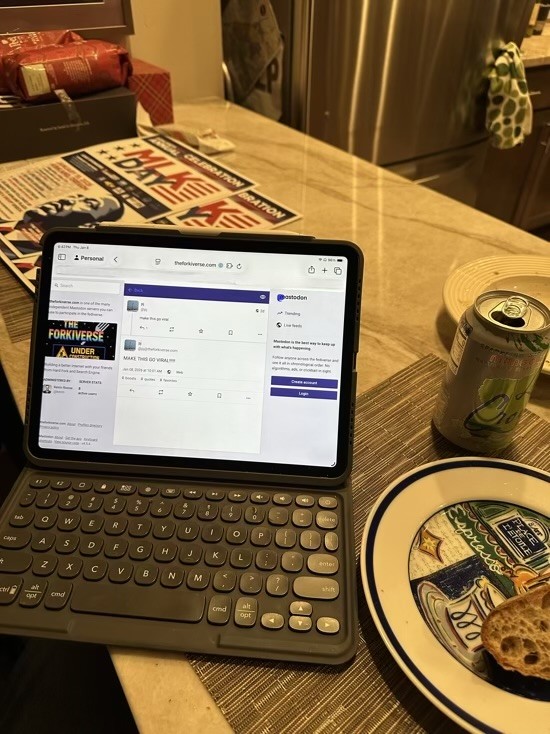
@… Pulled up theforkiverse.com in the kitchen while listening via incognito mode. Thanks for following through on fediverse reporting—fun episode, well explained. A followup might cover all the other fedi app types. You could even stream an episode recording session on Owncast (what’s the worst that could happen? :-) Enjoy your no-algo feed.

An ipad viewing a Mastodon instance web site, on a kitchen counter near a plate with a slice of bread and a LaCroix can