 @radioeinsmusicbot@mastodonapp.uk
2026-02-23 07:57:41
🇺🇦 Auf radioeins läuft...
Godford:
🎵 The Beast
#NowPlaying #Godford
https://godford.bandcamp.com/track/the-beast
https://open.spotify.com/track/0UiKfFGwVPf4ViApUorBkx
 @mmuenzl@sueden.social
2026-03-19 08:07:34
#fotovorschlag 'Umrisse' Am Verdens Ende - Am Ende der Welt
#Norwegen

 @azonenberg@ioc.exchange
2026-02-21 02:11:10
So one of the next scopehal filters on deck for a revamp is the NCO. It takes in a frequency vs time waveform and outputs a frequency modulated sine whose frequency tracks the input.
The refactoring was easy but I'm struggling with how to parallelize it. It's trivial to parallelize synthesis of a fixed frequency sine (since you can easily predict the phase at any future time) but if the frequency can change over time I'm not sure how you could predict the future phase witho…
 @penguin42@mastodon.org.uk
2026-01-18 18:13:34
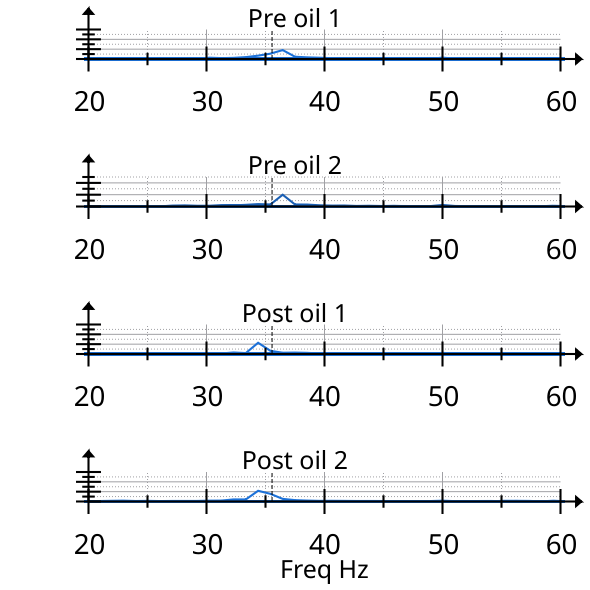
Continuing in the process of measuring the speed of my turntable in the oddest way; here is the FFT before and after oiling & replacing it's belt. Hmm, it's clearly a bit fast before and a bit slow after; it's not got any speed adjustment mechanism, it's a belt on an AC driven motor.
This FFT and plot was done using #labplot using the waveforms gathered by
 @arXiv_csGR_bot@mastoxiv.page
2026-01-22 07:44:12
PAColorHolo: A Perceptually-Aware Color Management Framework for Holographic Displays
Chun Chen, Minseok Chae, Seung-Woo Nam, Myeong-Ho Choi, Minseong Kim, Eunbi Lee, Yoonchan Jeong, Jae-Hyeung Park
https://arxiv.org/abs/2601.14766 https://arxiv.org/pdf/2601.14766 https://arxiv.org/html/2601.14766
arXiv:2601.14766v1 Announce Type: new
Abstract: Holographic displays offer significant potential for augmented and virtual reality applications by reconstructing wavefronts that enable continuous depth cues and natural parallax without vergence-accommodation conflict. However, despite advances in pixel-level image quality, current systems struggle to achieve perceptually accurate color reproduction--an essential component of visual realism. These challenges arise from complex system-level distortions caused by coherent laser illumination, spatial light modulator imperfections, chromatic aberrations, and camera-induced color biases. In this work, we propose a perceptually-aware color management framework for holographic displays that jointly addresses input-output color inconsistencies through color space transformation, adaptive illumination control, and neural network-based perceptual modeling of the camera's color response. We validate the effectiveness of our approach through numerical simulations, optical experiments, and a controlled user study. The results demonstrate substantial improvements in perceptual color fidelity, laying the groundwork for perceptually driven holographic rendering in future systems.
toXiv_bot_toot
 @heiseonline@social.heise.de
2026-01-29 15:59:00
@azonenberg@ioc.exchange2026-02-21 00:02:39
Anybody have a non emergency service contact for Puget Sound Energy? They have a contact to report outages and downed wires but not lower priority issues.
We've pretty definitively figured out what's going on at my friends' place: intermittent brownouts on one of the two 120V phases affecting the entire house but not neighbors. Waveforms show glitches in the sine right above and below the zero crossing consistent with series arcing. And it happens more often in windy weathe…
@azonenberg@ioc.exchange2026-02-16 18:10:15
1.7x speedup on the 100baseT1 decode from doing the PAM3 demodulation (but not the descrambling) in a shader.
Now the whole baseT1 demo is running at about 8 WFM/s, with a roughly 125ms filter graph execution time (on 80ms of waveform data, so real time would be 12.5 WFM/s)
This breaks down (roughly, not exact due to parallel execution) to:
* 1.3 ms subtract diffpair legs
* 10.6 ms de-embed directional coupler
* 0.6 ms equalization
* 7.5 ms upsample
* 14…
 @azonenberg@ioc.exchange
2026-01-08 14:30:03
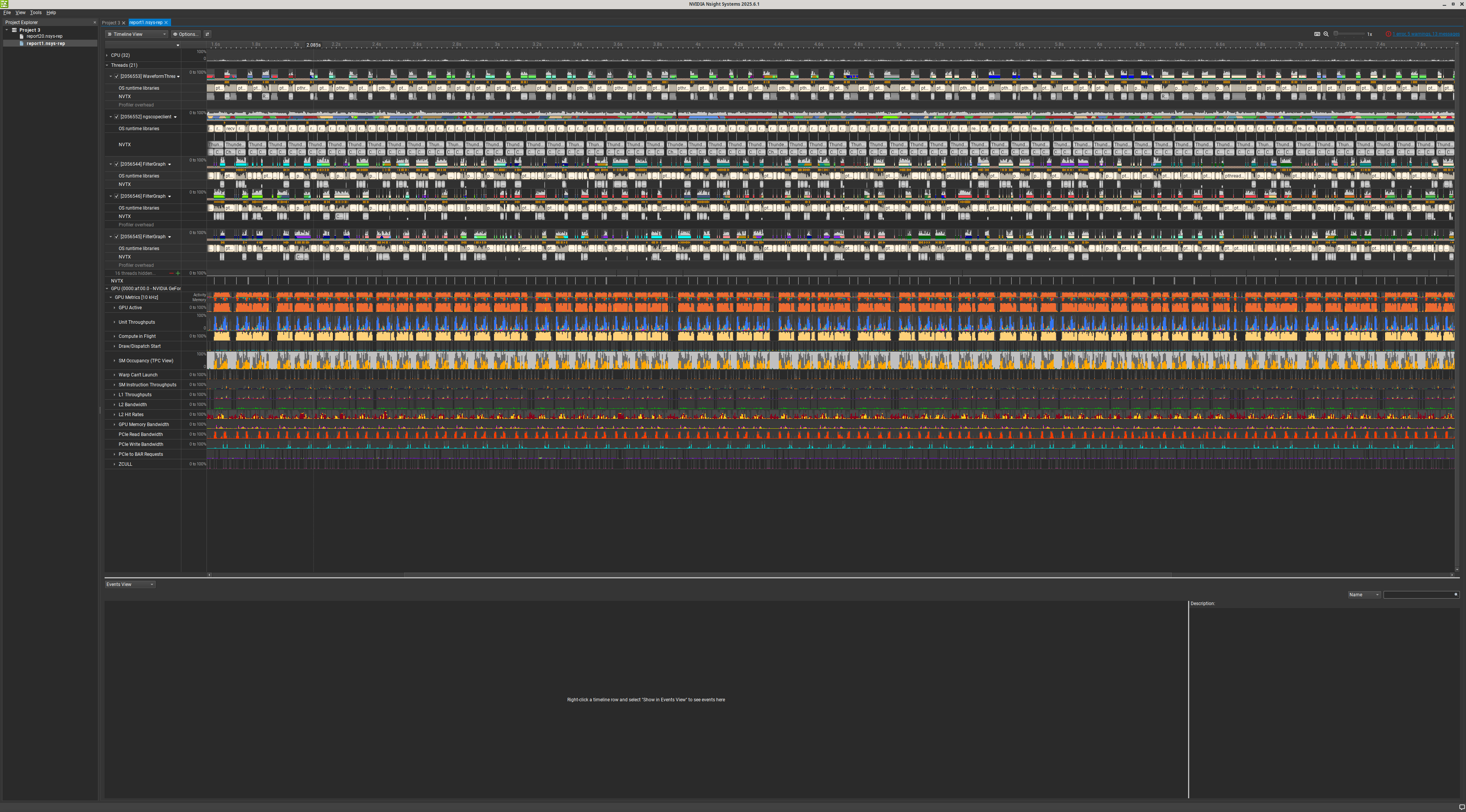
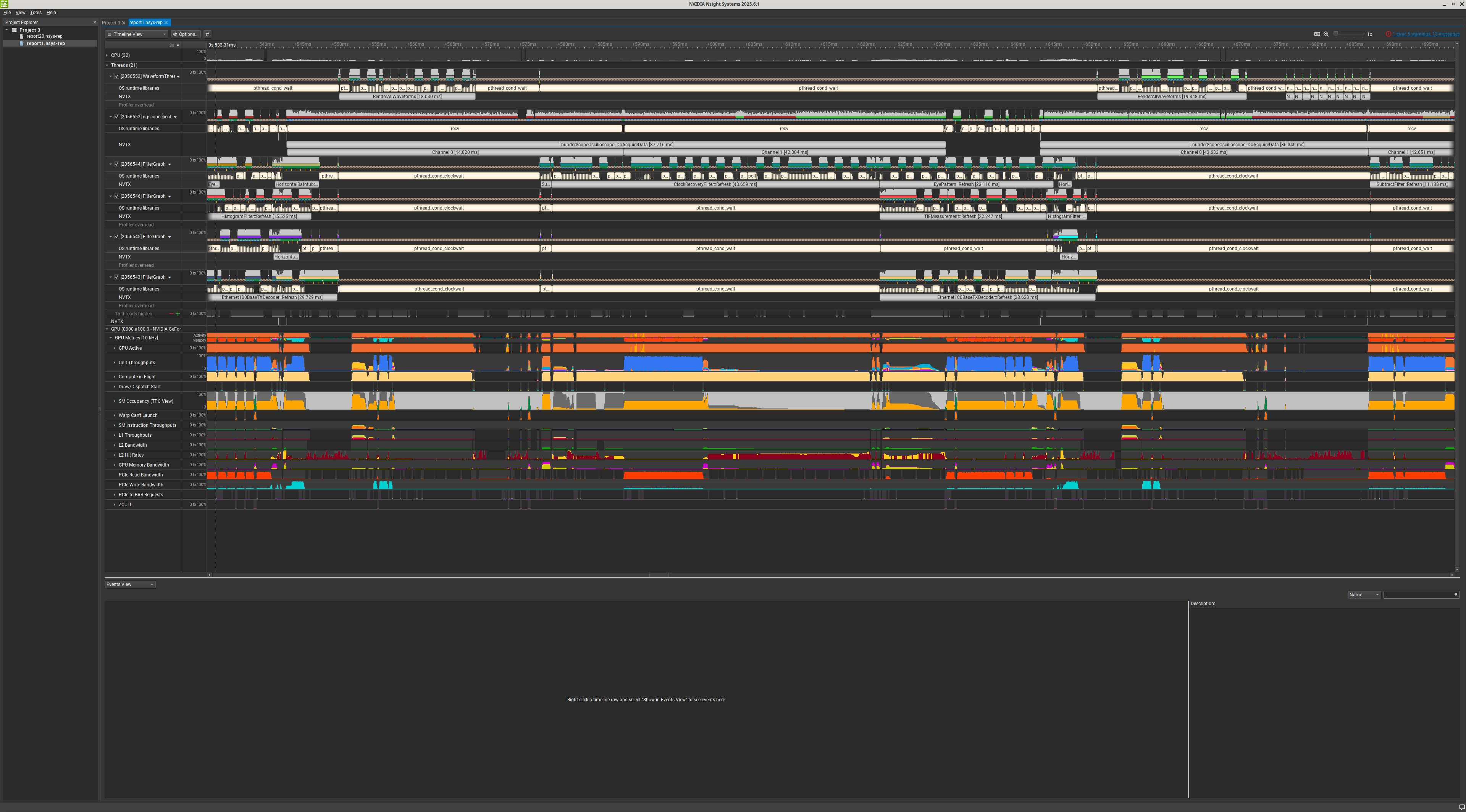
ngscopeclient is pretty fast, but it's never fast enough.
NVTX instrumentation has been super handy for helping to understand what's going on and which shaders are bogging things down.
I really need to make the CDR PLL both faster and not have artifacts at block boundaries. That's my single biggest pain point at the moment.
I'd love to find more people to help out with this side of things eventually. But where the heck do I find an AAA game shader developer …
 @azonenberg@ioc.exchange
2026-01-13 16:17:14
Now that I'm on a GPU acceleration kick in ngscopeclient again I'm spoiled. Every time I use a filter block even on a massive waveform I expect it to be instantaneous and get frustrated when it's not lol.
If this keeps up we'll have GPU i2c and spi decodes pretty soon.