Unsplittable Transshipments
Srinwanti Debgupta, Sarah Morell, Martin Skutella
https://arxiv.org/abs/2602.07230 https://arxiv.org/pdf/2602.07230 https://arxiv.org/html/2602.07230
arXiv:2602.07230v1 Announce Type: new
Abstract: We introduce the Unsplittable Transshipment Problem in directed graphs with multiple sources and sinks. An unsplittable transshipment routes given supplies and demands using at most one path for each source-sink pair. Although they are a natural generalization of single source unsplittable flows, unsplittable transshipments raise interesting new challenges and require novel algorithmic techniques. As our main contribution, we give a nontrivial generalization of a seminal result of Dinitz, Garg, and Goemans (1999) by showing how to efficiently turn a given transshipment $x$ into an unsplittable transshipment $y$ with $y_a<x_a d_{\max}$ for all arcs $a$, where $d_{\max}$ is the maximum demand (or supply) value. Further results include bounds on the number of rounds required to satisfy all demands, where each round consists of an unsplittable transshipment that routes a subset of the demands while respecting arc capacity constraints.
toXiv_bot_toot
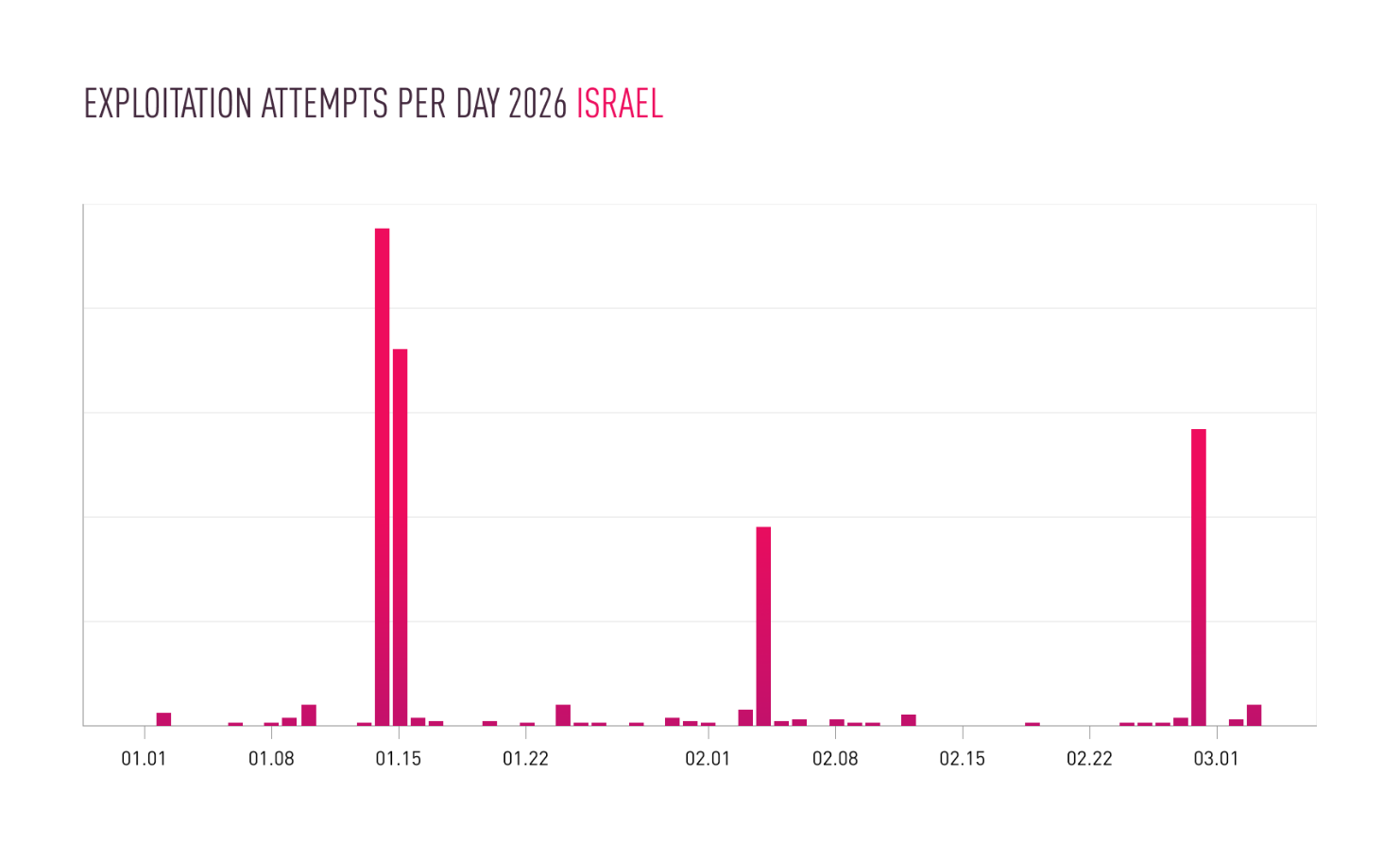
Bar plots like these may raise more questions than answers.
Without any y-axis label what are we to make of this? We don't really have a sense of scale.
Are two months on the x-axis long enough to show correlation or just coincidence?
They show graphs only for select neighbor countries all with a spike on or around around 3/1. What about non-neighbor countries? Could this have been a global phenomenon?
Don't want to pick on the source (in the image alt text)…
On Zero-Dimensional Glicci Monomial Ideals
Benjamin Mudrak
https://arxiv.org/abs/2602.03703 https://arxiv.org/pdf/2602.03703 https://arxiv.org/html/2602.03703
arXiv:2602.03703v1 Announce Type: new
Abstract: Consider the polynomial ring $R_n = k[x_1,...,x_n]$, where $k$ is a field. Let $m = (x_1,...,x_n)$ and $I$ be an $m$-primary monomial ideal in $R$. We consider the problem of determining whether such ideals are in the Gorenstein liasion class of a complete intersection (glicci). We prove that all $m$-primary monomial ideals in $k[x,y,z]$ with at most eight generators are homogeneously glicci. We also construct a large class of $m$-primary monomial ideals in $R_n$ for any $n$ with any number of minimal generators that are homogeneously glicci but not in the complete intersection liaison class of a complete intersection (licci). All Gorenstein links used are constructed explicitly and every second step links to another $m$-primary monomial ideal.
toXiv_bot_toot
A tautological continuous field of Roe bimodules
Vladimir Manuilov
https://arxiv.org/abs/2603.23366 https://arxiv.org/pdf/2603.23366 https://arxiv.org/html/2603.23366
arXiv:2603.23366v1 Announce Type: new
Abstract: We generalize the notion of a continuous field of C*-algebras to that of Hilbert C*-bimodules. Given a partially ordered set $P$ and a monotonically non-decreasing family of ternary rings of operators (TROs) assigned to the points of $P$, we equip $P$ with a certain zero-dimensional Hausdorff topology and use a certain compactification $\gamma P$ to get the base space for a continuous field of Hilbert C*-bimodules over $\gamma P$.
As a motivating example, we consider the set $D(X,Y)$ of coarse equivalence classes of metrics on the disjoint union of two metric spaces, $X$ and $Y$. Each such class gives rise to a uniform Roe bimodule, a TRO linking the uniform Roe algebras of $X$ and $Y$. The resulting family of TROs is non-decreasing with respect to the natural partial order on $D(X,Y)$ and thus yields a tautological continuous field of Hilbert C*-bimodules over $\gamma D(X,Y)$.
toXiv_bot_toot
In the interests of starting a more productive dialogue than yesterday's main character was interested in, let's make a #brainstorm thread about design changes to ActivityPub and/or client UI that could actually help address drive-by (often racist) harassment on the fediverse.
Feel free to discuss pros/cons but don't feel an idea needs to be perfect to suggest it. Also since this is a brainstorm don't worry about complexity/implementation cost. If you have a great-but-hard-to-implement idea someone else may think of a way to simplify it.
Note that the underlying problem *is* a social one, do there won't be a technological fix! But tech changes can make social remedies easier/harder.
I've got some to start:
1. Have a "protected mode" that users can voluntarily turn on. Some servers might turn it on by default. In protected mode, users whose accounts are less than D days old and/or who have fewer than F followers can't reply to or DM you. F and D could have different values for same-sever vs. different-server accounts, and could be customized by each user. Obviously a dedicated harasser can get around this, but it ups the activation energy for block evasion and pile-ons a bit. Would be interesting to review moderation records to estimate how helpful this might or might not be. Could also have a setting to require "follows-from-my-server" although that might be too limiting on private servers. Restriction would be turned off for people you mention within that thread and could be set to unlimit anyone you've ever mentioned. Would this lock new users out of engagement entirely? If everyone had it on via a default, you'd have you post your own stuff until someone followed you (assuming F=1). One could add "R non-moderated replies" and/or "F favorites" options to soften things; those experiencing more harassment could set higher limits. When muting/blocking/reporting someone who replied to your post, protected mode could be suggested with settings that would have filtered the post you're reporting.
2. Enable some form of public moderation info to be displayed when both moderator and local server opt-in. Obviously each server would be able to ignore federated public tags. I'm imagining "banned from X server for R reason (optional link to evidence)" appearing on someone's profile & an icon on their PFP in each post viewed by someone on server Y *if* the mods of server X decide it's appropriate *and* server Y opts in to displaying such tags from server X specifically. Alliances of servers with similar moderation preferences could then have moderation action on one server result in clear warning propagation to others without the other mods needing to decide whether to also take action immediately. In some cases different moderation preferences would mean you wouldn't take action yourself but would keep the notice up for your users to consider. Obviously the "Scarlet Letter" vibe ain't great, but in some cases it's deserved, and when there's disagreement between servers about that, mods on server Y could either disable a specific tag or disable federation of mod tags from that server in general. Even better shared moderation tools are of course possible.
3. Different people/groups have different norms around boosting. Currently we only have a locked/public binary. Without any big protocol changes, adding a "prefers boosts/doesn't" setting which would warn in the UI before a viewer chooses to boost if the preference is "doesn't" could help. This could be set per-post, but could also have defaults and could have different values for same-server or not, or for particular servers. For example, I could say "default to prefer boosts from users on my server but not from users on other servers" or "default to prefer boosting on all servers except mastodon.social." Last option might be harder to implement I guess.
#ActivityPub #Meta #Harassment
Find the best contrast between one color and a list of options, e.g. for labels in geom_tile: {prismatic::best_contrast()} https://emilhvitfeldt.github.io/prismatic/reference/best_contrast.html
Normality of monomial ideals in three variables
Maki Ataka, Naoyuki Matsuoka
https://arxiv.org/abs/2602.01782 https://arxiv.org/pdf/2602.01782 https://arxiv.org/html/2602.01782
arXiv:2602.01782v1 Announce Type: new
Abstract: An ideal $I$ in a Noetherian ring is called \textit{normal} if $I^n$ is integrally closed for all $n \geq 1$. Zariski proved that in two-dimensional regular local rings, every integrally closed ideal is normal. However, in dimension three and higher, this is no longer true in general, including monomial ideals in polynomial rings.
In this paper, we study the normality of integrally closed monomial ideals in the polynomial ring $k[x,y,z]$ over a field $k$. We prove that every such ideal with at most seven minimal monomial generators is normal, thereby giving a sharp bound for normality in this setting. The proof is based on a detailed case-by-case analysis, combined with valuation-theoretic and combinatorial methods via Newton polyhedra.
toXiv_bot_toot
 @seav@en.osm.town