The U.S. Forest Service is closing 57 of its 77 research facilities in 31 states
under a reorganization plan announced this week,
threatening science that looked at how wildfires, drought, pests and global warming are putting pressure on forests.
The agency plans to consolidate its research division into a centralized office in Fort Collins, Colo.,
and move field researchers to locations in nearby states.
But employees said they feared the move would lead many s…
What is the maximum amount of value destruction that could be wrought on the big centralized commercial AI vendors, and the maximum amount of acceleration of the ecosystem of open source and community-led
alternatives, using the knowledge gained from the leak of the Claude Code source code?
What's interesting is that this exact set of technologies leads to decision paralysis in centralized organizations:
https://mwi.westpoint.edu/cognitive-fratricide-how-the-transparent-battlefield-creates-decision-paralysis/
The problem here is a structural one, a function of hierarchy, where the direction of the flow of power determines what technology can do and how it can e used.
In a distributed network, this information is used by a central system to distribute data back to people so they can make the most informed decision. In a centralized network, this information is used to increase the power of central control node. It's a question of who is helping whom, who is autonomous and who is support.
While listening to discussions about federated systems and protocols at #fosdem (like the one I’m currently using): I realized something.
It recently resonated with me through some past and ongoing projects: when people are afraid of federation, they call it “balkanization” or “fragmentation.”
Sorry for the wording @…
Working on extending features for Warlock, and this round of features requires a backend web service running in a centralized, controlled environment due to the requirement of privileged access to partner network resources, (aka, they require an API key and prior authorization to access certain data, thus cannot be distributed in an open source project).
SO, since this is a traditional web service, I opted to use the traditional technologies to power it, but wanted to try out Symfony s…
There seems to be a new attempt to turn ActivityPub into some centralized monolithic thing with hard coded limited vocabularies. This is an attempt to have a new central power in social networking via the control of the vocabularies of the exchange protocols.
The argument is the same for the same attempt in the area of credentials and wallets: The format is sooo complex, we can't implement. Let's do a simple protocol instead. And BTW, protocol/format combinations are great, pl…
Fediverse Punk Month — We can grow something better!
We invest too much of our culture in centralized, for-profit, corporate social media platforms. These platforms enrich billionaires, expand surveillance, and fund the cult of capitalist war, all while trapping us with addictive algorithms that feed us mindless content. […]
— by @…<…
I just learned that a new release of the decentralized, open source Android (and iOS, but that requires a centralized Apple service) key attestation library warden-supreme has landed. It explicitly supports alternative/custom roots of trust for the attestation chain now and comes with a test for @… keys:
Überraschung am Morgen. Das Letsencrypt Zertifikat für meine Website https://pixelgalaxy.net war abgelaufen und wurde nicht automatisch erneuert. Die Pixelfed Instanz läuft auf einem Server mit Yunohost. Da hat Yunohost wieder Eigenheiten entwickelt, die einem nicht gefallen können. Das Verzeichnis für die Zertifikate…
Art Board is a centralized directory of visual arts exhibitions in the nine counties of the San Francisco Bay Area. It aims to support the local arts community by making this information more accessible and allowing people to more easily find and attend local arts events. https://artboard.info/
One of the best features of personal computing is that it’s not renting capacity from centralized data centers that are vulnerable to missile attacks computing
We’ve been saying this for years now, and we’re going to keep saying it until the message finally sinks in:
mandatory age verification creates massive, centralized honeypots of sensitive biometric data that will inevitably be breached.
Every single time.
And every single time it happens,
the politicians who mandated these systems and the companies that built them act shocked—shocked!
—that collecting enormous databases of government IDs, facial scans, and bio…
RE: https://twit.social/@MisuseCase/116213208120901739
Among the many, many, many reasons not to allow voting over the Internet, consider what the Trump regime would do with that kind of centralized power.
Working on extending features for Warlock, and this round of features requires a backend web service running in a centralized, controlled environment due to the requirement of privileged access to partner network resources, (aka, they require an API key and prior authorization to access certain data, thus cannot be distributed in an open source project).
SO, since this is a traditional web service, I opted to use the traditional technologies to power it, but wanted to try out Symfony s…
RE: https://theforkiverse.com/@pj/115888532620954856
this makes this the 29th biggest server on the fediverse which I guess just highlights how centralized and small the whole fediverse operation is.
Bikelution: Federated Gradient-Boosting for Scalable Shared Micro-Mobility Demand Forecasting
Antonios Tziorvas, Andreas Tritsarolis, Yannis Theodoridis
https://arxiv.org/abs/2602.20671 https://arxiv.org/pdf/2602.20671 https://arxiv.org/html/2602.20671
arXiv:2602.20671v1 Announce Type: new
Abstract: The rapid growth of dockless bike-sharing systems has generated massive spatio-temporal datasets useful for fleet allocation, congestion reduction, and sustainable mobility. Bike demand, however, depends on several external factors, making traditional time-series models insufficient. Centralized Machine Learning (CML) yields high-accuracy forecasts but raises privacy and bandwidth issues when data are distributed across edge devices. To overcome these limitations, we propose Bikelution, an efficient Federated Learning (FL) solution based on gradient-boosted trees that preserves privacy while delivering accurate mid-term demand forecasts up to six hours ahead. Experiments on three real-world BSS datasets show that Bikelution is comparable to its CML-based variant and outperforms the current state-of-the-art. The results highlight the feasibility of privacy-aware demand forecasting and outline the trade-offs between FL and CML approaches.
toXiv_bot_toot
If you don’t already know, I’m an anarcho-syndicalist and I’m tired of people thinking that means I’m some authoritarian commie pretending to be leftist. I don’t bootlick party lines or worship dead strongmen. Centralized power rots no matter what color the flag is.
Hear me out, I’ve read actual labor history, I know what labor power means. We build our politics on horizontal organizing and direct action, not on some bureaucrat ordering purges in the name of the people. Real socialism …
I have a theory that being a too-many-tabs person correlates strongly with how many captchas you see. So if you have 300 tabs open, and then you need to restart your browser and recover your tabs, your computer is hitting a whole bunch of cloudflare (or whatever centralized captcha org) sites at once which raises suspicions. And orgs like cloudflare probably track IP address reputations, almost like blacklists.
Is this on track? Is there anything out on the 'net that might bac…
Automating Computational Chemistry Workflows via OpenClaw and Domain-Specific Skills
Mingwei Ding, Chen Huang, Yibo Hu, Yifan Li, Zitian Lu, Xingtai Yu, Duo Zhang, Wenxi Zhai, Tong Zhu, Qiangqiang Gu, Jinzhe Zeng
https://arxiv.org/abs/2603.25522 https://arxiv.org/pdf/2603.25522 https://arxiv.org/html/2603.25522
arXiv:2603.25522v1 Announce Type: new
Abstract: Automating multistep computational chemistry tasks remains challenging because reasoning, workflow specification, software execution, and high-performance computing (HPC) execution are often tightly coupled. We demonstrate a decoupled agent-skill design for computational chemistry automation leveraging OpenClaw. Specifically, OpenClaw provides centralized control and supervision; schema-defined planning skills translate scientific goals into executable task specifications; domain skills encapsulate specific computational chemistry procedures; and DPDispatcher manages job execution across heterogeneous HPC environments. In a molecular dynamics (MD) case study of methane oxidation, the system completed cross-tool execution, bounded recovery from runtime failures, and reaction network extraction, illustrating a scalable and maintainable approach to multistep computational chemistry automation.
toXiv_bot_toot
Part 3 - Moving forward
One of Mastodon's strengths is its decentralized structure. That also means no centralized marketing or development strategy focused on growth, particularly in Canada. Perhaps a volunteer group could take on that development plan and grow the Canadian user base.
- A vision of what an ideal future state would look like would benefit the planning and action steps. Collecting input from Canadian admins is recommended.
- We shouldn't burden existing admins beyond their current responsibilities. Volunteers would take actions like reaching out to politicians or government agencies.
Potential next steps:
1) Host a web meeting with interested Canadian admins to collect input on a shared vision for this project.
2) Collect volunteers who would be interested in reaching out to politicians or government agencies about creating a presence on Mastodon.
3) Select members of the group to be part of a steering committee.
4) Create a unique hashtag for this project for reporting and followers.
@… @… In part the problem is that internet infrastructure has been invested in and managed in a centralized way for so long that it takes significant investment of resources and time to develop any reasonable a…
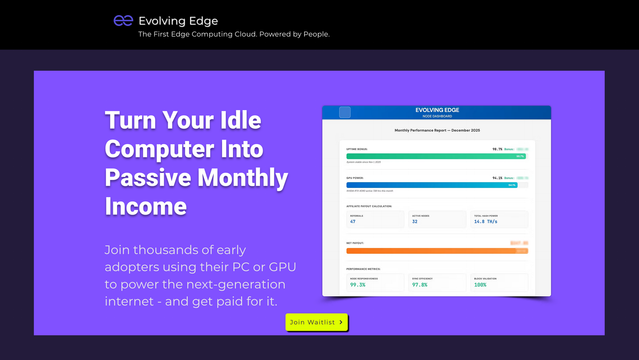
The Edge Computing Cloud is opening to early adopters at #SXSW. Turn idle home internet and hardware - Mac Minis, old PCs, even NAS boxes - into a decentralized edge cloud. Install our open-source agent, leave it running, and earn cash for helping deliver content and run AI inference 2x faster than centralized clouds. We handle security, routing, and node trust. Join before March 31st for 2x payou…
This becomes especially interesting when you understand the history of the church as a quasi-revolutionary organization. One could describe early church history as a mostly-successful attempt to overthrow the Roman empire. I say mostly successful because, in the end, the Roman state mutated the church for it's own ends and basically pulled a Lenin.
The early church was a religion of women and slaves that set up alternative institutions. See, the Roman economic system basically ran through the temples. Temples were basically the banks of their day (thus money changers in the temples and all that). So when the church set up their own institutions, they were actually attacking the economic system of the Roman empire. *That* is why the empire tried to destroy them. The Romans didn't really care about the gods. They would just mutate their beliefs to pull other pagans in. No, it wasn't about the gods. The Christian were fucking with the money.
The whole church as an institution was about dual power, and Paul (one of the early founders of the church) was central to organizing this into a political machine that could actually threaten the dominant order. One could argue that he saw the potential of the church, and used it to solidify his own power.
It all basically worked, right up until Constantine figured out how to flip the whole thing against the most radical elements. He had his people collect up different books of the Bible and modify them in such a way that it favored Rome. The trick here was to highlight the existing antisemitic threads of early church, and destroy the anti-Roman ones. Anti-authoritarian sects were killed as heretics, and centralized sects became aligned under the church.
This strategy of controlling internal dissent probably feels quite familiar. It's basically how the US works.
But this whole time, during the whole lead up to this, Christianity was illegal and it was continuing to grow as a system of dual power. When Romanism merged with Christianity, it created the most authoritarian institution in human history that brutally destroyed all opposition. Even still, several hundred years later it's power broke.
Today Liberalism has separated banking and the church, and has created the illusion of separation of church and state. But the same dual power strategy that allowed the first church to gain enough power to merge with the Roman power structure have now allowed Christian Nationalism to fully merge with Americanism into the Christian Fascism we see today...
Mastodon, a decentralized, open source social media platform and alternative to centralized social media apps like X and Threads,
announced on Wednesday its plans to make its platform more approachable for newcomers
while also targeting creators with the launch of new features.
The changes follow the expansion of Mastodon’s core development team over the past 18 months
to include people with experience across web and mobile and back end,
as well as the hiring o…
On Electric Vehicle Energy Demand Forecasting and the Effect of Federated Learning
Andreas Tritsarolis, Gil Sampaio, Nikos Pelekis, Yannis Theodoridis
https://arxiv.org/abs/2602.20782 https://arxiv.org/pdf/2602.20782 https://arxiv.org/html/2602.20782
arXiv:2602.20782v1 Announce Type: new
Abstract: The wide spread of new energy resources, smart devices, and demand side management strategies has motivated several analytics operations, from infrastructure load modeling to user behavior profiling. Energy Demand Forecasting (EDF) of Electric Vehicle Supply Equipments (EVSEs) is one of the most critical operations for ensuring efficient energy management and sustainability, since it enables utility providers to anticipate energy/power demand, optimize resource allocation, and implement proactive measures to improve grid reliability. However, accurate EDF is a challenging problem due to external factors, such as the varying user routines, weather conditions, driving behaviors, unknown state of charge, etc. Furthermore, as concerns and restrictions about privacy and sustainability have grown, training data has become increasingly fragmented, resulting in distributed datasets scattered across different data silos and/or edge devices, calling for federated learning solutions. In this paper, we investigate different well-established time series forecasting methodologies to address the EDF problem, from statistical methods (the ARIMA family) to traditional machine learning models (such as XGBoost) and deep neural networks (GRU and LSTM). We provide an overview of these methods through a performance comparison over four real-world EVSE datasets, evaluated under both centralized and federated learning paradigms, focusing on the trade-offs between forecasting fidelity, privacy preservation, and energy overheads. Our experimental results demonstrate, on the one hand, the superiority of gradient boosted trees (XGBoost) over statistical and NN-based models in both prediction accuracy and energy efficiency and, on the other hand, an insight that Federated Learning-enabled models balance these factors, offering a promising direction for decentralized energy demand forecasting.
toXiv_bot_toot
I just learned that a new release of the decentralized, open source Android (and iOS, but that requires a centralized Apple service) key attestation library warden-supreme has landed. It explicitly supports alternative/custom roots of trust for the attestation chain now and comes with a test for @… keys:
There are a lot of takeaways from this:
1. Organizing locally gives you a massive advantage because you will always know your local area better than ICE ever can.
2. Be agile. You can always change tactics faster than a centralized organization.
3. Organize now. The sooner you build your networks, the sooner you can learn.
4. Identify ICE facilities and organize monitoring them directly.
But I think the most interesting one that's not explicitly in there, one that's hinted at the last one, is to go on the offensive. ICE is already afraid. If we all take the anger we have at the murder of #ReneGood, find the local ICE facility that they'll stage from, and bring that anger to #OccupyICE we might be able to just shut the whole thing down preemptively. Completely stop all ICE operations across the US. If they want to fight, they can fight *with everyone, all at once.*
Shut down their ability to operate at all. They have a logistics pipeline. They need cars, they need oil in those cars, they need to be able to move those cars to target areas. They also need money to pay those agents. All of those can be disrupted.
The regime needs your money and labor to maintain the illusion of legitimacy. They chose a bad time because you can hit both of those at once *right now* with a combination of #GeneralStrike and #TaxStrike, and then #BoycottEverything.
The regime is weaker than it's ever been. It's flailing. Their own base is demanding the release of the #EpsteinFiles. Their last gasp attempt to prevent the radical change that's coming is just to ethnically cleanse the US back to the 50's (which is what they always meant by "Make America Great Again"). Trump will do anything to stay in power, even if it means killing everyone on Earth in the process. But Americans can end it now by going on the offensive.
Now is the time.
#USPol
 @cdarwin@c.im