Tootfinder

Opt-in global Mastodon full text search. Join the index!

@cosmos4u@scicomm.xyz
2026-02-12 13:46:03

Prospects for #Comet C/2026 A1 MAPS - a comet with a narrow tail in the evening twilight, with uncertain but potentially high brightness? hdr-astrophotography.com -> Tail simulations for comet MAPS: groups.io/g/comets-ml/message/ - in order not to depend on a single prediction, i have simulated different scenarii.

@cosmos4u@scicomm.xyz
2026-02-12 03:20:40

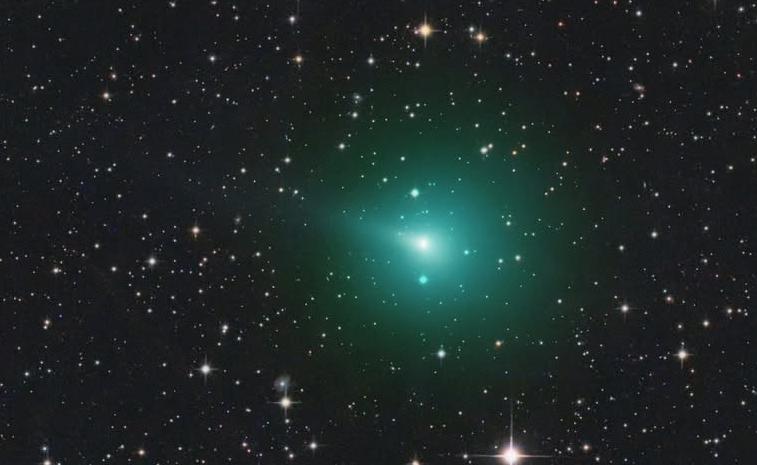
#Comet C/2024 E1 (Wierzchos) and #Galaxy NGC 55
Date: 11 02 2026 UT 18:39
Location: Farm Tivoli, #Namibia
Telescope: ASA Astrograph 12" f3.6
Camera: ZWO ASI 6200 MM Pro
Mount: ASA DDM 85
Exp.Time: LRGB 10/2/2/2 min.
Gerald Rhemann and Michael Jäger

@cosmos4u@scicomm.xyz
2026-03-10 00:31:43

The #Kreutz #comet #MAPS "has become more than 1 mag brighter between March 6 and 9" and stands at 10.5 mag. right now: groups.io/g/comets-ml/message/ and facebook.com/photo/?fbid=23744 with the latest picture by Jäger & Rhemann here - less than 4 weeks til perihelion, and the brightness continues to rise with a strong n~8 ...

@cosmos4u@scicomm.xyz
2026-03-04 23:25:41

So the new #Kreutz #comet #MAPS is *still* following the constant rapid rise in brightness it has shown since discovery: a dumb extrapolation - cobs.si/analysis/?comet=2688&f - has it get 10,000-times brighter than the Sun at its extremely close perihelion which makes so sense at all, of course, physically.
"It must therefore be assumed that this increase in activity will level off significantly in the near future," writes fg-kometen.vdsastro.de/koj_202: "More likely are parameters m m0=12.0 mag / n=4 (or even lower), which would still result in a (very short-term) maximum brightness of about –9 mag (but this would probably still be significantly too bright) – always assuming that the comet survives its perihelion passage unscathed."
For other views see cbat.eps.harvard.edu/iau/cbet/ and arxiv.org/abs/2602.17626 and facebook.com/photo?fbid=102365 and cometografia.es/cometa-kreutz- - and the actual brightness is tracked at cobs.si/obs_list?id=2688 where it has reached ~11.5 mag. now.

@cosmos4u@scicomm.xyz
2026-03-03 02:14:37

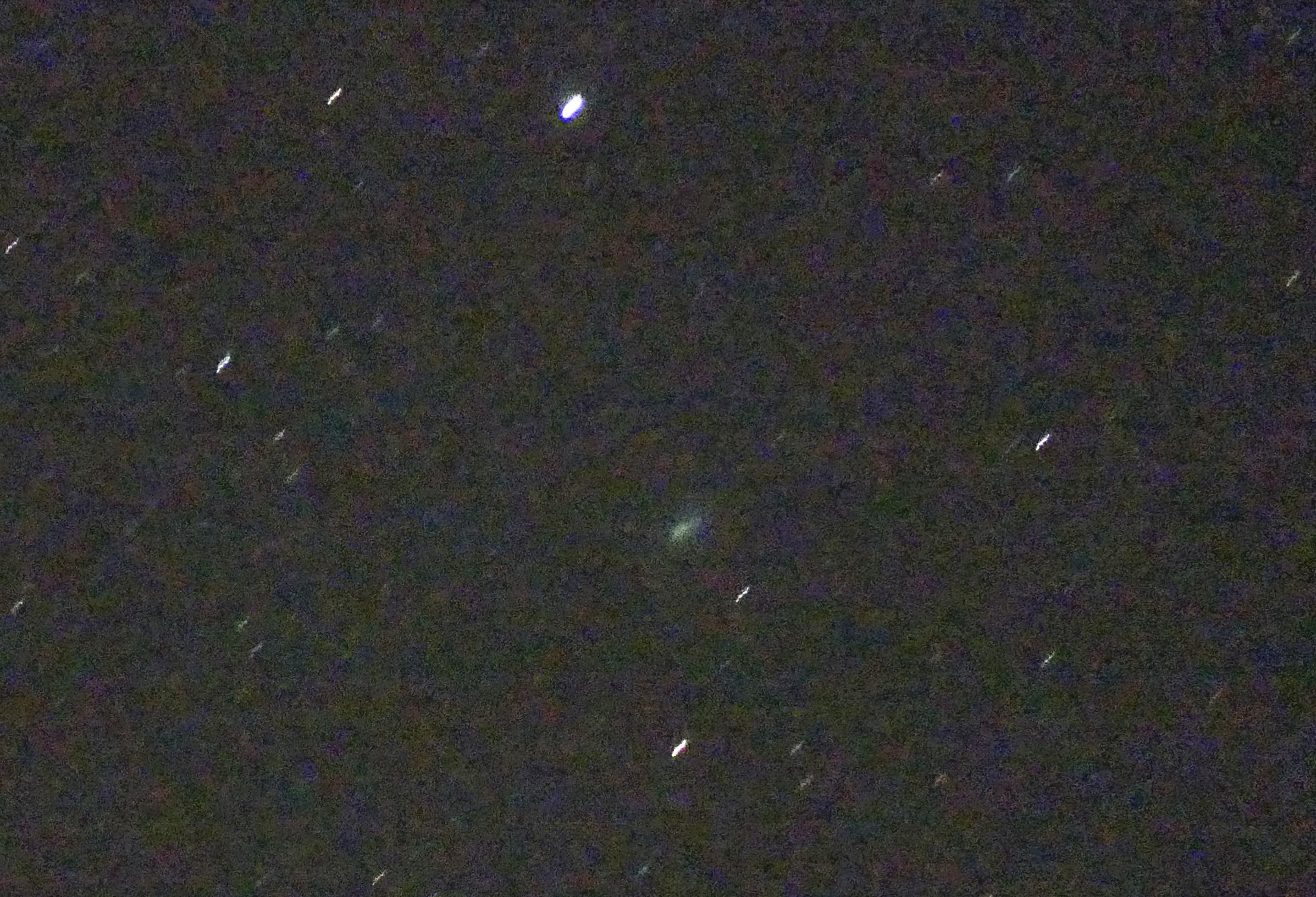
A clear detection of #comet C/2025 R3 (PANSTARRS) on the morning of March 2 "despite the 99% illuminated Moon, morning twilight and the comet at an altitude of 4.2 degrees": groups.io/g/comets-ml/message/ -> "The fact that the comet is showing this much detail under such bad conditions with such bad equipment and software bodes well for what we expect will be a very nice comet in the next few months."

@cosmos4u@scicomm.xyz
2026-03-01 23:49:23

The *other* potentially quite interesting April #comet C/2025 R3 (PANSTARRS) has been recovered in morning twilight: groups.io/g/comets-ml/message/ - it "has brightened nicely since my last observation on February 9 when it was in evening twilight at magnitude 13.3, magnitude calculations on the mornings of February 27/28 found the comet at magnitude 11.1 and 10.7 but I am sure the coma is a lot bigger and not fully reflected in these magnitude measurements."

@BBC6MusicBot@mastodonapp.uk
2026-01-29 22:19:31

🇺🇦 #NowPlaying on #BBC6Music's #RileyAndCoe
Comet Gain:
🎵 Seven Sisters To Silverlake
#CometGain
comet-gain.bandcamp.com/track/
open.spotify.com/track/09hOsne

@cosmos4u@scicomm.xyz
2025-12-21 14:11:53

High resolution Near IR images of fragmenting #comet C/2025 K1 (ATLAS) on 19 December from the JWST: on the left one of two raw images which just appeared on yuval-harpaz.github.io/astro/j, on the right two false-color images from both images published in reddit.com/r/jameswebb/comment and
bsky.app/profile/cheribliss.bs (and further processed by me).

@cosmos4u@scicomm.xyz
2025-12-21 00:54:45

There is also a #PUNCH video showing only #comet #Lemmon and its tails in science.nasa.gov/blogs/punch/2 - unfortunately too faint so much tail structure gets lost which can be glimpsed in the full video. But the data are there, waiting for someone to process them for science.

@cosmos4u@scicomm.xyz
2025-12-26 21:44:57

And here is now also a spectrum of #comet #3I/ATLAS taken during the #ShadowTheScientists session on 26 November, from astronomerstelegram.org/?read= - CN (388 nm), C3 (402 nm) and C2 (474 nm/517 nm) are detected. Meanwhile the paper arxiv.org/abs/2512.18341 concludes from the non-gravitational acceleration that the diameter of the comet's nucleus is 820 to1050 m.

@cosmos4u@scicomm.xyz
2025-12-29 20:34:03

The JWST has looked at #comet C/2025 K1 (ATLAS) again, in four filters yesterday and today: from the raw images - yuval-harpaz.github.io/astro/j - comes this false color image, flickr.com/photos/197464132@N0

@cosmos4u@scicomm.xyz
2026-01-28 00:41:22

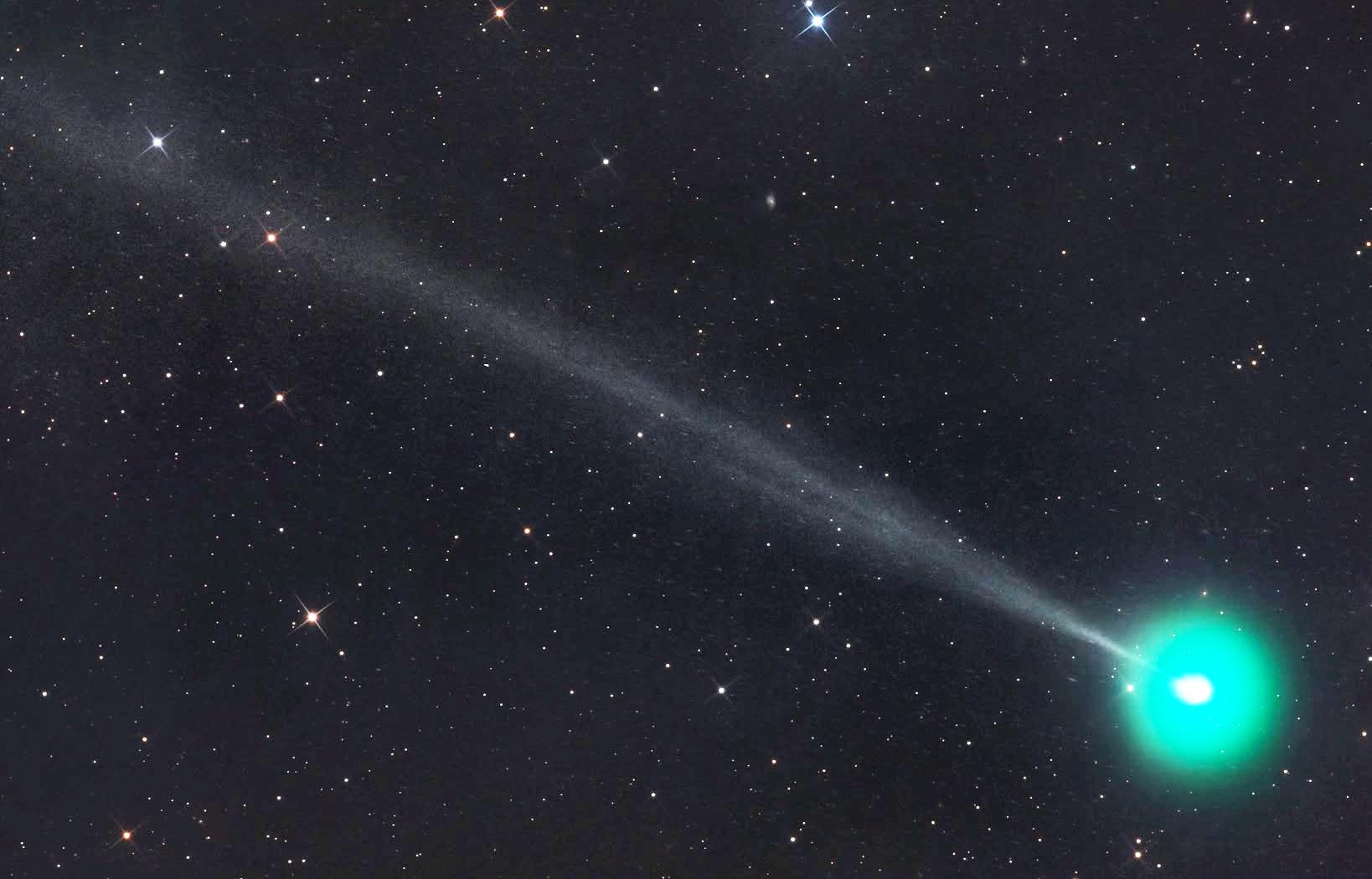
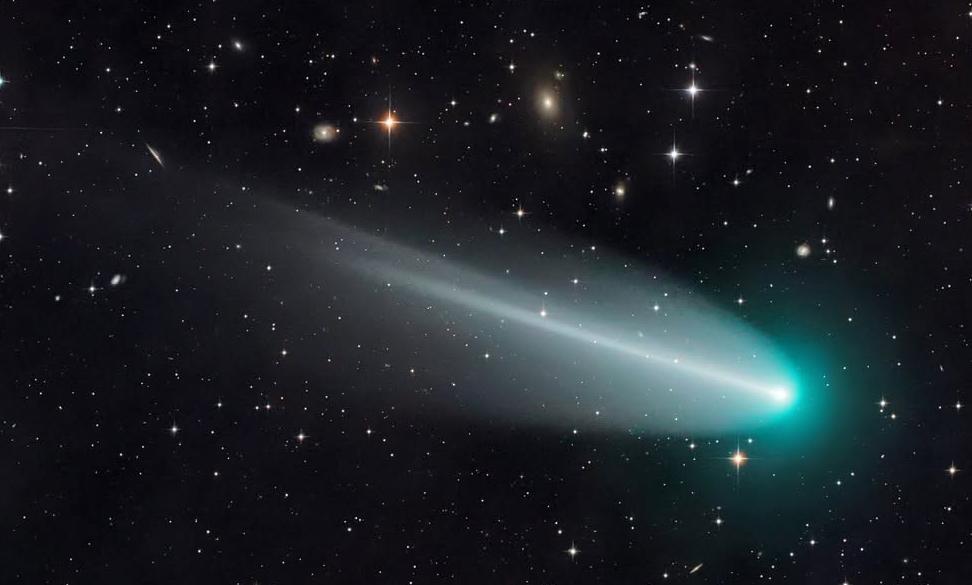
For optics large enough there is an amazing #comet in the - southern - sky right now, C/2024 E1 (Wierzchos): an image taken by Gerald Rhemann and Michael Jäger remotely in Namibia, facebook.com/photo/?fbid=25304
Date: 26 01 2026 UT 18:47
Location: Farm Tivoli, Namibia
Telescope: ASA Astrograph 12" f3.6
Camera: ZWO ASI 6200 MM Pro
Mount: ASA DDM 85
Exp.Time: LRGB 7.8/5/5/5 min.

@cosmos4u@scicomm.xyz
2026-01-23 18:20:37

The new #Kreutz #comet discovered unusually early has been named C/2026 A1 (MAPS): #photosphere on 4 April and becoming a bright comet.

@cosmos4u@scicomm.xyz
2026-01-24 01:27:56

The new #Kreutz #comet is now C/2026 A1 (MAPS): cbat.eps.harvard.edu/iau/cbet/ and #perihelion is highly uncertain but there is hope as facebook.com/groups/2270023586 and groups.io/g/comets-ml/topic/11 explain. And if MAPS makes it to perihelion and is (very) bright then coronagraphs on the ground might be able to catch it against the inner corona as the following table - calculated with ssd.jpl.nasa.gov/horizons/app. - shows.