 @mcdanlj@social.makerforums.info
2026-04-04 01:10:33
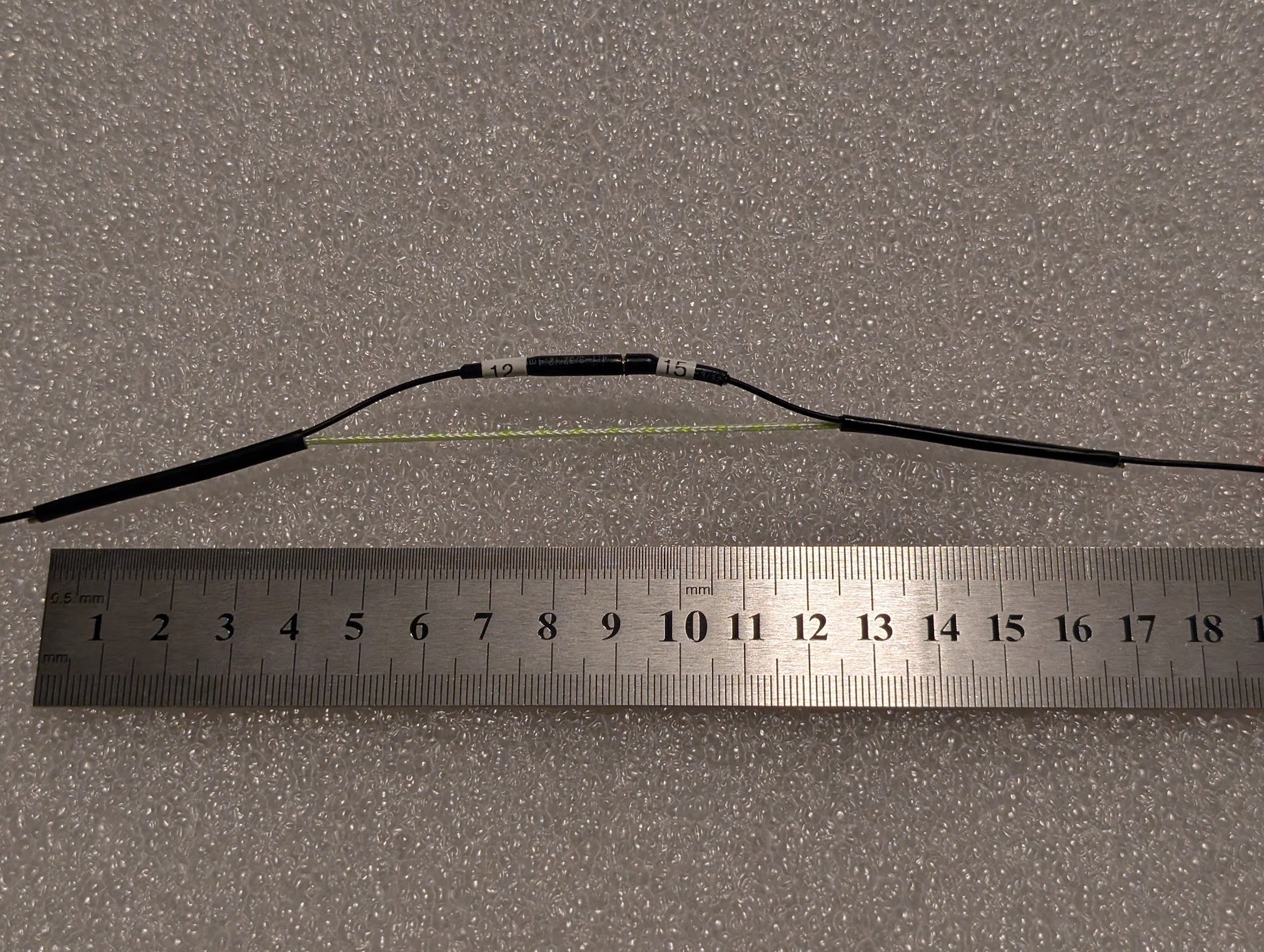
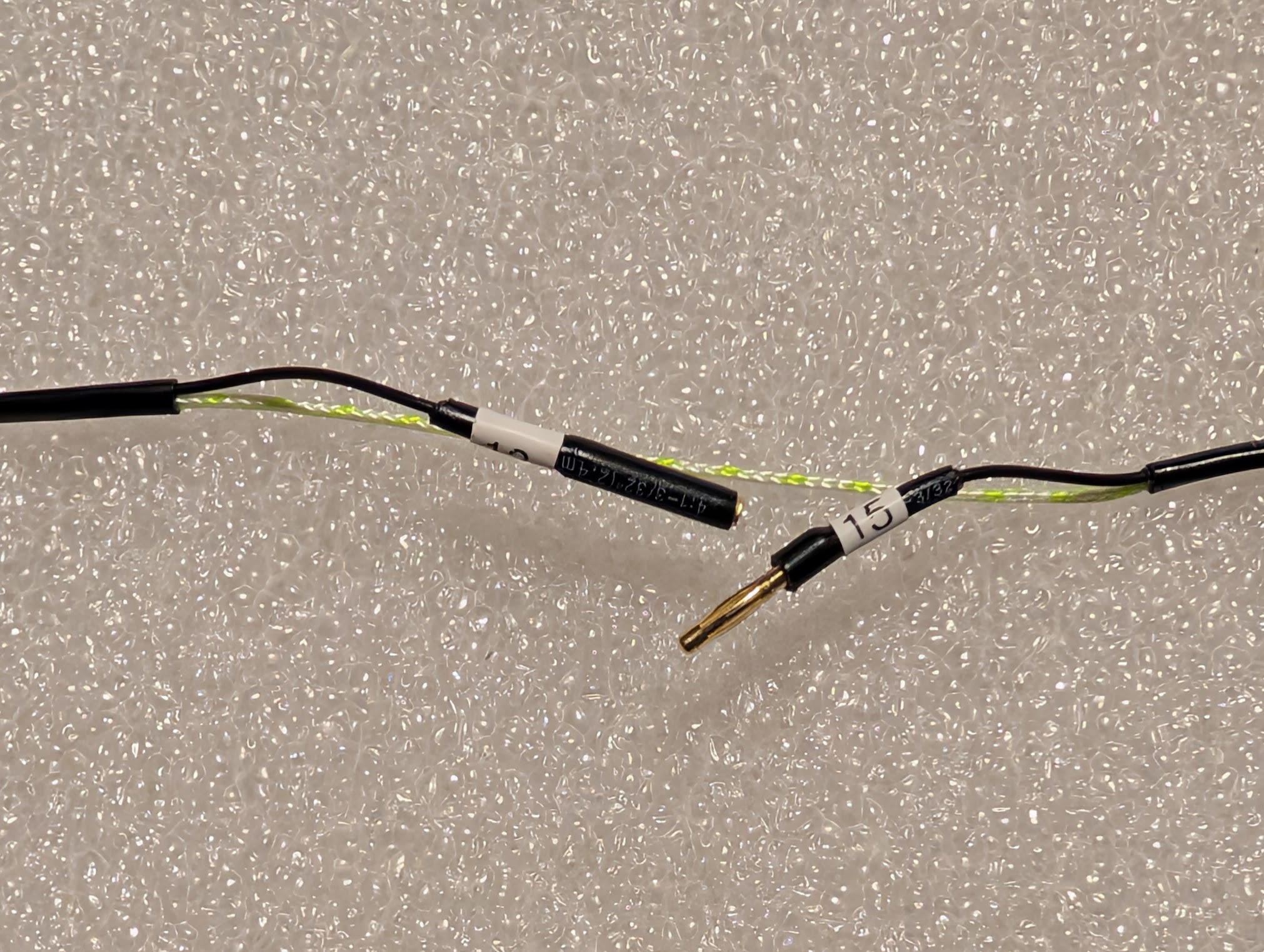
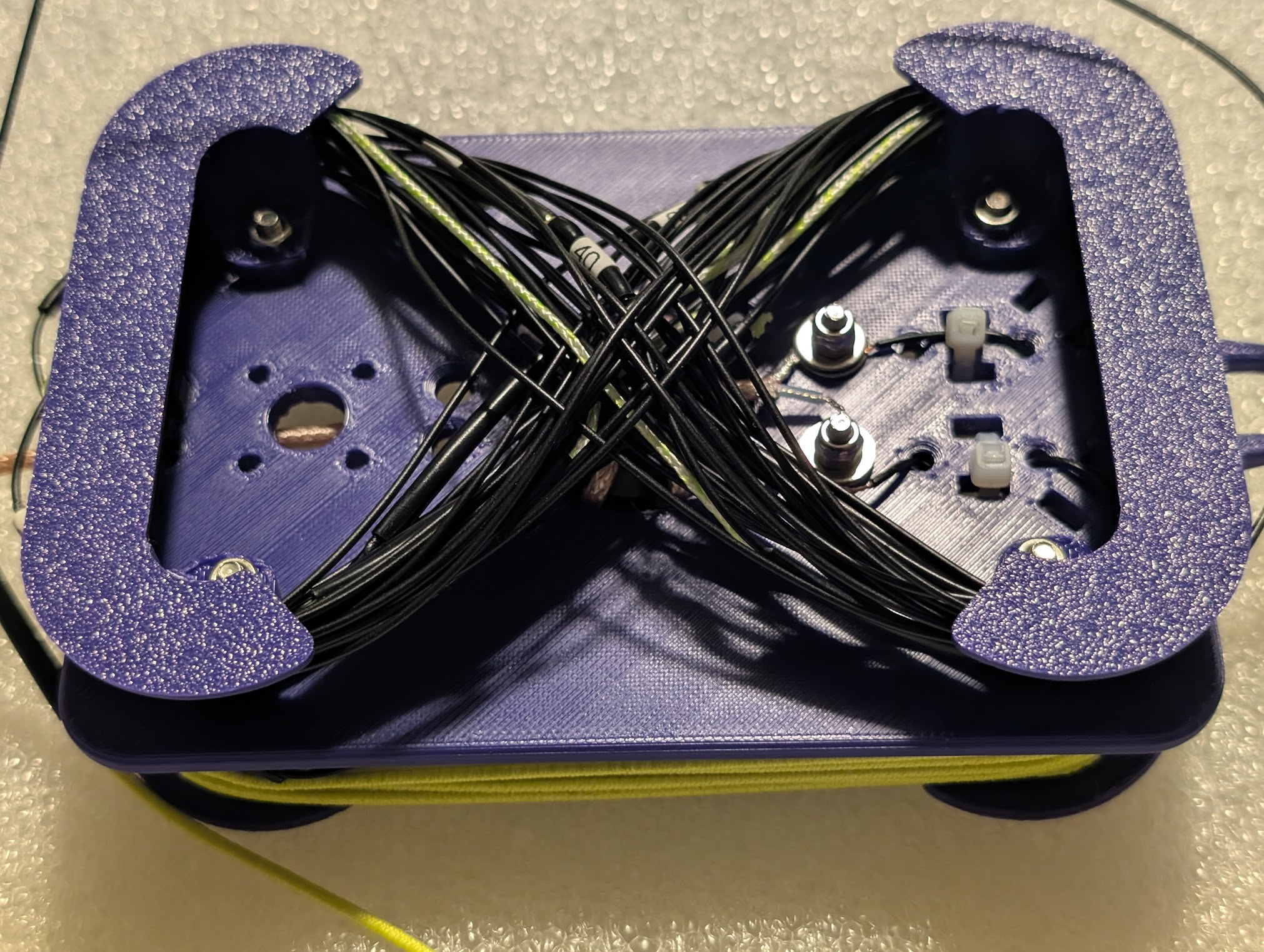
I keep seeing #HamRadio antennas using all sort of huge devices to create links between band segments. Alligator clips. Wago blocks. Mueller clips. Mostly with the antenna wire tied to something stiff that makes it hard to roll up neatly, rather than using flexible cord. I keep looking for and not finding examples of my approach to linking.
My solution is so simple, neat, and tidy…
 @arXiv_physicschemph_bot@mastoxiv.page
2026-03-26 08:16:02
Two-dimensional IR-Raman spectroscopy of vibrational polaritons: Role of dipole surfaces
Xinwei Ji, Tomislav Begusic, Tao E. Li
https://arxiv.org/abs/2603.24521 https://arxiv.org/pdf/2603.24521 https://arxiv.org/html/2603.24521
arXiv:2603.24521v1 Announce Type: new
Abstract: Nonlinear spectroscopy provides a unique perspective to understand time-resolved molecular dynamics under vibrational strong coupling (VSC). Herein, equilibrium-nonequilibrium cavity molecular dynamics simulations are performed to compute the two-dimensional (2D) infrared-infrared-Raman (IIR) spectroscopy of liquid water under VSC. In conventional computational chemistry practices, accurate molecular spectra are often constructed by using an advanced molecular dipole or polarizability model to post-process molecular dynamics trajectories evolved under a computationally efficient potential. By contrast, this work highlights the necessity of employing a consistent dipole surface model in both CavMD simulations and spectroscopic post-processing. While utilizing inconsistent dipole models only mildly influences the linear polariton spectrum, it severely distorts 2D spectra in wide frequency regions. With a consistent dipole-induced-dipole model, compared to the outside-cavity molecular 2D-IIR spectrum, the cavity 2D-IIR spectrum splits the OH stretch band to a pair of polariton branches along only the IR (not Raman) axis, while fading molecular signals at other frequency regions. This work provides the foundation for employing direct CavMD simulations to construct 2D spectra of realistic molecules under VSC.
toXiv_bot_toot
 @cdarwin@c.im
2026-01-18 07:03:13
For centuries, people believed ice was slippery because pressure and friction melted a thin film of water.
But new research from Saarland University reveals that this
long-standing explanation is wrong.
Instead, the slipperiness comes from the subtle interaction of molecular dipoles between ice and surfaces like shoes or skis.
These microscopic electrical forces disorder the crystal structure of ice,
creating a thin liquid layer even at temperatures near abs…

 @arXiv_physicsinsdet_bot@mastoxiv.page
2026-02-02 09:12:40
Simulation and optimization of the Active Magnetic Shield of the n2EDM experiment
N. J. Ayres, G. Ban, G. Bison, K. Bodek, V. Bondar, T. Bouillaud, G. L. Caratsch, E. Chanel, W. Chen, C. Crawford, V. Czamler, C. B. Doorenbos, S. Emmeneger, S. K. Ermakov, M. Ferry, M. Fertl, A. Fratangelo, D. Galbinski, W. C. Griffith, Z. D. Grujic, K. Kirch, V. Kletzl, J. Krempel, B. Lauss, T. Lefort, A. Lejuez, K. Michielsen, J. Micko, P. Mullan, O. Naviliat-Cuncic, F. M. Piegsa, G. Pignol, C. Pistillo, I. Rien\"acker, D. Ries, S. Roccia, D. Rozp\k{e}dzik, L. Sanchez-Real Zielniewicz, N. von Schickh, P. Schmidt-Wellenburg, E. P. Segarra, L. Segner, N. Severijns, K. Svirina, J. Thorne, J. Vankeirsbilck, N. Yazdandoost, J. Zejma, N. Ziehl, G. Zsigmond
https://arxiv.org/abs/2601.22960 https://arxiv.org/pdf/2601.22960 https://arxiv.org/html/2601.22960
arXiv:2601.22960v1 Announce Type: new
Abstract: The n2EDM experiment at the Paul Scherrer Institute aims to conduct a high-sensitivity search for the electric dipole moment of the neutron. Magnetic stability and control are achieved through a combination of passive shielding, provided by a magnetically shielded room (MSR), and a surrounding active field compensation system by an Active Magnetic Shield (AMS). The AMS is a feedback-controlled system of eight coils spanned on an irregular grid, designed to provide magnetic stability to the enclosed volume by actively suppressing external magnetic disturbances. It can compensate static and variable magnetic fields up to $\pm 50$ $\mu$T (homogeneous components) and $\pm 5$ $\mu$T/m (first-order gradients), suppressing them to a few $\mu$T in the sub-Hertz frequency range. We present a full finite element simulation of magnetic fields generated by the AMS in the presence of the MSR. This simulation is of sufficient accuracy to approach our measurements. We demonstrate how the simulation can be used with an example, obtaining an optimal number and placement of feedback sensors using genetic algorithms.
toXiv_bot_toot
 @@arXiv_physicsatomph_bot@mastoxiv.page@mastoxiv.page
2026-02-19 09:36:58
Ultracold atoms in a dipole trap in microgravity
Julien Le Mener, Clement Metayer, Vincent Jarlaud, Celia Pelluet, Baptiste Battelier
https://arxiv.org/abs/2602.16645 https://…
 @arXiv_hepph_bot@mastoxiv.page
2026-02-09 09:35:58
Direct Detection and Cosmological Constraints of Dark Matter with Dark Dipoles
Takumi Kuwahara, Jun-Chen Wang, Shu-Run Yuan
https://arxiv.org/abs/2602.06861 https://
@arXiv_physicschemph_bot@mastoxiv.page2026-03-26 08:16:02
Two-dimensional IR-Raman spectroscopy of vibrational polaritons: Role of dipole surfaces
Xinwei Ji, Tomislav Begusic, Tao E. Li
https://arxiv.org/abs/2603.24521 https://
 @arXiv_condmatmeshall_bot@mastoxiv.page
2026-02-12 08:04:58
Linear thermal noise induced by Berry curvature dipole in a four-terminal system
Wenyu Chen, Miaomiao Wei, Yunjin Yu, Fuming Xu, Jian Wang
https://arxiv.org/abs/2602.10406 https…
@@arXiv_physicsatomph_bot@mastoxiv.page@mastoxiv.page2026-02-18 08:18:12
Strong Collective Chiroptical Response from Electric-Dipole Interactions in Atomic Systems
Marcella L. Xavier, Felipe A. Pinheiro, Romain Bachelard
https://arxiv.org/abs/2602.15231
@arXiv_physicschemph_bot@mastoxiv.page2026-03-26 08:21:36
Electronic properties of the Radium-monochalcogenides RaX (X = O,S,Se) and RaO /- ions
Mateo Londo\~no, Jes\'us P\'erez-R\'ios
https://arxiv.org/abs/2603.24590 https://arxiv.org/pdf/2603.24590 https://arxiv.org/html/2603.24590
arXiv:2603.24590v1 Announce Type: new
Abstract: We present a theoretical investigation on the electronic structure and properties of radium monochalcogenides, with chalcogens O, S, and Se, as well as the ionic species RaO /-. Our approach combines fully relativistic and partially relativistic quantum-chemistry methods. Electronic properties are obtained using the exact two-component Hamiltonian-based coupled-cluster approach with single, double, and perturbative triple excitations [CCSD(T) X2C], while potential energy curves are computed using an internally contracted multireference configuration interaction method, including relativistic effects through small-core pseudopotentials and Pauli-Breit operator diagonalization (MRCI Q ECP SO). The dimers exhibit very large permanent dipole moments and sizable dipolar polarizabilities, while the Franck-Condon factors among the lowest electronic states are highly non-diagonal. These features are discussed in terms of the divalent character of the chemical bonding in the neutral species.
toXiv_bot_toot